
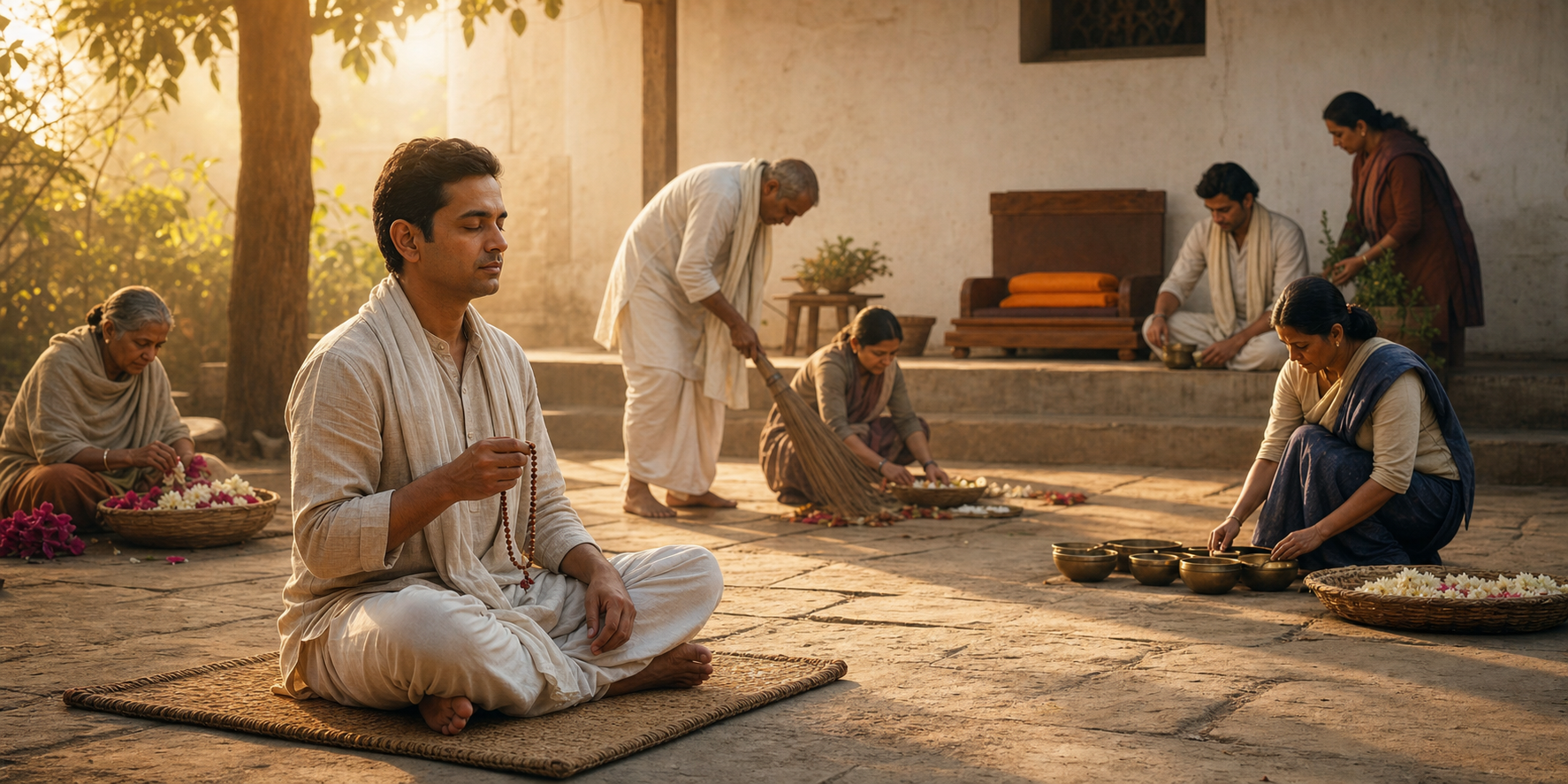
You may feel sincere love for your guru while your mornings still belong to the phone, your practice changes with your mood, and your spiritual association consists mostly of watching talks alone. That gap does not mean your devotion is false. It means your devotion needs a dependable form.
Guru-bhakti becomes visible when the teaching begins to govern your calendar, attention, speech, relationships, and service. You do not need to manufacture stronger emotion. You need to translate the reverence you already have into a rule of practice and a circle of people who help you keep it.
Let the guru’s instruction outrank the guru’s image

Bhagavad Gita 4.34 places humility, disciplined inquiry, and service together in the approach to a realized teacher. Each protects the others. Humility without inquiry can become passivity. Inquiry without service can remain intellectual. Service without discernment can slide into attachment to personality, access, or status.
The principle of guru-tattva directs your attention through the teacher toward liberating knowledge and transformed conduct. The guru’s form, voice, room, birthplace, ashram, or samadhi sthala may awaken remembrance, but the reminder must lead back to the teaching. A sacred object has served its purpose when it prompts japa, meditation, restraint, truthfulness, compassion, or seva. It has displaced that purpose when possessing, photographing, defending, or debating it becomes more important than obeying the instruction it represents.
Different dharmic traditions express this movement in distinct ways. An Advaita teacher may direct the disciple toward inquiry into the Self. A Vaishnava acharya may center remembrance of Bhagavan, nama, worship, and seva. Buddhist lineages direct disciples toward the Dhamma; Jain lineages toward vows, tapas, ahimsa, and release; Sikh tradition places enduring authority in Shabad and Guru Granth Sahib. These paths should not be blurred into one doctrine. Their practical agreement is narrower and more useful: honoring a teacher requires you to walk the path the teacher revealed.
Begin with an instruction audit. Do not write a vague aspiration such as “be more spiritual.” Write answers that can affect your next ordinary day:
- What practice did your guru or lineage repeatedly ask disciples to perform?
- What habit, indulgence, or form of speech does that instruction require you to restrain?
- What decision will you make differently because of it before your next satsang?
- Who has permission to ask whether you followed through?
If your answers describe only admiration, travel, memorabilia, institutional activity, or online content, return to the first question. Proximity to the guru is spiritually valuable when it produces fidelity to the guru’s purpose.
Apply the same test to pilgrimage. Begin with a sankalpa connected to a specific teaching. Study the relevant upadesa before traveling. During the visit, make room for japa, mauna, attentive darshan, and service instead of turning every moment into photography or social-media display. After returning, examine whether anger has softened, speech has become more truthful, consumption has become simpler, and practice has become steadier. Sacred geography should intensify sadhana, not substitute for it.
Build a daily rule that survives ordinary days

Most inconsistency is not solved by waiting for a more devotional mood. A practice becomes steadier when the cue, place, sequence, and social expectation remain stable. Repeated cues and shared routines reduce the number of fresh decisions you must make each day. That matters because a practice negotiated every morning will eventually lose to fatigue, work, family pressure, or the nearest screen.
Give your daily guru-bhakti four anchors:
- A visible cue: Keep your mala, text, meditation seat, or other appropriate practice object ready in one place. Make it easier to begin sadhana than to open a feed.
- A protected opening: Establish a device-free morning window. Begin with the practice received from your guru or lineage, whether that is japa, dhyana, prayer, recitation, scriptural study, or another discipline.
- A service expression: Connect practice to one real responsibility. Help a family member without resentment, fulfill temple seva reliably, support a practitioner in difficulty, teach what you are qualified to teach, or perform another duty that embodies the instruction.
- An evening review: Ask what you remembered, where you became reactive, whom you served, and what must be repaired tomorrow. Keep the review brief enough to repeat honestly.
If you have received formal vows or a prescribed practice, this framework does not replace or reduce them. Discuss genuine difficulty with a qualified mentor instead of quietly rewriting the commitment. For unusually disrupted days, agree on a minimum fallback with that mentor. The fallback protects continuity; it must not become a convenient new ceiling.
During a dry period, protect the sequence before judging the feeling. Sit in the usual place. Begin with the usual invocation. Perform the received practice with as much attention as you presently have. Record one sentence afterward: “What did I notice, and what will I protect tomorrow?” This gives you evidence about obstacles without turning every session into a verdict on your spiritual worth.
Measure fruits that can actually enter conduct. Useful signs include steadier practice, less impulsive speech, reduced reactivity, more spontaneous gratitude, better attention during kirtan or meditation, and greater readiness to serve. Compassionate measurement keeps review oriented toward learning, whereas obsessive scorekeeping can make sadhana another form of self-display.
Make sanga part of the practice, not an optional extra

Sadhu-sanga is not merely spending time near religious people. In a Vaishnava setting, it is association organized around Krishna-katha, nama, kirtan, japa, study, worship, and seva. In other dharmic settings, the forms differ, but the essential mechanism remains recognizable: the people around you reinforce what deserves remembrance, normalize disciplined conduct, notice drift, and help you continue when private enthusiasm weakens.
A large gathering can inspire you, but it may not provide the reciprocity required for lasting change. Add a micro-group of three to five committed practitioners who meet predictably. Keep the gathering simple enough to sustain:
- Begin with chanting, prayer, silence, or another shared practice appropriate to the lineage.
- Read a short passage from the agreed text or teaching and clarify its actual instruction.
- Let each person report one practice kept, one practice missed, and the main obstacle without performing success or hiding difficulty.
- Choose a concrete commitment for the next interval and name the cue that will trigger it.
- Coordinate one act of seva, care for a member in need, or prayer for someone beyond the group.
Use clear norms. Personal disclosures remain confidential. Correction addresses conduct rather than humiliating a person. Prajalpa does not take over the meeting. Questions are welcomed when asked sincerely. Roles such as facilitation, reminders, hospitality, and service coordination rotate so that responsibility is shared and one person does not become the permanent center.
Healthy association should make the teaching more accessible and your ego less protected. Look for these qualities:
- The guru’s teaching and the lineage’s shastra remain more important than insider status.
- Members practice together instead of only discussing other people’s practice.
- Guidance combines scriptural clarity with patience toward ordinary human difficulty.
- Accountability is specific, reciprocal, and free from public shaming.
- Leadership and study lineage are transparent enough for you to know where an interpretation comes from.
- Seva reaches real persons rather than functioning mainly as a display of loyalty.
Be cautious when a group treats proximity to a personality as proof of realization, turns every question into disloyalty, or spends more time on factions and prestige than on sadhana. Guru-bhakti does not require the suspension of dharmic discernment. Respectful inquiry, honest correction, and service are part of the Guru-Shishya Tradition, not intrusions upon it.
Notice whether association is changing your identity
The first threshold is reliability: you show up for practice and sanga on an unremarkable day. The next is reciprocity: you stop approaching the community only as a consumer of talks, blessings, or inspiration and begin carrying responsibility for other practitioners. Receiving and giving belong to the same devotional ecology.
After each gathering, note one change you intend to make and one person you can support. At the next meeting, report both. This prevents study from floating above conduct and keeps service from becoming detached from remembrance.
You can also cooperate across the dharmic family without pretending that doctrinal differences are trivial. Buddhist Sangha, the Jain fourfold sangha, and Sikh sangat each show how association can sustain ethical conduct, contemplation, and service. A joint act of compassion or a careful dialogue about community can build trust while every participant remains faithful to his or her own metaphysical commitments. Unity becomes credible when it protects integrity rather than demanding vagueness.
Use a 30-60-90 day path from reverence to responsibility

Do not try to repair every part of spiritual life in one burst. A 30-60-90 day sequence lets you establish reliability before adding responsibility, then review whether either has entered your character.
Days 1-30: establish reliability
- Select the guru’s instruction or lineage text that will guide this period.
- Fix the cue and place for your daily practice, including device-free morning and evening boundaries.
- Join or form a weekly satsang and a micro-group of three to five practitioners.
- Agree on a shared practice target appropriate to your tradition and existing commitments.
- Mark whether you practiced and write a brief reflection after the group meeting. Record facts, not spiritual theatrics.
Your aim in this phase is not an extraordinary experience. It is to become someone who appears at the appointed place and begins.
Days 31-60: move from receiving to serving
- Join a seva team or identify a recurring service that answers an actual need.
- Connect with a mentor who can interpret the teaching and address obstacles without flattery or harshness.
- Rotate one responsibility in your group so that care does not depend on a single organizer.
- Ask for correction on one repeated difficulty, then apply the counsel before asking for more.
- Reach out to a practitioner who has become absent instead of assuming someone else will do it.
This phase exposes a common misunderstanding: serving the guru is not limited to serving the guru’s physical needs, institution, image, or memory. It includes caring for the people, practices, and dharmic responsibilities entrusted to the community.
Days 61-90: integrate and refine
- Review which cues made practice easier and which forms of digital distraction repeatedly broke the sequence.
- Compare your conduct with the opening instruction audit. Look particularly at speech, reactivity, gratitude, simplicity, and willingness to serve.
- Keep the disciplines that produced steadiness. Refine weak points through counsel rather than continually adding new techniques.
- Strengthen the mentorship network so newer practitioners know whom they can approach.
- If the community has the capacity, arrange service or dialogue with a neighboring Buddhist, Jain, or Sikh community around compassionate association while keeping doctrinal identities clear.
At day ninety, do not ask only how many meetings you attended or how much content you consumed. Ask whether practice now begins with less negotiation, whether correction produces less defensiveness, whether someone can rely on your service, and whether remembrance reaches your behavior under pressure. Those are stronger signs of lived guru-bhakti than intensity displayed on ceremonial days.
Key takeaways
- Translate reverence into one instruction that changes a visible daily choice.
- Anchor received practice to a stable cue, place, and device-free window.
- Meet predictably with three to five practitioners for practice, accountability, and care.
- Judge pilgrimage, media, and religious activity by whether they deepen sadhana and dharmic conduct.
- Move from consuming inspiration to carrying recurring seva and supporting other practitioners.
- Review progress through steadiness, reduced reactivity, gratitude, truthful speech, and readiness to serve.
Before your next sacred hour, choose one instruction, prepare its physical cue, and tell one trusted practitioner what you intend to do. Then keep the appointment on an ordinary day. That quiet act of fidelity is where remembrance becomes practice, association becomes shelter, and guru-bhakti becomes a way of life.
References
- DharmaRenaissance Blog — Vaishnava Sanga 2025: Vraja Vihari Prabhu’s powerful roadmap for sanga, bhakti, and unity
- DharmaRenaissance Blog — Stop Chasing Birthplaces: Honor Guru-Bhakti by Living the Teaching, Not Worshiping Soil
