
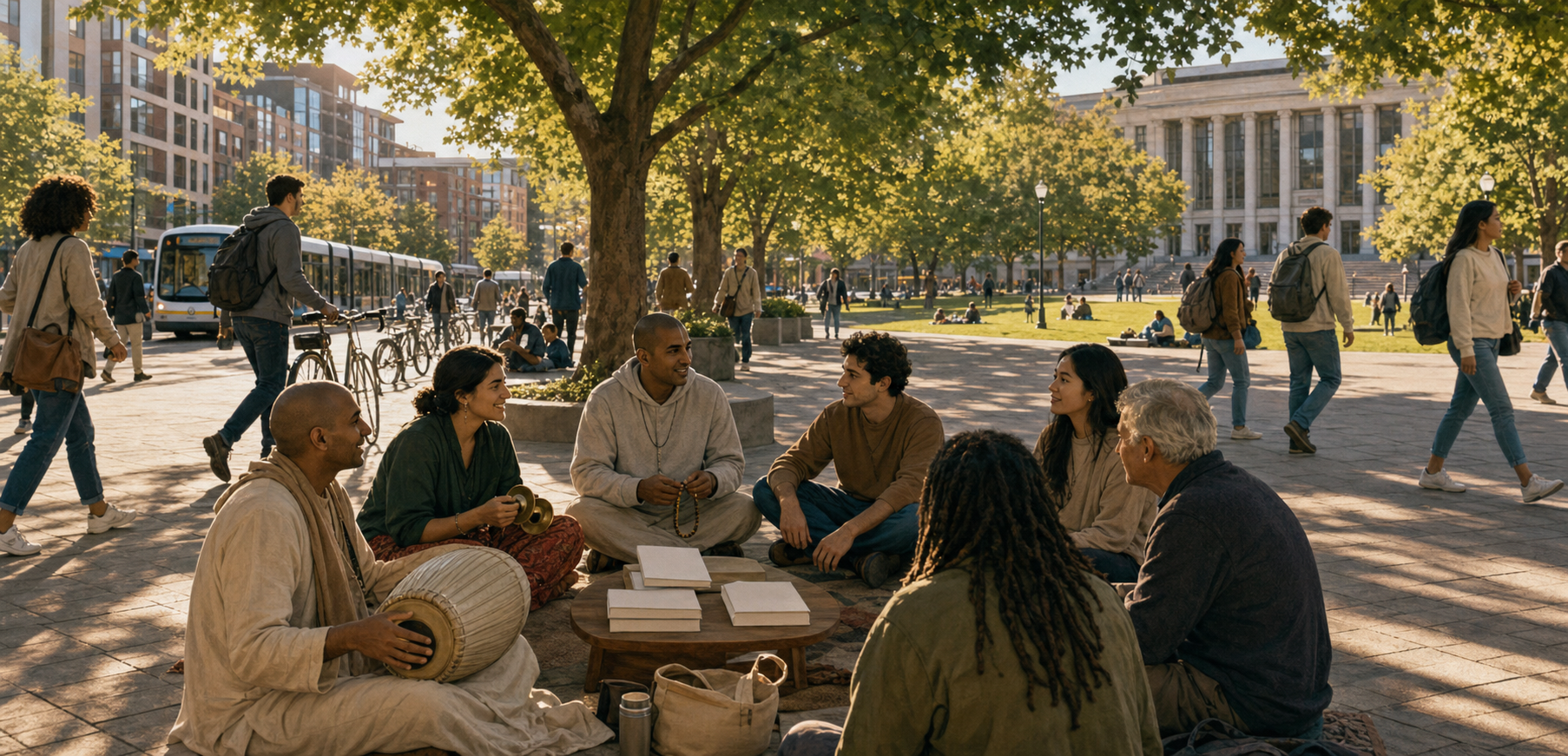
You have devotees ready to serve, books worth reading, and perhaps a kirtan team that can draw a crowd. The difficult question is what happens next. How do you offer Gaudiya Vaishnava practice in a busy city or secular university without becoming intrusive, disguising the tradition, or creating an encounter that disappears as soon as the event ends?
A workable answer begins by treating urban outreach and academic outreach as different forms of hospitality. A city encounter must be easy to enter and equally easy to leave. A campus initiative must earn a durable place through institutional policy, accurate description, and scholarly usefulness. In both settings, the tradition should be recognizably Gaudiya, participation should remain voluntary, and the host community should retain real agency.
Key takeaways
- Do not use one outreach script everywhere. A public space offers temporary attention; a university manages lasting access through formal governance.
- In a city, create a visible but low-pressure threshold: people should be able to listen, participate briefly, ask a serious question, or continue walking without friction.
- On a campus, begin with librarians, collection policies, cataloguing requirements, and curricular relevance rather than treating the institution as another book-distribution venue.
- Name the lineage, practice, text, translation, and commentary accurately. Inclusion does not require turning Krishna bhakti into generic wellness.
- Measure the handoff: whether an urban visitor can take a meaningful next step, and whether an academic collection becomes discoverable, used, and connected to teaching.
One lineage, two social contracts
Gaudiya outreach carries devotion, learning, sankirtana, hospitality, and seva into public life. Those elements belong together, but the surrounding social contract changes from one setting to another.
In an urban square, courtyard, festival route, or cultural venue, most people did not arrive expecting a theological conversation. They may be commuting, meeting someone, buying lunch, or looking for a few quiet minutes. London’s public Rathayatra and central-city kirtan show that a clearly devotional practice can nevertheless become an open civic encounter. The crucial conditions are visibility, welcome, freedom of movement, and respect for the shared setting.
A university works differently. A library gift enters a governed collection, not an unclaimed shelf. Librarians must consider collection scope, curricular value, space, binding, accessibility, metadata, and local gift rules. Faculty members must be free to interpret, compare, question, or criticize the material. Students must be approached as learners with intellectual agency, not as a captive audience.
This distinction changes the organizer’s job. In the city, you are designing a respectful encounter. On campus, you are proposing an academic resource. The first succeeds when attention becomes voluntary participation. The second succeeds when an institution can accept, describe, preserve, discover, and use what you offer.
Confusing the two produces predictable problems. A street team that blocks movement turns invitation into pressure. A campus team that arrives with an unsolicited stack of books shifts processing work onto librarians. Conversely, an urban program framed like a seminar can feel inaccessible, while a university proposal framed only as spiritual uplift gives decision-makers too little scholarly reason to accept it.
Build an urban invitation people can enter and leave freely
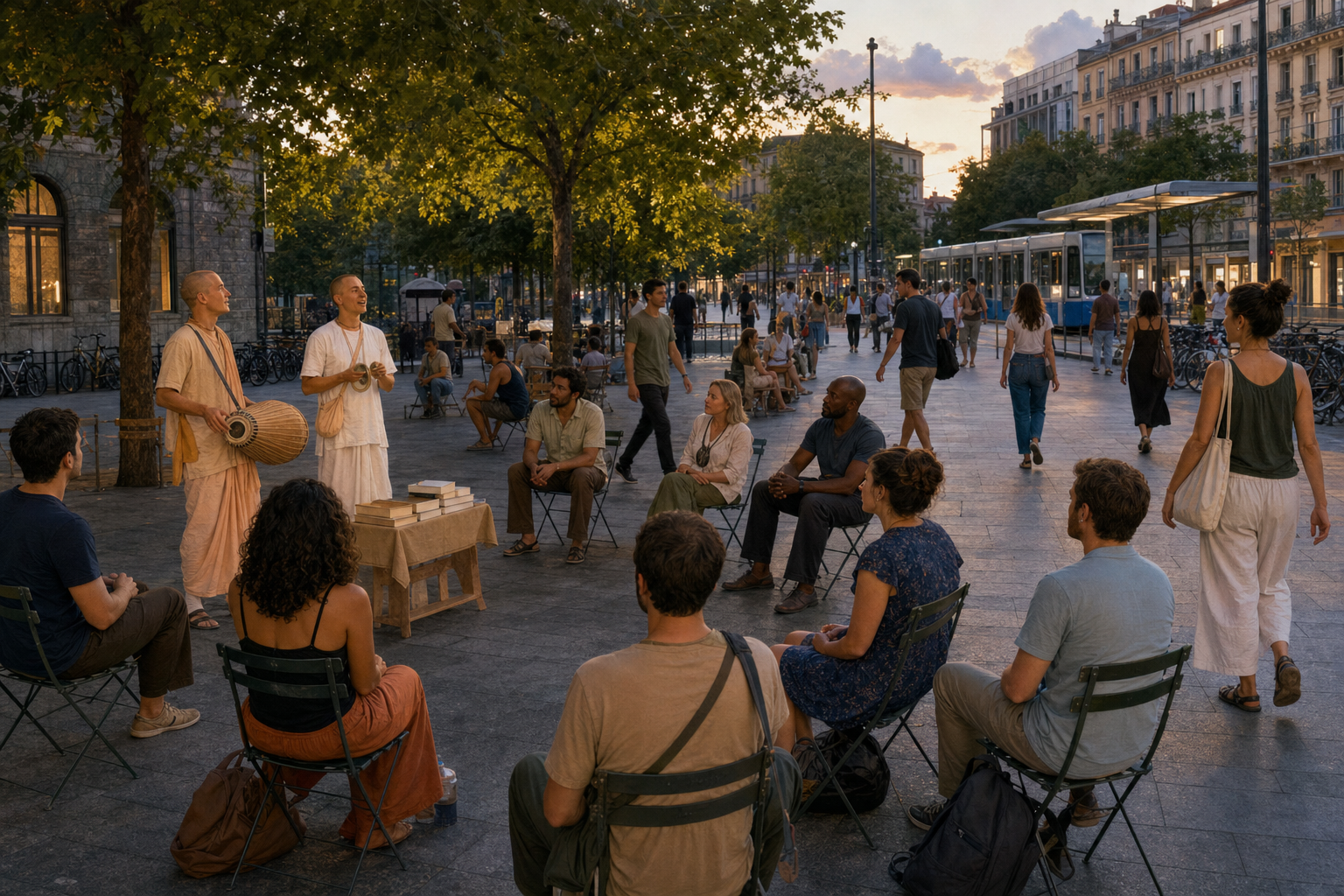
The best urban location is not necessarily the place with the highest footfall. It is the place where attention can change pace without obstructing the ordinary purpose of the space. A threshold works better than a bottleneck.
Neal’s Yard in London illustrates the spatial mechanism. A narrow entrance opens into a human-scale, car-free courtyard with color, greenery, softened sound, seating, and clear sightlines. That sequence creates a perceptible transition from the intensity of Covent Garden to a calmer urban node. You do not need to reproduce its appearance. You need to understand its movement: approach, threshold, pause, participation, and return to the city.
Plan the encounter in five layers
- Resolve permission and movement first. Confirm the host’s conditions, identify entrances and exits, protect accessible paths, and decide where listeners can stand without forming a barrier. No one should have to refuse a conversation merely to get through the space.
- Make the devotional identity legible. A simple sign can name the kirtan tradition, its association with Chaitanya Mahaprabhu, and the hosting community. People should not have to guess whether they are encountering a concert, a wellness exercise, a fundraiser, or a religious practice.
- Offer several depths of participation. The outer invitation is to listen or pass. The next is to join the response, receive prasada where permitted, or try a brief contemplative pause. The deeper invitation is a conversation about Krishna bhakti, japa, the Bhagavata tradition, or a recurring gathering.
- Make seva operational. Assign volunteers to welcome, answer questions, manage any food queue, watch pedestrian flow, and leave the site clean. Hospitality is weakened when every volunteer is trying to start the same conversation and no one is caring for the shared space.
- Give one proportionate next step. Offer a choice such as a recurring kirtan, a beginner reading circle, a temple program, or information about the text being discussed. A clear next step is more useful than a large bundle of unrelated material.
A short practice can help someone cross the threshold from observing to participating. The urban setting around Neal’s Yard has been associated with three-to-five-minute practices such as gentle breathing, metta reflection, silent japa, or walking meditation. If you use such an entry point, label it precisely. A breathing pause may help a visitor settle, but it is not a substitute for explaining kirtan or bhakti. Silent japa is devotional practice, not merely a concentration technique.
Sound also carries responsibility. Place musicians so the kirtan draws people into a defined area rather than projecting indiscriminately at workers, residents, or nearby events. Keep the welcome visible at the edge. A person who pauses should be allowed to listen before being approached. That small interval protects the voluntary character of the encounter.
Prasada and vegetarian food can make seva tangible, but distribution needs the same care as the kirtan. Keep passageways open, explain what is being offered, provide relevant ingredient information, and manage waste. The meal should embody care for the person and the place rather than function as leverage for a conversation.
Make a campus offer librarians can actually accept

If your goal is to place the Srimad Bhagavatam in a university, do not begin by asking how many sets can be delivered. Begin by asking who has authority to evaluate one set and what information that person needs.
The Srimad Bhagavatam, or Bhagavata Purana, comprises twelve cantos and engages questions of dharma, devotion, metaphysics, cosmology, aesthetics, virtue, and social responsibility. That range gives it legitimate relevance to philosophy, literature, religious studies, cultural heritage, Sanskrit, and Indian Knowledge Systems. A proposal should identify the disciplines it can serve rather than describing it only as a spiritual classic.
Prepare an acquisition packet before requesting a meeting
A useful packet reduces work for the institution without trying to make the collection decision on its behalf. Include:
- A concise description of the Srimad Bhagavatam and its relevance to the institution’s teaching or collection scope.
- An itemized inventory with the exact edition, title of each volume, ISBN, language, physical format, and binding information.
- A transparent edition statement. The widely used Bhaktivedanta Book Trust edition contains translation and purports by A. C. Bhaktivedanta Swami Prabhupada, with later portions editorially completed by his disciples. That exegetical standpoint should be named, not hidden behind the word “translation.”
- A gift letter confirming that the institution may evaluate, catalogue, locate, circulate, or decline the material under its normal policies, without donor-imposed restrictions.
- Available language and accessibility information, including Sanskrit text, roman transliteration, English translation, regional-language options where available, and any large-type or audio resources that can genuinely be supplied.
- An optional one-page outline for a faculty discussion or student reading circle, presented separately from the gift so acceptance is not conditional on hosting a program.
Contact the librarian responsible for religion, philosophy, South Asian studies, or gifts. Depending on the institution, a relevant department head or academic dean may help establish curricular relevance, but faculty enthusiasm does not replace library approval. Ask for the gift-in-kind policy, collection criteria, current processing expectations, and preferred bibliographic format before arranging transport.
Catalog-ready support is useful, but it does not mean volunteers should dictate the catalogue record. Authoritative bibliographic information, volume-level ISBNs, suggested subject terms, and edition notes can help. The final MARC21 fields, authority control, Dewey classification under Hinduism, cutters, and local call numbers remain the librarian’s responsibility. Respecting that boundary is part of respecting the university.
Physical details matter because a complete set can fail administratively even when its intellectual value is recognized. Confirm the condition of every volume, protect the set from moisture during transport, check the inventory on receipt, and ask whether the library prefers reference use or circulation. If the institution has an accessioning backlog, record the handoff and wait for processing rather than announcing that the set is available before it appears in the catalogue.
Separate collection approval from intellectual activation
Once a set has been accepted, programming can help students find a way into a large text. The event should be organized around a real academic question, not around the fact that a donation occurred. Possible approaches include:
- A philosophy seminar on epistemology, metaphysics, virtue, duty, or the relation between the self and the divine.
- A literature session on narrative architecture, poetics, characterization, or devotional aesthetics.
- A translation workshop that distinguishes Sanskrit text, transliteration, English rendering, and purport, allowing students to examine how interpretation enters an edition.
- A professional-ethics discussion for engineering or management students focused on leadership, responsibility, stewardship, and the moral limits of technical competence.
- A comparative dharmic dialogue in which the Bhagavata is studied alongside material from Buddhist, Jain, or Sikh traditions selected by qualified faculty and consistent with the library’s scope.
In Bharat, an institution may see additional relevance through the National Education Policy 2020 emphasis on Indian Knowledge Systems, multidisciplinary learning, and ethical reasoning. Use that alignment to clarify educational value, not to bypass local governance. A policy reference cannot substitute for a sound acquisition proposal or willing faculty partner.
A reading map can lower the entry barrier without predetermining what students must conclude. It might identify themes, relevant cantos, key Sanskrit terms, and the relationship between translated verse and purport. QR access to syllabus suggestions can help instructors, but the physical set should remain independently discoverable through the library catalogue. A digital pointer is an aid, not a replacement for accessioning and metadata.
Keep the Gaudiya center clear, then measure the handoff

Use common ground without claiming sameness
Gaudiya Vaishnavism does not need to become vague in order to be hospitable. Navadvipa is a historic center of learning associated with Chaitanya Mahaprabhu and his kirtan tradition. The lineage joins devotion, scholarship, congregational chanting, and compassionate practice; its global expression through ISKCON has carried those forms into multicultural cities and institutions far from Bengal.
Say that plainly. Kirtan is an offering of divine names, not just participatory music. Japa is devotional remembrance, not merely a productivity exercise. The Srimad Bhagavatam is a theological and philosophical text, not a collection of neutral self-help lessons. Prabhupada’s purports are an identifiable Gaudiya exegetical voice, not an invisible editorial layer.
Clear identity also makes genuine pluralism easier. Ahimsa, seva, contemplative discipline, hospitality, and concern for ethical life can create meaningful points of contact among Hindu, Buddhist, Jain, and Sikh communities. Those affinities do not erase differences in doctrine, authority, practice, or ultimate aims. Common ground should open a conversation, not settle it in advance.
On campus, this means welcoming critical study and allowing the Bhagavata to sit within a wider learning ecosystem that may include the Dhammapada, Jain Agamas, and introductions to Guru Granth Sahib. In a city, it means welcoming people of different faiths or no faith while remaining honest about what the chanting and prasada mean to the community offering them.
Measure whether the invitation became access
Counting books delivered or people passing a kirtan gives you activity totals, not evidence that the outreach worked. Track the transition that each setting is meant to create.
For an urban program, record whether the host’s conditions were met, pedestrian movement remained clear, visitors could opt in without pressure, and the team left the site clean. Note which next steps people actually requested: another kirtan, a reading group, a temple visit, a text, or no follow-up. If many people pause but cannot tell what is happening, improve the sign and welcome. If conversations form a barrier, move them away from the entry path. If the host would not welcome the program back, visible attendance cannot be called success.
For a campus initiative, follow the institutional chain. Was the gift formally accepted? Was every volume accessioned? Can a student find it in the Online Public Access Catalog? Is it available under the circulation or reference conditions the library intended? Are there shelf-use observations, circulation records, reference queries, program attendance, faculty course links, or qualitative student responses? These are the indicators that distinguish a ceremonial handover from an academic resource.
Review the weak handoff before expanding. If the books are accepted but absent from the catalogue, work with the library on missing bibliographic information rather than arranging another public event. If a reading circle draws interest but students cannot navigate the set, improve the reading map. If an urban kirtan is welcoming but offers no proportionate next step, create one recurring point of contact before adding more locations.
Write the two invitations your team will actually use
Before your next volunteer meeting, write one sentence for each setting. For the city: “You are welcome to listen, join the kirtan, or ask us about the tradition.” For the campus: “Would your library consider this complete, catalog-ready edition under its normal gift and collection policies?”
Those sentences reveal whether your plan respects the person and the institution in front of you. If your team cannot support what either invitation promises, reduce the promise and complete one faithful cycle first. A modest kirtan that leaves the public space cared for, or one Bhagavatam set that students can truly find and study, creates a stronger foundation than expansion without a handoff.
References
- Dandavats – From Navadvipa to Neal’s Yard: Discover a Dharmic Sanctuary in London’s West End
- Dandavats – Transforming Campuses: TSP’s Scalable, Inclusive Installations of Srimad Bhagavatam Sets
