
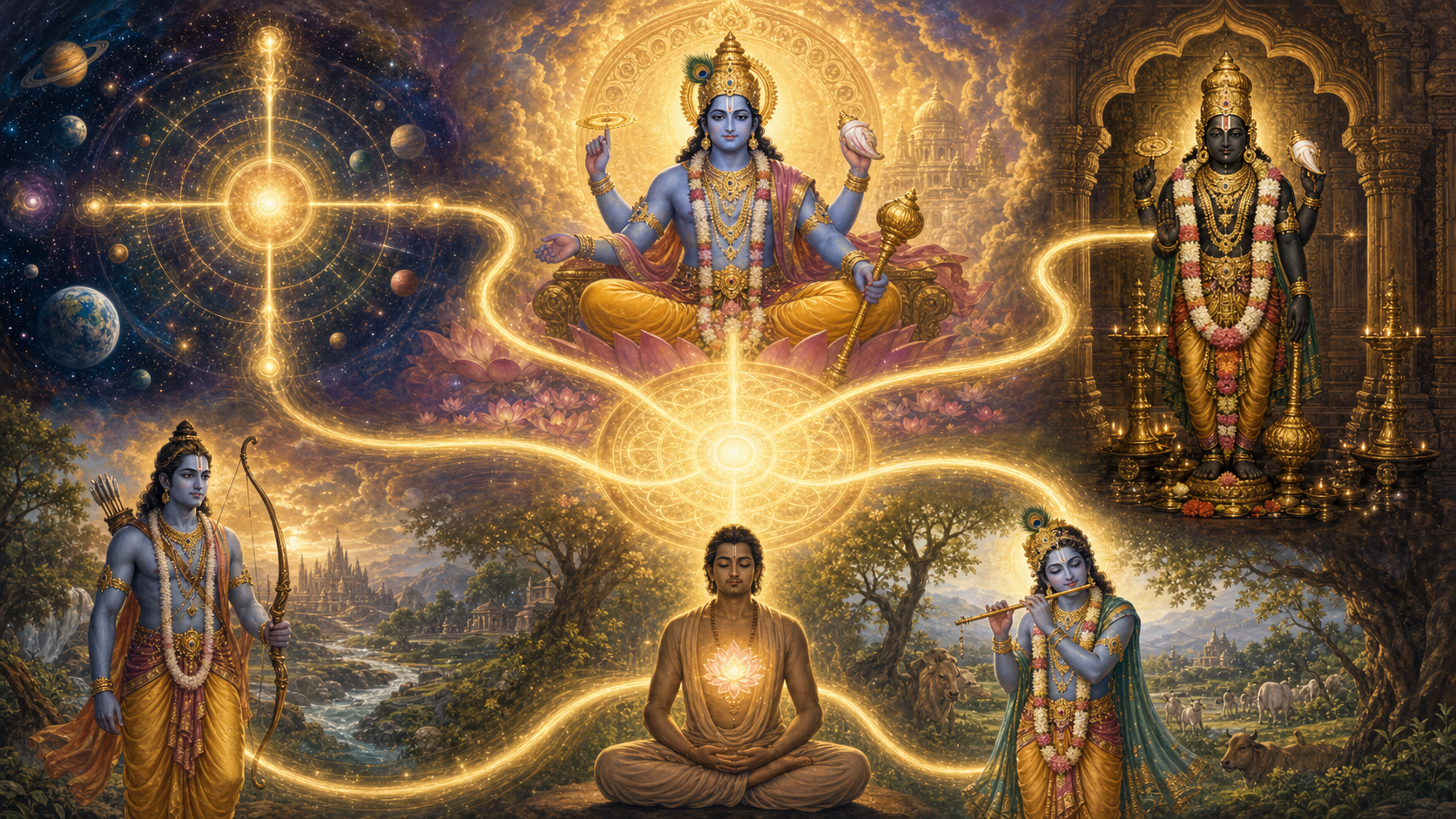
You may have been told that Vishnu is beyond every material limit, then invited to bow before a murti, remember Rama or Krishna, and seek the Lord within your own heart. If all of these are true, what exactly is present in each encounter?
The fivefold teaching gives you a precise answer. Para, Vyuha, Vibhava, Antaryami, and Archa are not five rival Vishnus. They are five modes in which the one Lord remains supreme while becoming intelligible, historically active, inwardly present, and accessible to embodied worship. Once you grasp that distinction, scripture, meditation, avatara devotion, ethical action, and temple darshana stop looking like unrelated practices.
One Lord, five modes—not five rival deities
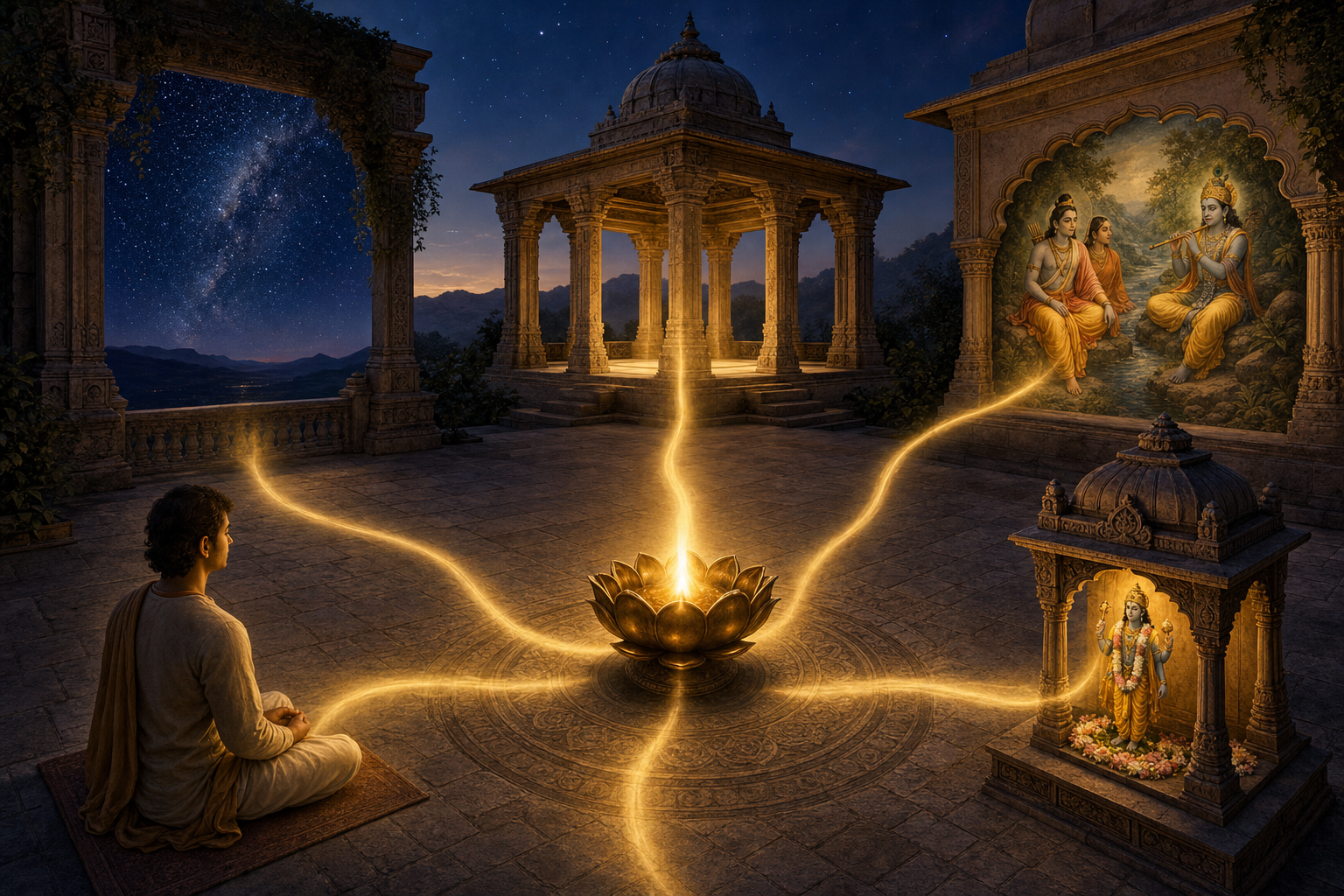
The fivefold formulation belongs especially to Pancharatra theology and Sri Vaishnava tradition. Its scriptural setting includes the Sattvata, Ahirbudhnya, Jayakhya, and Padma Samhitas; the Narayaniya portion of the Mahabharata; Purana accounts of the avataras; the Antaryami teaching of the Brihadaranyaka Upanishad; and the Bhagavad Gita’s declaration in 18.61 that the Lord abides in the hearts of beings.
The five forms answer five different questions. Para answers who Vishnu is beyond material limitation. Vyuha explains how divine unity can be expressed through an ordered plurality without being divided. Vibhava shows the Lord entering the world through avatara. Antaryami identifies the Lord as the presence within every being and within the cosmos. Archa makes that presence available to sight, touch, offering, ritual, and community.
Think of this as a movement in accessibility, not a chronology in which Vishnu first becomes one form and later changes into another. It is also not a ladder on which Archa sits at the bottom and Para at the top. Para prevents you from reducing Vishnu to a material object; Archa prevents transcendence from becoming remote and unusable. Vibhava prevents theology from remaining outside history; Antaryami prevents it from remaining outside your conscience. Vyuha shows how ordered distinction can exist without a collection of competing gods.
| Form | Question it answers | Where you encounter it | Your practical response |
|---|---|---|---|
| Para | Who is Vishnu in supreme, unconditioned fullness? | Contemplation of Paravasudeva or Vaikuntha-natha | Orient study and desire toward moksha rather than temporary gain alone |
| Vyuha | How is divine activity ordered without dividing the Lord? | Vasudeva, Sankarshana, Pradyumna, and Aniruddha in Pancharatra theology, mantra, and liturgy | Learn the four as coordinated self-expressions, not separate gods |
| Vibhava | How does Vishnu enter the world’s struggle with adharma? | Avatara narratives, festivals, vows, poetry, and drama | Translate the avatara’s dharmic example into a concrete choice |
| Antaryami | How is the Lord present within beings and the cosmos? | Interior recollection and ethical encounters with others | Test your conduct against truthfulness, compassion, and ahimsa |
| Archa | How can embodied people approach the transcendent Lord? | Consecrated murti, temple worship, home puja, darshana, and seva | Approach with regularity, reverence, and an offering rather than as a spectator |
Not every Vaishnava sampradaya presents these categories with identical emphasis. Gaudiya Vaishnava theology elaborates the catur-vyuha within Krishna-centred accounts that also include the Purusha forms. Madhva’s Dvaita strongly preserves the difference between the self and the Lord while giving central place to avatara and murti worship. Sri Vaishnava Vedanta develops Antaryami through the relation of the universe to Ishvara as body to indwelling self. Before borrowing a detailed mantra chart or cosmological correspondence, identify which sampradaya produced it.
What each form asks you to notice
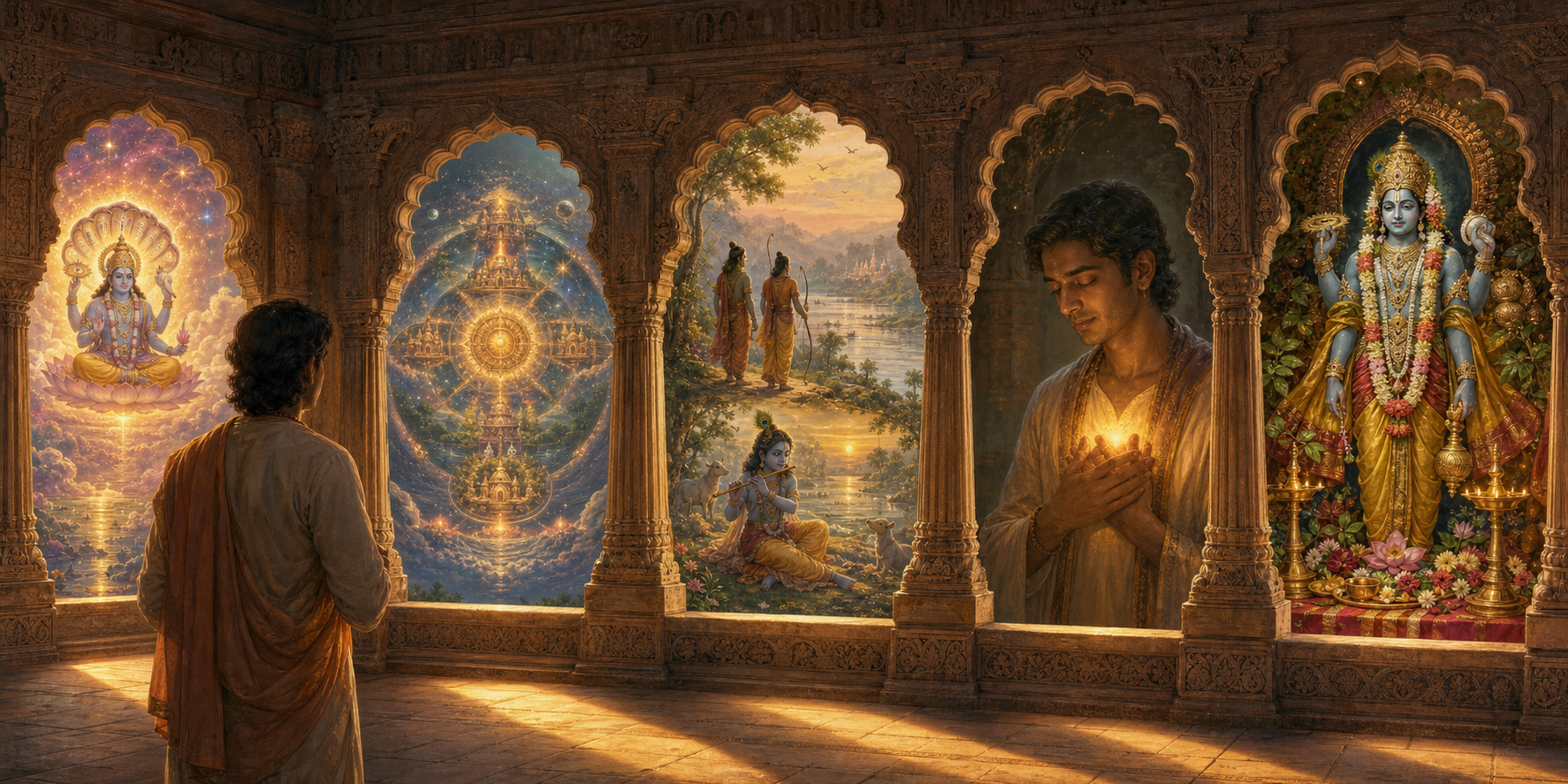
Para: transcendence is fullness, not absence
Para, also called Paravasudeva or Vaikuntha-natha, is Vishnu in the supreme form untouched by material limitation and change. Within this Vaishnava understanding, transcendence does not mean an empty remoteness or a deity stripped of every quality. The Lord possesses limitless auspicious qualities while remaining unconfined by the conditions that govern material beings.
Para corrects a common distortion in spiritual life: treating God as valuable only when a prayer produces an immediate result. Contemplation of Para turns your attention toward the highest end, moksha, and asks whether your practice is changing what you ultimately seek. When you study Vedanta or sit in quiet remembrance, do not merely ask what Vishnu can give you. Ask what remains worth desiring when temporary gains have passed.
Do not use Para to dismiss the other forms as concessions for less advanced devotees. If the supreme Lord is genuinely free, accessibility does not diminish that supremacy. The ability to be near without becoming materially limited is part of the theological claim.
Vyuha: ordered distinction without divine fragmentation
The four Vyuhas are Vasudeva, Sankarshana, Pradyumna, and Aniruddha. They are structured self-expressions of Vishnu associated with divine governance, cosmology, mantra practice, and temple liturgy. The category allows differentiated functions to become thinkable and worshipful without turning the one Lord into four independent gods.
Vyuha is therefore not another name for the dashavatara. The catur-vyuha expresses an ordered theological structure; Vibhava concerns compassionate descent into the world’s narratives. Mixing the two will make both difficult to understand.
Your safest starting point is simple: learn the four names in order and hold firmly to their unity. More detailed associations should come from the Pancharatra liturgy or teaching lineage you actually follow. If a temple or acharya gives you a specific mantra or visualization, receive it in that setting rather than assembling a private system from disconnected correspondences.
Vibhava: avatara turns theology into a dharmic decision
Vibhava is the mode most devotees meet through narrative. Vishnu descends as avatara to restore dharma and uplift beings. Classical lists include Matsya, Kurma, Varaha, Narasimha, Vamana, Parashurama, Rama, Krishna, Buddha in several Purana traditions, and Kalki. The qualification matters: the inclusion and arrangement of particular avataras can vary, so one familiar list should not be treated as the only account found across every Vaishnava tradition.
An avatara narrative becomes spiritually useful when you stop at the point of decision. What form has adharma taken? What response restores order? Which quality must a devotee embody rather than merely admire? Carry one answer into a real obligation, conflict, or act of service. This keeps Rama, Krishna, Narasimha, or another avatara from becoming only a festival image or a childhood story.
The presence of Buddha in several Vaishnava accounts should be handled with the same care. It is evidence of a capacious Hindu theological history, but it does not erase the distinct doctrines by which Buddhists understand the Buddha. Respect grows from accurate distinction, not from declaring every dharmic path identical.
Antaryami: inward presence is not private impulse
Antaryami is the indwelling Lord: Vishnu present within every self and within the wider cosmos as inner ruler and guide. The Antaryami Brahmana of the Brihadaranyaka Upanishad supplies an important Upanishadic foundation, while Bhagavad Gita 18.61 places the Lord in the heart of all beings.
This teaching does not make every inward urge a divine instruction. Anger, fear, appetite, habit, and self-interest also arise inwardly. Test what you feel against dharma rather than baptizing preference as guidance. Does the intended act preserve truthfulness? Does it reduce needless harm? Does it honour responsibility? If not, the mere fact that an impulse feels intense or personal does not make it Antaryami’s command.
The most immediate practice is ethical. Before speaking to someone you dislike, remember that the indwelling Lord is not present in you alone. That recognition does not require passivity or agreement. It requires you to tell the truth without treating the other person as spiritually disposable. In this way, Antaryami turns ahimsa and compassion from attractive ideals into disciplines of speech and conduct.
Archa: embodied access without reducing God to matter
Archa is Vishnu’s accessible presence in consecrated form. Prana-pratishtha, regular nitya-archana, ornamentation, food offering, and the festival cycle locate this form within a living relationship. The Vaishnava claim is not that a finite material object contains and exhausts the infinite Lord. It is that the Lord freely accepts a form through which an embodied devotee can offer service and receive darshana.
Srirangam’s Ranganathaswamy, Tirumala’s Venkateswara, and Puri’s Jagannath show how Archa gathers theology, music, dance, alankara, procession, food offering, and annadana into a shared sacred culture. A temple is not merely a lecture hall with an image at the front. Its entire rhythm trains attention around divine presence.
When you go for darshana, resist the urge to treat the visit as visual consumption: arrive, obtain a glimpse, record proof, and leave unchanged. Attend to the murti, the names being recited, the offerings, and the opportunity for seva. Tears, relief, or courage may arise, but you do not need to manufacture emotion. Reverent attention is already a meaningful response.
Four questions that prevent the most common mistakes
Do I need to worship all five as separate deities?
No. The framework differentiates modes of one divine reality. A prayer before an Archa murti can be directed to the supreme Para; an avatara name can awaken awareness of Antaryami; a temple liturgy can carry Vyuha theology. The categories clarify the encounter without forcing you to divide your devotion into five competing loyalties.
Is Vyuha simply a more philosophical word for avatara?
No. Vyuha describes ordered self-expression through Vasudeva, Sankarshana, Pradyumna, and Aniruddha. Vibhava describes descent as avatara. If you are reading a Pancharatra explanation of cosmology, mantra, or liturgy, Vyuha is probably the relevant category. If you are reading how Rama, Krishna, or Narasimha confronts adharma, you are dealing with Vibhava.
Does Antaryami mean that the individual self is Vishnu?
Not in the ordinary sense of equating ego with the Lord. Antaryami teaches indwelling presence and governance, not the infallibility of personal desire. Sri Vaishnava thought preserves an intimate relation between Ishvara, selves, and the universe while still distinguishing the indwelling Lord from the beings in whom he dwells. Other Vedanta schools formulate that relation differently, so do not import one school’s conclusion into another without qualification.
Are the five forms equivalent to Buddhist, Jain, or Sikh teachings?
No exact equivalence should be claimed. A functional resemblance can help conversation: Buddhist accounts of dharmakaya, sambhogakaya, and nirmanakaya also move between transcendence and manifest teaching; Jain reverence for the realized Tirthankara emphasizes ethical exemplarity; Sikh remembrance through Naam and Shabad makes divine presence central within the sangat. Yet each term belongs to its own doctrine, discipline, and community. Use comparison to ask a sharper question, not to erase the answer each tradition gives.
Turn the theology into a workable sadhana
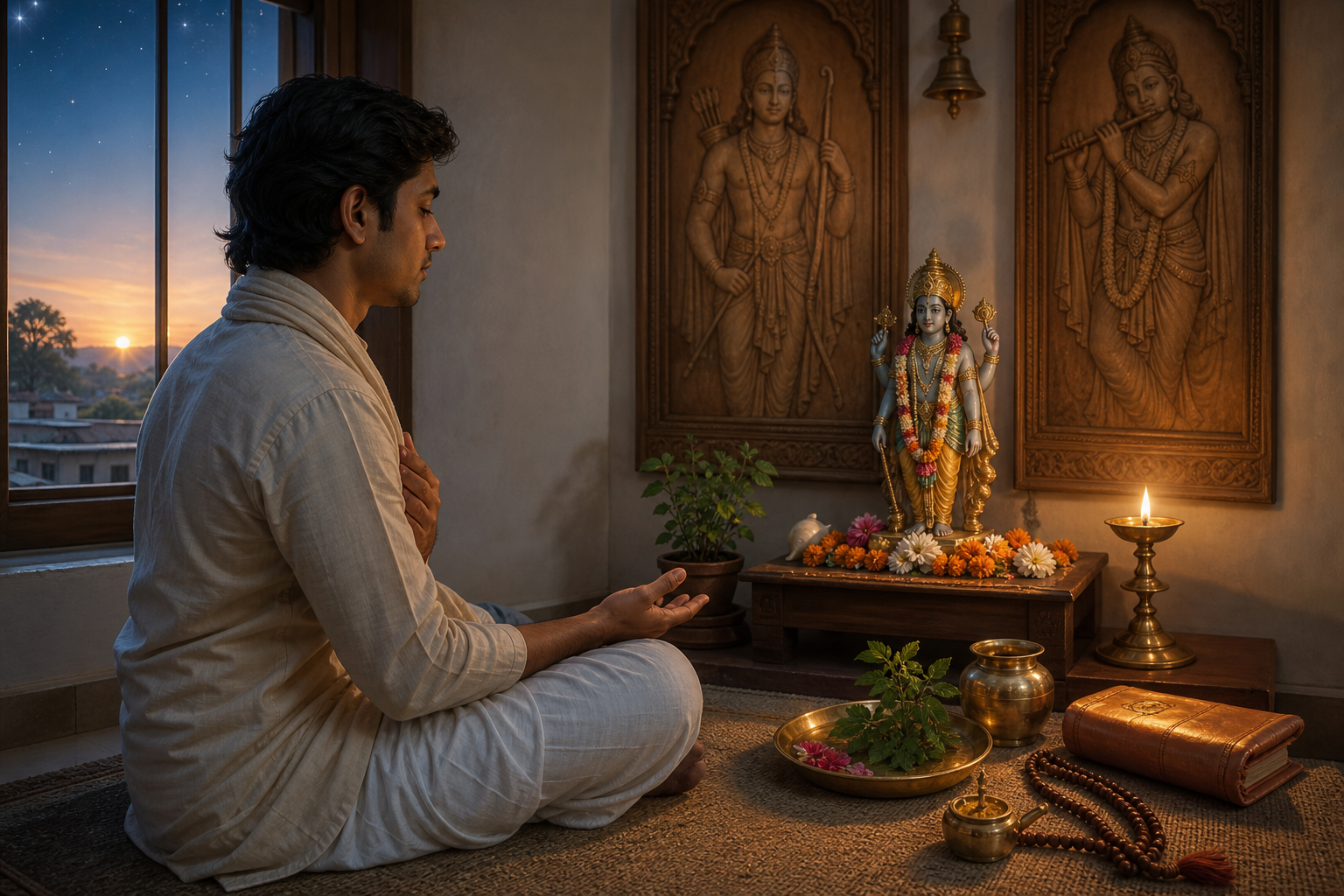
You do not need five elaborate rituals. You need practices that keep transcendence, understanding, dharmic example, interior awareness, and embodied devotion connected. The following cycle can be used as a complete practice when appropriate or divided across your regular rhythm.
- Begin with Archa. Sit before the established focus of your home worship, or receive darshana at a temple. Let the visible form gather your attention instead of treating embodiment as an obstacle.
- Remember Para. Recite Om Namo Narayanaya while holding the understanding that the Lord before you is not confined by matter, place, or your present need.
- Name the Vyuha order. Recall Vasudeva, Sankarshana, Pradyumna, and Aniruddha as coordinated expressions of the one Lord. Keep detailed mantra or visualization practices within the instructions of your lineage.
- Bring in Vibhava. Recall one avatara episode and name the dharmic quality it demands from you now. Choose an actual response—an honest conversation, a fulfilled duty, restraint, protection of another, or service—rather than ending with admiration.
- Pause for Antaryami. Sit silently and acknowledge the Lord within you and within those affected by your next action. Before eating, make the food an offering rather than consuming it absent-mindedly.
- Close through seva. Let devotion leave a visible trace in conduct. Temple service, care for another person, truthful work, or participation in annadana joins inward remembrance to responsibility.
If the complete cycle feels crowded, keep the practice coherent rather than hurried. A steady home or temple act of worship, remembrance of Antaryami before food or a difficult decision, and regular engagement with an avatara narrative give you three strong anchors. Study Para and Vyuha alongside them so that devotion gains theological depth instead of becoming mechanical.
Read according to the question you are trying to answer
- For the indwelling Lord: begin with the Antaryami Brahmana of the Brihadaranyaka Upanishad and Bhagavad Gita 18.61.
- For Vyuha and temple theology: turn to the Pancharatra Samhitas, including the Sattvata, Ahirbudhnya, Jayakhya, and Padma Samhitas, with guidance appropriate to their ritual setting.
- For avatara devotion: read the Bhagavata Purana and related Purana narratives, paying attention to the form of adharma confronted and the virtue embodied.
- For the broader synthesis: study the Narayaniya of the Mahabharata and the Vedantic discussions associated with the Brahma Sutra’s Pancharatra-adhikarana.
- For Sri Vaishnava interpretation: follow the line of Nathamuni, Yamunacharya, Ramanujacharya, and Vedanta Desika, where metaphysical coherence and devotional accessibility are developed together.
Choose the doorway already in front of you. If you have a murti and an established puja, make the next offering more attentive. If you face an ethical decision, begin with Antaryami. If an avatara festival is approaching, study the dharmic conflict before joining the celebration. Then let the other forms widen that beginning until your understanding, worship, and conduct point toward the same Lord.
References
