

If you donate to a temple, serve its community, or question the authority of a government-appointed administrator, do not stop at asking who controls the institution. Ask who authorized the particular decision, how it serves the deity and the endowment, and when any exceptional government control is supposed to end.
Those questions turn a broad demand to free temples into something harder to dismiss: a test of legal authority, financial stewardship, and institutional accountability. The Sri Kallazhagar Temple proceedings show why all three must be examined together.
The first test is regulation versus managerial control
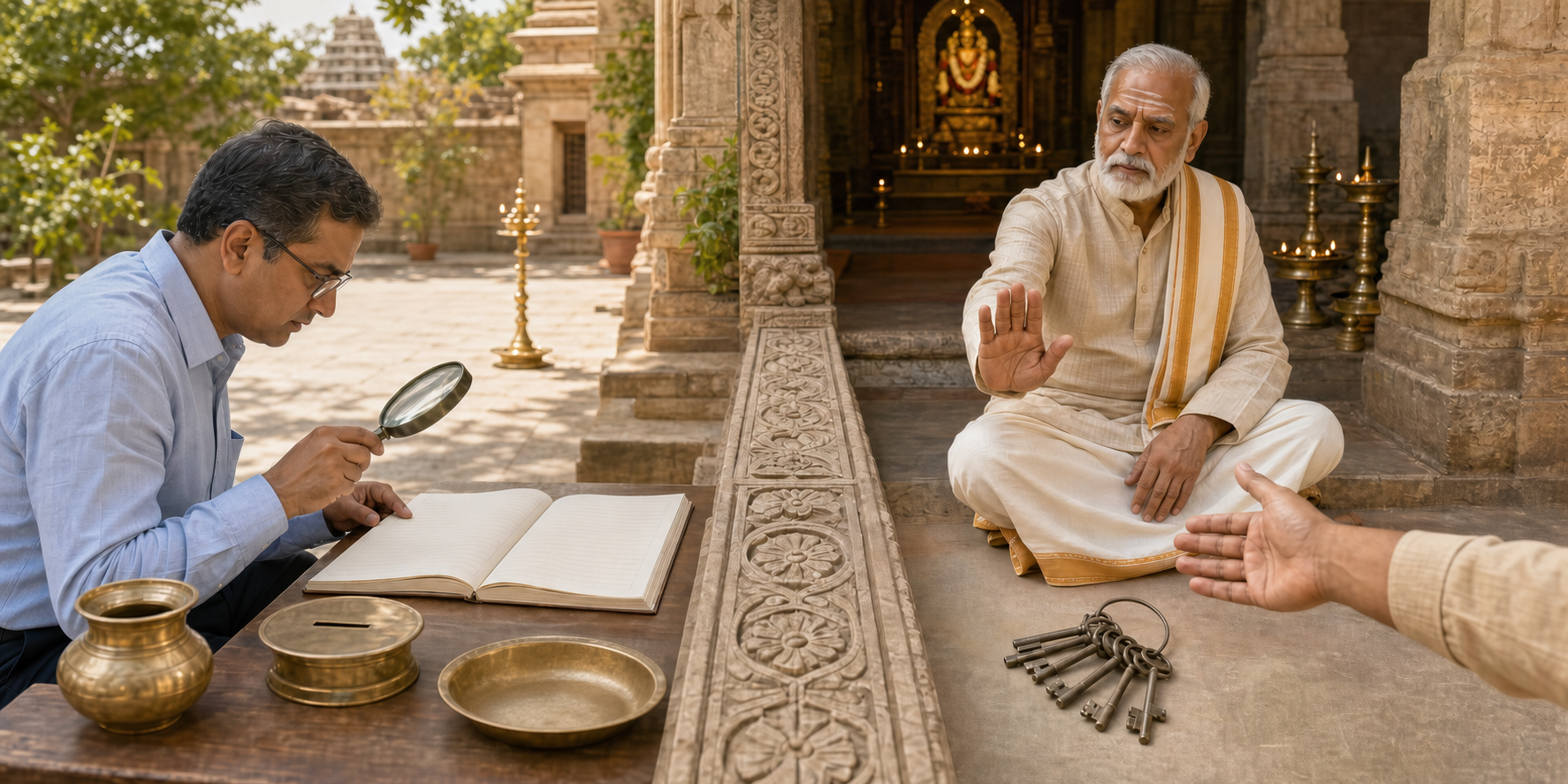
A secular government can regulate religious institutions where the law permits it. Regulation may include requiring accounts, addressing proven maladministration, protecting endowed property, and installing a corrective arrangement during a genuine crisis. That does not automatically give the State a proprietary interest in the temple or a permanent right to make its ordinary decisions.
Managerial control begins when exceptional supervision displaces the temple’s regular governing body. An administrator who makes routine financial and property decisions for an indefinite period is doing more than correcting a named failure. The practical distinction can be tested with four questions:
- Source of power: Which statute, scheme, appointment order, or court order authorizes the intervention?
- Trigger: What specific instance of maladministration, vacancy, danger, or statutory default justified it?
- Scope: Which decisions may the appointed officer make, and which remain with trustees or other temple authorities?
- Exit: What condition, review date, or time limit returns management to a duly constituted trustee body?
The exit question is decisive. Temporary control without a working route back to ordinary governance can become permanent through bureaucratic inertia. The passage of time does not cure the absence of authority.
Government involvement in Hindu endowments has a long institutional history, running through Madras Regulation VII of 1817, the 1863 and 1927 enactments, the 1951 law, and the Tamil Nadu HR&CE Act of 1959. That history helps explain why direct administration can appear normal. It does not answer whether a current appointment remains lawful, necessary, or consistent with the governing scheme.
What the Kallazhagar case requires you to notice
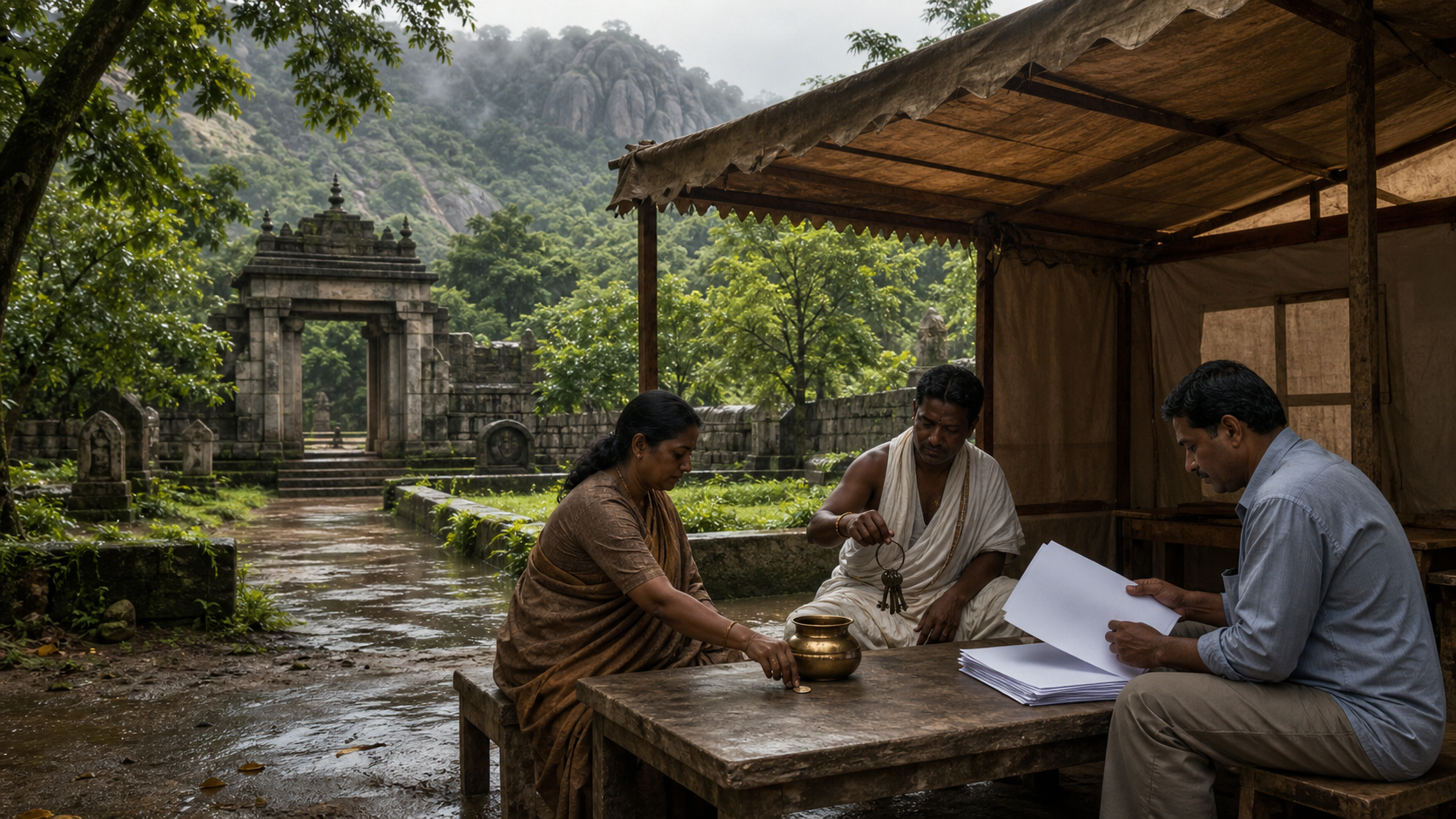
The Madurai Bench of the Madras High Court confronted an arrangement that was temporary in theory but extraordinary in duration. It noted that Sri Kallazhagar Temple had remained without a Board of Trustees for more than thirteen years, while the Executive Officer’s appointment traced back to 1966. A corrective mechanism lasting across generations no longer resembles a short response to a particular emergency.
The Bench also reaffirmed that the temple’s current and accumulated funds vest in the deity. The State, its department, ministers, trustees, and executive officers are therefore not owners of that wealth. They are authorities or stewards whose powers must come from law and must remain tied to the purposes for which the endowment exists. The Bench went so far as to characterize unauthorized use of those funds as a "crime against the deity".
That principle has concrete consequences. A socially attractive project is not lawful merely because an official announces it. A ministerial preference cannot replace statutory authority. A trustee’s signature does not convert temple property into the trustee’s property. The decision-maker must show both legal power and a connection to the temple’s authorized religious or charitable purposes.
Nor does the principle mean that every rupee must be spent only inside the sanctum. A temple endowment may lawfully sustain worship, maintenance, festivals, charity, learning, music, community service, or other purposes supported by its governing terms and applicable law. The controlling question is not whether the expenditure looks broadly beneficial. It is whether this temple’s funds may be used for that purpose by this decision-maker through this procedure.
The Bench did not make every form of government supervision unlawful or automatically transfer every State-administered temple to a new body. Different temples may have different schemes, endowments, appointments, and litigation histories. A ruling arising from one temple supplies a powerful legal test, but the application of that test still requires the records of the institution in front of you.
Build an evidence file before making a public allegation

Temple-governance campaigns often begin with a large revenue estimate or a photograph of neglected property. Those may identify a problem, but they do not establish who breached which duty. If you want an audit, administrative correction, trustee appointment, or judicial remedy, build the case decision by decision.
- Name the disputed act. Identify the payment, land lease, appointment, construction decision, diversion, failure to collect rent, or prolonged vacancy. Avoid a general accusation when the real issue is one traceable transaction or omission.
- Locate the governing instrument. Record the applicable statute, temple scheme, endowment terms, trustee order, Executive Officer or Fit Person appointment, and any relevant court direction. For a Tamil Nadu temple, the 1959 HR&CE Act may be central, but it is not a substitute for the temple-specific scheme and orders. Other states have different legal frameworks.
- Create a governance chronology. List when the previous trustees ceased to serve, when the present administrator was appointed, the stated reason, later renewals or reviews, and any announced timetable for constituting a board. Mark missing documents as unknown instead of filling the gap with an assumption.
- Trace the money. For each disputed expenditure, record the amount, originating account, approved purpose, approving authority, resolution or order number, recipient, payment date, and completed work. Separate annual income from accumulated funds and restricted endowments; they may not be interchangeable.
- Map the property problem precisely. Record each parcel, present occupant, lease or tenancy terms, rent due, rent received, arrears, suspected encroachment, and the latest recovery action. Low rent, unpaid rent, encroachment, and unlawful alienation are different failures and require different evidence.
- Ask for a defined remedy. A useful demand might seek production of an appointment order, completion of an audit, recovery action on identified arrears, a timetable for trustee appointments, or an explanation of the statutory power behind a particular expenditure. A demand to fix everything gives the authority no measurable result to deliver.
Keep allegation and proof in separate columns. A lease producing a poor return may reflect outdated terms, weak enforcement, litigation, an encroachment, or an unlawful concession. You cannot tell which from the income figure alone. The next useful record is the lease, demand register, arrears statement, valuation basis, or recovery file.
The same discipline applies to government claims of public benefit. Ask for the statutory provision, written sanction, temple-purpose analysis, account entry, and decision record. If the authority cannot produce them, that absence becomes a specific governance issue rather than a political slogan.
Before filing litigation or publicly accusing a named person of criminal conduct, take the evidence file to an advocate familiar with the applicable State endowment law. Standing, limitation periods, available remedies, and evidentiary requirements depend on the proceeding. An administrative irregularity, a recoverable civil loss, breach of statutory duty, and a criminal offence are not interchangeable labels.
Temple autonomy needs an accountable institutional design

Removing a department from daily management is not, by itself, a complete governance model. Devotees should reject the false choice between indefinite State control and unreviewable private control. A temple can be community-governed while remaining subject to audits, conflict rules, property safeguards, and judicial remedies.
A credible reform model should contain the following features:
- A functioning trustee body: Vacancies should be filled through the temple’s lawful scheme, with appointment dates, terms, qualifications, and conflicts disclosed.
- Narrow emergency intervention: Any State-appointed officer should receive a written mandate tied to a documented failure, not an open-ended power to operate the temple indefinitely.
- A real exit mechanism: The appointment order should state the corrective tasks, review point, and conditions for restoring ordinary management. If the law supplies a duration, administrators must not treat it as optional.
- Temple-specific financial accountability: Accounts should allow devotees and auditors to see income, accumulated funds, restricted endowments, authorized expenditure, arrears, and asset-recovery work without treating the temple as a general government treasury.
- Usable property disclosure: Aggregate acreage is not enough. Oversight requires parcel-level status, possession, lease terms, collection history, defaults, encroachments, and pending proceedings.
- Judicial oversight of boundaries: Courts should be able to compel statutory action, test unauthorized spending, require records, and end unlawful appointments. They should not have to become permanent managers of worship, festivals, personnel, or ordinary budgets.
Temple resources have historically sustained more than ritual alone. They have supported learning, music, dance, scholarship, charity, and community life. That wider Dharmic role can be renewed, but only through the temple’s lawful purposes and a transparent governance structure. A wealthy temple’s assets cannot simply be treated as an administrative pool because another cause is worthy. Even support for struggling rural temples needs a lawful structure compatible with the relevant endowments and the rights of each deity.
The secular question therefore cannot be avoided. If churches and mosques are largely managed within their own communities while Hindu temples remain under routine departmental administration, the State must justify the difference through constitutionally valid and consistently applied law. Correcting proven maladministration is one thing. Maintaining ownership-like control after the stated crisis has passed is another.
Hindu autonomy must carry its own discipline. Community management cannot become a shield for opaque leases, personal capture, neglected worship, missing accounts, or unfilled governance posts. The strongest case for freeing temples is a model that protects the deity from both bureaucratic appropriation and private misuse.
Key takeaways
- Temple wealth vests in the deity; the State, trustees, ministers, and appointed officers do not acquire ownership merely by administering it.
- Test every intervention by its legal source, specific trigger, permitted scope, and enforceable exit.
- The Kallazhagar facts show how exceptional administration can harden into the norm: no trustee board for more than thirteen years and an Executive Officer appointment originating in 1966.
- Public benefit does not cure a missing legal power. An expenditure must be authorized and connected to the temple’s valid purposes.
- Judicial oversight is most useful when it restores statutory governance, protects assets, orders disclosure, and ends unlawful permanence rather than running the temple itself.
- A record-based demand naming one decision, one authority, and one remedy is more actionable than a sweeping allegation of corruption.
Choose one temple and prepare a one-page governance docket: the governing scheme, current trustees and their appointment dates, every exceptional administrator and the underlying order, the latest available accounts, accumulated funds, property status, arrears, encroachments, and unresolved audit or court directions. Leave an explicit blank where a record is unavailable. Those blank cells tell you what to request next, and the completed rows tell you whether the problem calls for an audit, an appointment, recovery action, or legal review.
References
