

You may have found the name Sudarshana Samhita while looking for a mantra, a ritual sequence, or a way to bring Sudarshana worship into daily life. Your first decision is not which formula to repeat. It is whether you want a self-guided devotional discipline or formal Pancharatra practice.
The distinction matters. You can begin with reverence, steady attention, and honest examination of your conduct. Technical worship is different: when a practice depends on initiation, precise mantra, ritual placement, consecration, or lineage-specific rules, learn it from a qualified acharya rather than reconstructing it from isolated instructions.
What you are meant to integrate
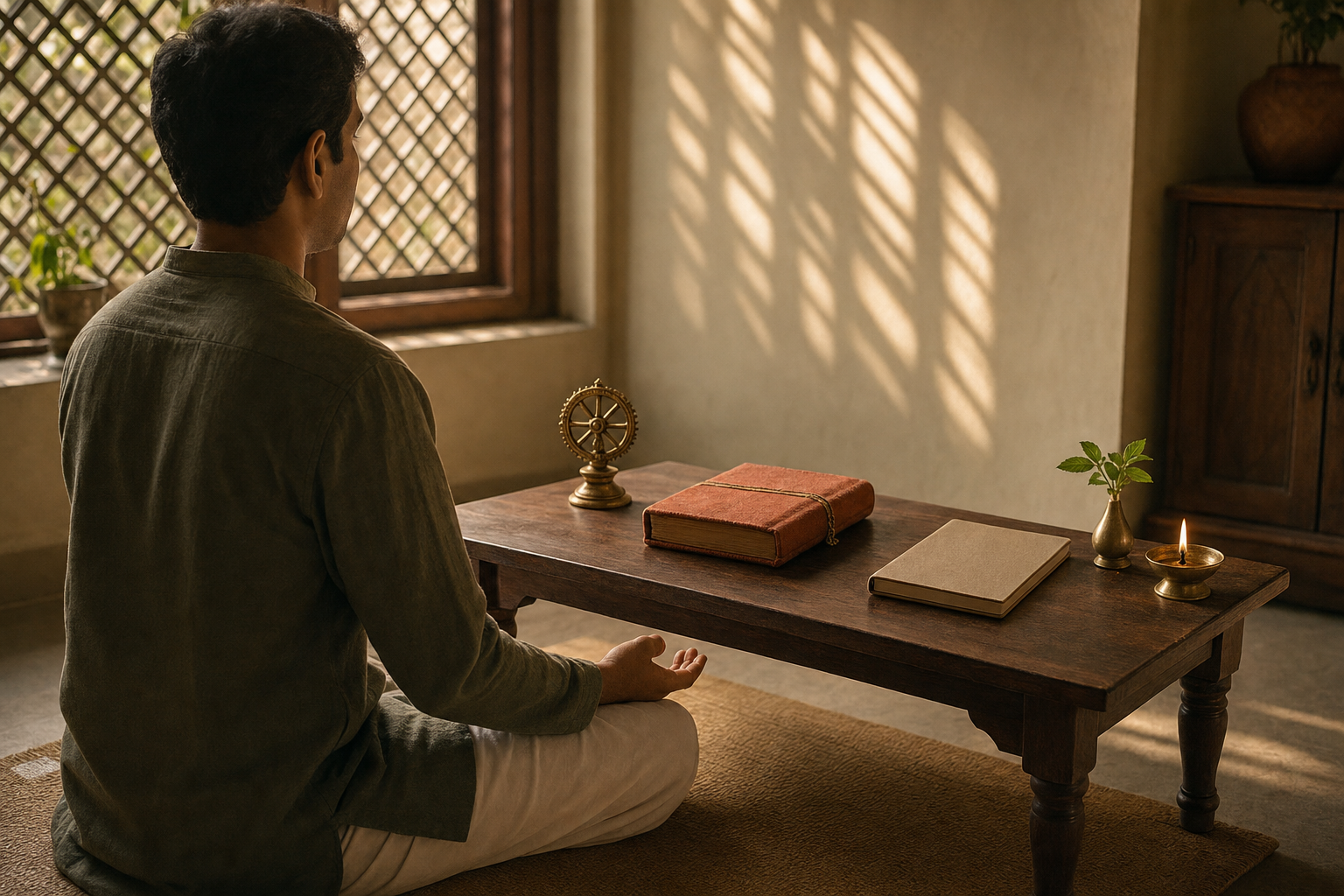
Pancharatra is a Vaishnava agamic tradition in which theology, devotion, worship, and contemplative discipline form a connected path. Within that setting, you encounter a forty-one-chapter treatment of devotional practice, meditation, and spiritual purification. That breadth is your first practical clue: reducing the Sudarshana Samhita to a powerful mantra or a desired result misses its organizing principle.
Use three questions whenever you read or receive an instruction connected with it:
- Devotion: Does this deepen your relationship with Bhagavan, or are you treating Sudarshana as an impersonal force to control?
- Meditation: Does the practice train attention, recollection, and inward steadiness, or are you merely completing external actions?
- Purification: Does it expose pride, anger, carelessness, and selfish motive, or does it give those tendencies a religious disguise?
Each question corrects a common imbalance. Devotion without disciplined attention can become sentimental. Meditation without devotion can become self-absorption. Ritual cleanliness without ethical purification can become anxiety about details while speech and conduct remain unchanged. A sound approach keeps all three together.
This also changes how you understand Sudarshana. Do not approach the divine discus of Vishnu as though it were a detachable occult device. Within Vaishnava worship, sacred power remains inseparable from Bhagavan, dharma, surrender, and right intention. If your interest begins and ends with defeating an opponent, removing an inconvenience, or gaining control, return first to the devotional foundation.
A conservative home practice when you have no teacher
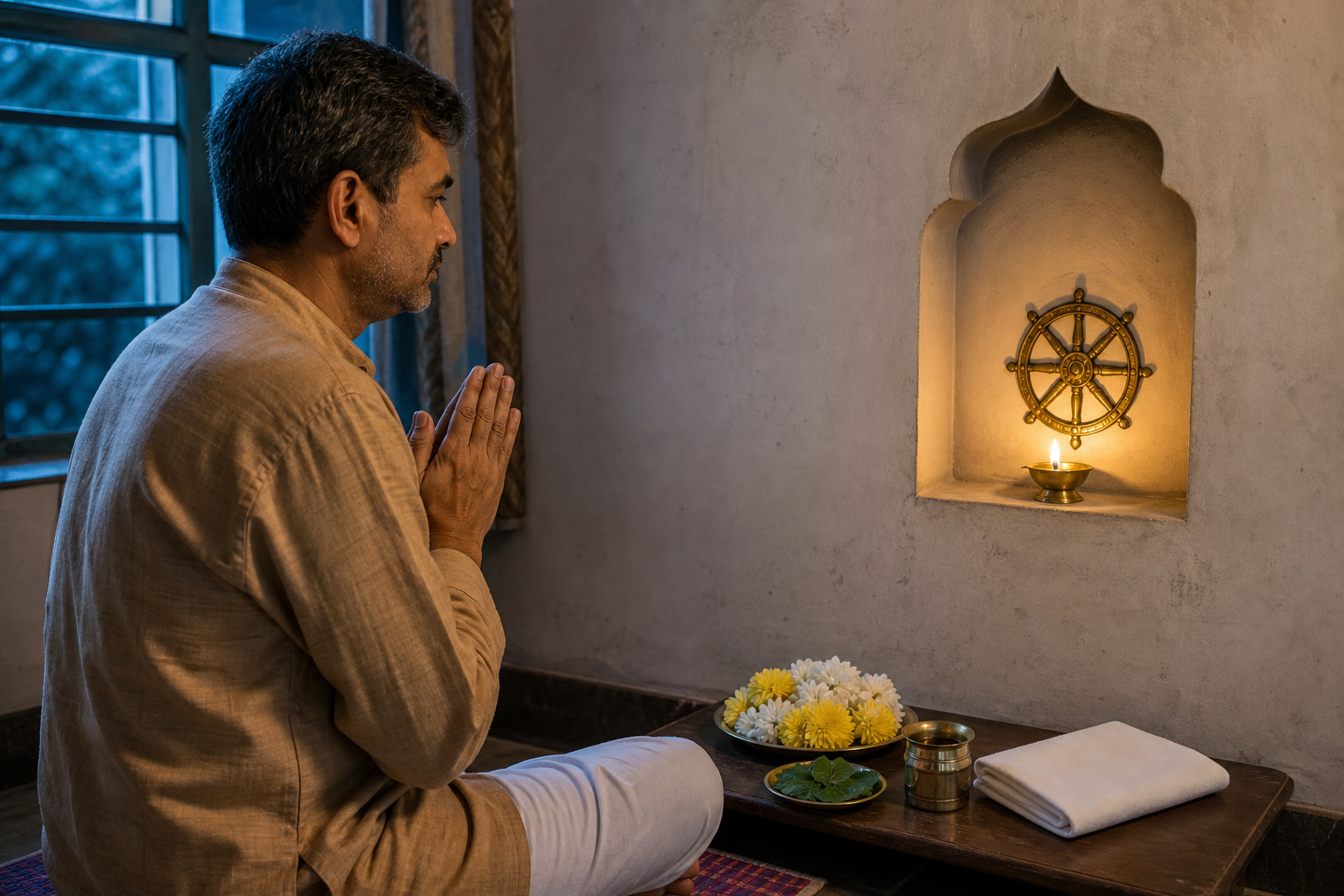
You do not need to pretend that you are performing the complete ritual system in order to begin. The following routine draws on the linked disciplines of devotion, meditation, and purification; it is not presented as a chapter-by-chapter reproduction of formal Sudarshana worship.
- Prepare an ordinary clean place. Wash, settle the space, and reduce avoidable interruption. Use a familiar image or lamp only if these already belong to your household practice. Elaborate equipment is unnecessary at this stage.
- Begin with relationship, not demand. Bow mentally to Bhagavan Narayana and remember Sudarshana with reverence. Do not open with a list of outcomes that the deity must produce for you.
- State a dharmic intention. Ask for clearer discernment, correction of harmful tendencies, and strength to perform your duties well. Keep the intention connected to purification rather than domination.
- Let the breath remain natural. Sit steadily and bring the wandering mind back to the presence of Bhagavan. Do not add breath retention or other technical methods merely because they seem more advanced.
- Use only what you are entitled to use. If an acharya has given you a mantra and instructions, follow those instructions. If you have received no such teaching, remain with silent remembrance and prayer instead of copying seed syllables or ritual formulas from fragments online.
- Close with one correction in conduct. Identify a concrete place where greater clarity should appear: a dishonest sentence to avoid, a duty you have delayed, an angry response to restrain, or a promise you need to keep.
Keep the routine stable long enough to notice what it reveals. Constantly adding new gestures, visualizations, and formulas makes it difficult to distinguish practice from novelty. Regularity is more useful than religious complexity that you cannot explain or sustain.
Avoid making a severe vow simply because your first days feel intense. Choose a rhythm compatible with your household duties, then keep it honestly. Pancharatra practice belongs within dharma; it should not become an excuse to neglect the people and responsibilities already entrusted to you.
Where self-guided practice should stop
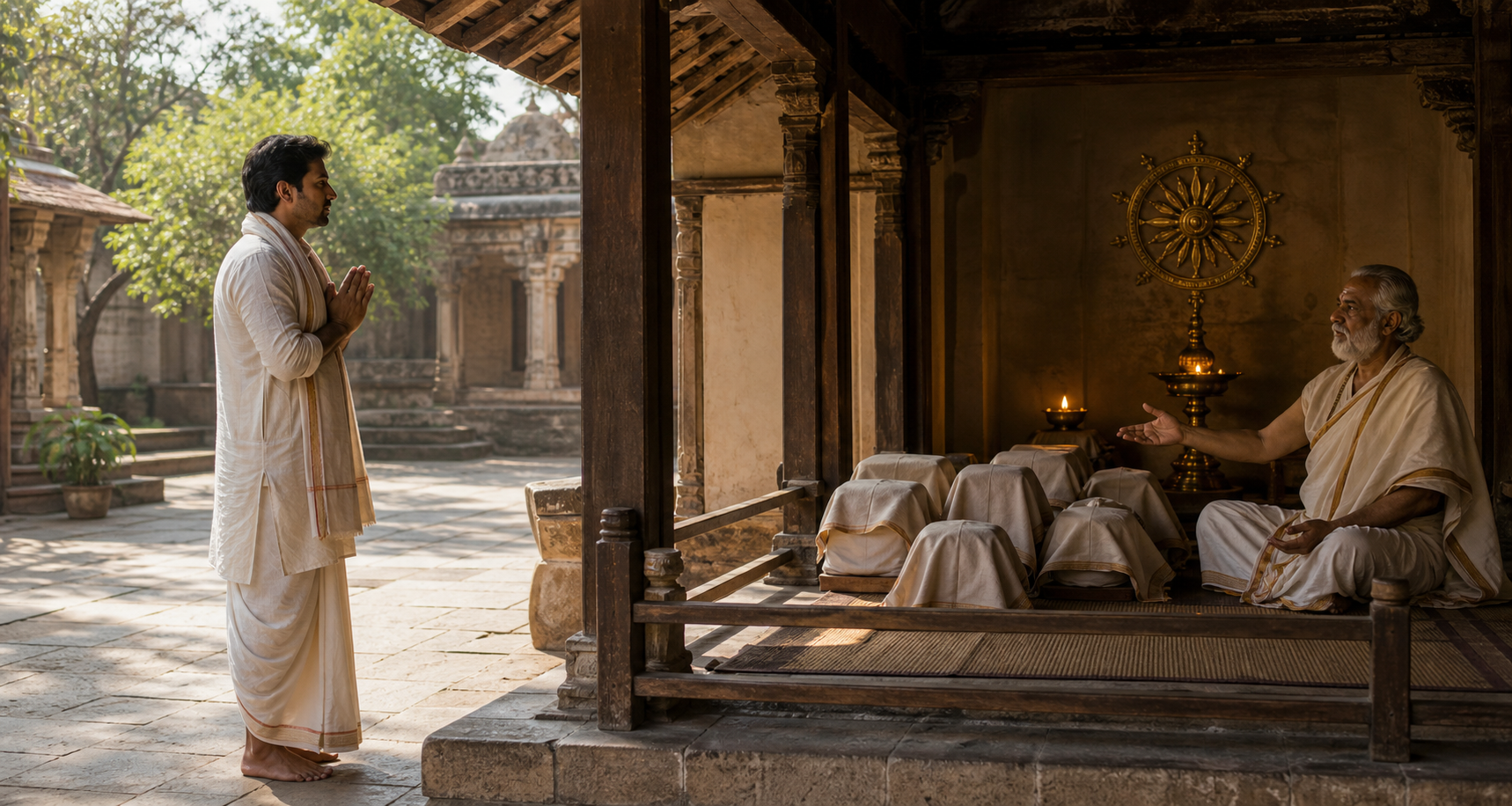
Formal practice begins where context becomes indispensable. A mantra may belong with a particular visualization, bodily placement, ritual preparation, or rule of eligibility. Removing one element from that setting can change the practice rather than simplify it.
Pause and seek instruction when you encounter any of the following:
- A bija or other mantra presented as restricted, initiated, secret, or dependent on transmission.
- Nyasa, in which mantra is ritually placed on parts of the body.
- Detailed mudra, yantra, fire-offering, installation, or consecration procedures.
- A promised result that depends on an exact sequence, ritual substance, observance, or qualification.
- An instruction that conflicts with what your guru, family sampradaya, or temple tradition has already given you.
Temple procedure is not automatically household procedure, and an instruction intended for an initiated practitioner is not automatically universal. Ask an acharya whom the practice is for, whether initiation is required, what preparatory disciplines accompany it, and what should be done when the routine is interrupted. These are not minor administrative questions. They tell you what kind of practice you are actually considering.
A trustworthy teacher should be able to identify the lineage in which the instruction is used and explain its purpose without selling fear or guaranteed results. Be cautious when secrecy itself becomes a sales technique, when every difficulty is blamed on an invisible attack, or when payment is presented as a substitute for qualification and discipline.
Measure purification through conduct, not spectacle
Meditative practice can produce unusual sensations, vivid imagery, or strong emotion. None of these, by itself, proves spiritual maturity. The more reliable question is what happens when you stand up and return to ordinary life.
Use a simple examination after practice:
- Are you becoming less transactional in prayer, or more impatient for visible rewards?
- Do you notice anger, deception, and vanity earlier, while there is still time to choose differently?
- Are you more attentive to duties, or using worship to escape them?
- Can you accept correction without defending your spiritual identity?
- Is devotion making you steadier and more truthful, or more eager to advertise special experiences?
If you keep notes, record the distraction that dominated your sitting and the conduct you intend to correct afterward. This is usually more revealing than cataloguing visions. Over time, the record should connect inner practice with recognizable changes in speech, motive, and duty.
Do not confuse purification with perfectionism. Cleanliness and careful observance support attention, but panic over every small mistake can displace devotion. When you make an ordinary error, acknowledge it, correct what you can, and continue humbly. When the issue concerns a formal vow or initiated rite, ask the teacher who authorized it rather than inventing an expiation.
Key takeaways
- Approach the Sudarshana Samhita as an integrated path of devotion, meditation, and purification, not as a collection of techniques for obtaining results.
- Without formal instruction, begin with clean surroundings, reverent remembrance, natural breathing, and a concrete commitment to better conduct.
- Do not copy restricted mantras, nyasa, consecration, fire rites, or other technical procedures from isolated material.
- Ask whether an instruction is intended for householders, requires initiation, and belongs to your lineage before adopting it.
- Judge progress by greater steadiness, humility, truthfulness, and attention to dharma rather than by unusual experiences.
Your next step can be modest and real: establish a simple devotional sitting, connect it to one correction in daily conduct, and write down the technical questions that require an acharya. That gives you a genuine beginning without claiming an authority or initiation you have not received.
References
