
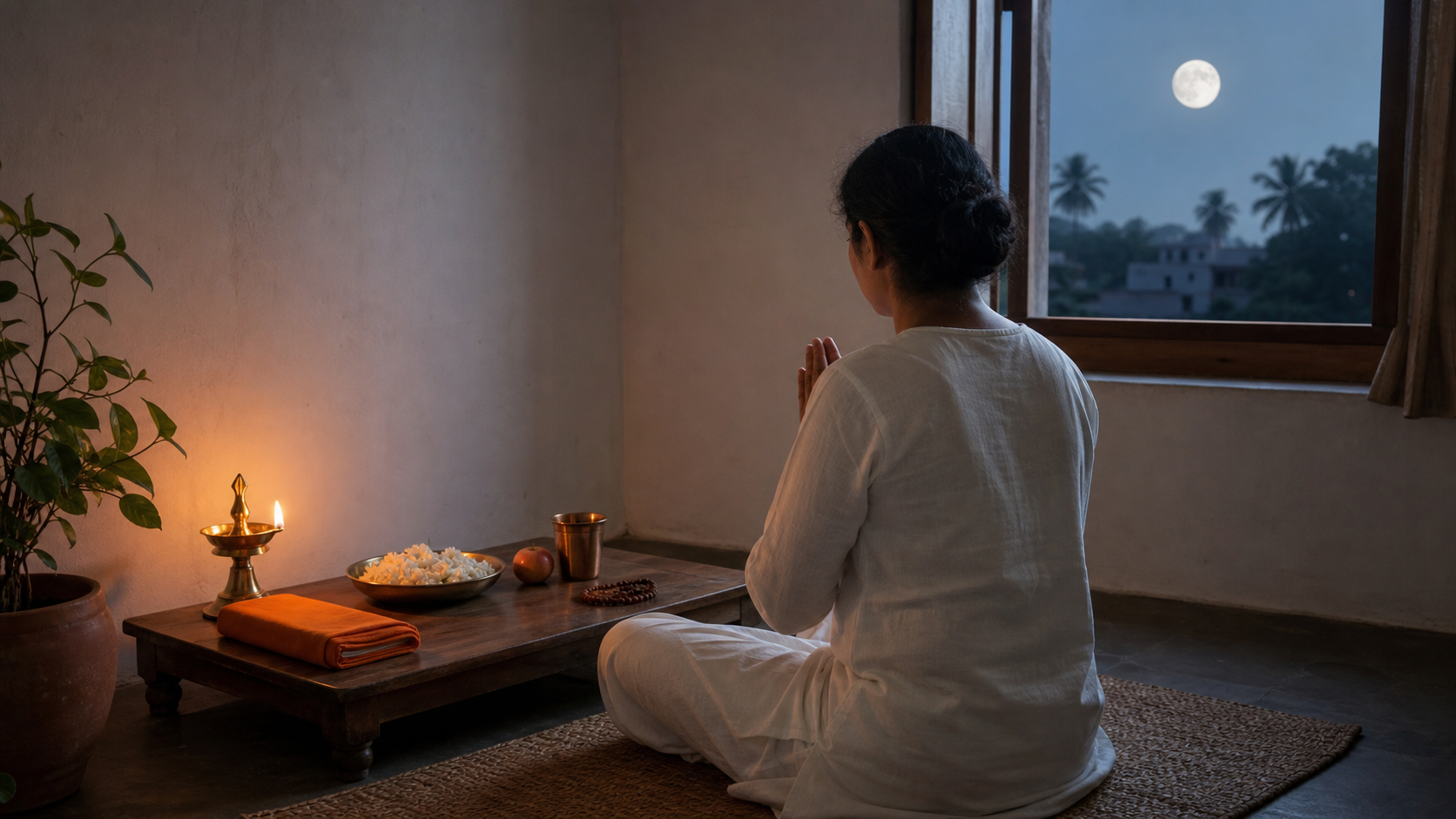
Guru Purnima falls on Wednesday, 29 July 2026. If you are deciding how to observe it, the useful question is not how elaborate your puja can become. It is how clearly you can express gratitude, receive a teaching and carry that teaching into conduct.
You can do that at a temple, in the presence of your guru, with your family or alone at home. Begin by confirming the timing for your location, then choose one coherent tradition to follow and one discipline to continue after the festival.
Put the correct date and local timing on your calendar
The civil date is Wednesday, 29 July 2026. Do not treat a clock time copied from another city as a universal muhurta. Hindu observances follow the lunar tithi, while published clock times and temple schedules are tied to a location, time zone and the convention followed by a particular tradition.
Use one consistent chain of information:
- Check a trusted panchanga calculated for the city where you will perform the observance.
- Check whether your guru, ashram or local temple has issued its own schedule.
- If you are joining an online programme, write down its time zone as well as your converted local time.
- If the temple schedule differs from a general calendar, follow the temple for the temple ceremony and the local panchanga for your private observance.
The common mistake is to combine the beginning of the tithi listed for one city, the sunrise convention of another calendar and the puja time announced by a third institution. That produces apparent precision without a coherent basis. Select the authority relevant to your observance and stay with it.
Decide whom and what you are honouring
Guru Purnima is also observed as Vyasa Purnima. Vyasa stands in dharmic memory for the preservation, organisation and transmission of sacred knowledge. Remembering Vyasa therefore turns the day toward something larger than admiration for a personality: the living passage of knowledge from teacher to student.
Before arranging the ritual, identify the relationship you are actually honouring. Your focus may be your diksha guru, another teacher recognised within your lineage, a departed acharya, the guru-parampara or Vyasa as the emblem of dharmic transmission. Parents and other teachers may also deserve gratitude, but that does not require you to blur every form of teaching into the same spiritual office.
Write a one-sentence sankalpa in plain language before the day. Name the teacher or lineage, the teaching for which you are grateful and the conduct you intend to change. A useful intention is concrete: continue a daily recitation already received, resume a neglected period of study, correct a recurring fault or complete a piece of seva. Vague reverence fades quickly; a named discipline gives it a place in your life.
If your sampradaya has given you a Guru Purnima paddhati, mantra or order of worship, that instruction takes precedence over a general checklist. Do not collect unfamiliar mantras from unrelated lineages merely to make the ceremony appear more substantial. Fidelity is more meaningful than variety.
A simple home observance centred on practice
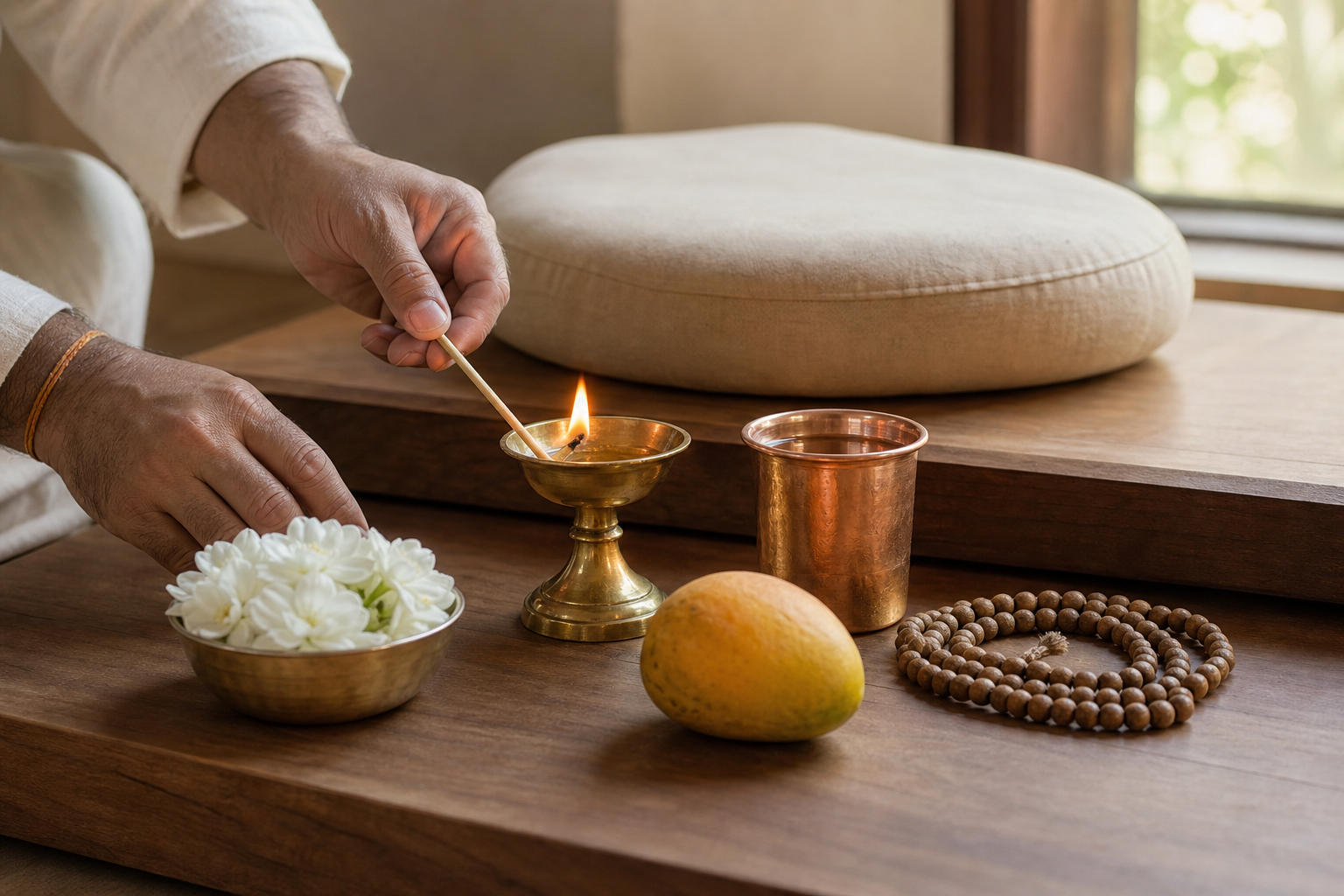
The following sequence is a non-sectarian framework for someone who has not received a lineage-specific procedure. Adapt the offerings to your household custom rather than presenting it as a universal ritual.
- Prepare a clean place. Use the altar or prayer space you already maintain. Place an image, book or other object of reverence only if it properly belongs to your practice.
- Set aside distraction. Bathe, wear clean clothing and silence devices that are not needed for the observance. If you are joining a livestream, open only the programme you intend to follow.
- State your sankalpa. Say whom you are honouring and why. This prevents the ritual from becoming a sequence of gestures without attention.
- Begin according to household custom. You may light a lamp and incense where that is customary and safe. Use only invocations you understand or have been taught.
- Offer pranama. Remember Vyasa, your guru and the guru-parampara in the order recognised by your tradition. Flowers, fruit, water or another simple offering may be used according to custom.
- Receive the teaching again. Read or hear a short passage that your teacher has actually explained. Resist the urge to cover many texts. Stay with one teaching long enough to notice what it asks of you.
- Translate it into conduct. Write down one instruction and the situation in which you will apply it. If the teaching concerns speech, name the conversation in which restraint is needed. If it concerns practice, decide where it will sit in your existing daily routine.
- Complete the offering. Give guru-dakshina where that relationship and institution provide an appropriate way to do so, or undertake a form of seva consistent with the teacher’s work. End with gratitude, not with a request for status, attention or public recognition.
The decisive movement occurs between receiving a teaching and practising it. Abhyasa is what keeps Guru Purnima from becoming a single ceremonial day. Choose a commitment small enough to keep honestly but substantial enough to correct something real.
For a family or community observance
Tell participants in advance which tradition will shape the programme. A shared gathering can include a lamp, pranama, a reading, bhajan, reflection and seva without blending lineage-specific mantras into an improvised hybrid ritual. Members can perform their personal japa separately if their instructions differ.
Give children one intelligible act rather than a long explanation: offer a flower, read a short passage, write a note of gratitude or help prepare the prayer space. They should be able to say whom they are thanking and what they learned. That makes participation more than ceremonial imitation.
If you do not have a living guru
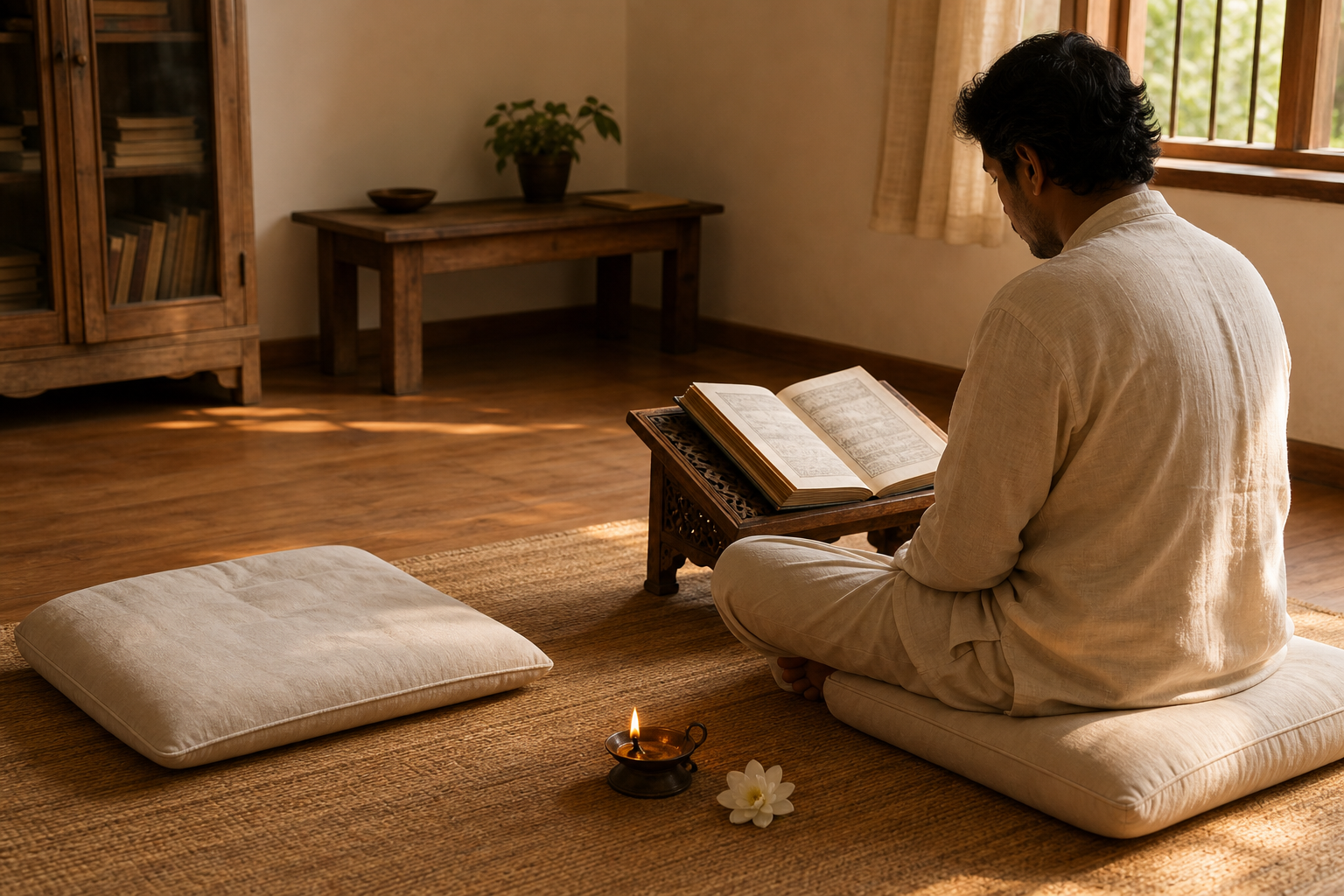
You do not need to manufacture a guru relationship in order to observe Guru Purnima. Honour Vyasa, the acharyas of the tradition you study, the teachers who have genuinely formed you and the discipline through which knowledge becomes lived wisdom. Read from a text you are already studying, acknowledge the person or institution that helped you understand it and support serious dharmic learning where you can.
Do not accept initiation merely because a festival gathering creates emotional urgency. Attending a discourse, benefiting from a book or respecting a saint does not by itself establish a guru-shishya relationship. A spiritual commitment deserves time, observation and freedom from pressure.
If you are considering a teacher, notice the matters that charisma can conceal: whether teachings are consistent with the stated sampradaya, whether questions are permitted, whether financial expectations are disclosed, whether personal boundaries are respected and whether misconduct can be addressed without silencing the student. Reverence and discernment are not enemies. Dharma does not require you to rename coercion as surrender.
You can still make the day demanding in the right way. Ask what knowledge you have received but failed to practise. Then remove one obstacle to that practice. The absence of a formal guru should lead to patient preparation, not spiritual passivity and not a hurried allegiance.
Guru Purnima 2026 observance questions
What if my guru is in another time zone?
Join the guru’s announced programme at the converted local time, but use the panchanga for your own location when scheduling a separate home observance. Label both entries clearly so that an online event time is not mistaken for your local tithi timing.
What if I cannot contact or visit my guru?
Physical access is not the measure of sincerity. Offer pranama from where you are, revisit a teaching you received and act on it. Send a respectful message only through a channel the teacher or institution normally uses; a public social-media tribute is not required.
Must everyone fast on Guru Purnima?
No single fasting rule can be imposed across all lineages and households. Follow the practice given by your guru or maintained by your family, and do not endanger your health to imitate someone else’s vrata. Dietary restrictions related to a health condition take priority over an improvised fast.
Can relatives from different traditions observe together?
Yes. Keep the common portion centred on gratitude, study, pranama and seva. Let each person retain lineage-specific mantras and ritual details instead of forcing them into a single composite ceremony. Unity does not require erasing legitimate distinctions.
Before 29 July, choose the local calendar or temple schedule you will follow, place one teaching aside for study and write down the practice you will continue afterward. The lamp marks the observance; what you do when the lamp is no longer burning reveals whether the teaching has entered your life.
References
