

You may believe that a civilization unable to defend its temples, teachers, families, institutions, and public memory will eventually lose the freedom to practise its Dharma. Yet you may also reject politics that turns civilizational confidence into permission to humiliate minorities, silence criticism, or place a leader above restraint. There is no contradiction here. This is precisely the problem Rajadharma is meant to solve.
The useful question is not whether a Dharmic society should possess power. It is what that power protects, which limits bind it, and whether ordinary people can hold it to account. You can apply that test to a candidate, party, law, social movement, religious institution, or foreign-policy decision before lending it your support.
Political weakness is not a pluralist virtue
A community cannot preserve pluralism merely by refusing to exercise influence. Schools still teach some account of history. Courts still decide which claims receive protection. Administrators still allocate resources. Media and cultural institutions still establish which ideas appear respectable. If Dharmic communities withdraw from these arenas, power does not disappear; it passes to people who may have very different purposes.
This is why a serious politics must distinguish power from domination. Political power is the capacity to make and enforce common decisions. Hegemony is the more durable capacity to shape institutions, culture, and economic choices, often by securing consent as well as obedience. Domination begins when those capacities are used without reciprocity, fair protection, or meaningful accountability.
- Power answers: who can make a decision when interests conflict?
- Legitimacy answers: why should the people affected accept that decision?
- Accountability answers: who can inspect, challenge, reverse, or punish an abuse?
- Pluralism answers: can people who reject the prevailing view still live, worship, teach, associate, and argue within the common order?
Dharmic statecraft takes the danger of a power vacuum seriously. Matsyanyaya, the law of the fishes, names the condition in which the strong consume the weak because no effective authority protects them. The answer is not unlimited government. It is power disciplined by Dharma, protective Kshatra, and responsibility for Lokasangraha, the cohesion and well-being of society.
When someone proposes abolishing, defunding, or delegitimizing an institution, ask a replacement question: who will perform its necessary function the following day? Who will resolve disputes, protect the vulnerable, and stop an organized predator? If the answer is only that people will cooperate voluntarily, the proposal has not yet confronted scarcity, fear, unequal information, or the speed required during a crisis. Rejecting abusive authority is necessary; leaving its protective work unassigned is negligence.
Rajadharma judges outcomes, not devotional branding
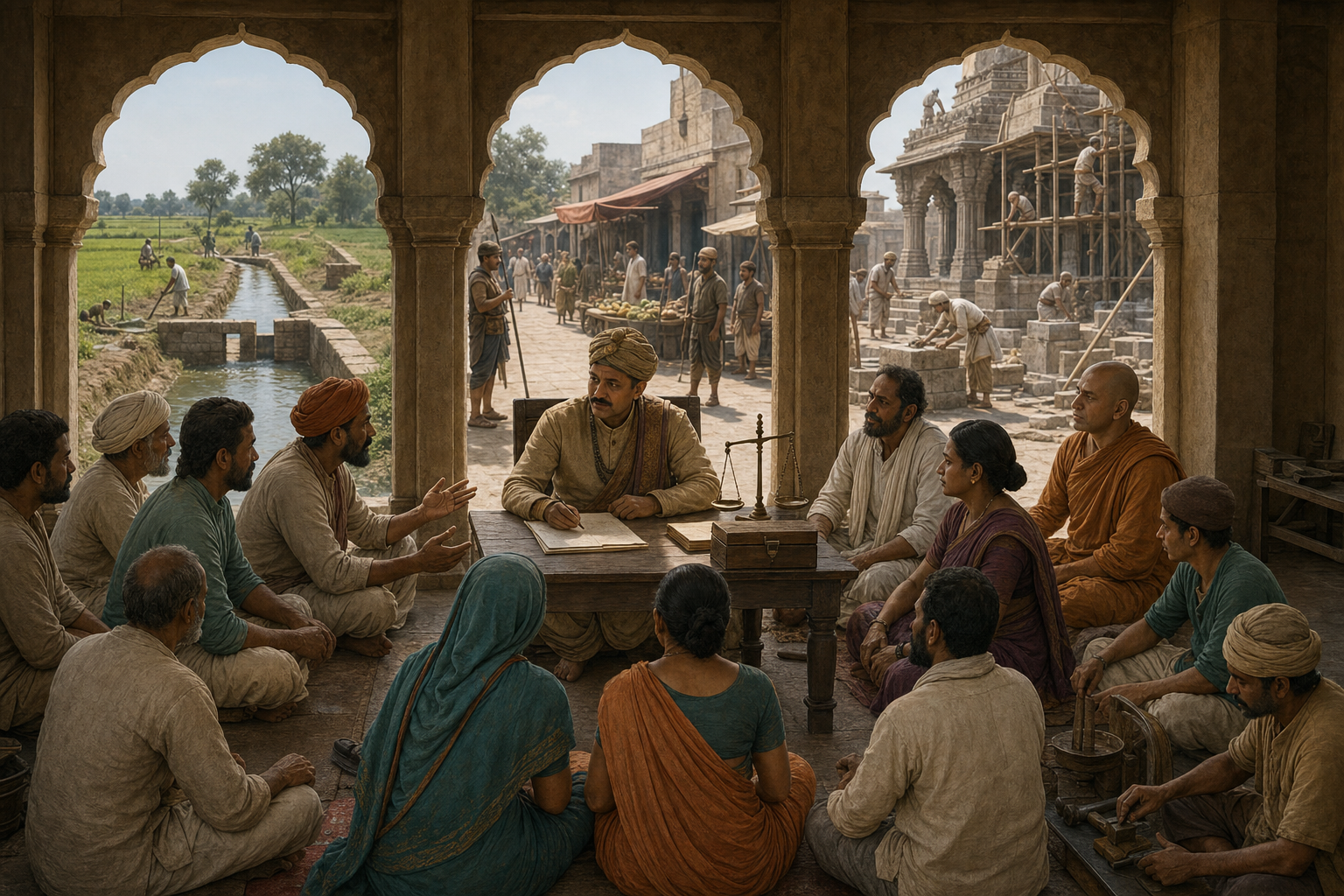
The Mahabharata’s Shanti Parva, Kautilya’s Arthasastra, and the Bhagavad Gita approach rule from different angles, but they do not treat office as personal property. Kshatra has ethical meaning when strength protects a just order. Lokasangraha gives that strength a public purpose. Karma Yoga then disciplines the officeholder: act from duty, not attachment to personal reward.
This gives you a harder standard than slogans, ritual display, or civilizational vocabulary. Cultural restoration can matter. A society should not have to erase its sacred inheritance to prove that it is fair. But symbolism cannot compensate for arbitrary justice, concealed finances, administrative decay, broken promises, or the abandonment of vulnerable people.
- Protection: Does the state reliably restrain predation, including predation by politically useful allies?
- Impartial justice: Do comparable acts receive comparable treatment, or does identity determine enforcement?
- Stewardship: Are taxes, public assets, and offices treated as trusts, or distributed as private rewards?
- Continuity: Are learning, sacred institutions, civic institutions, treaties, and public promises maintained beyond one leader’s convenience?
- Counsel: Can informed people deliver unwelcome advice without being treated as enemies?
The Sattva-Rajas-Tamas triad sharpens this audit. Sattva contributes clarity, wisdom, compassion, and self-restraint. Rajas supplies ambition, motion, and the will to act. Tamas appears as confusion, inertia, concealment, and decay. Government needs energy, so Rajas is not the enemy. The danger is Rajas without Sattva: rapid action driven by vanity, factional appetite, or the desire to dominate. Tamas presents the opposite failure, in which leaders invoke prudence while allowing disorder to deepen.
Do not label an entire leader sattvic or tamasic and stop thinking. Examine one decision at a time. A large programme announced without visible accounts may be ambition without sufficient restraint. Endless delay while the vulnerable face organized harm may be inertia disguised as tolerance. A forceful decision with a stated purpose, narrow scope, disclosed cost, independent review, and a clear stopping condition is more likely to channel Rajas through Sattva.
Rajadharma therefore places duty before loyalty. A ruler is a trustee, not a proprietor, and authority remains legitimate only while it serves the common good under accountable conditions. Supporting Dharmic political power does not require excusing an adharmic act committed by your own side. In fact, refusing that excuse is part of protecting Dharmic power from corruption.
Pluralism must be secured by design, not a ruler’s mood

Pluralism does not require you to believe that every claim is equally true or every practice equally beneficial. It requires humility about human knowledge, room for sincere difference, and a common order that prevents one path from destroying the freedom of all the others. It is principled plurality, not administrative indifference.
Several Dharmic traditions supply distinct checks against political absolutism. The Hindu recognition of Ishta makes spiritual diversity more than a reluctant concession. Jain Anekantavada warns that any single viewpoint is partial, while Ahimsa places a moral burden on coercion and cruelty. The Buddhist ideal of a Dhamma-raja makes restraint, welfare, and non-cruelty tests of rule. Sikh Miri-Piri joins temporal responsibility to spiritual discipline, while Sarbat da bhala directs strength toward the welfare of all.
These are not interchangeable doctrines or a single constitutional blueprint. Their useful political convergence is narrower: possession of truth, status, or force does not grant an unlimited right to rule other consciences. Protective strength is legitimate; subjugation is not. Diversity may operate inside a common Dharma, but no faction should receive a license to prey upon others in the name of diversity.
This is where institutional design matters. Pluralism that survives only because the current ruler is generous remains revocable. Durable pluralism gives communities lawful space while distributing enough authority to prevent any one centre from becoming the sole judge of its own conduct.
South Asian political life has included royal courts alongside sabhas, srenis, forest polities, and gana-sanghas. That record should not be romanticized as hierarchy-free, but it does show the practical value of polycentric authority embedded in customs, obligations, and community oversight. Modern equivalents can include capable local councils, professional bodies, monastic and scholastic institutions, independent courts, transparent fiscal systems, and civic organizations able to serve people without waiting for a central command.
When judging an institutional proposal, locate the checks. Who appoints the officeholder, and who can remove that person? Is the mandate permanent or time-bound? Can an affected citizen appeal? Are accounts visible outside the governing faction? Can local communities decide genuinely local matters? If all oversight ultimately returns to the same leader, ministry, or party, the system has multiplied offices without distributing power.
The standard should also be reciprocal. Ask whether you would accept the same legal power in the hands of a political rival. If not, narrow it before granting it to an ally. This single reversal test exposes many demands that sound righteous only because their supporters expect to control enforcement forever.
Coercion should climb a ladder instead of leaping to punishment

A state that cannot sanction wrongdoing is weak, but a state that reaches first for punishment trains itself in excess. The Arthasastra’s familiar instruments of Sama, Dana, Bheda, and Danda offer a graded way to think before acting:
- Sama – conciliation: clarify the dispute, correct misinformation, negotiate, and seek voluntary compliance.
- Dana – incentives: alter the costs and benefits so that cooperation becomes possible without compulsion.
- Bheda – differentiation: distinguish reconcilable participants from determined aggressors instead of treating an entire population as one hostile bloc.
- Danda – sanction: use lawful coercion within the narrowest band required to stop the harm and uphold order.
The ladder is a discipline of judgment, not a rigid timetable. An immediate threat may not permit prolonged conciliation. Even then, the burden of justification rises with the level of force. Officials should be able to identify the harm being prevented, explain why a less coercive measure is inadequate, limit who bears the sanction, provide review, and state how the exceptional measure ends.
Dharma-Yuddha is therefore not a decorative name for any conflict pursued by a preferred side. Righteous force is a last-resort means of protecting the vulnerable and restoring justice. Intention, necessity, proportionality, and restraint still matter. Ahimsa does not demand passivity before predation; it demands that avoidable violence never become a shortcut, spectacle, or source of political pleasure.
You can apply the same reasoning to speech restrictions, policing, economic penalties, emergency authority, and institutional discipline. Define the injury precisely. Separate criticism from material aggression. Choose the least coercive measure capable of stopping the injury. Publish the rule in advance where possible. Allow appeal. Review whether the measure is working. End it when its protective purpose has been met.
For Bharat’s external relations, ethical restraint need not mean strategic dependence. Multi-alignment without subservience, respect for sovereignty, capable defence, conflict de-escalation, and the expansion of shared goods form a more realistic Dharmic posture than either imperial imitation or naive pacifism. Vasudhaiva Kutumbakam changes the purpose for which strength is used; it does not require a nation to leave its family undefended.
Key takeaways: six questions before you lend support
Before endorsing a leader, law, campaign, or use of state force, ask these questions in order:
- What is being protected? Look for a concrete public good or vulnerable population, not merely the prestige of a leader or faction.
- Is the rule reciprocal? Would you accept the same power if a rival administered it against your community?
- Were less coercive means considered? Identify where conciliation, incentives, or narrower differentiation failed or proved inadequate.
- Who can verify the claim? Demand visible accounts, evidence, due process, and review outside the body exercising the power.
- Can lawful difference survive? People who reject the governing view should retain space to worship, teach, organize, serve, and disagree without becoming prey.
- How does the power end? Find the time limit, appeal, removal process, independent audit, or stopping condition before accepting exceptional authority.
Your responsibility does not stop at voting. Viveka helps you distinguish protection from factional flattery, while Svadhyaya exposes the fears and attachments that make manipulation effective. Seva, Dana, local deliberation, and support for competent community institutions reduce dependence on distant authority. The more capable civil society becomes, the more political power can operate as coordination rather than permanent command.
Use the six questions on the next political promise you encounter. Do not ask only whether its language sounds Dharmic. Ask whether its power would still behave dharmically when opposition, fear, ambition, and scarcity make restraint costly. Support strength that accepts this test, and withhold loyalty from power that demands exemption from it.
References
