
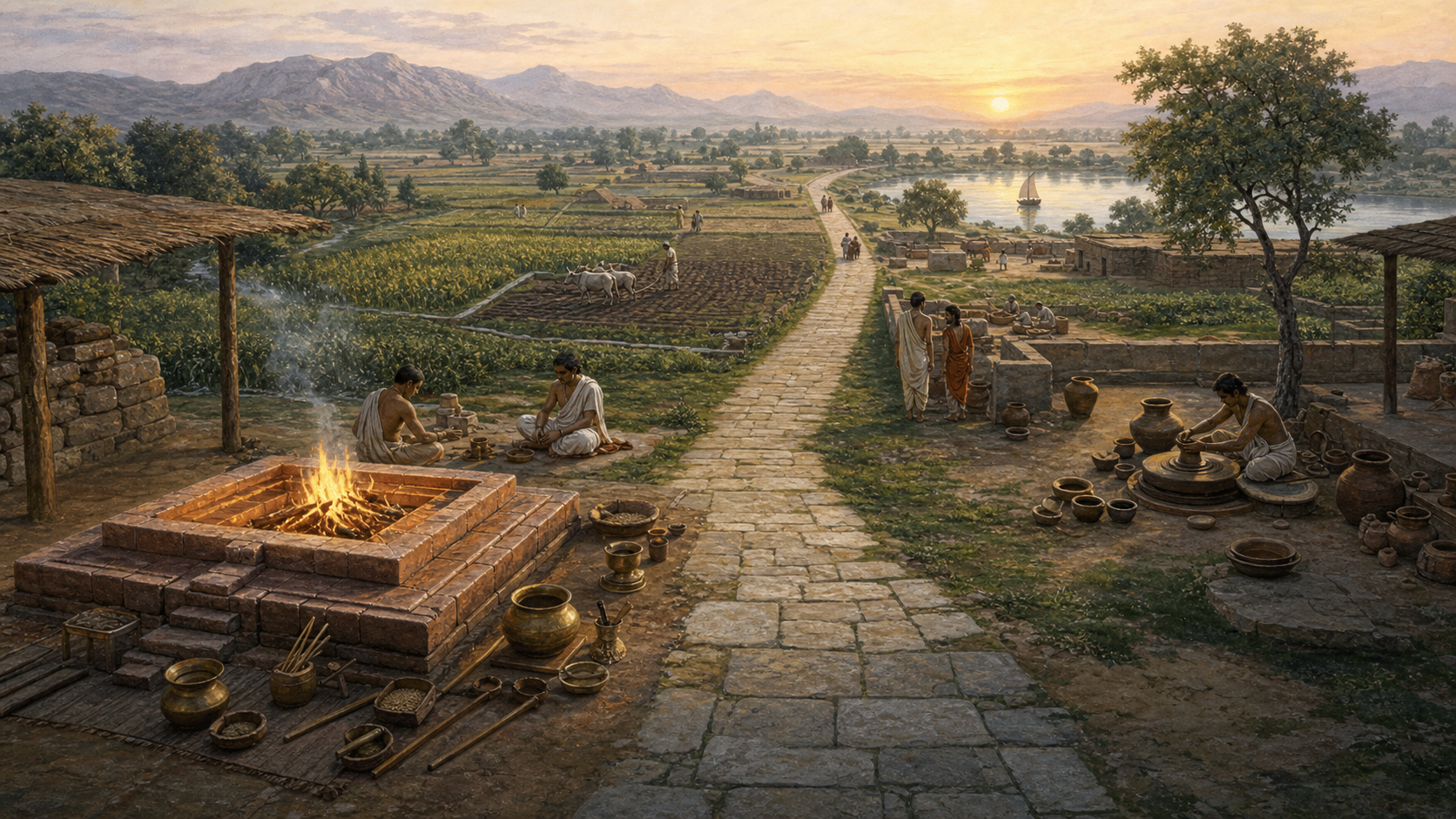
You may know that a practice is called dharmic and still be unsure what that claim means. Is the practice binding because the Veda enjoins it? Is it good because it produces welfare? Does intention matter more than exact performance? And why should an action count when its result cannot yet be seen?
Mimamsa and Vaisheshika help you separate these questions. Mimamsa tests the warrant and structure of an obligation. Vaisheshika places action within a world of substances, qualities, causes, consequences, and final release. Their vocabularies overlap at important points, but treating them as interchangeable hides what each can teach you.
The two schools answer different questions about dharma
Purva Mimamsa begins with a problem of knowledge: how can you know a duty whose dharmic status and distant fruit are not available to ordinary perception? Jaimini compresses its answer into the formula codana-lakshano artho dharmah: dharma is the purpose indicated by Vedic injunction.
The key word is injunction. A pleasant feeling, an admired custom, a good intention, or a favourable result does not by itself establish a Vedic obligation. Mimamsa asks whether an authoritative statement actually directs an action, forbids it, qualifies it, praises it, explains it, or merely repeats something already known. Dharma must be established before its fruit can be discussed.
Vaisheshika starts elsewhere. Attributed to Kanada, it defines dharma through two ends: abhyudaya, or flourishing, and nihshreyasa, the highest good. This definition refuses a false choice between responsible life in the world and the movement toward freedom. Conduct must be considered through both horizons.
This difference gives you a useful first rule. When the question is, “What makes this a duty?”, use the Mimamsa lens. When the question is, “What does this action set in motion, and toward what end?”, use the Vaisheshika lens. Neither question should be allowed to swallow the other.
Mimamsa requires you to establish the obligation before acting
Dharma and its remote efficacy cannot be seen in the way a flame or a ritual vessel can be seen. Mimamsa therefore gives sabda-pramana, authoritative testimony, a decisive role. The Veda is understood as apaurusheya, not the composition of a human author, and as possessing intrinsic validity. Its authority does not depend on recovering an author’s intention or proving the reliability of a historical speaker.
Smriti, sadachara or established conduct, and reasoning remain relevant, but they do not simply overrule Shruti. They must be interpreted within a hierarchy of authority. This matters whenever someone calls a family preference, regional custom, or recent innovation “Vedic.” The proper response is not immediate acceptance or rejection. Ask for the chain by which the obligation is being established.
Mimamsa supplies a disciplined vocabulary for that inquiry. A vidhi enjoins; a nishedha prohibits; an arthavada praises, explains, or gives context; an anuvada restates; and upapatti supplies reasoning. Atidesha extends an established feature from one context to another. Confusing these functions produces practical errors. Praise can be mistaken for a separate command, a restatement can be treated as a new duty, or an extension can be made without a valid basis.
Before accepting a claimed ritual duty, work through these questions:
- What kind of statement carries the claim: injunction, prohibition, explanation, praise, restatement, or reasoning?
- Is the act nitya, an enduring obligation; naimittika, required when a particular occasion arises; or kamya, undertaken for a desired result?
- What condition activates the duty, and what exactly must be performed?
- Is any feature being transferred through atidesha, or is a familiar statement merely being repeated through anuvada?
- What follows from performance, faulty performance, or omission?
The third classification is especially important. A kamya rite is optional in the sense that it depends on wanting its specified fruit. It does not cancel a nitya or naimittika responsibility. Conversely, omitting an obligatory rite generates pratyavaya, a demerit attached to the omission. Mimamsa therefore recognizes that inaction can have moral weight; avoiding a choice is not always morally neutral.
Prayashchitta, or expiation, completes the practical picture. A lapse need not be hidden behind vague remorse, nor is remorse alone automatically equivalent to correction. The relevant question is whether tradition prescribes a calibrated act of repair for that lapse. You should identify the failure accurately before choosing its remedy.
Apurva explains how a correctly performed prescribed act can bear fruit later. The rite produces an imperceptible potency connecting action with its promised phala. This does not make visible details unimportant. The entire point is that the prescribed act, performed as prescribed, generates the relevant potency. Invoking an unseen result cannot excuse careless execution.
This action-centred account does not require the Veda to have a divine author. The Bhatta and Prabhakara streams can uphold Vedic authority without making it depend on Ishvara as composer. That position should not be flattened into the claim that Mimamsa simply rejects deities. Deities retain places within ritual, while the authority of dharma is protected from dependence on a disputed theory of authorship.
Vaisheshika asks what action becomes in an ordered reality
Vaisheshika approaches dharma through an exact account of what exists. Its classical categories are dravya, substance; guna, quality; karma, motion or action; samanya, universal; vishesha, particularity; and samavaya, inherence. Abhava, absence, receives recognition in later development. These are not decorative classifications. They train you to distinguish an entity from its qualities, an action from its agent, and a present condition from the causal process that produced it.
That precision matters in ethical judgment. “This is good” often hides several claims: an action occurred, certain qualities were present, an immediate outcome followed, a durable disposition may have formed, and a moral consequence may mature later. Vaisheshika encourages you to separate those claims instead of treating one visible result as the whole truth.
Early Vaisheshika gives primary importance to pratyaksha, perception, and anumana, inference. In the later Nyaya-Vaisheshika synthesis, authoritative testimony receives more explicit treatment for realities beyond the reach of the senses. The method is layered: observe what is perceptible, infer only where the relation warrants inference, and receive testimony where the subject cannot be established by either alone.
Adrishta names the unseen moral momentum through which merit and demerit continue toward their results. It addresses the delay between an act and a consequence that may not be immediately visible. Apurva and adrishta therefore solve related problems, but they should not be collapsed into one term. Apurva belongs to Mimamsa’s account of the efficacy generated by prescribed ritual action; adrishta operates more broadly in Vaisheshika’s explanation of moral causality and cosmic order.
You can apply the Vaisheshika discipline in three passes. First, describe the action and its observable qualities without rushing to a moral label. Second, trace the consequences that perception and careful inference actually support. Third, remember that an unseen residue may remain even when no immediate reward or penalty appears. The third pass is a limit on superficial judgment, not permission for speculation.
That limit has an ethical consequence: you cannot inspect another person’s present fortune or suffering and confidently reconstruct an invisible moral history. Adrishta is imperceptible by definition. It preserves the intelligibility of delayed consequence; it does not license victim-blaming, fatalism, or claims of secret knowledge.
Vaisheshika also prevents dharma from shrinking into a technique for obtaining favourable circumstances. Abhyudaya matters, but it is paired with nihshreyasa. The highest good is expressed as apavarga, release associated with the ending of suffering through the termination of karmic bondage and erroneous cognition. Clear knowledge of reality and action aligned with dharma belong to the same movement toward freedom.
Use both lenses without forcing them into one system
Mimamsa and Vaisheshika can cooperate without losing their differences. Mimamsa is strongest when you need to determine whether a Vedic obligation exists and how it is structured. Vaisheshika is strongest when you need to analyse action, qualities, causation, moral residue, and the ends of human life. One supplies a grammar of obligation; the other supplies an ontology of consequence.
For any practice you are examining, move through this sequence:
- Establish the warrant. Identify whether the claim rests on Shruti, Smriti, sadachara, reasoning, or personal preference, and do not silently promote a lower claim into a Vedic command.
- Classify the act. Decide whether it is obligatory, occasion-dependent, desire-driven, prohibited, or expiatory.
- Specify the performance. State what must be done, what condition triggers it, and which details belong to the prescription.
- Examine causality. Separate visible effects from reasonably inferred effects and from unseen potency or moral momentum.
- Test the direction. Ask whether the practice serves only a desired outcome, supports genuine flourishing, or also orients life toward the highest good.
This sequence corrects three common mistakes. Visible success does not by itself prove that an action was dharmic. Sincere intention does not automatically satisfy a precisely specified injunction. Belief in an unseen fruit does not relieve you of the obligation to interpret carefully and act correctly.
The same discipline helps in conversations across the Dharmic family. Buddhist accounts of conditioned arising and karmic fruition, Jain disciplines of vows and karmic purification, and Sikh practices such as kirat karni, nam simran, and seva all affirm that repeated conduct matters beyond a passing mood. Yet conceptual kinship is not doctrinal identity. Compare the function a concept performs before declaring two technical terms equivalent.
You can also carry the method into ordinary life without pretending that every modern decision is directly named in a Vedic injunction. Distinguish inherited obligation from communal custom and voluntary discipline. Then examine what your repeated action builds: reliability or negligence, clarity or confusion, restraint or compulsion. This is a responsible application of the schools’ habits of thought, not a claim that private preference has acquired scriptural authority.
Key takeaways
- Mimamsa identifies dharma through Vedic injunction and disciplined interpretation, not through sentiment or visible success alone.
- Nitya and naimittika obligations differ from kamya rites; desired results do not displace duties, and omission can produce pratyavaya.
- Apurva connects prescribed ritual performance with a later fruit, while Vaisheshika’s adrishta describes a broader unseen moral momentum.
- Vaisheshika joins worldly flourishing to the highest good and places ethical action within a precise account of reality and causation.
- Use perception, inference, and testimony within their proper domains; do not turn an imperceptible causal principle into a claim that you know why another person suffers.
- Apply the schools in sequence: establish the obligation, specify the action, trace its consequences, and ask which human end it serves.
Choose one recurring practice before its next performance. Write down its claimed authority, classify the act, identify its exact requirements, and distinguish its visible effects from its promised unseen fruit. If you cannot establish the first two clearly, call it a custom or personal discipline until you can. That small act of precision is already faithful to what both schools demand: do not speak vaguely about dharma when careful inquiry is possible.

References
