

If you have seen claims that a nurse disposed of small Hindu murtis near a shoe stand in a Nerul healthcare facility, two questions need to be kept separate. What actually happened? And, if the alleged act occurred, does the evidence show the deliberate religious insult required for a criminal offence?
You do not have to choose between defending the sanctity of Hindu symbols and defending due process. A serious response does both: preserve the evidence, insist on an impartial investigation, prevent further disrespect, and refuse to turn an allegation into a verdict.
An FIR opens the inquiry; it does not settle the facts
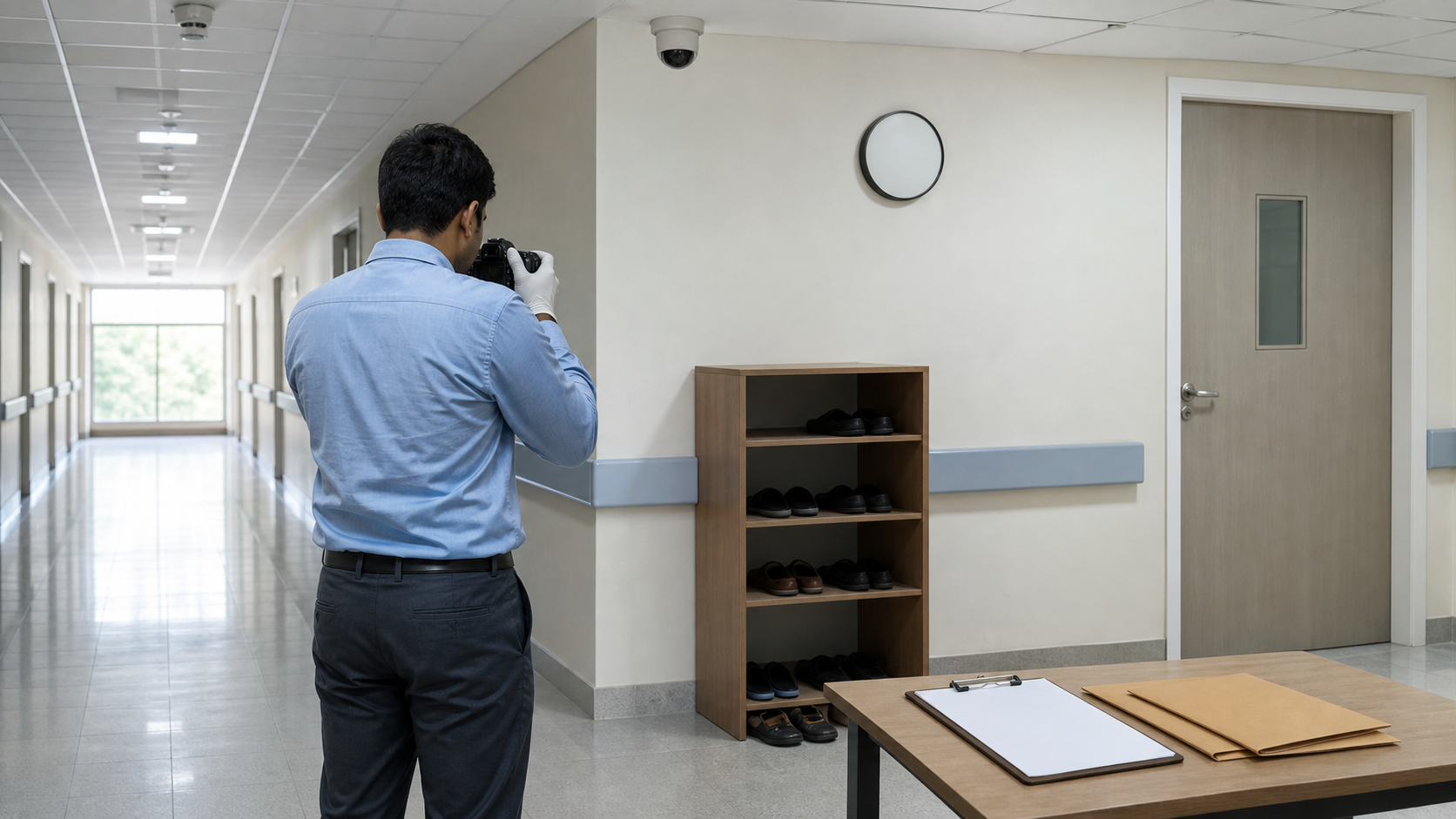
The publicly described position is limited but consequential: an FIR has reportedly been registered and the Nerul allegation remains under investigation. That means the police have a formal basis to examine the complaint. It does not mean that motive, criminal intent or guilt has been established.
An FIR is neither a conviction nor meaningless paperwork. It begins a process in which police may record witness statements, preserve and examine the objects involved, review CCTV footage, check workplace rules and reconstruct what happened before and after the alleged act. Each of those steps matters because a photograph of an object beside footwear may show its final position without showing who put it there, why it was moved or what was said at the time.
When you assess an update about the case, look for the difference between an observation and an inference. “The murtis were found near the shoe stand” describes an observable condition. “They were placed there to insult Hindus” is a conclusion about intent. The second claim may eventually be supported, but it needs additional evidence.
- Check whether the information comes from an identified witness, an official statement or an unattributed social-media message.
- Ask whether any video shows the complete sequence rather than only the objects after they were discovered.
- Distinguish words heard directly from words repeated by another person.
- Check whether the facility had a written rule for unattended personal or devotional items.
- Look for evidence that the rule was applied consistently to all staff and all religious traditions.
- Notice whether claims about motive are supported by conduct, words, prior incidents or selective treatment.
Do not circulate a person’s name, photograph, phone number or workplace details merely because that person has been accused. Doxxing can expose an untried person to harassment, interfere with witness accounts and turn a workplace dispute into a communal confrontation. If evidence exists, preserve it for investigators rather than editing it into a viral clip.
Religious hurt is real; criminal intent is a separate question

For a practising Hindu, a murti is not interchangeable with an ornament. It may be a focus of worship, divine presence, remembrance and strength. This is especially significant in a hospital, where patients and staff live with anxiety, pain and uncertainty. Placing a sacred representation near footwear is therefore widely understood as degrading, even when an outsider does not grasp the depth of the injury.
Recognising that injury does not require us to assume a criminal motive before the evidence is tested. The law asks a narrower question than public anger often does: was the act accompanied by the kind of intention required by the particular offence?
Public discussion of religious-offence cases commonly invokes IPC Sections 295, 295A and 298, and sometimes Section 153A. They are not interchangeable labels:
- Section 295 concerns injury or defilement connected with a place of worship and an intention to insult a religion.
- Section 295A addresses deliberate and malicious acts intended to outrage the religious feelings of a class of citizens.
- Section 298 concerns words or gestures made with deliberate intent to wound religious feelings.
- Section 153A may arise in narrower circumstances involving the promotion of enmity between groups.
The repeated words “intent,” “deliberate” and “malicious” do real legal work. Insensitivity, negligence, a badly executed housekeeping decision and deliberate desecration can all cause hurt, but they are not the same legal event. Carelessness may justify an apology, disciplinary action, retraining or a change in hospital procedure without necessarily meeting the high threshold associated with a malicious religious offence.
The reverse warning also matters. A facility cannot make the allegation disappear merely by calling the act “housekeeping.” Investigators should test that explanation. Was there a known storage rule? Were staff told about it? Were other personal or religious objects handled in the same way? Was a respectful storage option available? Did the person make any relevant statement? A neutral explanation gains credibility when it is supported by a consistent practice, not when it is supplied after public criticism.
Intent does not always arrive as a confession. It may be inferred from the complete sequence, including words, repetition, knowledge, selective conduct and attempts to conceal what happened. But inference must be tied to evidence. Anger at the result cannot substitute for proof of the mental element.
Do not copy a section number from a social-media message and present it as individual legal advice. The governing provision must be matched to the date, alleged conduct and precise wording of the complaint. If you are the complainant, the accused person or a responsible officer of the facility, ask a qualified Indian criminal-law advocate to review the actual FIR and current statutory framework.
If you are reporting the incident, build a factual record

A complaint becomes stronger when it separates what you personally observed from what you believe the act means. That does not dilute the religious injury. It gives investigators material they can verify and makes it harder for a genuine grievance to be dismissed as rumour.
- Write a contemporaneous account. Record where the murtis were first seen, their position, who was present and the exact words you personally heard. Label second-hand information as second-hand.
- Preserve original files. Keep unedited photographs and videos with their original filenames and metadata. Do not rely on forwarded, cropped or captioned copies.
- Request preservation of CCTV footage and relevant access records in writing. Routine system processes may remove older material, so the preservation request should not wait for an online debate to end.
- Identify witnesses without coaching them. Ask each person to record an independent account rather than producing a shared statement that blurs who saw what.
- Ask for respectful custody of the objects. The handling record should identify who found them, who moved them, when they were moved, why movement was necessary and where they were stored. The objects should not be cleaned, altered or repeatedly displayed for photographs.
- Submit a precise written complaint. Use neutral action words, attach copies of evidence and request an acknowledgement. State why the placement is religiously injurious, but do not fill evidentiary gaps with claims you cannot support.
- Keep patient care and public safety in view. Do not summon a crowd into a working hospital or pressure patients and junior staff to take sides. Use the police, the facility’s grievance channel and lawful community representation.
If you are accused, do not delete messages, edit recordings, contact witnesses to align accounts or publish a detailed defence before obtaining legal advice. Preserve the relevant material and identify any written workplace policy that governed the handling of unattended objects. Destruction or alteration of records can create a separate and avoidable evidentiary problem.
Community representatives can help by appointing a small number of responsible interlocutors. Their written requests should be concrete: preservation of evidence, respectful custody of the murtis, an update through lawful channels and disclosure of the facility’s relevant policy. A demand for a fair investigation is more durable than a demand that police announce a predetermined conclusion.
Hospitals need a content-neutral handling rule

Healthcare facilities have legitimate concerns about hygiene, infection control, medication areas, emergency access and uncluttered workspaces. Those concerns can coexist with respect for sacred objects. The practical failure occurs when staff are told to “clear the area” but receive no rule for identifying, documenting and respectfully relocating devotional items.
A workable policy should define the process before a dispute occurs:
- Specify where personal devotional objects may be kept, including staff lockers, desks, clinical zones and any designated reflection area.
- Give reasonable notice of restricted areas and explain the hygiene or safety reason for the restriction.
- Authorise designated staff, rather than any passer-by, to relocate an unattended item.
- Require a simple handling log recording the item, original location, reason for movement, time, staff member, witness and secure destination.
- Use clean, respectful temporary storage and notify the apparent owner or relevant department.
- Apply the same location and safety rules to all religious and non-religious personal belongings while recognising that sacred objects require careful handling.
- Provide an accessible grievance contact and a documented response, rather than forcing staff to seek an audience on social media.
- Train clinical, housekeeping, security and administrative personnel together, because any of them may be the first person asked to move an object.
Content-neutral does not mean treating a murti as rubbish. It means that the decision to clear a clinical surface is based on the use of the space, while the method of removal preserves dignity. A documented procedure also protects staff from an unfounded accusation by showing that an item was moved for a defined operational reason and placed in secure custody.
If the verified facts show disrespectful handling but leave criminal malice uncertain, restorative measures may help repair the injury. Possible steps include respectful re-placement, an unforced apology, mediation and a prayaschitta or shuddhi observance led by willing Hindu practitioners where appropriate. No person should be coerced into a religious ritual, and a ritual should not be used to suppress a lawful complaint.
Where evidence supports deliberate targeting, restorative dialogue should not be presented as a substitute for investigation. Where evidence instead shows carelessness, an institution should not hide behind the absence of a criminal offence. Administrative accountability, training and a written handling procedure can still be necessary.
Key takeaways
- The reported FIR begins an investigation; it does not establish the nurse’s motive or guilt.
- The placement of Hindu murtis near footwear can cause a serious religious injury, but the legal question still turns on the elements of the specific offence.
- For provisions centred on deliberate or malicious conduct, an offensive result alone does not ordinarily prove the required intent.
- Original video, independent witness accounts, workplace rules and a documented handling history are more useful than viral captions.
- Complainants, accused persons and hospital officials should preserve evidence and obtain case-specific legal advice before making detailed public claims.
- A clear, consistently applied hospital protocol can protect sacred objects, clinical safety, staff fairness and communal peace at the same time.
If you are directly involved, make three requests in writing: preserve the CCTV, retain the murtis with a handling log, and provide the relevant complaint acknowledgement and hospital policy. Then let verified evidence determine the legal conclusion. Satya requires accuracy, ahimsa requires restraint, and accountability requires that neither be used as an excuse for inaction.
References
