
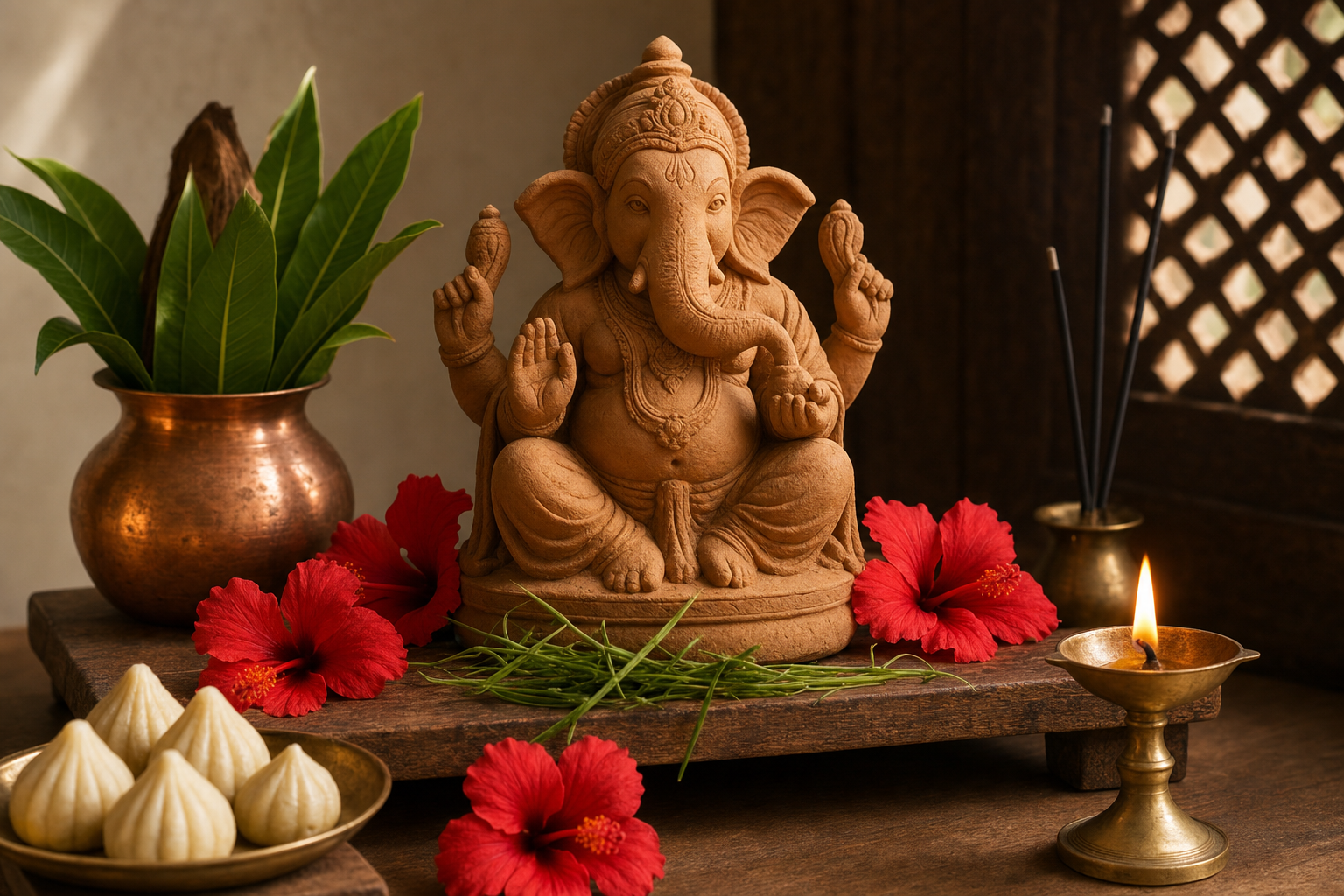
If you are trying to decide whether Thursday, June 18, 2026 should be observed as Vinayaka Chaturthi, the practical answer is yes. The date begins in Shukla Paksha Tritiya, but Tritiya lasts only until 01:40, after which Shukla Paksha Chaturthi prevails. For the location underlying that calculation, the ordinary waking day therefore belongs to Chaturthi.
Your puja plan should begin with that tithi transition, not with a generic midnight-to-midnight calendar. The exact clock times for Rahu Kaal, Abhijit Muhurat, Choghadiya, nakshatra transitions, and other Panchang factors still depend on your location. Use the 01:40 transition as the working reference for this date, then confirm it against a Panchang calculated for your city before fixing a minute-specific schedule.
Why June 18 is treated as Shukla Chaturthi
A civil date changes at midnight. A tithi does not. It changes when the angular distance between the Moon and Sun crosses the next twelve-degree interval. This is why one civil date can contain portions of two tithis, and why the tithi at 00:00 need not govern the rituals performed after sunrise.
On June 18, Tritiya ends at 01:40 and the fourth waxing lunar day begins. Shukla Paksha means the waxing half of the lunar cycle; Chaturthi is its fourth tithi. Because the transition occurs soon after midnight, the principal puja, vrata, japa, and household observance can be organized around Chaturthi for the rest of the day. You do not need to treat June 18 as a divided ritual day merely because Tritiya occupies its first hour and forty minutes.
This is the recurring Vinayaka Chaturthi observance centered on Shri Ganesha. It does not have to imitate the scale of the annual public Ganesh festival. A focused household puja, a clear sankalpa, mantra-japa, and the sharing of prasada are entirely suited to the monthly tithi.
The weekday adds another useful emphasis. June 18 falls on Thursday, or Guruvara, a day associated with Brihaspati and traditionally favored for study, teaching, satsanga, and dana connected with learning or spiritual guidance. The conjunction of Guruvara and Shukla Chaturthi makes the day especially coherent for beginning a course of study, returning to neglected scripture reading, addressing an educational obstacle, or seeking greater discipline before an examination or demanding intellectual project.
The practical order is simple: establish that Chaturthi is active, follow the vrata rule of your sampradaya, and only then use local muhurta information to refine the clock time. Reversing that order can lead you to select an attractive generic muhurta while overlooking the ritual tithi that gives the observance its meaning.
A practical Vinayaka Chaturthi puja you can perform at home
Shri Ganesha is invoked as Vighna-vinashaka, the remover of obstacles, and as the guardian of clarity, learning, and sound beginnings. Your sankalpa should reflect that purpose. Name the duty, confusion, habit, course of study, or new responsibility for which you seek steadiness. A specific sankalpa keeps the worship connected to conduct after the lamp is extinguished.
A simple household sequence
- Confirm that Chaturthi is prevailing at your chosen puja time in a Panchang set to your city.
- Clean the puja space and place a murti or image of Shri Ganesha where the household can sit without interruption.
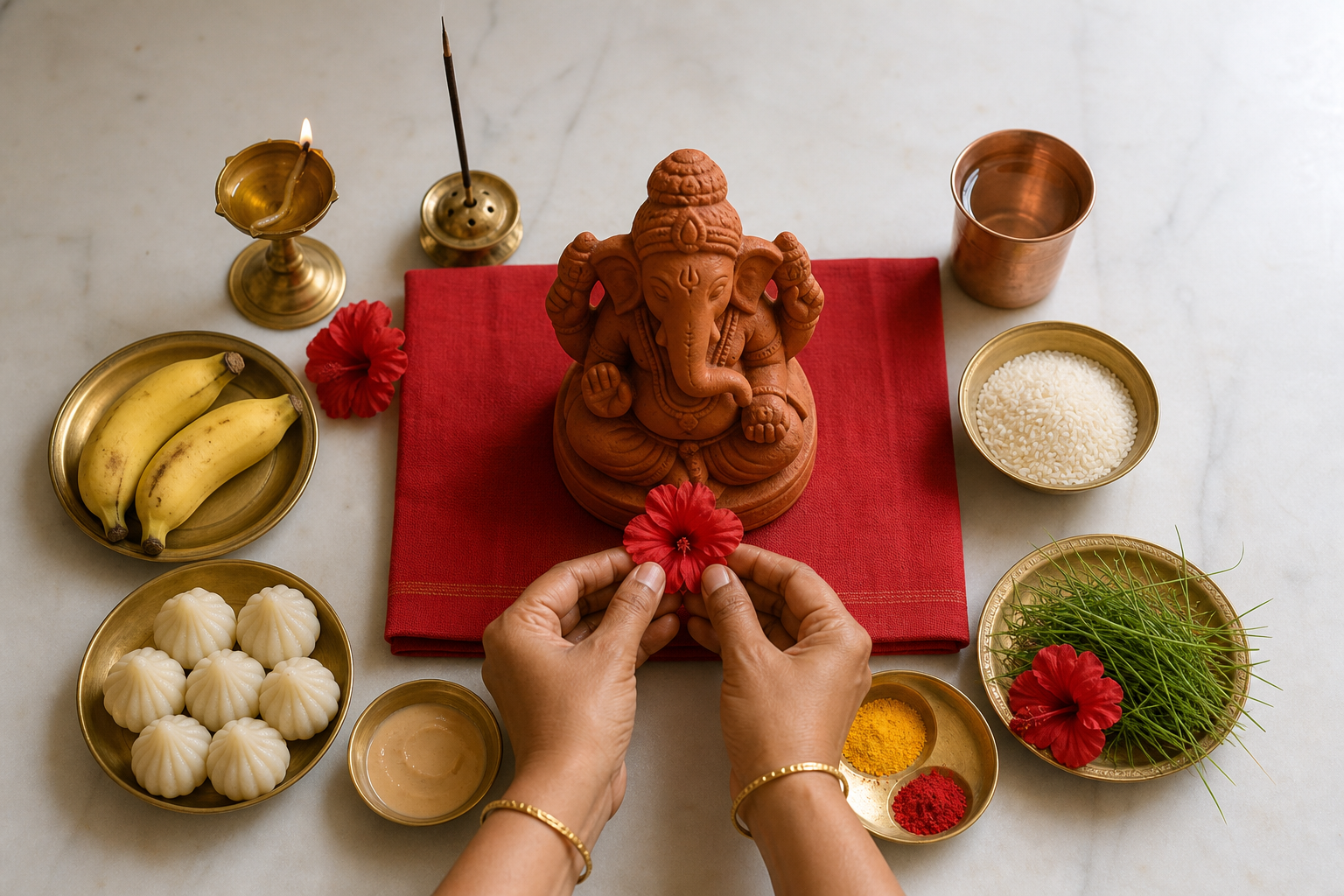
- Arrange the offerings before beginning. Durva grass, red flowers, and modaka are traditional choices for this observance. Use what your family tradition permits rather than delaying worship in pursuit of an elaborate arrangement.
- Take your sankalpa. State the date, the Chaturthi observance, and the purpose of the vrata or puja in the form taught in your household or temple tradition.
- Invoke Shri Ganesha and make the offerings with attention. If your sampradaya has a prescribed puja paddhati, that procedure takes precedence over a simplified household sequence.
- Recite Om Gam Ganapataye Namah with a steady count you can complete attentively. The point is disciplined repetition, not choosing an impressive count that forces you to rush.
- Recite the Ganesha Atharvashirsha or a familiar Ganapati stotra. If time is limited, choose one text and complete it with concentration rather than assembling many incomplete recitations.
- Sit quietly after the recitation, offer the result of the practice, and distribute the modaka or other prepared offering as prasada.
Children can participate without turning the puja into a performance. Give them one clear responsibility: arranging the flowers, offering durva, joining a short mantra recitation, or distributing prasada. This lets them associate Chaturthi with an intelligible family practice rather than with instructions they only watch adults perform.
Plan the vrata before the morning begins
Vinayaka Chaturthi vrata commonly includes a daytime upavasa followed by puja while Chaturthi is active. The detailed rules are not identical in every region or lineage. Some almanac traditions give particular weight to Chaturthi at sunrise, while others emphasize its presence during madhyahna. Follow the rule already used by your family, guru, or temple rather than creating a stricter personal rule on the morning of the vrata.
Decide in advance whether you are undertaking the established fast, a permitted modified observance, or a puja-and-japa discipline without food restriction. If fasting is unsuitable for your health or circumstances, do not turn physical severity into the measure of devotion. Use the form allowed by your tradition and keep the sankalpa, worship, self-restraint, and remembrance of Ganesha at the center.
A workday does not make the observance impractical. You can make the sankalpa and perform a brief mantra practice in the morning, then hold the principal puja in the Chaturthi period selected by your local Panchang and sampradaya. If your tradition specifically requires the main worship around madhyahna, arrange the workday around that requirement instead of assuming that any evening hour is equivalent.
How to choose the puja time without false precision
There is no responsible all-city answer for the exact Abhijit Muhurat or Rahu Kaal on June 18. Both are derived from local sunrise, sunset, and solar noon. A timetable copied from another city can shift the relevant interval enough to defeat the purpose of minute-specific planning.
Use this hierarchy when you open your local Panchang:
- Confirm the Chaturthi tithi and its local end time. The ritual must first belong to the correct lunar interval.
- Apply the selection rule of your sampradaya, especially if it requires Chaturthi at sunrise or during madhyahna.
- Check the city and time-zone settings. Do not assume that a calendar displaying Indian festival names is automatically calculated for your location.
- Use Abhijit Muhurat, Choghadiya, and the avoidance periods as secondary filters after the tithi and tradition-specific rule have been settled.
Abhijit Muhurat is centered on local solar noon and is often used for success-oriented undertakings when a specially calculated muhurta is unavailable. Local solar noon is not automatically 12:00 on the wall clock. Your longitude, time zone, and the season all matter, so use the interval printed by a reliable local Panchang rather than substituting ordinary noon.
Rahu Kaal, Yamaganda, and Gulika are traditionally avoided when beginning a new undertaking. Thursday’s Rahu Kaal generally falls in the afternoon, but it should not be assigned a universal clock range. The daytime from sunrise to sunset is divided into eight equal portions, which means the result changes with location and daylight length.
For a short practical task, local Choghadiya can provide another layer of selection. Laabh, Amrit, and Shubh periods are generally preferred; Rog and Kaal are avoided for commencements. This is useful if you intend to submit an application, begin a course, open a new ledger, or take another discrete step under Ganesha’s auspices.
Do not let these secondary filters become a reason to miss the vrata itself. The Chaturthi tithi establishes the observance. Rahu Kaal and similar periods are most relevant to new commencements, while a prescribed puja belongs first to its ritual date. If two rules appear to conflict, follow your sampradaya or ask the temple whose calendar you ordinarily use.
It also helps to separate worship from the secular beginning it supports. You might perform Ganesha-puja at the period prescribed for the vrata and choose Abhijit or a favorable Choghadiya later for the first formal act of a new project. Combining them is convenient when the timings align, but it is not necessary to pretend they are the same calculation.
What the other Panchang fields can and cannot tell you
A Panchang is not only a festival list. Its five limbs describe different dimensions of the day, and each answers a different planning question:
- Tithi identifies the lunar day. It is the first field to check for a vrata such as Vinayaka Chaturthi.
- Vara identifies the weekday. Here it is Guruvara, supporting the day’s emphasis on learning, guidance, and dana.
- Nakshatra records the Moon’s position among twenty-seven stellar divisions of 13 degrees and 20 minutes each. It helps refine action-specific muhurta decisions.
- Yoga is derived from the combined longitudes of the Sun and Moon and mapped into twenty-seven divisions.
- Karana is half of a tithi and provides a finer subdivision for evaluating the character of a proposed action.
Rashi, although not one of the five limbs named by the word Panchang, is commonly displayed alongside them. It places the Moon in one of twelve thirty-degree sidereal signs. An exact nakshatra, rashi, yoga, or karana transition printed in clock time should be read for the stated location, not transplanted without checking.
Many contemporary Panchangs use the sidereal framework with Lahiri, or Chitrapaksha, ayanamsha. If two calendars disagree, compare their location, time zone, ayanamsha, sunrise convention, and displayed transition times before concluding that one of them has simply mislabeled the day.
The lunar month name can also vary without changing the underlying tithi. June 18 may be placed in late Jyeshtha or early Ashadha according to the regional calendar convention. Purnimanta reckoning, common in much of North India, organizes the month from full moon to full moon; Amanta reckoning, common in Western and Southern India, organizes it from new moon to new moon. If your family calendar and a temple calendar use different month labels but agree on Shukla Chaturthi, the difference may be conventional rather than astronomical.
When sharing the observance with relatives in another region, send three pieces of information: the civil date, the tithi, and the city-specific puja time. Sending only the lunar month name creates avoidable confusion across Amanta and Purnimanta households.
The wider Dharmic world also keeps distinct forms of lunar discipline. Buddhist Uposatha observances follow new-moon, full-moon, and quarter-lunar rhythms; Jaina vrata and pratikraman are organized around particular tithis; and Sikh community life may acknowledge Puranmashi and Masya even though the Nanakshahi calendar is solar. These observances are not interchangeable. The useful common principle is to publish the actual civil date and local time when coordinating a shared gathering rather than assuming that every community uses the same calendar label.
Key takeaways for June 18, 2026
- June 18 begins with Shukla Tritiya, which ends at 01:40; Shukla Chaturthi then governs the remainder of the date in the calendar used for this timing.
- Treat the day as the monthly Vinayaka Chaturthi observance, with the principal puja placed inside the locally confirmed Chaturthi interval.
- Keep the home practice focused: sankalpa, durva and red flowers where available, modaka, Ganesha mantra-japa, a Ganapati stotra or Ganesha Atharvashirsha, and prasada.
- Follow your sampradaya’s rule concerning sunrise or madhyahna before using generic auspicious periods to refine the time.
- Use a city-specific Panchang for Abhijit Muhurat, Rahu Kaal, Yamaganda, Gulika, Choghadiya, and all minute-level transitions.
- Do not mistake late Jyeshtha and early Ashadha labels for different tithis until you have checked whether the calendars use Amanta or Purnimanta reckoning.
On June 17, check your Panchang’s city setting, note the local Chaturthi and puja window, prepare the offerings, and write down your sankalpa. That small preparation will let June 18 begin with worship instead of a hurried search for timings.
References
