
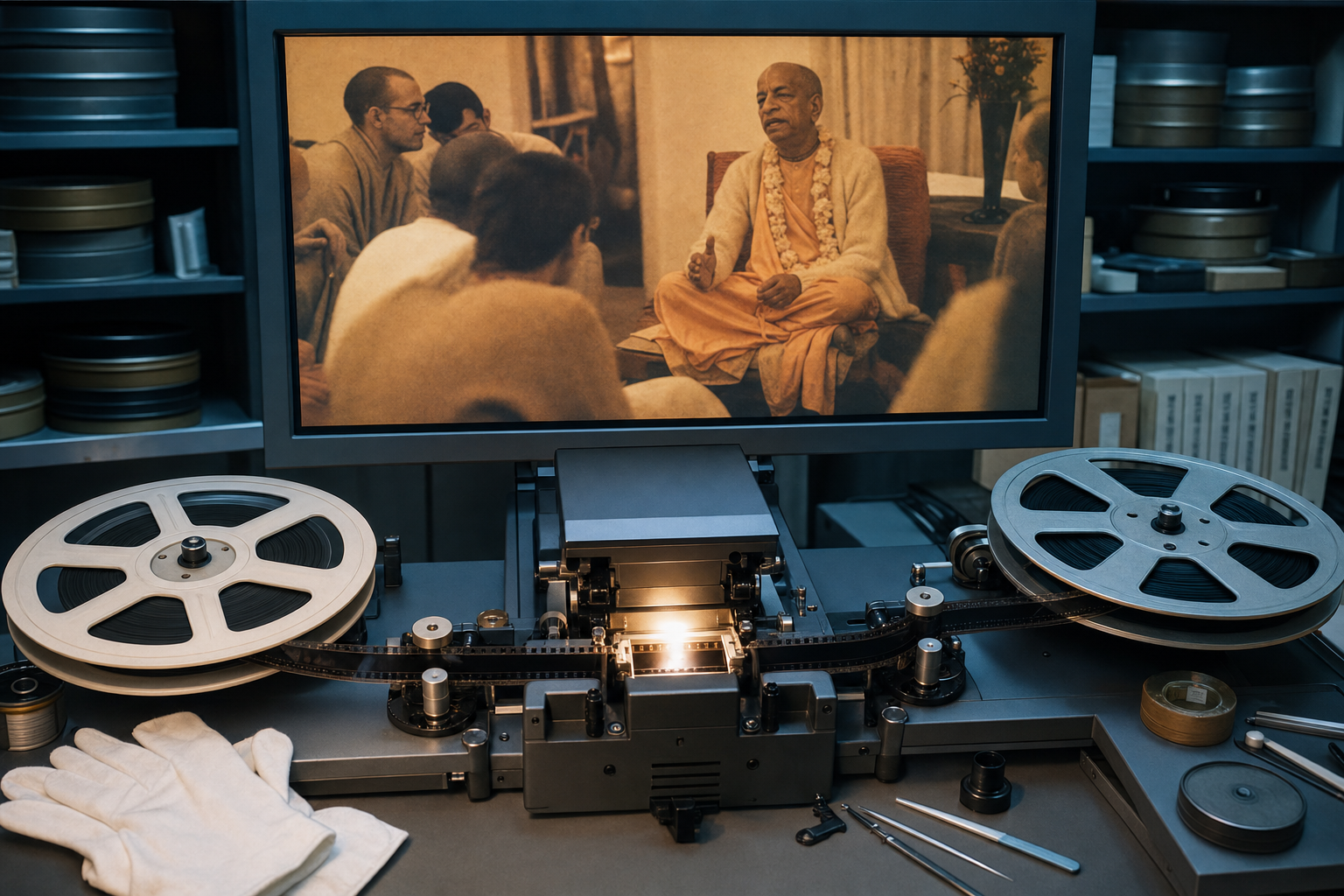
If you came looking for an old Srila Prabhupada film, you may want more than a sharper video. You may need to know whether the image is complete, whether the sound belongs to that reel, whether the colors are credible, and whether a scene can be trusted as historical evidence.
The 4K preservation of all known motion-picture recordings of Srila Prabhupada and early ISKCON made between 1965 and 1977 addresses those questions at the level of the surviving film elements. Understanding that distinction will help you watch, cite, screen, teach, or safeguard this material responsibly.
What the archive actually preserves
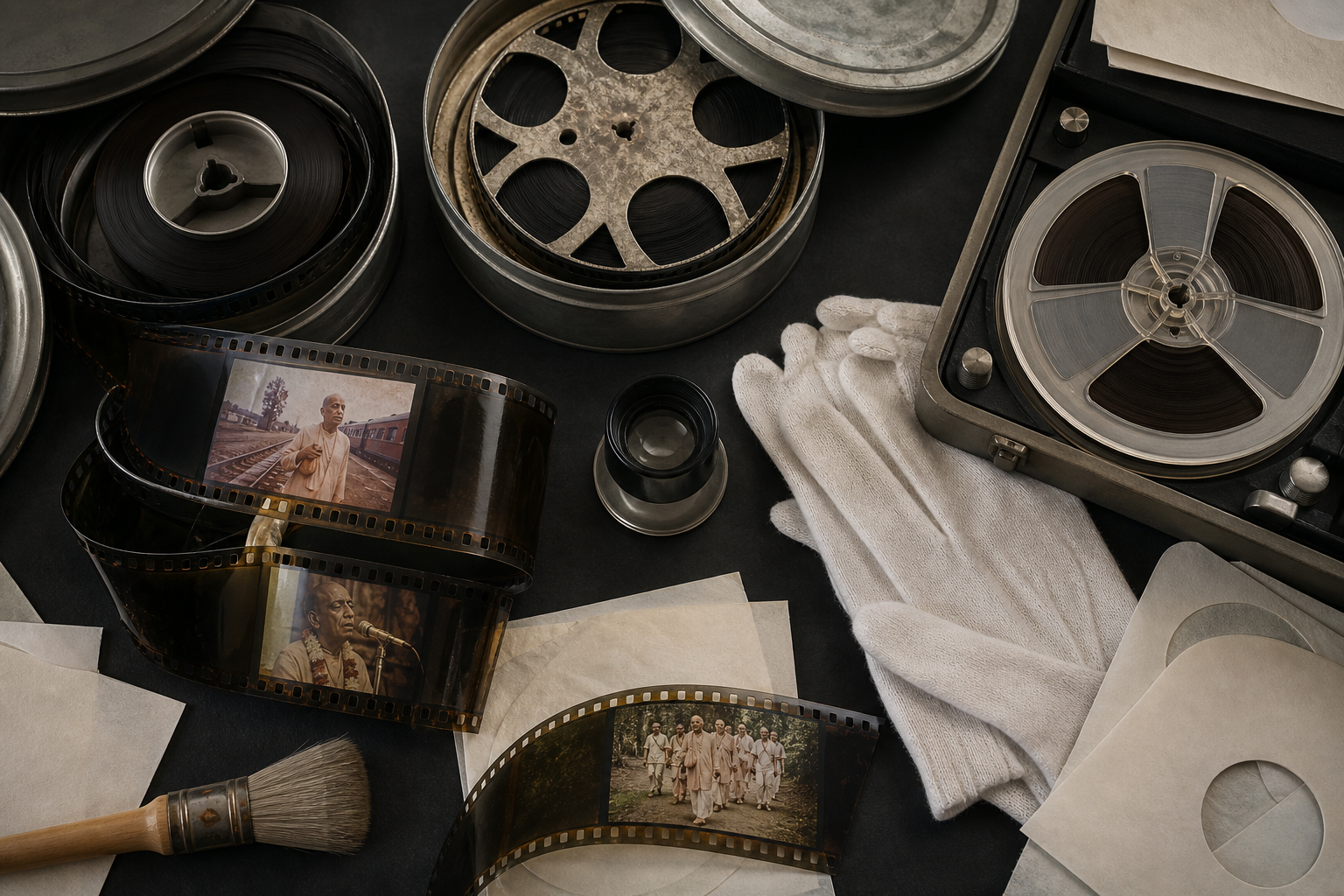
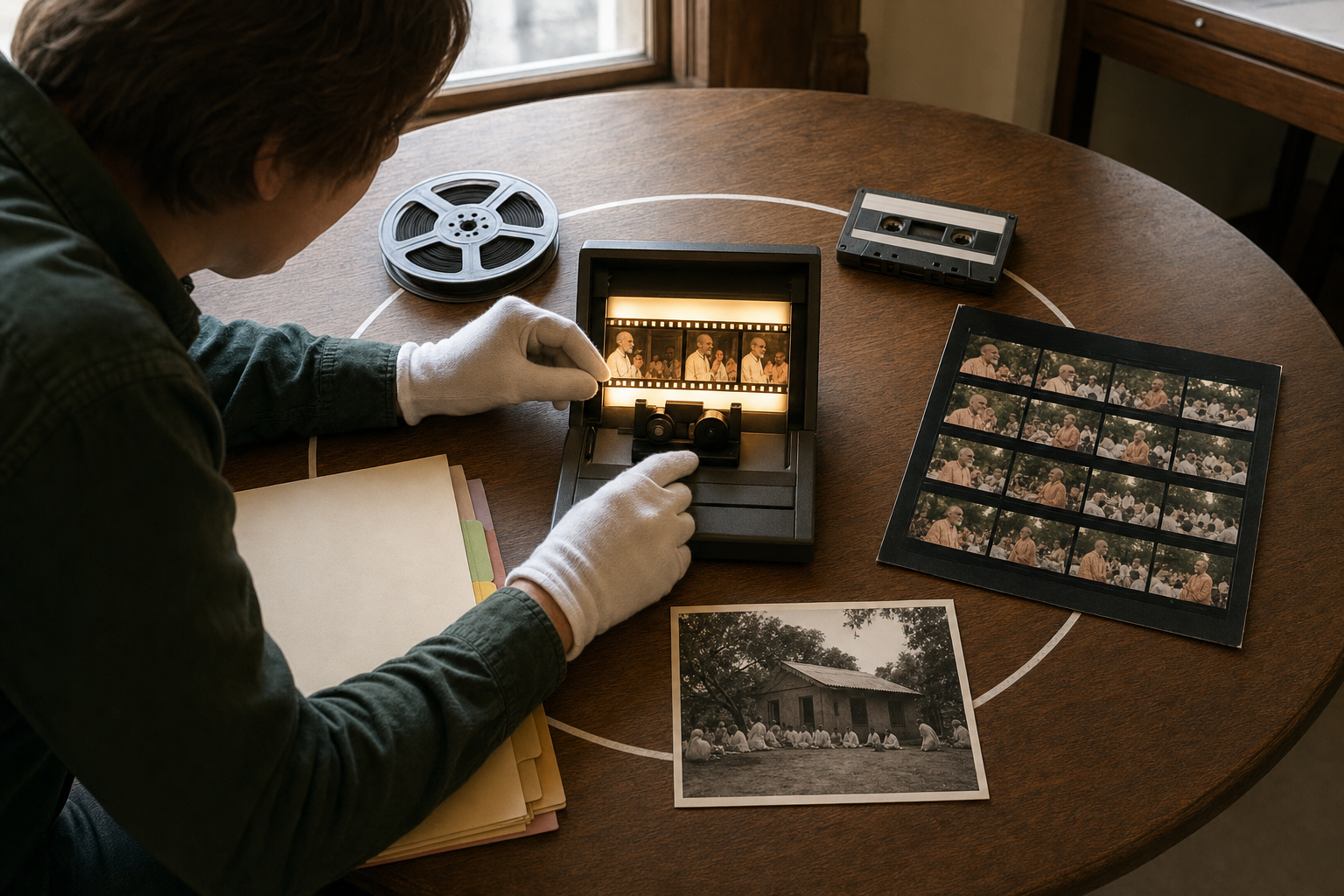
This is not simply a collection of familiar videos enlarged to 4K. The work began with film held by individuals, temples, and private collections in different parts of the world. The surviving materials included reversal originals, projection prints, and duplicate elements in 8mm, Super 8, and 16mm. Some carried optical sound, some had magnetic sound at the film edge, and some required a separate audio recording to be identified and synchronized.
Those distinctions matter. A camera original may retain detail or color information that a later print has lost. A projection print may contain scratches acquired through use. A duplicate can be further removed from the photographed event but may preserve frames missing from another copy. Two digital files showing the same scene therefore need not represent the same archival object.
The films record more than formal appearances. They preserve kirtans, public festivals, lectures, temple routines, community life, interfaith encounters, and the movement of teachers and practitioners across national boundaries. Scenes associated with 26 Second Avenue, early public sankirtana, and global travel can be connected to known places and events through catalog information rather than through visual guesswork alone.
Key takeaways
- The preservation scope covers all motion-picture recordings from 1965-1977 that were known to the project, not every photograph, audio tape, or later video copy.
- “Restored in 4K” describes a preservation and restoration workflow; it does not mean every surviving reel began with the same sharpness, color, completeness, or sound quality.
- The highest-resolution master, a screening file, and a compressed online copy serve different purposes. Ask which version you are viewing before judging the restoration.
- Preservation and public reuse are separate questions. Rights, privacy, music, and third-party appearances can affect the access terms for a particular item.
Faithful restoration begins before the scanner
Old film can be damaged by an apparently routine transfer. Shrinkage can prevent perforations from moving safely through conventional machinery. Weak splices can open. Dirt can become more conspicuous at high resolution, while chemical deterioration can continue even after a digital copy has been made.
Each reel therefore underwent base identification, shrinkage measurement, vinegar-syndrome inspection, perforation and splice checks, color-fade assessment, and abrasion mapping. Vulnerable sections were stabilized, failed splices were rebuilt, and leaders were replaced where necessary. This examination determined how a reel could be cleaned and scanned without sacrificing the object in pursuit of the image.
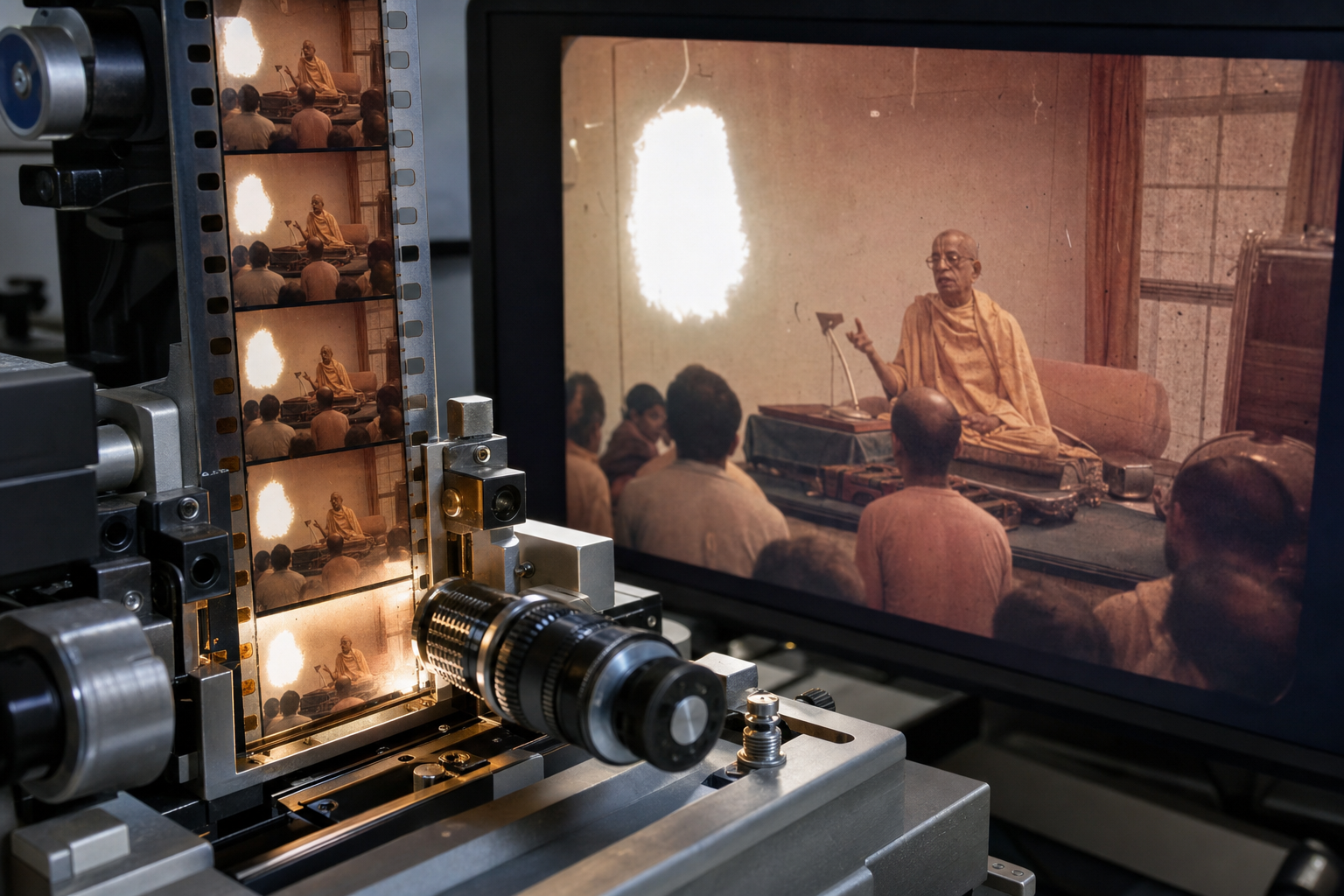
Cleaning was similarly selective. Embedded particles, fungal residue, and oily deposits had to be removed without disturbing the emulsion. Wet-gate transfer could reduce the visibility of surface scratches on appropriate prints because the transfer liquid temporarily fills abrasions. Sprocketless, capstan-driven transport reduced the strain on shrunken or brittle film.
The reels were then captured at native 4K with overscan. For 16mm film, that commonly meant a scan about 4096 pixels wide, including information beyond the projected picture. On 8mm and Super 8, 4K capture helps retain the character of the small image, the grain, and contextual details such as writing on slates. Overscan can also preserve edge codes and other markings that help identify the material. Cropping those markings for a pleasing screening copy is reasonable; losing them from the archival master is not.
High-bit-depth log image sequences retained a broad range of tonal and color information for future work. Optical tracks were read separately, while magnetic or dual-system recordings could be digitized at 24-bit, 96 kHz and aligned to the picture. Because surviving footage could have originated at 18 or 24 frames per second, correct speed was also part of preserving natural movement, speech, musical pitch, and duration.
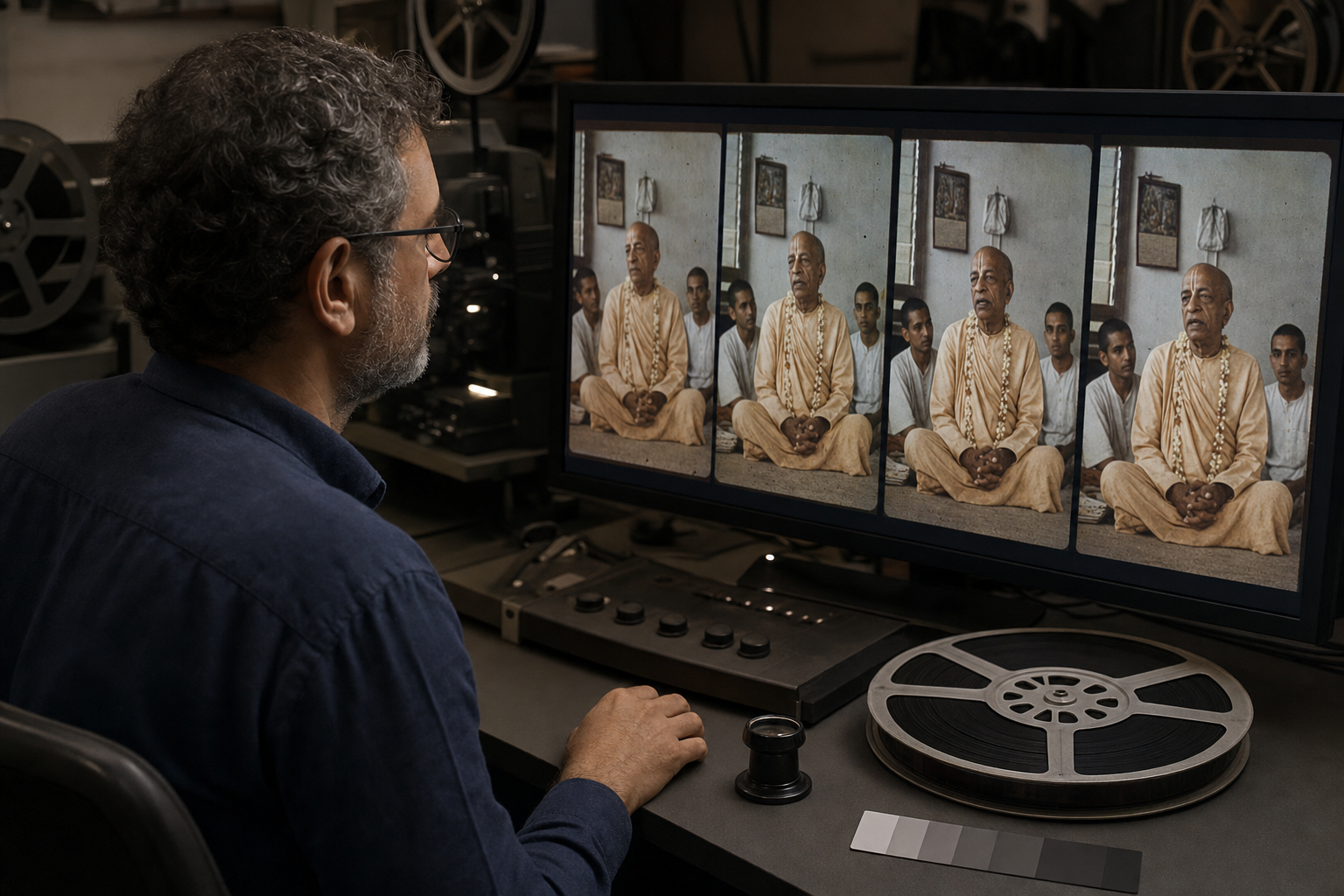
Restoration did not mean making the 1960s and 1970s look as though they had been photographed with a modern digital camera. Color decisions used film-stock behavior, reference targets, and contextual anchors such as skin tones, saffron cloth, temple stone, and daylight. Stabilization reduced gate weave and transport jitter; other work addressed flicker, dirt, scratches, hiss, hum, crackle, wow, flutter, and dropouts. Grain, room tone, and crowd ambience were retained when they carried the character of the recording.
When you evaluate a restored clip, look for restraint. A stable image should not become waxy. Cleaner speech should not make the surrounding gathering sound unnaturally silent. Corrected color should remain plausible for the stock and setting rather than becoming intensely saturated. The best restoration makes the event easier to encounter without pretending that the film was created in another era.
How to read the films as primary historical evidence
A film can show the arrangement of a temple room, the gestures used during worship, the relationship between a speaker and an audience, the structure of a kirtan, the clothing worn at a gathering, or the practical labor behind a festival. None of those details should be treated as universal merely because a camera captured them once. A reel documents a particular event from a particular position.
Use the following method when a historical, devotional, or academic claim depends on the footage:
- Identify the archival item. Record the title, reel or item identifier, date, location, named people, and restoration version when those fields are available. Rich records using Dublin Core, PREMIS, and PBCore can describe both the event and the technical object.
- Determine the film generation. Note whether you are examining an original, print, duplicate, composite, or edited excerpt. Visible damage in a print is not necessarily evidence of damage to the original photography.
- Confirm the playback speed. An 18-fps source shown at 24 fps can distort movement, timing, music, and speech. Do not analyze gesture, rhythm, or duration until the presentation speed is known.
- Separate observation from interpretation. Write “three participants enter the frame carrying instruments” before deciding what the entrance means ritually or socially. This keeps the visible evidence distinct from your argument.
- Use sound with the same care as picture. Establish whether the sound was recorded on the film, added from a separate tape, reconstructed from another source, or absent. Synchronization can be careful and historically justified without making two separate objects identical.
- Cite a timecode and version. Time-coded transcripts, captions, and subtitles improve access, but a translation or transcription remains an interpretive layer. Preserve the original-language wording in your notes when a theological or historical conclusion turns on a particular phrase.
This method also improves comparative work across Dharmic traditions. The films can help you examine seva, satsanga, pilgrimage, disciplined community life, musical devotion, and public teaching alongside Hindu, Buddhist, Jain, or Sikh materials. Comparison should illuminate shared civilizational concerns without erasing differences in doctrine, lineage, ritual authority, or historical setting.
For a classroom or community screening, provide the date, place, film type, known participants, and the limits of identification before interpretation begins. That short introduction prevents a visually compelling sequence from floating free of its historical circumstances.
A 4K viewing copy is not the archive
Resolution is only one part of preservation. A compressed 4K upload may look excellent while omitting the original frame boundary, edge markings, uncompressed sound, scan data, catalog history, and documentation of restoration decisions. Conversely, an archival master may be impractical for ordinary viewing because it consists of thousands of large image files.
| File or copy | Primary purpose | What you should expect |
|---|---|---|
| Preservation master | Retain the maximum recoverable film information | High-bit-depth log DPX image sequences with high-resolution WAV audio, plus technical and provenance metadata |
| Lossless preservation encoding | Provide a compact lossless path alongside image-sequence masters | FFV1 video in a Matroska container where that preservation option was created |
| Mezzanine file | Editing, exhibition preparation, and high-quality distribution | Formats such as ProRes 4444 or ProRes 422 HQ |
| Access or study copy | Streaming, classroom use, and convenient viewing | An H.264/AVC derivative, commonly presented in Rec.709 color for broad compatibility |
The files also need durable stewardship. The preservation workflow uses redundant 3-2-1 storage, geographically separated copies, LTO tape and other offsite storage, SHA-256 fixity checks, and planned media migration. A checksum can reveal that a file has changed unexpectedly. Multiple copies protect against a single device or location failing. Migration prevents a perfectly intact file from becoming stranded on obsolete media.
If your temple, family, or institution holds related footage, do not begin by projecting a brittle reel or cleaning it with household materials. Preserve the can, leader, labels, notes, and any separate audio exactly as found, and seek a film conservator who can assess shrinkage, perforations, splices, and chemical deterioration. The handwritten label may carry provenance that the visible scene cannot supply.
Before entrusting a collection to any digitization effort, ask whether the raw scan will be retained, how sound will be captured, whether edge information will remain in the master, how checksums will be monitored, where redundant copies will live, and how the files will migrate when storage technology changes. A vendor can deliver an attractive movie file without delivering a preservation system.
Access requires its own questions. Clearances may need to account for third-party appearances, music, privacy, and culturally sensitive representation. Educational access, public exhibition, online publication, and commercial reuse are not automatically equivalent. State your intended use when requesting material and keep the supplied credit line and usage terms with the file.
Turn preserved footage into living heritage
The archive becomes culturally useful when people do more than circulate isolated clips. A devotee may recognize a participant, place, melody, or ritual sequence. A historian may connect a gathering with a dated publication. A musicologist may examine tempo and call-and-response structure. A teacher may use captions and contextual notes to make the material accessible without reducing it to devotional illustration.
If you can identify something, submit the evidence behind the identification rather than confidence alone: a contemporaneous photograph, a dated program, a publication, a matching architectural feature, or several independent recollections. Distinguish “identified” from “possibly identified.” Future catalog users need to know whether a name is documented, inferred, or remembered.
If you organize a screening, request the appropriate access copy rather than handling a preservation master. Keep the intended aspect ratio and playback speed, use the available captions or subtitles, and introduce the reel with its date, location, provenance, and uncertainties. Leave time afterward for documented corrections and additional identifications, then return those findings to the archive in a form that can be reviewed.
If you cite a scene, preserve enough information for another person to find the same frame: the archival title or identifier, restoration or access version, timecode, event date if known, and access date. A social-media link alone is fragile evidence because clips can be shortened, recolored, reframed, retimed, or removed.
Your next encounter with a Srila Prabhupada film can begin with four questions: Which physical element survives behind this image? Which version am I watching? What metadata supports the identification? What use is permitted? Those questions turn appreciation into responsible guardianship and help the footage remain intelligible to people who did not inherit its context.
References
