
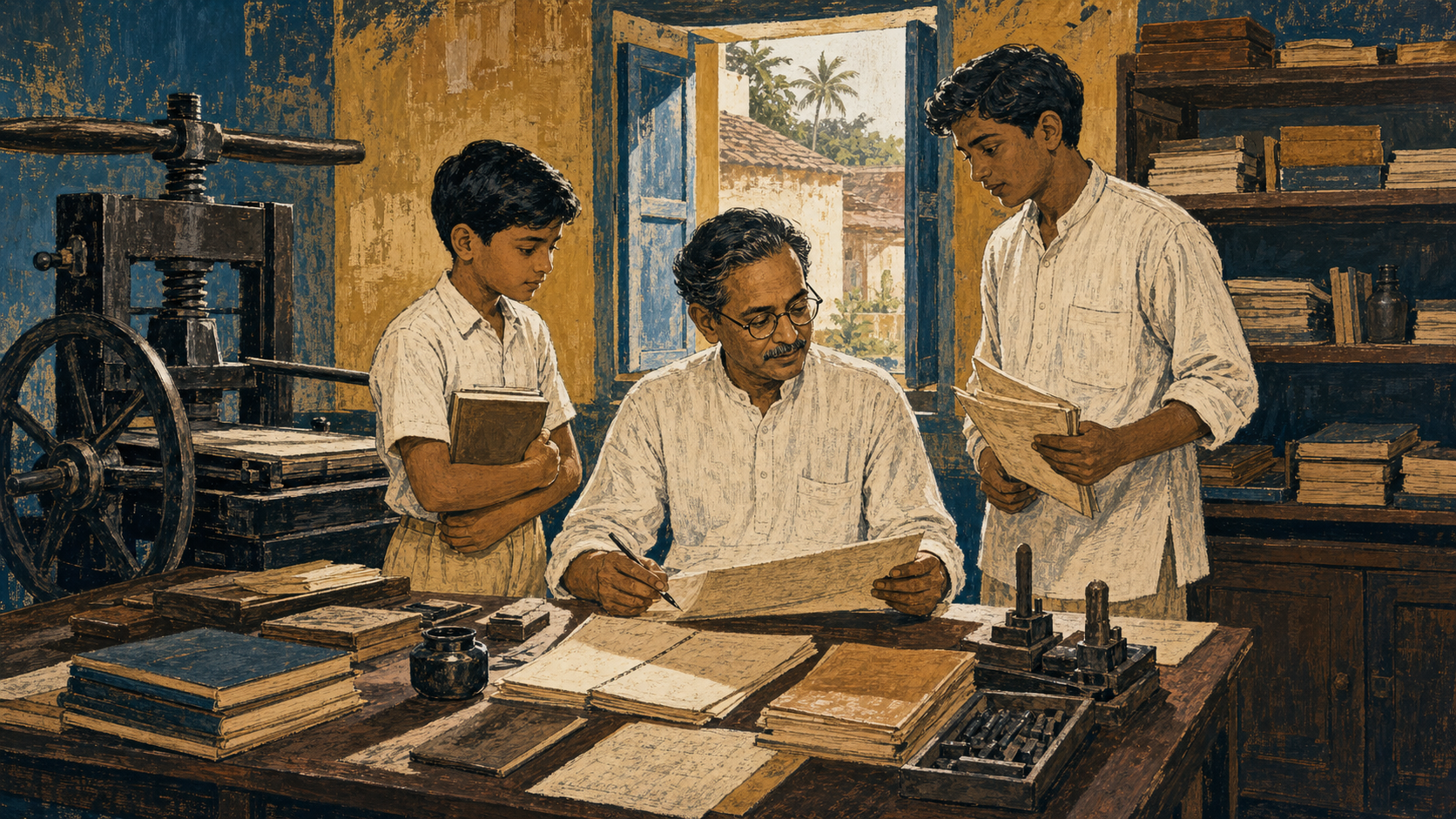
If you know twentieth-century Kannada literature mainly through celebrated poets and finished books, Betageri Krishna Sharma can look like a secondary figure: a primary-school teacher who later worked with magazines. That impression changes once you ask how readers were formed, how new writing reached them, and who kept literary conversation alive between one book and the next.
Sharma, who lived from 1900 to 1982 and wrote as Anandakanda, offers you a practical way to read Kannada print culture as an institution rather than a shelf of individual works. His path from classroom teaching to editing Matru Bhumi and Svadharma, followed by the founding of Jayanti, shows where to look when literary history has preserved famous names more clearly than the machinery that sustained them.
The editor belongs inside literary history
A book-centred history naturally rewards authorship. A print-culture history asks additional questions. Who selected the work? Who arranged unlike genres within the same issue? Who maintained a regular relationship with readers? Who gave an emerging writer a first or early venue? These questions do not diminish the author. They reveal the conditions that allowed authorship to become public culture.
A periodical editor ordinarily works at several levels at once: manuscript selection, sequencing, correction, correspondence, presentation, and continuity from issue to issue. The surviving outline of Sharma’s career does not justify assigning every one of those activities to him in every journal. It does justify treating his editorial roles as substantive literary labour, not as an administrative footnote.
This distinction matters because periodicals create habits that isolated publications cannot. A recurring journal gives readers an appointment with the language. It places poems beside essays, criticism beside creative writing, and established voices beside less familiar ones. Each issue also tests standards in public: what counts as clear Kannada, what deserves debate, and what kinds of writing belong in a shared literary space.
Sharma’s beginning as a primary-school teacher makes this institutional role easier to understand. Teaching and editing meet at the point where language becomes usable for another person. A teacher develops the reader’s capacity; an editor constructs the reader’s encounter with texts. You should therefore read Sharma’s move from school to periodical work as an expansion of audience, while avoiding the stronger claim that every editorial decision can be reconstructed from his teaching career.
Three periodicals reveal three kinds of cultural work
The most secure way to approach Sharma is to begin with his documented relationship to each periodical. The role determines the question you can responsibly ask.
| Periodical | Documented relationship | What the role lets you investigate |
|---|---|---|
| Matru Bhumi | Editor | Selection, editorial framing, recurring themes, contributor networks, and the journal’s address to a Kannada reading public |
| Svadharma | Editor | How ethical and cultural vocabulary was presented, and whether the title’s promise can be demonstrated in actual contents |
| Jayanti | Founder | Institution-building: why a new venue was created, which forms and writers it carried, and how its identity developed across issues |
This is a map of research questions, not a substitute for the journals themselves. An editorial title does not prove a particular policy. Founding a magazine does not, by itself, establish its circulation, longevity, contributor base, or ideological programme. Those details require mastheads, contents pages, editorials, correspondence, publication notices, and dated issues.
The distinction protects Sharma’s legacy from two opposite mistakes. The first is neglect: reducing him to a name attached to three publications. The second is embellishment: crediting him with every desirable feature of Kannada literary modernity without issue-level evidence. A stronger appreciation identifies the work he unquestionably did and then marks the precise places where archival verification must begin.
Read Anandakanda and Svadharma as clues, not conclusions
Names carry intellectual invitations, but they do not settle intellectual history. Sharma’s pen name, Anandakanda, brings together ananda, or bliss, with kanda, a word that can evoke a root, essence, or textual division. It is reasonable to hear an aesthetic and ethical aspiration in that choice. It is not reasonable to treat the pen name as proof of a complete philosophical system.
The same discipline applies to Svadharma. In Dharmic thought, svadharma can point toward one’s proper duty, disposition, or way of acting within a larger moral order. As a journal title, it raises productive questions. Did editorials define the term? Was dharma discussed philosophically, socially, culturally, or politically? Which traditions and genres appeared in its pages? Did the meaning change over time?
Kannada’s inheritance gives those questions depth. Jaina literary contributions and the Veerashaiva vachana tradition belong to a long, internally diverse civilizational conversation. That background makes a plural reading of dharma possible, but it does not prove that Svadharma followed a pluralist policy. To establish that claim, you would need to identify contributors, subjects, quoted texts, translations, reviews, and editorial statements across more than one issue.
Matru Bhumi presents a related interpretive challenge. Its title, meaning motherland, can suggest cultural belonging and public responsibility. Yet a title cannot tell you whether the journal emphasized language, history, literature, education, national life, or some combination of them. Let the name direct your attention; let the contents determine your conclusion.
This evidence-first method is especially important for a Dharmic cultural history. Reverence does not require exaggeration. It requires enough care to distinguish what Sharma’s career establishes from what his vocabulary invites us to explore.
How to reconstruct Sharma’s print-cultural legacy
If you are a student, librarian, family historian, or Kannada reader trying to recover this legacy, begin with a small, reproducible archive project. Do not start by attempting a grand verdict on Sharma’s influence. Start by making one periodical searchable at the issue level.
- Fix the identity fields. Search and record both Betageri Krishna Sharma and Anandakanda. Keep the personal name and pen name in separate fields so that signed creative work is not confused with unsigned editorial labour.
- Build an issue register. For every copy of Matru Bhumi, Svadharma, or Jayanti you locate, record the title exactly as printed, issue date, volume and number when present, page range, holding location, catalogue identifier, and whether the copy is complete.
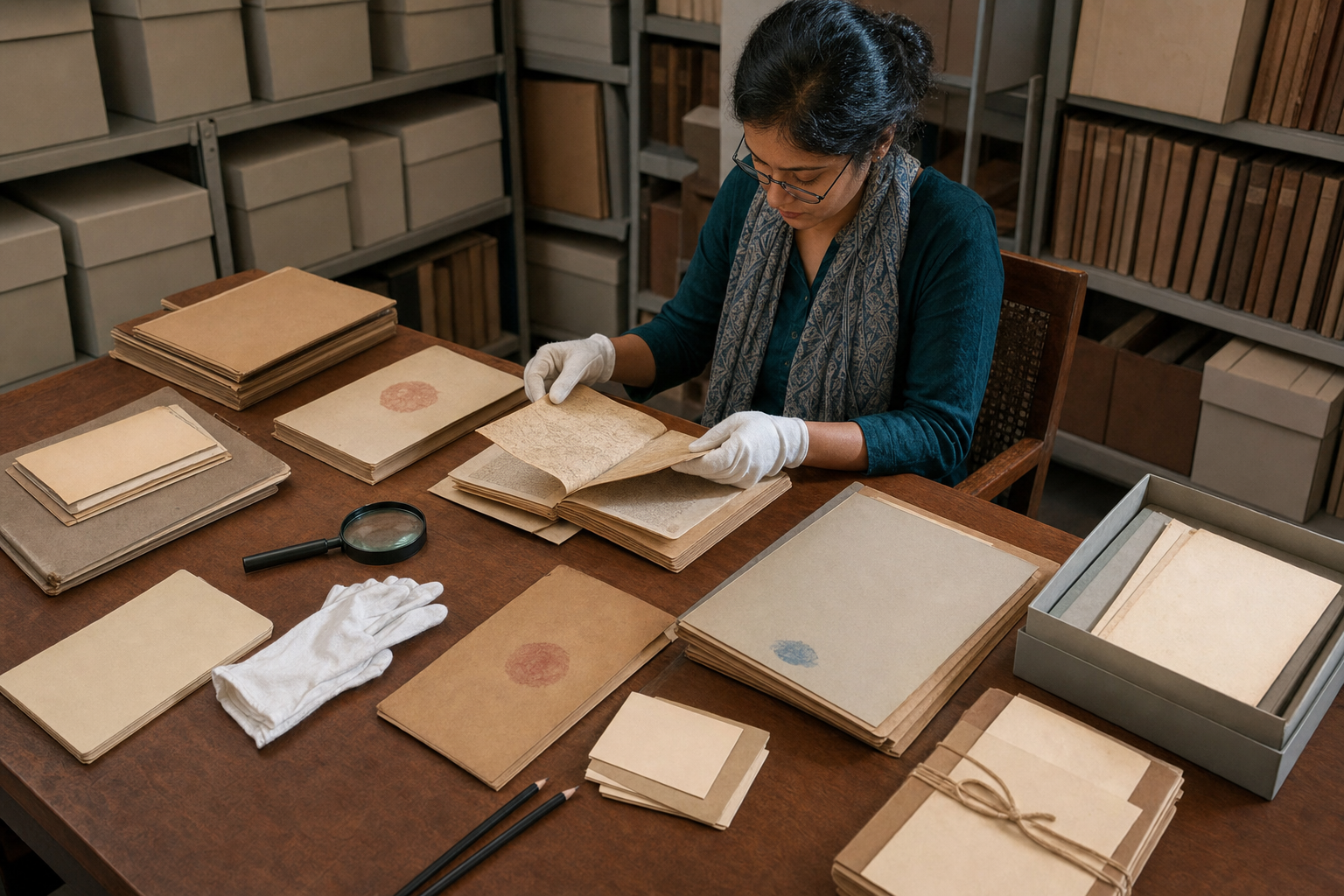
- Photograph the publication evidence first. Capture the cover, masthead, contents page, editorial page, contributor notes, subscription information, and announcements for the following issue. These pages establish roles and continuity more reliably than an isolated literary extract.
- Separate roles from signatures. Create distinct entries for editor, founder, named author, pen name, translator, reviewer, and correspondent. A masthead credit establishes an institutional role; a byline establishes responsibility for a particular text. Do not silently merge the two.
- Index contents before interpreting them. Record author, title, genre, page, language of any translated material, and explicit subject terms. Only after several issues are indexed should you claim a recurring editorial preference.
- Transcribe editorials with page citations. Editorials, forewords, replies to readers, and calls for submissions are the best places to test claims about literary standards or public purpose. Preserve original wording, but keep your interpretive summary in a separate field.
- Verify text against the page image. If searchable text has been produced through optical character recognition, use it as a finding aid. Confirm names, headings, dates, and quotations visually before publishing them.
- Report gaps as gaps. Missing issues can distort apparent trends. State the period you actually examined and list absent numbers rather than presenting an incomplete run as continuous evidence.
A compact spreadsheet is enough to begin. The minimum useful columns are periodical, issue date, volume, number, page, contributor, contributor role, text title, genre, signature used, subject, and notes. Add image filenames or catalogue identifiers so another reader can retrace your work.
This process turns admiration into durable cultural preservation. It can reveal whether contributors returned, whether genres gained or lost space, how editorial language changed, and where Sharma appeared under his pen name. Just as importantly, it prevents attractive but unsupported claims about translation, reform, circulation, or influence from hardening into accepted biography.
Key takeaways
- Sharma’s progression from primary-school teacher to editor and magazine founder links the formation of individual readers with the creation of a wider Kannada literary public.
- Matru Bhumi and Svadharma establish his editorial service; Jayanti establishes his role as a founder. Each role calls for a different kind of evidence.
- Anandakanda, Matru Bhumi, and Svadharma are meaningful names, but names should generate questions rather than predetermine answers.
- The most reliable measure of editorial influence is issue-level evidence: mastheads, contents, editorials, contributor patterns, correspondence, and change over time.
- Recovering an editor’s legacy is not secondary to literary history. It explains how literature acquired venues, standards, continuity, and readers.
If you have only one hour to give this history, locate one complete issue from any of the three journals and document its masthead, contents page, editorial, and publication notices. That small record will give the next reader something verifiable to build on. Repeated carefully, issue by issue, the same act can restore Betageri Krishna Sharma to his proper place: not behind Kannada literature, but within the system that enabled it to live in public.
References
