

If one calendar marks Amavasya on Sunday, 14 June, while your family plans to observe it on Monday, 15 June, neither side has necessarily misread the Panchang. The tithi begins on Sunday afternoon in India but remains in force at Monday sunrise. In traditions that assign Amavasya by the sunrise tithi, Monday is therefore the principal observance day.
This particular new moon needs two additional labels: Adhik Jyeshta identifies the intercalary lunar month, while Somvati describes Amavasya prevailing at sunrise on a Monday. If you are observing it in India, prepare on Sunday and keep Monday morning free for the time-sensitive part of your vrata, tarpana, japa, or household worship.
The exact Amavasya window in India

| Calendar point | Time in IST | What it means for you |
|---|---|---|
| Amavasya tithi begins | 12:19 PM, Sunday, 14 June 2026 | The tithi is active from Sunday afternoon, making this a suitable period for preparation and any practice your tradition assigns to the beginning of Amavasya. |
| Monday sunrise | 15 June 2026 | Amavasya prevails at sunrise, so many sunrise-based traditions observe the vrata on Monday and call it Somvati Amavasya. |
| Amavasya tithi ends | 8:23 AM, Monday, 15 June 2026 | Complete practices that must occur during Amavasya before this boundary, subject to your city-level Panchang. |
The full Amavasya interval is 12:19 PM on 14 June to 8:23 AM on 15 June, in Indian Standard Time. The Sunday-Monday overlap is normal. A tithi is based on successive 12-degree segments of the angular relationship between the Sun and Moon, not on a civil day beginning at midnight. Its boundaries can therefore fall in the morning, afternoon, or night.
The practical distinction is simple: the astronomical interval tells you when Amavasya exists, while the sunrise rule used by your sampradaya or regional calendar tells you which civil day carries the observance. For most households in India following the Monday sunrise criterion, the safest plan is to assemble everything on Sunday and begin early on Monday. Do not leave a time-sensitive rite until after 8:23 AM IST.
City-level sunrise and ritual rules still matter. If your family follows a temple, matha, priest, or established regional Panchang, use that authority for the final sankalpa date and ritual schedule rather than replacing it with a national-level time table.
What Adhik Jyeshta and Somvati actually change
Adhik Maas is the calendar’s intercalary month. The lunar year is about 354 days while the solar year is about 365 days, so an additional lunar month is inserted roughly every 32 months and 16 days to keep the two cycles aligned. In 2026, that adjustment produces Adhik Jyeshta Maas.
This does not make the month spiritually empty. It changes the kind of work traditionally emphasized. Many families defer major auspicious life-cycle ceremonies, including marriage and griha pravesh, during Adhik Maas. At the same time, they increase japa, scripture recitation, dana, seva, vrata, and quiet worship. Vishnu worship receives particular emphasis in many Adhik Maas traditions.
If you are deciding whether to schedule a major samskara in this period, do not infer a universal prohibition from the word Adhik. Customs differ. Confirm the date with the priest or calendar authority responsible for that ceremony. For personal sadhana, however, the direction is much clearer: choose a modest discipline you can actually sustain, such as a fixed daily nama-japa, a regular stotra, or a planned act of service.
Somvati adds a different layer. It means that Amavasya is associated with Monday under the applicable sunrise rule. Somvati customs in several regions include vrata for household well-being, Peepal parikrama, charity, and intensified prayer. These are regional or family practices, not tests of whether your observance is valid. Adhik Jyeshta tells you the lunar month; Somvati tells you the weekday condition. The two names are complementary, not competing calendar dates.
A workable home observance for Monday morning
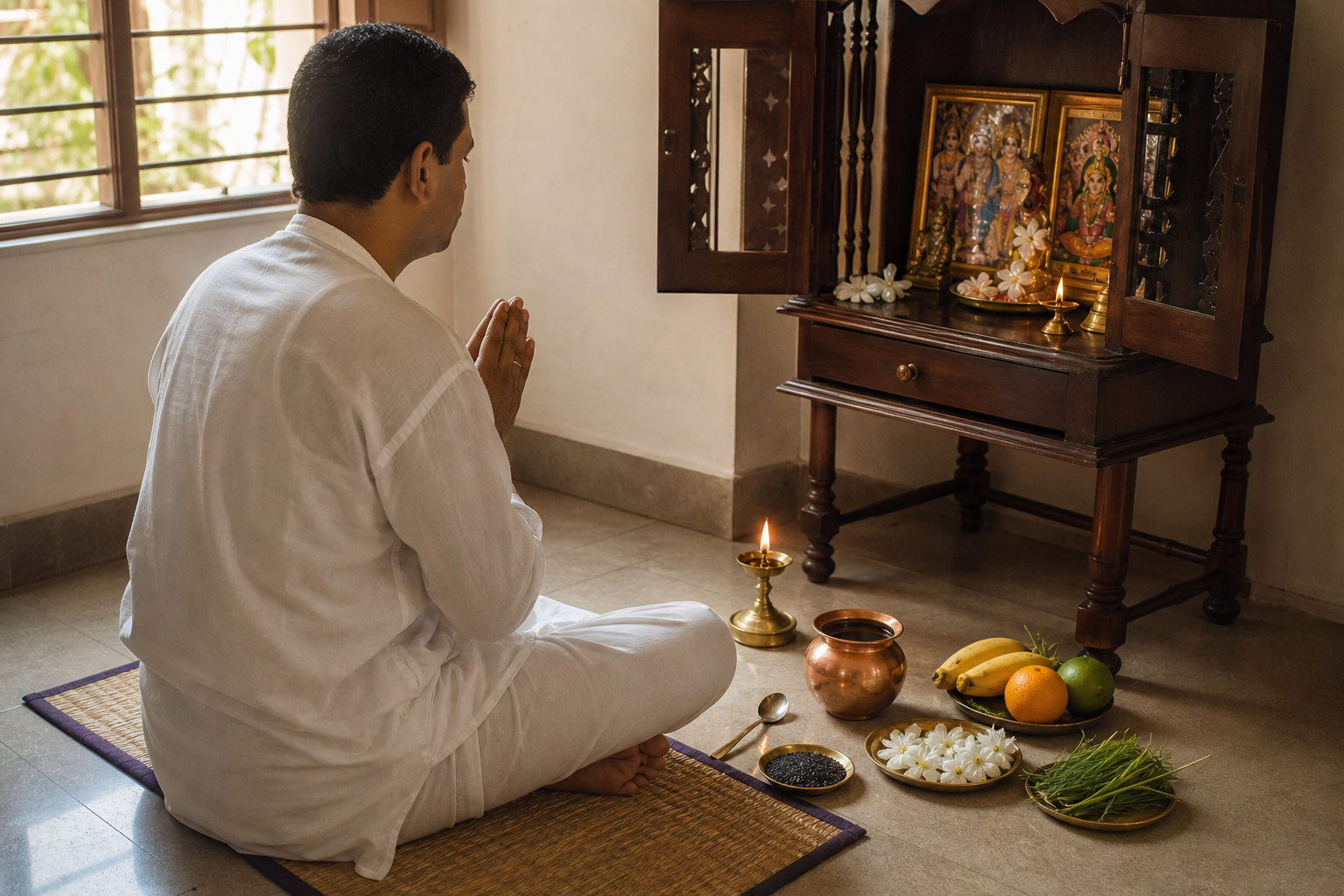
You do not need to crowd every known Amavasya custom into a short morning. Give priority to the practices your family has actually received. The following sequence provides a restrained framework that can be adapted without pretending that every sampradaya uses the same mantras or procedure.
- Confirm your local observance on Sunday. Check the Panchang for your city and any instructions issued by the temple, priest, or lineage you follow. This is especially important if you are performing a formal ancestral rite.
- Prepare before the tithi-sensitive morning. Set aside clean water, black sesame where customary, a deepa, your chosen stotra or japa mala, and the item or amount intended for dana. Preparing on Sunday prevents the 8:23 AM end time from turning Monday worship into a rush.
- Begin with an early snana. Bathe, wear clean clothing, and settle the mind before worship. Keep the sankalpa specific: remembrance of the Pitrs, purification of conduct, a chosen japa, or service undertaken without display.
- Remember the ancestors according to family practice. Light a deepa in remembrance. If your household performs pitru-tarpana, follow its inherited mantras and procedure; water and black sesame are commonly used. If you have not received a formal method, do not improvise a complex shraddha from scattered instructions. A simple, respectful remembrance and lamp can preserve the intention until you obtain guidance.
- Keep one focused spiritual practice. Recite the Vishnu Sahasranama, a Shiva stotra, or the nama-japa already established in your daily life. Repetition with attention is more coherent than switching among several texts merely to make the observance look elaborate.
- Choose fasting or simple food responsibly. A vrata may include fasting, but a simple sattvic meal is also widely observed. If fasting is unsuitable for your health or obligations, do not treat physical strain as the measure of devotion. Keep the discipline through simple food, restraint in speech, japa, and service.
- Complete the observance with dana or seva. Decide in advance whom the act will help. Food, practical assistance, support for a temple or community need, and direct service all express the Adhik Maas emphasis on giving rather than display.
If you have only a short period before work, keep the sequence intact but compact: snana, deepa, ancestral remembrance, one familiar prayer, and a definite act of dana or seva. Do the parts that must fall within Amavasya before the tithi ends. The charitable act can be arranged in advance and completed as promised rather than abandoned because the morning window is narrow.
Peepal parikrama may be added if it belongs to your Somvati custom. It should not displace pitru-smarana, japa, or ethical restraint merely because it is more visible. The inner logic of the day is remembrance, offering, and a deliberate reduction of noise.
That logic also makes room for a wider Dharmic household without erasing real distinctions. Buddhist communities may use new-moon Uposatha for meditation and intensified precepts. Jain Amas observance may include fasting, pratikraman, and dana. Sikh discipline emphasizes regular simran and seva rather than dependence on a lunar phase. A family can share quiet, compassion, and service on the day while each member follows the practice proper to their tradition.
How to avoid regional and overseas calendar mistakes

Purnimanta and Amanta calendars
Purnimanta calendars, common across much of North India, reckon the month from the period following a full moon. Amanta calendars, used in much of western and southern India, begin the new month after Amavasya. This structural difference can make adjacent month labels look confusing even when the tithi calculation agrees.
The June 2026 new moon is identified as Adhik Jyeshta Amavasya in the North Indian Hindi calendars and in the Marathi, Gujarati, Kannada, and Telugu systems. In the Amanta reckoning, this Amavasya closes Adhik Jyeshta and is followed by Nija, or Shuddha, Jyeshta. You therefore do not need to choose between an Adhik Jyeshta date and an Amavasya date; the Amavasya is the closing tithi of that intercalary month.
Names also vary without changing the ethical purpose of the observance. You may encounter Amas in Gujarati usage, Amavasya in Hindi, Kannada, and Telugu contexts, or Amavasai in Tamil usage. When comparing calendars, match the tithi interval and local sunrise first; do not reject a date merely because its regional name differs.
If you live outside India
The listed times are in IST, which is UTC+5:30. Converting those boundaries tells you when the same astronomical interval occurs on your clock, but it does not automatically tell you which local civil day should carry a sunrise-based observance. Depending on where you live, Amavasya may prevail at sunrise on a different date or weekday from India.
- Select a reliable Panchang calculated for your city, not merely for India or the nearest Indian metropolis.
- Confirm the local start and end of Amavasya, then check which tithi is active at your local sunrise.
- Do not copy the Monday designation mechanically. The term Somvati depends on Amavasya meeting Monday under the calendar rule used in your location and tradition.
- If a temple or family priest is coordinating a collective rite, follow that announced local schedule so the sankalpa and participation remain aligned.
This distinction matters most in the Americas and other regions many hours from India, where the converted tithi can fall on a different civil date. A message saying simply “observe on 15 June” is incomplete unless it also identifies its location and Panchang convention.
Key takeaways for your June observance
- In IST, Amavasya begins at 12:19 PM on Sunday, 14 June 2026, and ends at 8:23 AM on Monday, 15 June 2026.
- Because the tithi prevails at Monday sunrise in India, many traditions observe it as Somvati Amavasya on 15 June.
- Adhik Jyeshta favors japa, dana, seva, vrata, and inner discipline; many families defer major life-cycle ceremonies, subject to their own tradition.
- For ancestral rites, inherited family procedure takes precedence over a generic online sequence. A simple lamp and respectful remembrance are preferable to an improvised formal ritual.
- Outside India, use a city-specific Panchang and local sunrise. The Indian civil date and the Somvati label may not transfer unchanged.
Set your reminder for Sunday, place the required items together, and decide your japa and dana before the tithi-sensitive morning begins. On Monday, start early enough that remembrance does not become a race against 8:23 AM. After Amavasya, look for Chandra Darshan on the next clear evening; monsoon cloud may delay visibility without changing the lunar transition. Let the waxing fortnight carry forward one discipline chosen during Adhik Jyeshta rather than leaving the resolve behind with the calendar date.
References
