
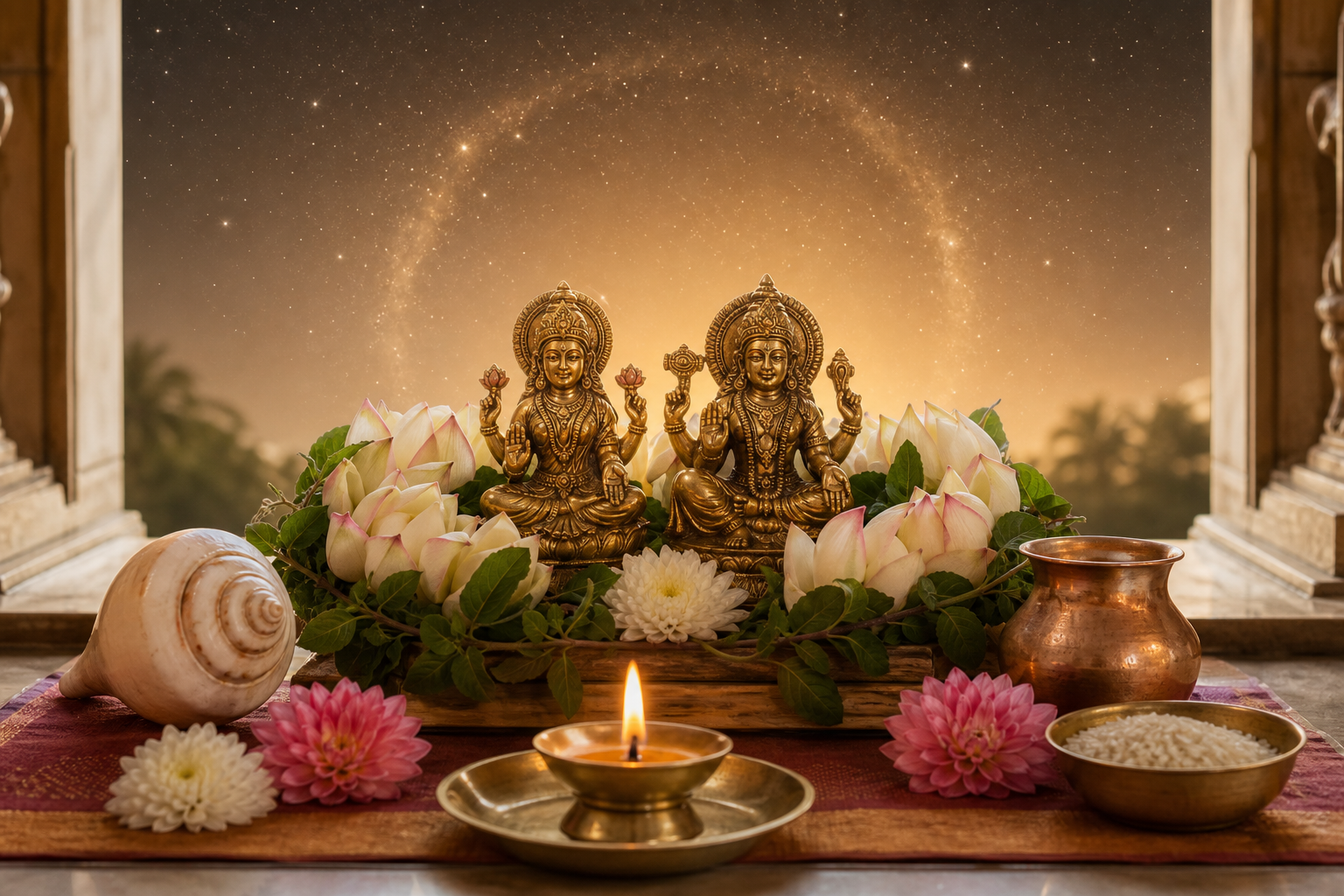
If you are considering this rite for prosperity, household stability, or Lakshmi-Narayana worship, do not begin by choosing a Friday, buying an elaborate tray of offerings, or copying the longest text you can find. Begin by identifying the recension, the samputa pattern, and the teacher or parampara that governs both.
That order of decisions prevents the basic error of joining verses from different transmissions and calling the result samputikarana. It also keeps the purpose clear: you are not trying to extract wealth from a mantra. You are placing the pursuit of abundance inside cosmic order, ethical restraint, and service.
Why the pairing changes the meaning of prosperity
Samputikarana is an interleaving method. A verse, mantra, or refrain is placed at defined points within another recitation so that two currents of worship form one liturgical structure. Reciting Sri Suktam and Purusha Suktam consecutively can be a meaningful combined recitation, but it is not automatically the same as an interleaved samputa.
In the Lakshmi-Narayana setting of this rite, Purusha is the all-pervading cosmic Person, not merely an individual man. Rigveda 10.90 presents the universe as the unfolding of Purusha: beings, elements, space, time, and ordered social existence belong to one living totality. The declaration purusha evedam sarvam yad bhutam yac cha bhavyam places what was, what is, and what will be within that cosmic reality.
Sri is the auspicious power that makes ordered existence fruitful, beautiful, nourishing, and generous. The opening hiranyavarnam harinim suvarna-rajatasrajam invokes a radiant, golden presence. Here prosperity is larger than cash or possessions. It includes the conditions that sustain life, learning, virtue, stable relationships, and the capacity to give.
The theological movement is therefore precise. Purusha supplies measure, coherence, and the horizon of the whole. Sri supplies grace, fertility, beauty, and beneficent abundance. Samputikarana makes their inseparability audible. Order without generosity becomes sterile; acquisition without order becomes appetite.
Your sankalpa should reflect that relationship. A request for household stability, for example, can name an honest livelihood, responsible use of resources, care for dependants, generosity, and spiritual growth. This connects artha and kama to dharma while keeping moksha in view. It is more faithful to the rite than an undefined demand for more.
- Dharma: What right conduct will govern the way you seek and use prosperity?
- Artha: What legitimate resource or form of stability is actually needed?
- Kama: What wholesome human need will that resource serve?
- Moksha: How will you avoid making possession, status, or success your identity?
This balance also has recognizable resonances across the wider Dharmic family, without making different traditions identical. Wisdom and compassion reinforce each other in Buddhism; Jain discipline refuses the violence of narrow, one-sided certainty; Sikh remembrance becomes concrete through seva. Sri-Purusha worship expresses the same civilizational conviction in its own Vedic form: inner orientation and outward responsibility cannot be separated.
Choose one complete textual stream before you chant
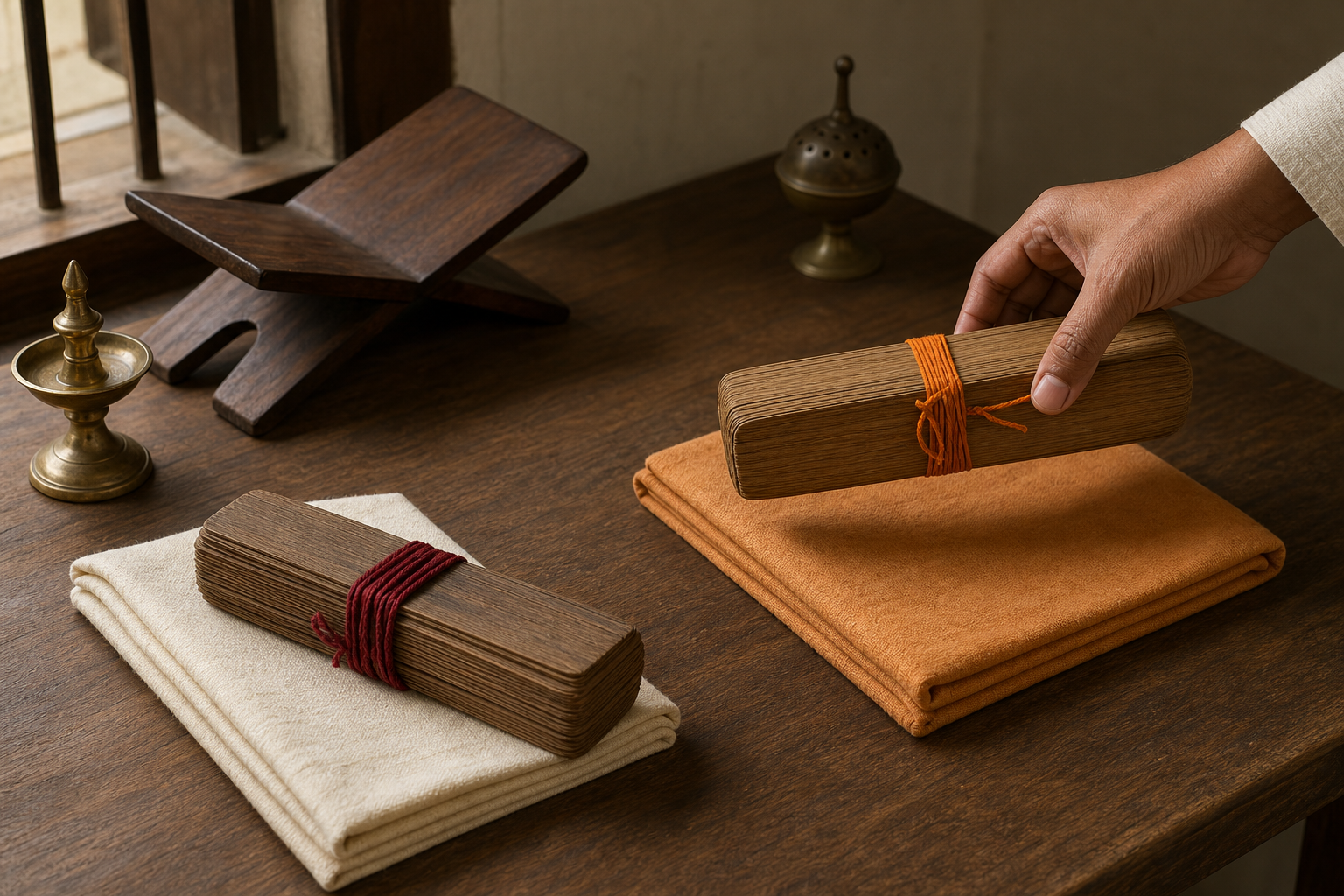
There is no responsible universal script that can be assembled without knowing the transmission being followed. Purusha Suktam and Sri Suktam circulate with recension-dependent differences in verse count, sequence, concluding material, meter, and accent. The Rigvedic Purusha Suktam commonly circulates in a 16-verse form, while Yajurvedic transmissions may extend it. Sri Suktam also appears with different appended verses and benedictions.
An extra verse is not an automatic upgrade, and a longer version is not automatically more potent. The practical standard is internal consistency. Use the order, boundaries, pronunciation, and conclusion belonging to one received textual stream for the entire anushthana.
Before beginning, have these points marked on the exact copy from which you will recite:
- Transmission: Which śākhā, recension, temple tradition, or parampara supplies the text?
- Verse boundaries: Which verses belong to the core sequence, and which concluding verses or benedictions are included?
- Samputa: What exact refrain or inserted verse is used, and after which units is it repeated?
- Svara and pronunciation: Which udātta, anudātta, and svarita markings apply to this recitation?
- Counts: Is the interleaved sequence performed once, or are separate japa counts prescribed before or after it?
- Opening and close: Which preparatory acts, dhyana, offerings, and peace invocation belong to the procedure?
Correct svara is not decorative singing. In Vedic recitation it belongs to the fidelity of transmission. A printed transliteration may help you follow the order, but it cannot listen to your syllable length, articulation, or pitch movement. If you have not learned the chanting, ask a qualified acharya to demonstrate it and correct you in manageable sections.
If that guidance is not yet available, do not manufacture a hybrid from unrelated recordings and PDFs. You can listen attentively, follow the text, learn pronunciation gradually, participate in the puja, and join the concluding peace prayer. Being a learner is a valid form of participation; silently guessing at accent is not a shortcut to mastery.
How the interleaving architecture actually works

The word samputa can suggest a container or enclosure, but the operative detail is placement. A mantra repeated at structurally meaningful intervals becomes the thread that binds the sequence. Change the thread or its placement and you have changed the ritual architecture.
| Recognized pattern | Basic movement | What must be confirmed |
|---|---|---|
| Sri-led interleaving | One Sri Suktam verse, followed by a designated Purusha refrain, then the next Sri verse | The exact Purusha passage, its repetition point, and the Sri recension |
| Purusha-led interleaving | One Purusha Suktam unit, followed by a designated Sri verse or response | The Sri insertion, the Purusha verse divisions, and the closing sequence |
| Stabilizing mantra refrain | A prescribed sequence joined by a mantra such as Om Namo Narayanaya, Om Shreem Mahalakshmyai Namah, or a Lakshmi Gayatri | Which mantra the lineage authorizes and exactly where it is placed |
These are families of patterns, not three ready-made scripts. An acharya may prescribe a particular refrain, opening, closing, and count within one of them. Do not infer missing instructions from the table or substitute a favorite mantra because its meaning seems compatible.
The sonic contrast between the hymns is also part of the experience. Purusha Suktam primarily carries stately tristubh and jagati cadences, while many Sri Suktam verses use the more intimate anuṣṭubh movement. One expands the mind toward cosmic scale; the other brings auspiciousness close to embodied life. Follow the cadence you were taught rather than flattening both into hurried, mechanical delivery or dramatizing the contrast according to personal taste.
A steady pace matters more than a fast completion. Each inserted refrain should renew attention to the relation between order and abundance. If it becomes merely a repeated sound used to get to the next verse, the outer sequence may remain intact while its contemplative purpose is lost.
A careful framework for home practice
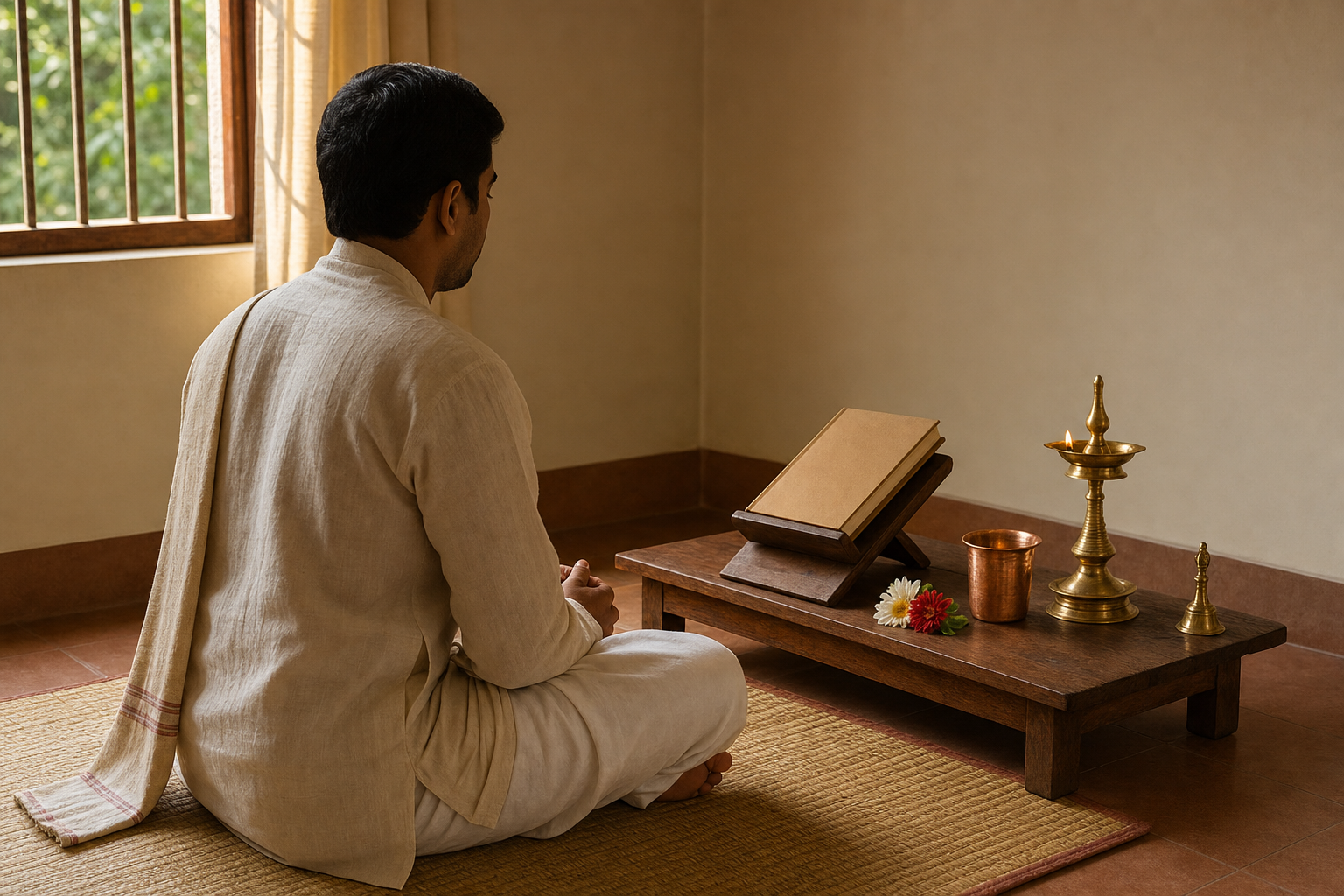
Once the textual decisions are settled, keep the physical arrangement clear and proportionate. A clean worship space, a deepa as a sign of awareness, and a focused representation or contemplation of Lakshmi-Narayana are enough to establish the center. Lotus, grains, clarified butter, and white sesame occur in different traditions, but they are not a universal shopping list.
- Confirm the form of practice. Decide whether you are undertaking recitation, a fuller puja, a vrata observance, a group satsang, or a homa. The same hymn pairing does not make the procedures interchangeable.
- State the sankalpa precisely. Name the person, family, or community purpose as your tradition requires, and connect the desired artha to dharma. Avoid a vague demand for limitless prosperity.
- Prepare a simple altar. Cleanliness, order, and attentive placement matter more than display. Use only the offerings appropriate to your lineage and circumstances.
- Perform preliminary disciplines as prescribed. Karanyasa, anganyasa, and bhuta-shuddhi may be part of the procedure, but they should not be added as ornamental preliminaries when they have not been taught.
- Establish dhyana. Contemplate Lakshmi-Narayana before the first verse so that Sri and Purusha are approached as a unity rather than as two unrelated petitions.
- Follow the marked interleaving. Preserve the chosen verse order, the exact samputa placement, the learned svara, and a steady tempo from beginning to end.
- Keep offerings subordinate to mantra. In a recitation or puja, do not multiply substances for the sake of grandeur. In a homa, the order of ahutis and the dravya belong to a specific transmitted procedure.
- Close completely. Use the prescribed concluding verses and peace invocation rather than stopping when the main sequence ends.
Do not derive a homa procedure from a recitation outline. Fire, offerings, mantra endings, and the order of oblations require competent ritual supervision as well as an appropriately safe physical setting. If those conditions are absent, retain the practice as recitation or puja instead of improvising a fire rite.
Fridays, days in Shukla Paksha, and festivals associated with Sri or Narayana are preferred in many households, but calendar preference does not repair an uncertain text or unlearned pronunciation. A properly prepared ordinary occasion is better than a prestigious date approached with a composite script and rushed attention.
Give the sankalpa a visible ethical consequence after the worship. If you ask for household stability, review whether your way of earning is honest and whether your obligations are being met. If you ask for abundance, decide what portion of your capacity can nourish learning, family, community, or someone vulnerable. This is not a fee paid for divine favor. It is how the meaning of Sri enters conduct.
The rite may settle the breath, widen attention, or produce a distinct stillness as its alternating cadence becomes familiar. Treat such experiences as experiences, not as proof that every accent was correct or as an omen of financial gain. Sri Suktam-Purusha Suktam Samputikarana is worship and discipline, not an investment forecast; loans, investments, and business commitments still require ordinary due diligence.
Questions to settle before your first recitation
Can I chant the two suktas separately?
Yes, each hymn has its own liturgical and contemplative integrity, and reciting them consecutively can be a meaningful devotional practice. Call it samputikarana only when a defined verse or mantra is actually inserted at the prescribed structural points.
Is Friday mandatory?
No. Friday is preferred in many Sri-oriented household traditions, and Shukla Paksha or a relevant festival may also be chosen. The controlling considerations are the guidance you received, the correctness of the text, adequate preparation, and undistracted attention.
Which verse count is correct?
The correct count is the one belonging to the recension and procedure you have undertaken. A commonly circulated 16-verse Rigvedic Purusha Suktam does not invalidate extended Yajurvedic forms, and an extended form should not be pasted onto a Rigvedic sequence merely because it contains more verses. Sri Suktam requires the same consistency.
Can a beginner participate without knowing Vedic svara?
Yes. Sit with the text, listen, learn one section at a time, and join the parts your teacher considers appropriate. Group worship can be welcoming without pretending that accent and pronunciation do not matter. Until you are trained, attentive listening and the concluding peace prayer are sound places to participate.
Your next step is small and concrete: take the exact text you intend to use to a qualified acharya and ask them to mark its recension, samputa, verse boundaries, svara, counts, and conclusion. Once those points are settled, keep the altar simple and the practice stable. Let its first fruit be greater order in how you earn, spend, share, and serve; receive anything further as prasada.
References
