

You may have arrived looking for a definitive rule from the Madanaparijata about marriage, inheritance, adoption, evidence, debt, or ritual duty. A quotation can look decisive. Yet it is easy to misread that quotation if you approach the work as a single medieval statute book.
The more useful question is how a Hindu jurist made inherited authority workable when canonical rulings, local customs, social institutions, and particular cases did not line up neatly. Once you can trace that process, you can use the Madanaparijata more responsibly in historical research, Dharmic education, ritual inquiry, and public debate.
First identify what kind of legal work you are reading
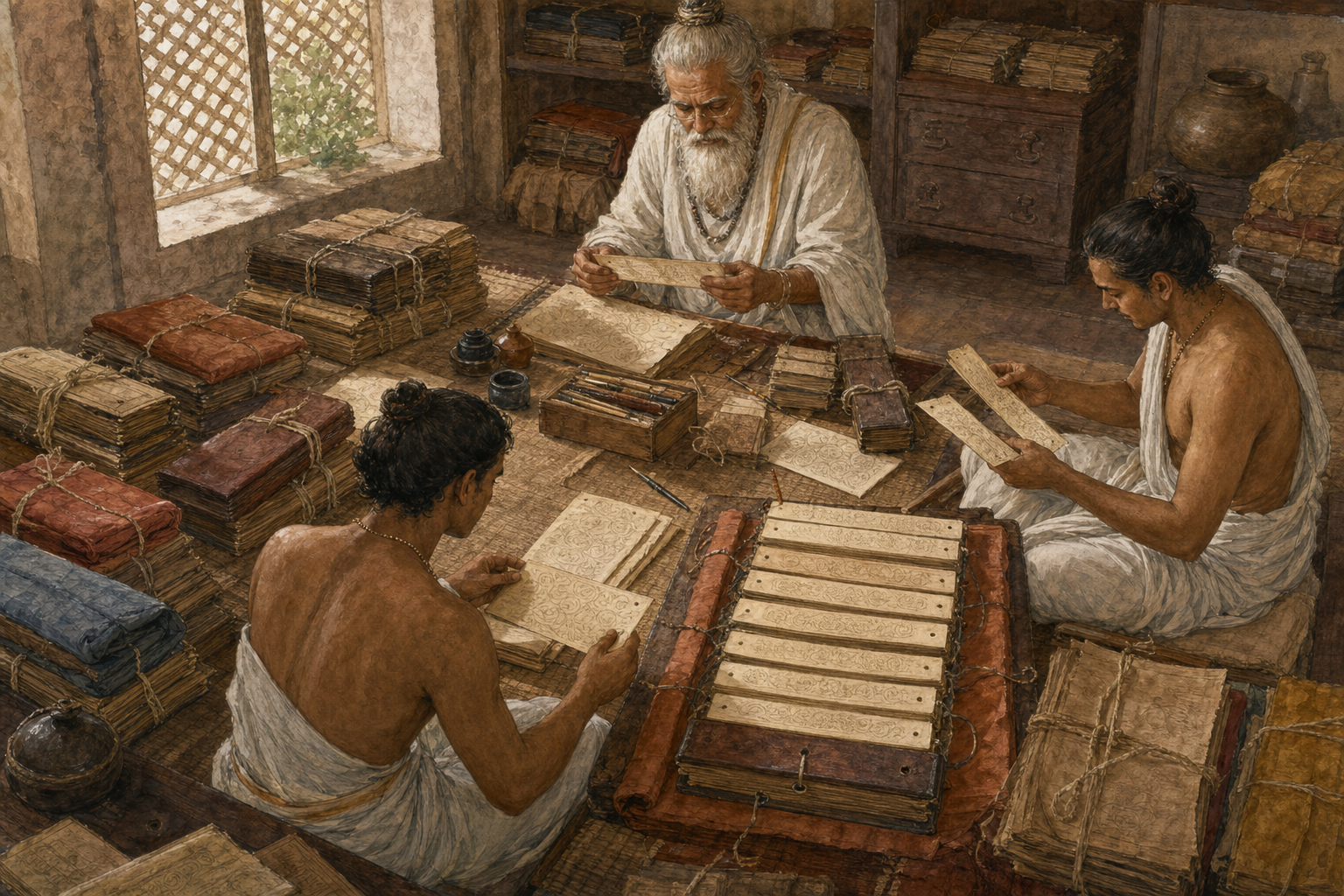
Vishveshvara Bhatta compiled the Madanaparijata in roughly 1360-1390 CE. Its genre is the nibandha, or learned digest. That classification matters more than it may initially appear.
A digest gathers rulings dispersed across earlier Smritis and commentarial traditions, places them under usable topics, and reconciles apparent tensions. It is therefore neither a sovereign’s newly enacted code nor a scrapbook of quotations. Its legal intelligence lies in selection, arrangement, interpretation, and application.
This immediately gives you three levels to distinguish. The first is the inherited authority being quoted. The second is Vishveshvara Bhatta’s handling of that authority. The third is the context in which a resulting rule could apply. If you collapse these levels, you may present an older quotation as the compiler’s unrestricted conclusion or turn a qualified ruling into a universal command.
The historical setting also explains why digest-making was practical work. The 14th century brought consolidating regional polities, increasingly complex courts and communities, and the foundation of Vijayanagara in 1336. Jurists had to make a large normative inheritance usable across changing institutions. That setting does not prove that one political event caused a particular rule, and it does not establish that Vishveshvara Bhatta belonged to a specific court. His precise geographical location remains debated. Do not attach the digest to a kingdom or region more narrowly than your evidence permits.
Genre should therefore govern the language you use. Say that the Madanaparijata preserves, organizes, reconciles, or applies Dharmashastra reasoning. Use the word code only with a qualification, because its modern connotations conceal the plurality that a nibandha was designed to manage.
Read its three domains together with its layers of authority
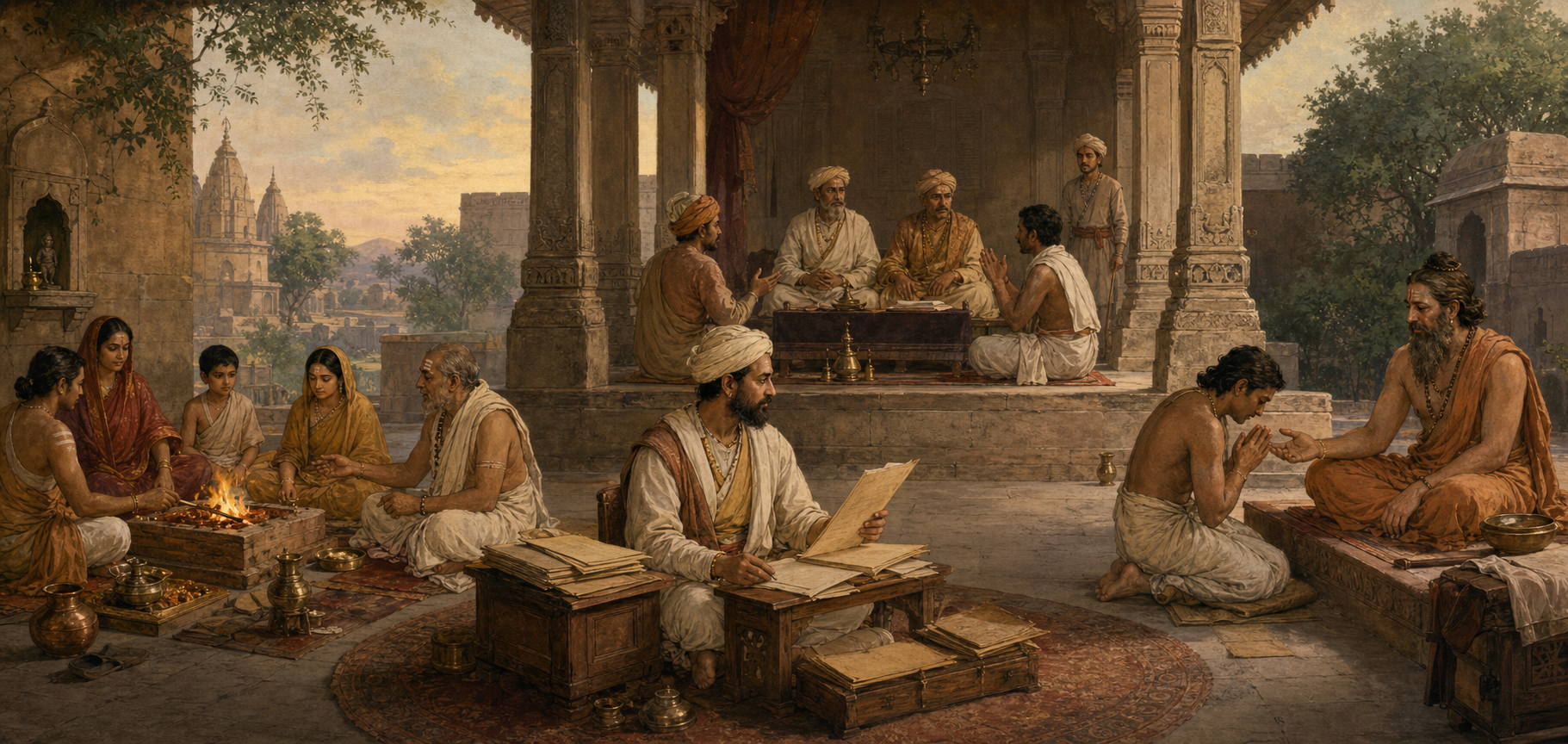
The digest becomes easier to navigate when you begin with the classical division among achara, vyavahara, and prayashchitta. These are working domains, not sealed compartments.
| Domain | Primary concern | What to look for |
|---|---|---|
| Achara | Rites, conduct, and ordered household or community life | Samskaras, daily observances, festival practice, purity, hospitality, life-stage duties, and ritual eligibility |
| Vyavahara | Claims, adjudication, obligations, and judicial procedure | Jurisdiction, evidence, witnesses, possession, documents, debt, property, contracts, and legal status |
| Prayashchitta | Expiation and restoration after wrongdoing | Intention, repetition, consequences, prescribed discipline, purification, recitation, fasting, and dana |
Funeral and ancestral rites, gifts, and endowments extend this map. Family questions frequently cross it. Marriage is a samskara, but it also affects kinship, property, guardianship, and ritual standing. Adoption has a ritual procedure while creating consequences for lineage and inheritance. A modern division between religion and law can therefore hide the very relationships that the jurist was trying to clarify.
The authority structure is layered as well. Shruti and Smriti retain priority, while sadachara, exemplary conduct, and deshachara, established local custom, possess normative force. The triad desa-kala-patra requires attention to place, time, and the person or parties concerned. Context is not an afterthought added once the rule has been found. It is part of determining how a rule reaches an actual case.
That does not mean every practice becomes valid merely because it is local. The relevant custom must be established, ethically defensible, and capable of sustaining the community. Nor do all authorities become interchangeable. The juristic task is to preserve the priority of authoritative injunctions while deciding whether apparently conflicting rulings concern different circumstances.
The Madanaparijata participates in a broad learned conversation involving Manu Smriti, Yajnavalkya Smriti, Narada Smriti, the Mitakshara, the Smritichandrika, and the works associated with Lakshmidhara and Hemadri. A list of names, however, is not yet an argument. When you take notes, place the inherited proposition in one column and the compiler’s reconciliation or application in another. Add a third column for custom and desa-kala-patra. This simple separation prevents citation from masquerading as conclusion.
When two statements appear contradictory, first test whether they address the same act, the same category of person, the same procedural stage, and the same local setting. Only then decide whether you are looking at a genuine doctrinal conflict. In a digest tradition, qualification is often the mechanism of reconciliation.
Test the legal method against concrete kinds of dispute
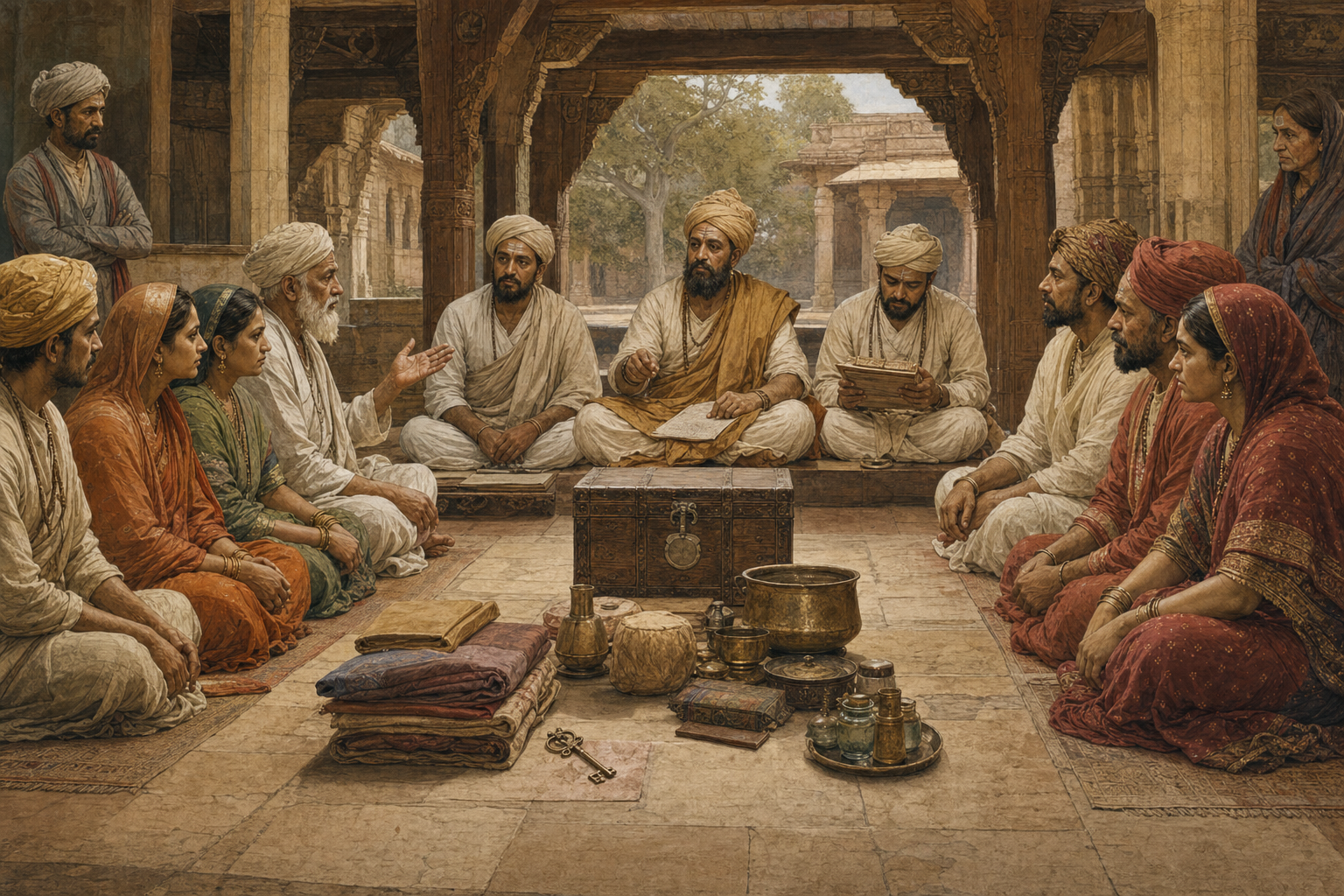
Abstract claims about Hindu law become clearer when you follow a problem from eligibility through procedure to consequence. Four clusters show how much disappears when a rule is quoted alone.
Family continuity joins ritual status to property
Marriage appears as both sacrament and legal institution. Its forms, spousal duties, kinship consequences, guardianship questions, property relations, and ritual eligibility belong to one connected structure. The treatment of stridhana similarly shows that women’s property had recognized categories requiring juristic analysis. Recognition of a category does not, by itself, tell you the precise rule governing every asset or every claimant. You still need the applicable classification and circumstances.
Adoption makes the chain especially visible. The fitness of adopter and adoptee, prescribed ritual steps, gotra and lineage considerations, and the child’s inheritance standing cannot be separated without distorting the institution. Adoption serves continuity across ancestors, living householders, and descendants; it is not adequately described as either a private contract or a ceremony alone.
Inheritance analysis requires the same care. Birthright, partition, coparcenary, maintenance, differentiated property categories, and exceptional cases all matter. The Mitakshara and Dayabhaga schools later became major regional frameworks, but you should not project their later crystallized opposition backward onto every earlier discussion. Ask which underlying category is being analyzed before assigning a rule to a later school.
A reliable family-law note should therefore record a chain: who is eligible, what rite or procedure occurs, what status results, which property consequence follows, and which continuing duties remain. If one link is missing, the conclusion is probably too broad.
Commercial rules make trust a juridical concern
Loans and interest, pledges, deposits, agency, sales, and suretyship all fall within the digest’s treatment of obligations. These categories point to an economy in which credit, custody, representation, documentation, and personal reliability needed explicit rules.
Economic conduct remains connected to satya, fairness, and ritual responsibility. That does not make the legal analysis imprecise. It means that truthfulness is simultaneously a moral duty and a condition of trustworthy exchange. The distinction between lawful and unlawful debt, together with concern about exploitative terms, places commerce inside an ethical order rather than outside Dharma.
When reading a commercial passage, identify the transaction before making a civilizational claim about it. Was property lent, deposited, pledged, sold, or entrusted to an agent? Who bears the obligation? What could prove it? Which remedy or consequence follows? Exact classification is more informative than simply calling the system sophisticated or spiritual.
Courts combined plural venues with formal proof
Judicial authority could operate through the king’s bench as well as guild and community bodies such as the shreni and puga. Jurisdiction and avenues of appeal mattered because a plurality of forums still required an ordered procedure. Local adjudication was not the same thing as the absence of legal structure.
The principal evidentiary categories include written documents (lekhya), possession (bhukti), and dependable witness testimony (sakshi). Ordeal (divya) appears as a restricted last resort, not as the ordinary substitute for evidence. False claims and perjury attract graded consequences, reinforcing the centrality of truthful participation in adjudication.
Be exact when presenting these rules. A juristic framework permitting a procedure does not reveal how frequently every court used it. The digest can establish that a procedure belonged to the available normative repertoire. A claim about actual frequency would require a different kind of evidence.
Expiation treats accountability as repair
Prayashchitta is calibrated by intention, repetition, and consequence. Available disciplines include fasting, recitation, purificatory rites, and generosity through dana. The aim is not exhausted by inflicting pain on an offender. Wrongdoing disturbs personal, social, and cosmic order; disciplined action opens a path toward restored alignment and reintegration.
This domain also warns you against forcing every wrong into one modern category. A litigated claim, a ritual breach, and a moral failure can overlap without becoming identical. Identify the kind of disorder being addressed and the kind of remedy prescribed. Do not assume that an expiatory act automatically cancels every proprietary, familial, or procedural consequence unless the relevant reasoning connects them.
Use a five-pass method before relying on any passage

You can turn the digest’s complexity into a repeatable reading practice. Use these five passes whether you are preparing an essay, teaching a class, evaluating an online claim, or investigating a family or ritual institution.
- Define the narrow question and its domain. Replace a broad topic such as Hindu inheritance with a specific issue such as the status created by adoption or the basis for a partition claim. Mark whether the problem belongs mainly to achara, vyavahara, prayashchitta, or more than one domain.
- Identify each level of authority. Separate an older Smriti proposition from a commentary, Vishveshvara Bhatta’s reconciliation, and the rule finally applied. A cited authority may supply a premise without supplying the whole conclusion.
- Reconstruct the relevant facts. Record the parties’ status, relationship, property category, transaction, procedural stage, and ritual setting. Then apply the desa-kala-patra check: would place, historical moment, or the persons involved alter the reach of the rule?
- State what the evidence can actually prove. Distinguish a prescribed norm, an available legal argument, a procedural possibility, and proof of widespread social behavior. The Madanaparijata is strong evidence for juristic reasoning; by itself, it cannot establish that every community followed every rule uniformly.
- Verify transmission before making a word-level claim. Multiple manuscript lineages circulated in Devanagari and southern scripts, and variant readings reflect continued scribal and editorial engagement. If your conclusion depends on one term or grammatical construction, check which manuscript or edition carries it rather than treating every printed reading as uncontested.
A compact note template is enough: question; domain; inherited authority; compiler’s synthesis; applicable custom; desa-kala-patra factors; procedure or evidence; consequence; confidence level. If you cannot fill one of those fields, name the gap instead of hiding it inside a sweeping statement.
Historical rules about marriage, adoption, inheritance, contracts, or property are not present-day legal advice. Acting on one in a live dispute could affect rights, deadlines, assets, or family status. Consult a qualified lawyer in the relevant jurisdiction for an actual legal matter. For a living ritual decision, consult a competent practitioner who understands the applicable sampradaya and regional custom; a detached quotation cannot supply that context.
Madanaparijata FAQ
Is the Madanaparijata a medieval Hindu law code?
Not in the modern legislative sense. It is a Dharmashastra nibandha: a learned digest that collects, organizes, and reconciles inherited norms for practical use. Calling it a code without that qualification obscures the role of interpretation, custom, and context.
Did local custom override Smriti?
That formulation is too simple. Shruti and Smriti retain authority, while established conduct and local usage help determine application. Desa-kala-patra makes place, time, and person legally significant, but it does not turn every common practice into a valid rule. The custom still has to fit an ethical and community-sustaining normative order.
Does the digest show what every medieval Hindu actually did?
No. It shows how a major jurist organized valid norms, legal categories, procedures, and remedies. Its circulation and reception demonstrate influence, but a prescription is not a census of behavior. Claims about what a particular community regularly did need evidence specific to that community, period, and institution.
Choose one concrete problem next – adoption, documentary proof, debt, stridhana, shraddha, or expiation – and build a one-page authority map for it. Until you can show the inherited rule, the juristic synthesis, the context of application, and the resulting consequence, you have a quotation rather than an understanding of medieval Hindu law.
References
