
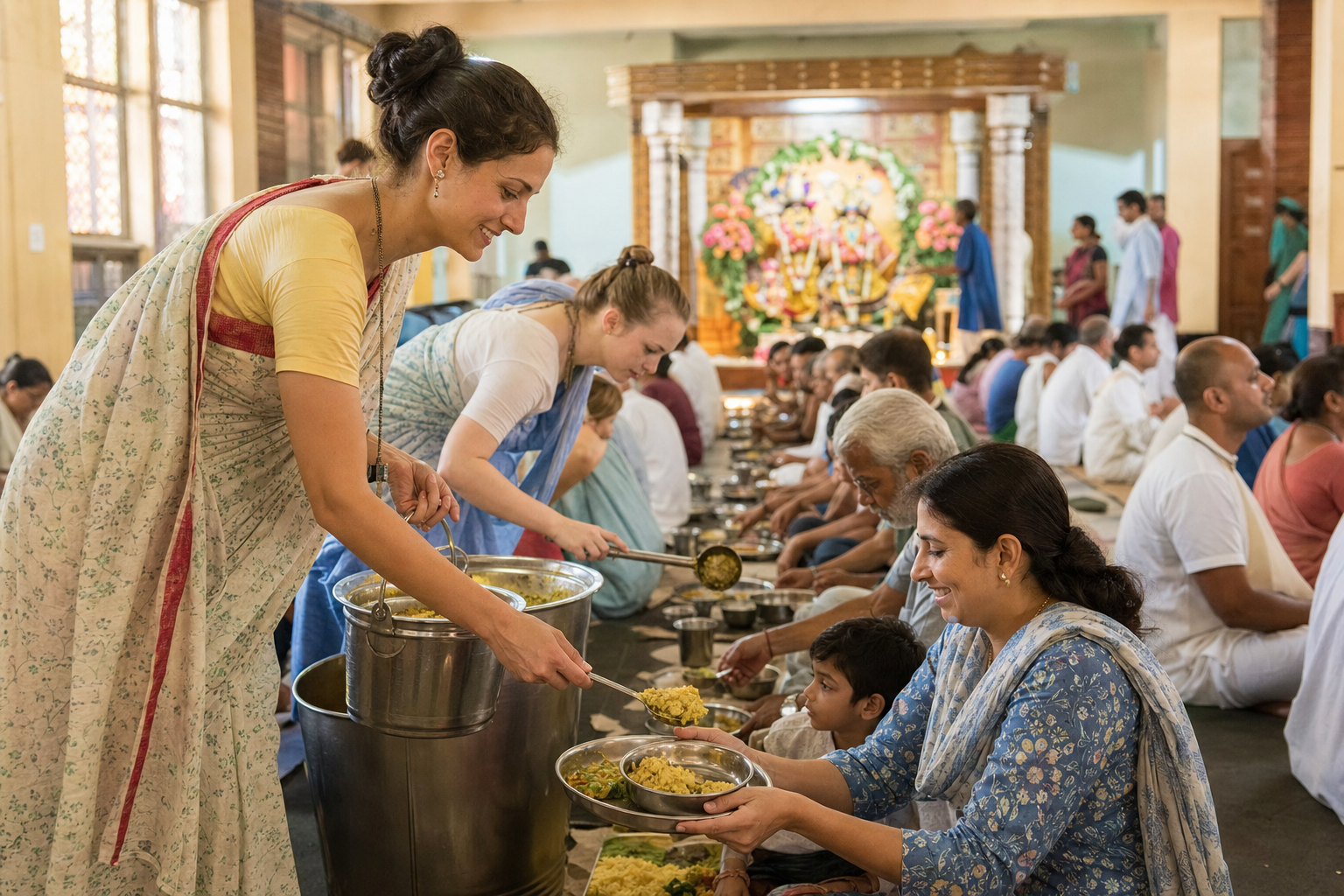
You may have shared a Hare Krishna Sunday feast and wondered how a community can offer such generous hospitality without turning the meal into either a commercial service or an unsustainable burden on a few devotees. If you are planning prasadam distribution at a temple, campus, neighbourhood gathering, or community event, that is the real question in front of you.
The answer is not to begin with fifteen dishes. Begin with a clear sacred purpose, a manageable menu, dignified hospitality, and a volunteer system that can serve again next week. A modest feast offered and distributed with care fulfils the spirit of seva better than an impressive feast that exhausts its cooks.
Keep the offering to Krishna at the centre
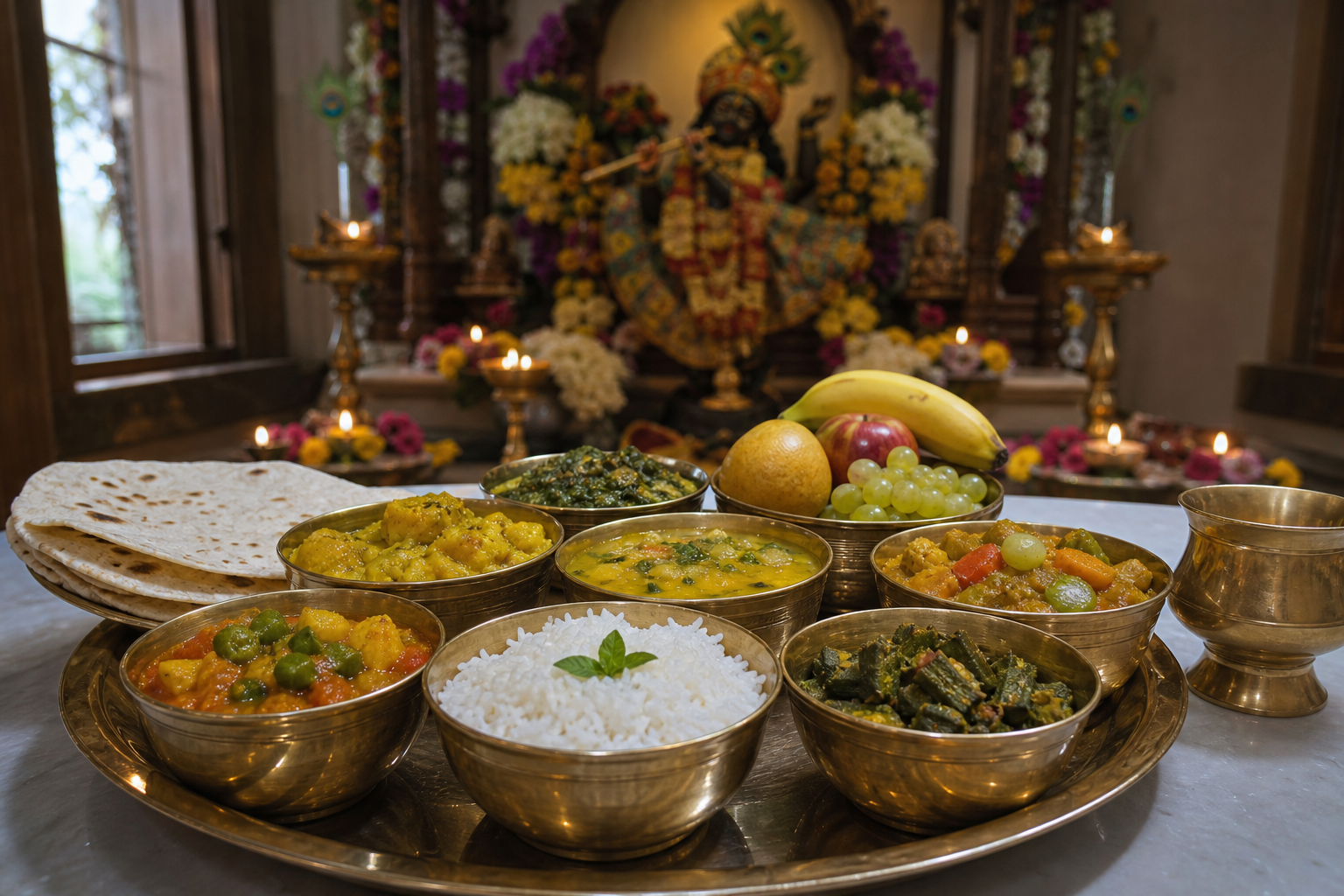
Prasadam is not merely free vegetarian food with a devotional label attached. In Gaudiya Vaishnavism, food is prepared for Krishna, offered as bhoga, and then received and distributed as grace. That sequence changes the meaning of the entire activity: cooking becomes bhakti, the kitchen serves the altar, and feeding a guest becomes seva rather than a transaction.
This distinction matters when you organise a meal. If the offering is treated as a ceremonial pause squeezed into an otherwise ordinary catering operation, practical pressures will eventually displace it. Instead, establish the altar time first and plan procurement, preparation, cooking, and distribution backwards from it.
- Confirm the temple’s food standard before buying ingredients. Vaishnava preparations exclude meat, fish, and eggs, while many kitchens also omit onions and garlic.
- Name one person who will coordinate with the pujari or other person responsible for the offering.
- Decide which preparations must be ready together and which can be completed closer to serving.
- Keep offered and unoffered food clearly identified so that volunteers do not distribute a preparation prematurely.
- Give guests a short, plain explanation: the meal was prepared devotionally, offered to Krishna, and is now shared as prasadam. Receiving it should not require a theological examination.
The familiar Hare Krishna Sunday Feast brought kirtan, philosophy, and prasadam into one public invitation. Each part supported the others. Kirtan opened a shared devotional space, philosophy supplied meaning, and prasadam allowed the guest to participate through an immediate act of receiving. Preserve that coherence even when your programme is small.
Make dignity visible in the way the meal is served
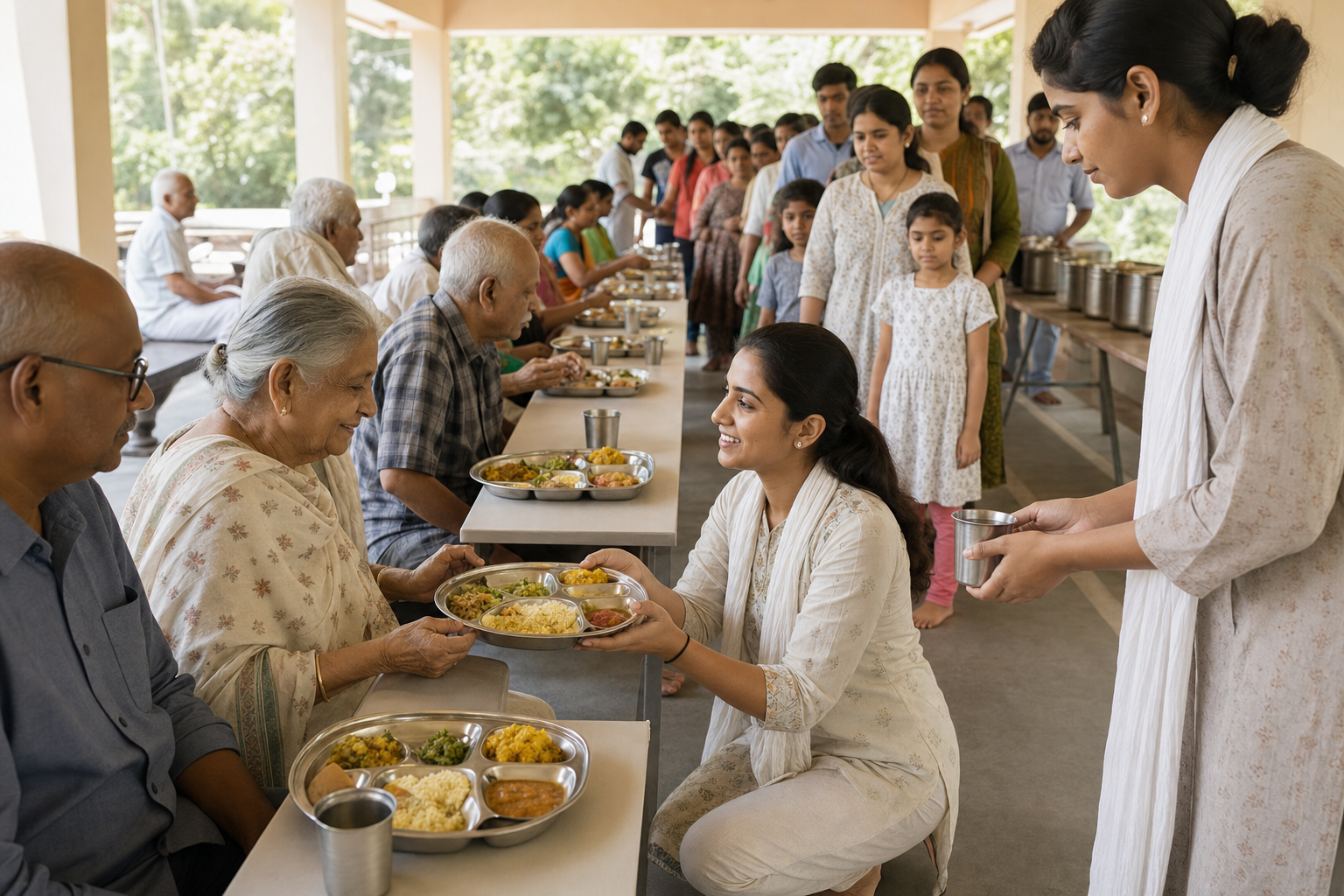
Removing the price does more than make food affordable. It removes the moment in which one person must prove need and another person decides whether that need deserves help. Students, workers, elders, families, donors, first-time visitors, and people facing hunger can receive from the same serving line without being sorted into social categories.
Free does not mean costless. Produce, grains, dairy, cooking fuel, equipment, cleaning materials, and safe storage still have to be funded. The difference is that the community carries those costs collectively through donations, volunteer labour, bulk purchasing, and careful stewardship. The guest is not handed an individual bill for the plate.
You can test whether dignity is real by examining ordinary details:
- Serve the same prasadam to everyone. Do not create a visibly inferior meal for people receiving it without payment.
- Use clean plates, orderly queues, accessible seating, and attentive service. Sacred hospitality is weakened when cleanliness and courtesy are treated as optional.
- Ask before adding more food. Generosity includes respecting a guest’s appetite rather than filling a plate that will be wasted.
- Keep any donation invitation separate from the act of receiving prasadam. A donation box or announcement can explain how the seva is sustained without turning gratitude into pressure.
- Allow people to sit together wherever practical. Shared tables do more community-building work than a room silently divided by age, income, language, or familiarity with the temple.
- Welcome a newcomer who does not yet know when to stand, chant, bow, or begin eating. Explain gently instead of using etiquette as a test of belonging.
A warm farewell matters as much as a warm plate. Tell first-time visitors when the next gathering will be held, but do not corner them into a commitment. The invitation should remain open in the same spirit as the meal.
Build a kitchen that can repeat the seva
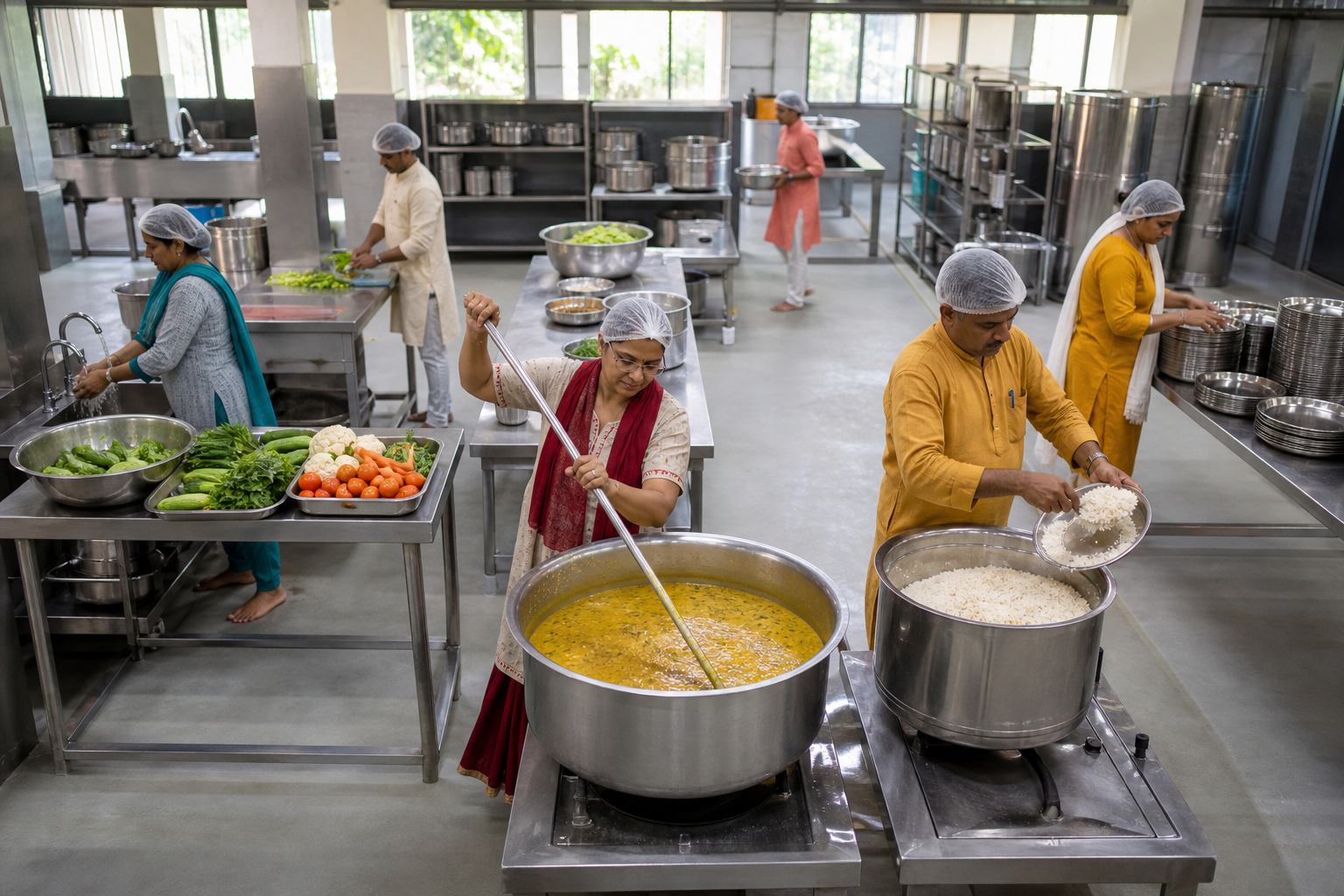
Early Sunday Feasts became memorable for extraordinary abundance, sometimes reaching as many as fifteen preparations. That history should inspire generosity, not numerical imitation. Five well-made preparations served reliably can express abundance more truthfully than fifteen rushed dishes that arrive late, strain the budget, or end as waste.
A practical menu begins with structure. A grain such as rice or chapati provides the base. Dal, chickpeas, or another legume adds substance. A seasonal vegetable sabji supplies colour and texture. Yogurt, paneer, pickle, chutney, or fruit can provide contrast according to the community’s standards and resources. A modest sweet gives the meal a festive conclusion. You can expand from that foundation when the kitchen, funding, and volunteer team are ready.
Use a written run sheet rather than relying on one experienced cook to remember everything:
- Set a realistic capacity. Work from the number of people the kitchen can cook for, offer, seat, and serve safely. If attendance is uncertain, choose dishes that scale predictably.
- Fix the menu before procurement. Check every ingredient against the devotional standard. Also identify common allergens honestly; do not promise an allergen-free preparation unless the kitchen can actually prevent cross-contact.
- Buy staples deliberately. Bulk grains and legumes can reduce costs, while seasonal vegetables can keep the meal varied. Inspect, clean, and sort ingredients before the main cooking period begins.
- Separate work zones. Keep raw-ingredient cleaning away from finished preparations. Give knives, hot vessels, serving utensils, and cleaning supplies defined places so that volunteers are not improvising around heat and congestion.
- Stagger the cooking. Dal and rice suit predictable batch schedules. Time sabjis so that vegetables retain their texture, and prepare sweets early enough to cool properly. Coordinate every cycle with the offering time.
- Control the first serving without appearing ungenerous. Offer a satisfying initial portion and make seconds readily available. This serves late arrivals fairly and gives the kitchen a clearer view of actual demand.
- Close the loop. Record which dishes ran short, which produced surplus, and which slowed the kitchen. Store or redistribute surplus only when local food-safety requirements can be met; devotional intention does not make unsafe food safe.
Waste is not just a financial problem. Every discarded portion represents donated ingredients, volunteer effort, cooking energy, and food that could have served someone. Measure recurring surplus by preparation, then reduce the next batch or change the serving pattern. Precision is compatible with generosity.
Funding should be equally transparent. Work out the recurring ingredient and operating needs, explain them to regular supporters, and let donors sponsor the seva without acquiring special status at the table. The meal remains a gift when financial stewardship happens before and after distribution rather than across the serving counter.
Turn volunteer shifts into a durable community
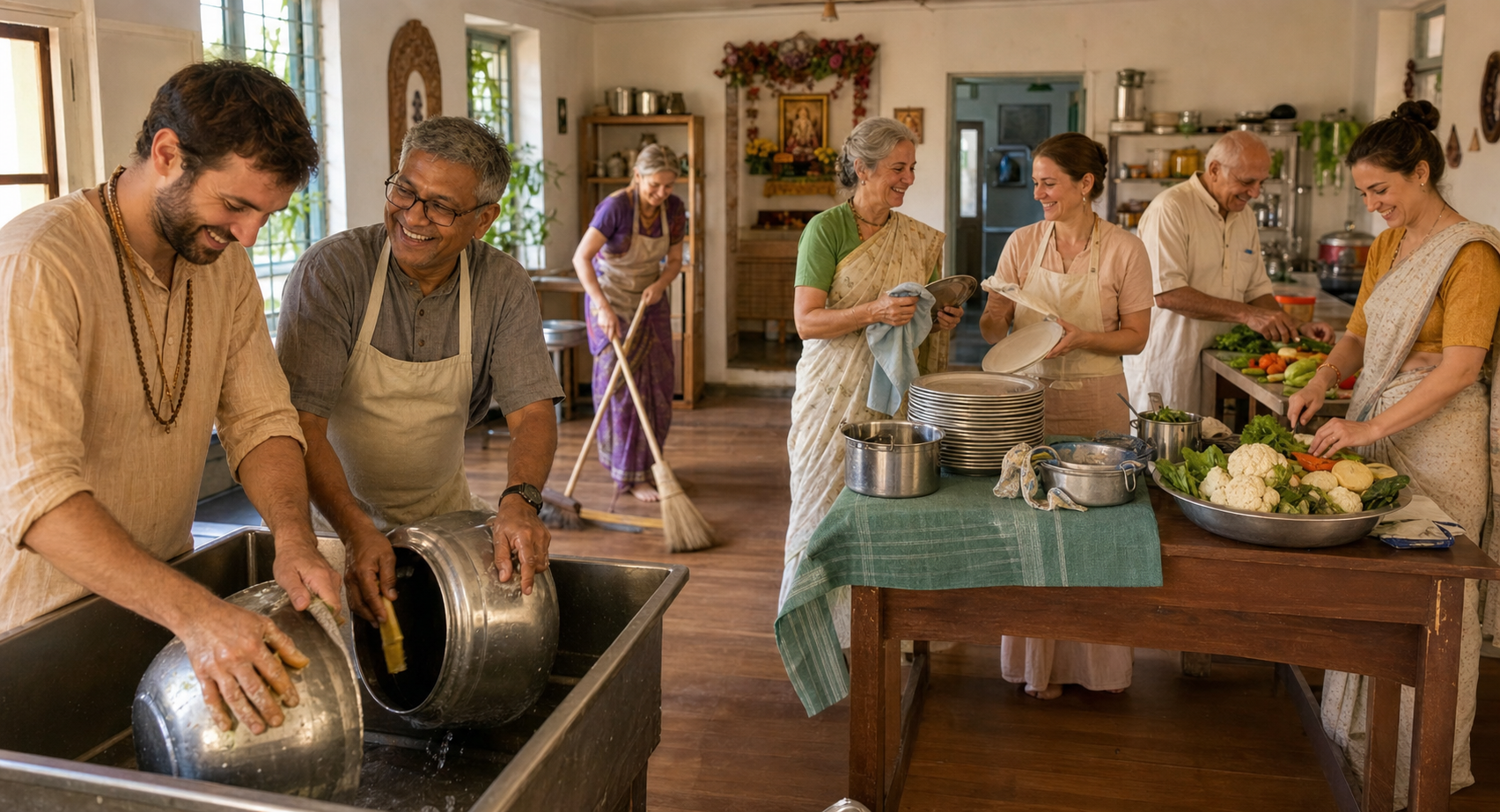
A prasadam programme becomes fragile when two skilled people cook everything while everyone else arrives to eat. It also becomes unsafe when enthusiastic newcomers wander among hot vessels without a defined task. Give each person a bounded responsibility, teach it properly, and make the path to greater responsibility visible.
At minimum, assign one accountable person to each of four functions:
- Kitchen lead: owns the menu, quantities, cooking sequence, and final readiness of each preparation.
- Offering liaison: coordinates the altar vessels, offering time, and release of prasadam for distribution.
- Service lead: organises the queue, portions, seating, seconds, and assistance for guests who need it.
- Cleanliness and surplus lead: manages washing, waste separation, storage decisions, and the condition in which the kitchen is handed back.
Begin each service with a short briefing. State why the food is being prepared, when it must be ready, who can authorise a change, and where each volunteer belongs. End with an equally short review. Ask what ran late, what confused guests, where food accumulated, and who is ready to learn another role next time.
Rotate visible and invisible duties. Serving prasadam may feel more rewarding than washing heavy vessels, but both are seva. If the same people are repeatedly left with procurement, cleaning, and storage, cheerful service can quietly become resentment. A rotation makes the shared-duty principle concrete.
The meal can also introduce people to a wider dharmic culture without erasing theological differences. Sikh langar, Buddhist dana, and Jain meals shaped by ahimsa all show how food can embody generosity and reduce social distance. Hare Krishna prasadam has its own centre: the offering to Krishna. You can recognise the civilisational kinship while explaining that the practices are related, not interchangeable.
This is especially valuable in a diaspora community. A young person or unfamiliar visitor may not begin with a command of Gaudiya Vaishnava philosophy, but they can hear kirtan, watch devotees cooperate, receive prasadam, and help stack chairs or wash plates. Ideas such as bhakti, seva, ahimsa, and hospitality become intelligible because the person can see them taking social form.
Key takeaways for your next prasadam programme
- Protect the sacred sequence: prepare for Krishna, make the offering, and then distribute prasadam.
- Measure abundance by the reliability and warmth of the welcome, not by the number of dishes.
- Keep the meal free at the point of service and keep donation requests separate from receiving a plate.
- Start with a balanced, manageable menu that the kitchen can execute safely and repeatedly.
- Give altar coordination, cooking, serving, cleaning, and surplus management clear owners.
- Use the same table to welcome regular devotees, curious visitors, donors, and people facing material need.
- Review quantities and workflow after every gathering so that generosity produces less strain and less waste over time.
For your next gathering, resist the urge to add another preparation first. Write a one-page run sheet naming the menu, offering time, four role owners, free-service policy, and surplus plan. Run that simple system well, review it with the volunteers, and expand only when the community can carry the expansion together.
References
- Dandavats – Feast Without Price: What Hare Krishna Prasadam Teaches About Seva, Community, and Unity
