

You may have noticed a fine inner sound in meditation, read that it can draw the mind into laya, and wondered whether you should follow it or try to awaken kundalini. The useful answer is neither dismissive nor sensational: nada can support inward absorption, but only when your breath remains unforced, your attention stays lucid, and your life becomes steadier rather than more disturbed.
If you want a sound starting point, make your aim simpler than “raising energy.” Learn to recognize wakeful quiet, use inner sound as an anchor rather than an achievement, and let ethical conduct test whether the practice is ripening. This gives you a practical way forward without confusing intensity with depth.
Laya is lucid absorption, not mental disappearance
Layayoga works through the progressive dissolution of sensory, mental, and energetic patterns into subtler awareness. “Dissolution” does not mean damaging the mind, suppressing thought, or becoming insensible. It means that attention is no longer scattered among competing objects and identifications. What was noisy becomes quiet enough for awareness to recognize its own ground.
Advaita Vedanta supplies an essential distinction here. Mano-laya is a temporary settling of mental activity. Mano-nasha is the ending of the ignorance that makes us identify the Self with passing mental forms. A peaceful meditation may therefore be valuable without being final. Thoughts can subside and return. The mistake is not enjoying that peace; the mistake is treating an interval without thought as proof of liberation.
Blankness is especially easy to misread. Fatigue, dullness, and tamas can reduce mental content, but they do not produce clear seeing. Genuine laya remains awake. You may lose interest in surface distractions, but you do not lose the thread of awareness. Afterward, you should be more oriented and less entangled, not foggy, inflated, or hungry to claim an attainment.
Use three tests. During practice, ask whether awareness is continuous or merely absent. Immediately afterward, notice whether the mind is clear or heavy. In daily life, look for less compulsive reaction, more truthful perception, and a greater capacity to act without harming yourself or others. An unusual sensation that leaves conduct unchanged is an experience, not reliable evidence of realization.
Other Dharmic traditions contain recognizably related disciplines without becoming interchangeable with Layayoga. Buddhist jhana and nirodha concern deep pacification; Jain samayika and pratikraman help calm passions through ethical and contemplative discipline; Sikh simran and anhad shabad resonate with remembrance and unstruck sound. These family resemblances invite mutual respect, but each tradition interprets absorption through its own view of self, liberation, and ultimate reality. If you practice within one of those lineages, receive operational guidance from that lineage rather than imposing an Advaitic conclusion upon it.
Key takeaways
- Laya means wakeful absorption, not unconsciousness, suppression, or simple fatigue.
- A quiet mind is useful, but temporary quiet is not the same as the ending of ignorance.
- Nada is an attentional support, not proof that kundalini has awakened.
- Judge practice by clarity, ethical steadiness, and integration in ordinary life.
- Forceful breath or energy work belongs under competent guidance, not in an improvised beginner routine.
A low-risk way to begin nada-laya practice

Nada-laya turns attention toward subtle sound. The traditional term anahata nada points to spontaneous or “unstruck” resonance: sound that is not being deliberately produced as an external object. Your task is not to manufacture it, hunt for the correct pitch, or decide where it must be located. The practice begins with listening itself.
The Nada-Bindu and Hamsa Upanishads place inner sound and the natural So’ham current within a movement from concentrated attention toward absorption. For a beginner, the safest version preserves that simplicity. It does not require breath retention, energetic locks, or attempts to push sensation along the spine.
- Set the intention. Sit to cultivate lucid inwardness, not to make something dramatic happen. This protects you from interpreting every sensation as a spiritual event.
- Establish an undemanding posture. Let the body be upright and stable without turning discomfort into a test of will. Release avoidable tension in the face, jaw, throat, shoulders, and abdomen.
- Allow external sound to be present. Do not fight the environment. Hear sound without following its story. This is pratyahara in practical form: sensory information is received, but it no longer commands attention.
- Let the breath remain natural. If So’ham is already meaningful within your practice, notice “So” with inhalation and “ham” with exhalation. Do not lengthen, hold, or force the breath to fit the mantra.
- Notice whether a subtler auditory thread becomes apparent. If it does, rest attention on it lightly. Do not squeeze concentration around it. If nothing appears, remain with natural breath or mantra; the absence of an inner tone is not failure.
- Return without commentary. When thought carries you away, recognize that movement and return to breath, mantra, or sound. Avoid analyzing the pitch, assigning it to a chakra, or ranking the sitting while you are still practicing.
- Close deliberately. Let external sounds, bodily contact, and visual perception return to the foreground. Notice whether the result is wakeful composure. End while attention is still clear rather than continuing until exhaustion produces dullness.
This sequence intentionally leaves out advanced pranayama, bandhas, and mudras. Those methods can alter the relation between breath, attention, and felt energy, so they require more individual calibration than written instructions can provide. Precision matters more than intensity.
Do not automatically spiritualize every perceived sound. If a sound is intrusive outside meditation, produces distress, or is accompanied by concerning physical symptoms, pause the practice and seek assessment from a qualified health professional. A meditation framework cannot determine whether a sound has a medical cause, and spiritual guidance is not a substitute for clinical care.
Kundalini belongs inside a complete discipline

Kundalini is often presented online as an event to trigger. Layayoga places it within a much larger discipline of ethical restraint, sensory withdrawal, regulated prana, concentration, meditation, and insight. That change of frame matters. If awakening becomes a trophy, every twitch or wave of heat invites interpretation. If liberation is the aim, the more useful questions are whether attention is stable, ignorance is weakening, and conduct is becoming aligned with dharma.
In the traditional subtle-body map, prana moves through nadis. Ida and pingala flank the central sushumna nadi. The principal chakras are described from muladhara through svadhisthana, manipura, anahata, vishuddha, and ajna, with sahasrara associated with the crown of awakening. Kundalini is said to ascend through sushumna as prana becomes refined and the granthis, or energetic knots, are loosened. These are categories of yogic anatomy and practice; they should not be confused with ordinary biomedical anatomy.
You do not need to produce a sensation at every chakra or mentally push energy upward. A visualization can be vivid without representing transformation, while a quiet practice can be profound without producing spectacle. Sensory intensity is therefore a poor measure of progress.
Prana-laya uses measured pranayama to quiet the mind alongside the breath. Bandhas and mudras may help direct and stabilize prana when they are correctly chosen. The operative words are “measured” and “correctly chosen.” Straining the breath, repeating locks without understanding their purpose, or combining several advanced methods because each promises faster ascent works against Layayoga’s demand for balance.
Keep a clear boundary between what can reasonably be explored alone and what needs guidance. Natural breath awareness, uncomplicated japa, So’ham remembrance, pratyahara, and gentle attention to nada are suitable foundations when they remain comfortable and lucid. Deliberate breath retention, forceful pranayama, complex combinations of bandhas and mudras, and attempts to provoke kundalini should be learned from a competent teacher who can observe your response and reduce the practice when needed.
Choose the doorway that matches your actual obstacle

Layayoga contains several doorways because distraction does not have a single cause. Collecting all of them at once usually gives the mind more material to manage. Identify the pattern that repeatedly interrupts clarity, then use the least complicated practice that addresses it.
| What you notice | Useful doorway | Your next move | What not to infer |
|---|---|---|---|
| Every sight, sound, or notification pulls attention outward | Pratyahara-laya | Let sensory input be present without pursuing it, then return to one inward anchor | Withdrawal does not mean numbness, repression, or hostility toward the world |
| Breath and thought become agitated together | Prana-laya | Begin with natural breath awareness; learn deliberate regulation from a teacher | Breath strain is not purification and does not prove prana has entered sushumna |
| A subtle sound holds attention without much effort | Nada-laya | Rest lightly on the sound and return whenever commentary begins | Hearing a tone does not establish spiritual rank or kundalini awakening |
| You remain identified with body, vitality, mood, thought, or pleasure | Tattva-laya | Use pancha-kosha viveka to distinguish the changing annamaya, pranamaya, manomaya, vijnanamaya, and anandamaya sheaths from witnessing awareness | Memorizing the five sheaths is not the same as releasing identification with them |
| Discursive thought needs a steady sacred rhythm | Mantra-laya | Use deliberate japa or the breath-linked remembrance of So’ham | Mechanical repetition does not automatically become insight or devotion |
These doorways can converge, but convergence should happen through maturity rather than accumulation. Japa may naturally become subtler until it resembles listening. Listening may draw the senses inward. A quiet breath may support both. Let one stable practice reveal the next requirement instead of assembling a dense routine from unrelated instructions.
Tattva-laya is particularly helpful when meditation is peaceful but identification remains strong. Pancha-kosha viveka examines experience layer by layer: physical embodiment, vitality, mental activity, discernment, and subtle happiness are all observable and changing. The point is not to dislike these layers. It is to stop mistaking any changing layer for the invariant witness. This contemplative clarity keeps absorption from becoming an escape into pleasant states.
Let conduct and competent guidance verify the practice
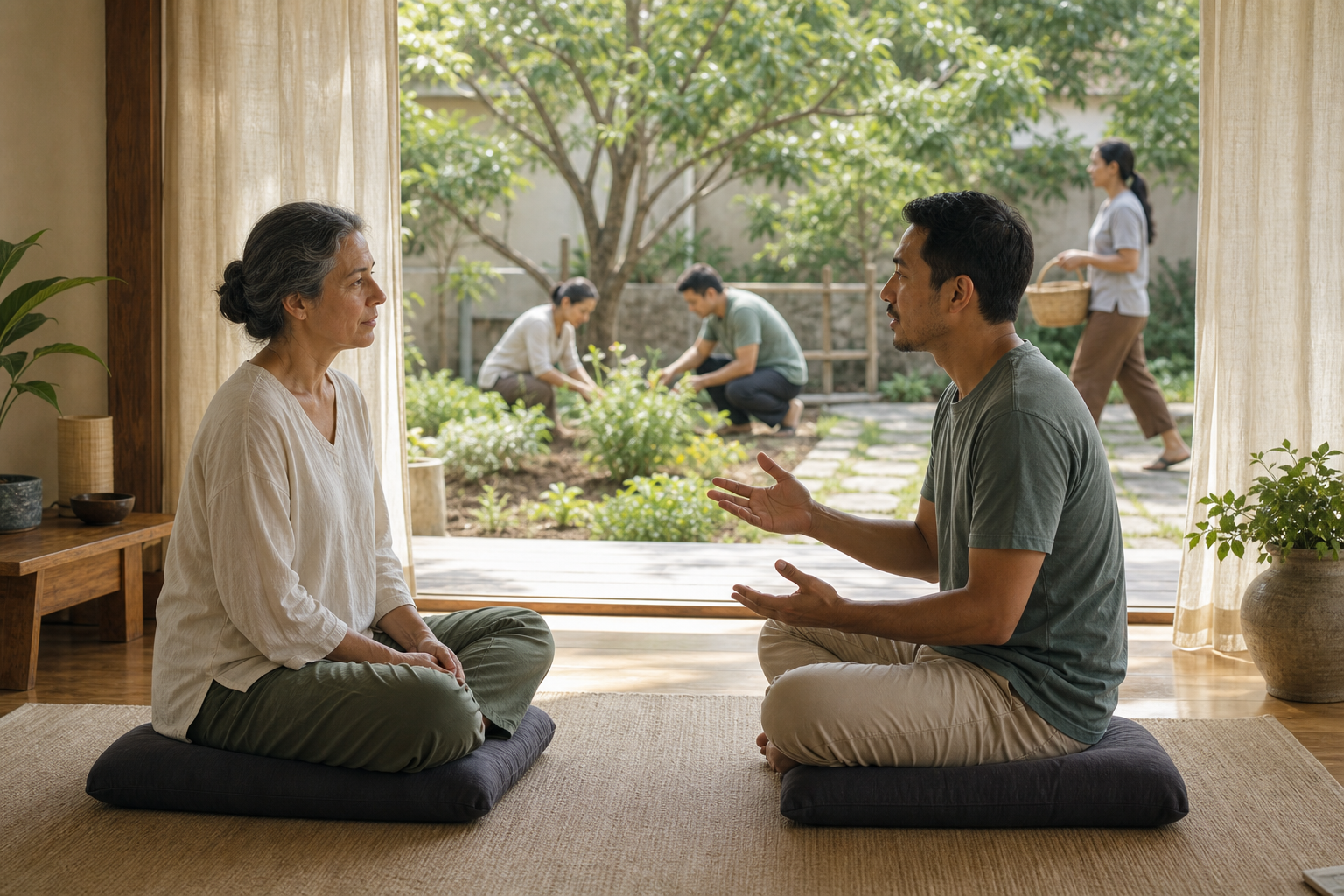
The yamas and niyamas are not preliminary rules that advanced practitioners outgrow. They reduce the very conflicts that keep attention divided. They also provide a sober test when inner experiences are ambiguous.
Apply the yamas directly. Ahimsa means you do not injure the body or destabilize the mind in pursuit of an experience. Satya requires honest reporting: “I felt pressure” is more truthful than “kundalini pierced a chakra” when interpretation exceeds observation. Asteya prevents you from claiming attainments that are not yours. Brahmacharya asks for responsible containment of energy rather than compulsive discharge or display. Aparigraha keeps you from hoarding methods, initiations, and spiritual identities.
The niyamas give the practice its positive shape. Saucha supports an orderly body, environment, and intention. Santosha weakens the demand for novelty. Tapas sustains disciplined warmth without turning discipline into violence. Svadhyaya joins self-examination to scriptural orientation. Ishvara-pranidhana releases the demand to control the result. Together, these foundations keep Layayoga directed toward freedom rather than fascination.
How to recognize useful guidance
Guru-kripa is honored because a competent teacher can see where ambition, dullness, fear, and genuine absorption are being confused. Guidance is especially valuable before adding strong pranayama, bandhas, mudras, or practices intended to move kundalini.
- The teacher asks about your ethical foundation, ordinary responsibilities, and stability instead of discussing energy in isolation.
- The teacher can explain the difference between wakeful laya and tamasic blankness in terms you can actually apply.
- The teacher adjusts or reduces practice when strain appears rather than treating every difficulty as proof of purification.
- The teacher distinguishes observation from interpretation and does not demand that you label every sensation as kundalini.
- The teacher relates practice to a coherent lineage, scriptural framework, and liberating aim rather than promising spectacle.
- The teacher respects the boundary between spiritual instruction and medical or psychological care.
When to pause rather than push through
Pause any method that repeatedly makes the breath strained, produces persistent agitation or confusion, or interferes with your ability to carry out ordinary responsibilities. Return to uncomplicated grounding practices only if they are comfortable. If distress persists or functioning is impaired, seek an appropriately qualified health professional. A teacher may help revise spiritual practice, but should not replace necessary medical or psychological assessment.
Also pause when dullness becomes the goal. If you are using meditation mainly to disappear from difficult emotions or duties, deeper withdrawal may reinforce avoidance rather than dissolve ignorance. Layayoga is not flight from the world. Its fruit should be a clearer capacity to meet the world without being bound by every sensory impression, thought, or impulse.
For your next sitting, do less. Keep the breath natural, let the senses settle, and follow one stable thread of So’ham or spontaneous sound. Close while clarity remains intact, then observe the quality of your conduct. If that simple practice cannot stay lucid and humane, adding kundalini methods will not repair the foundation; strengthen it or find competent guidance.
References
