

You may be deciding whether to tell a painful truth, break a promise that now shelters wrongdoing, or remain loyal to people whose conduct you cannot defend. In that moment, the instruction to follow dharma can sound clear while the duties in front of you do not.
The Ramayana and Mahabharata offer a demanding way through this confusion. First ask whether ego has damaged your perception. Only then ask whether two real duties collide. Ravana represents the first problem; Yudhishthira represents the second. Confusing them lets self-interest borrow the language of exceptional duty, or reduces a genuinely tragic choice to simple corruption.
Before you call dharma difficult, examine how you see
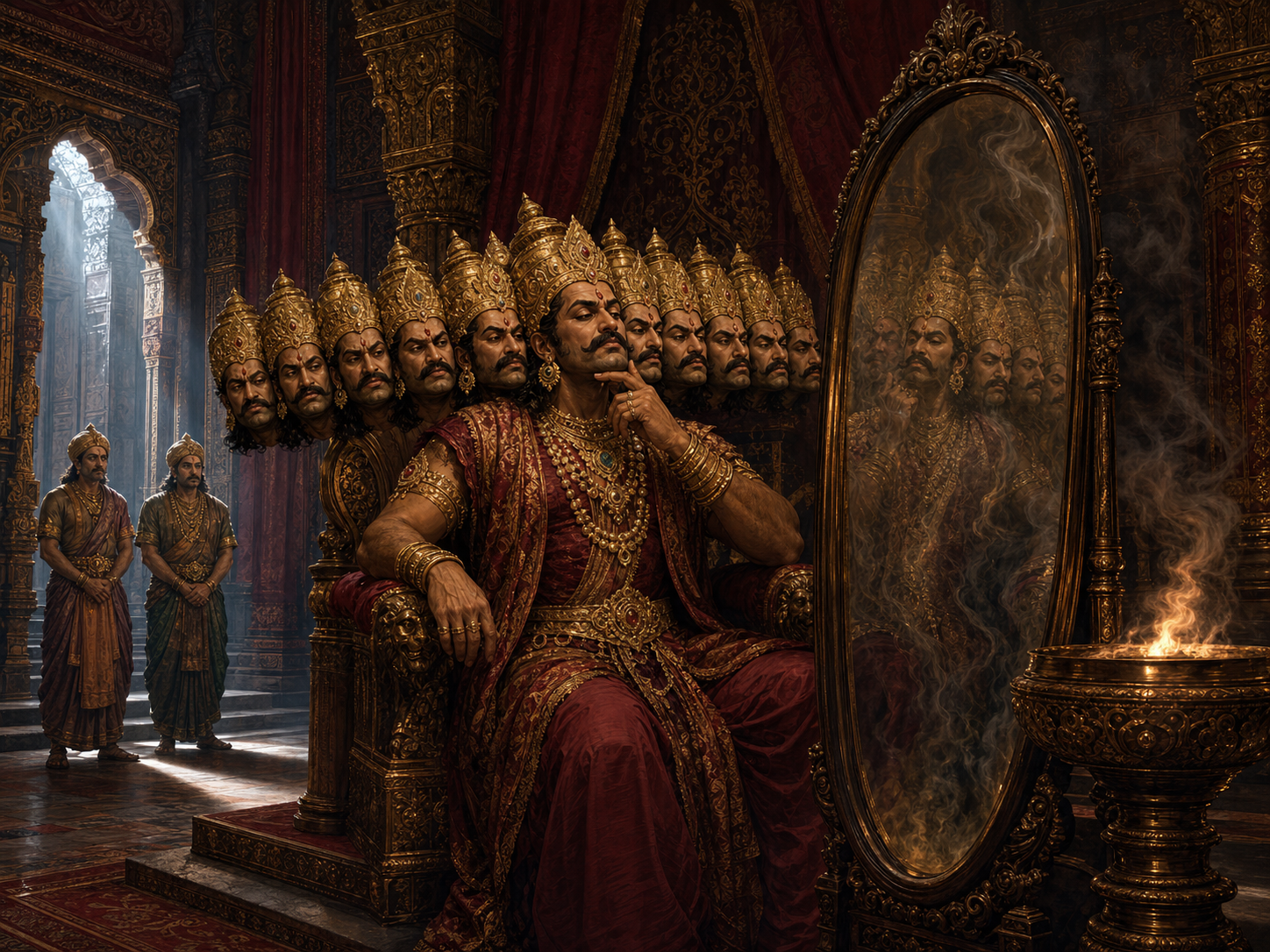
A decision is not ethically complex merely because the right action will cost you status, comfort, loyalty, or power. Sometimes the apparent conflict exists because the mind has already chosen its desired result and is now recruiting moral language to defend it.
Ravana has learning, tapas, authority, and access to sound counsel. What he lacks is a willingness to let truth revise his identity. After abducting Sita, he interprets every warning through pride and attachment. Vibhishana identifies the wrong, anticipates its consequences, and proposes the return of Sita. Ravana does not answer the substance of that counsel. He turns inconvenient dissent into apparent disloyalty.
That is an ethical failure of perception before it is a failure of action. Ravana sees his own desire as entitlement, resistance as insult, and retreat from wrongdoing as humiliation. His intelligence remains active, but it works for ahankara rather than viveka. Knowledge without humility becomes an advocate for whatever the ego has already decided.
Vibhishana sees the same kingdom, danger, family obligations, and approaching war. Yet he reaches another judgment because he does not make family loyalty sovereign over dharma. His clarity is not passive disapproval. It produces counsel, a proposed remedy, and finally a refusal to become complicit.
Before treating your own case as an exception, run a perception audit:
- What fact, if true, would prove that your preferred judgment is wrong?
- Whose advice are you discounting because it threatens your status, attachment, or public image?
- Would you call the same conduct dharmic if an opponent used it against you?
- Are you describing the welfare of everyone affected, or mainly defending your role and identity?
- Have you answered the strongest objection, or merely questioned the loyalty of the person raising it?
If those questions immediately make you defensive, do not invoke apaddharma yet. Slow the decision, state the opposing case in language its advocate would recognize, and ask someone who can disagree without needing your approval.
This is why right perception is itself a spiritual discipline. Hindu viveka, Buddhist samyak drishti, Jain anekantavada, and the Sikh struggle against haumai are not interchangeable doctrines, but each refuses to let private desire become the sole measure of reality. They train you to widen the field of vision before claiming moral certainty.
A necessary choice can still leave a moral wound
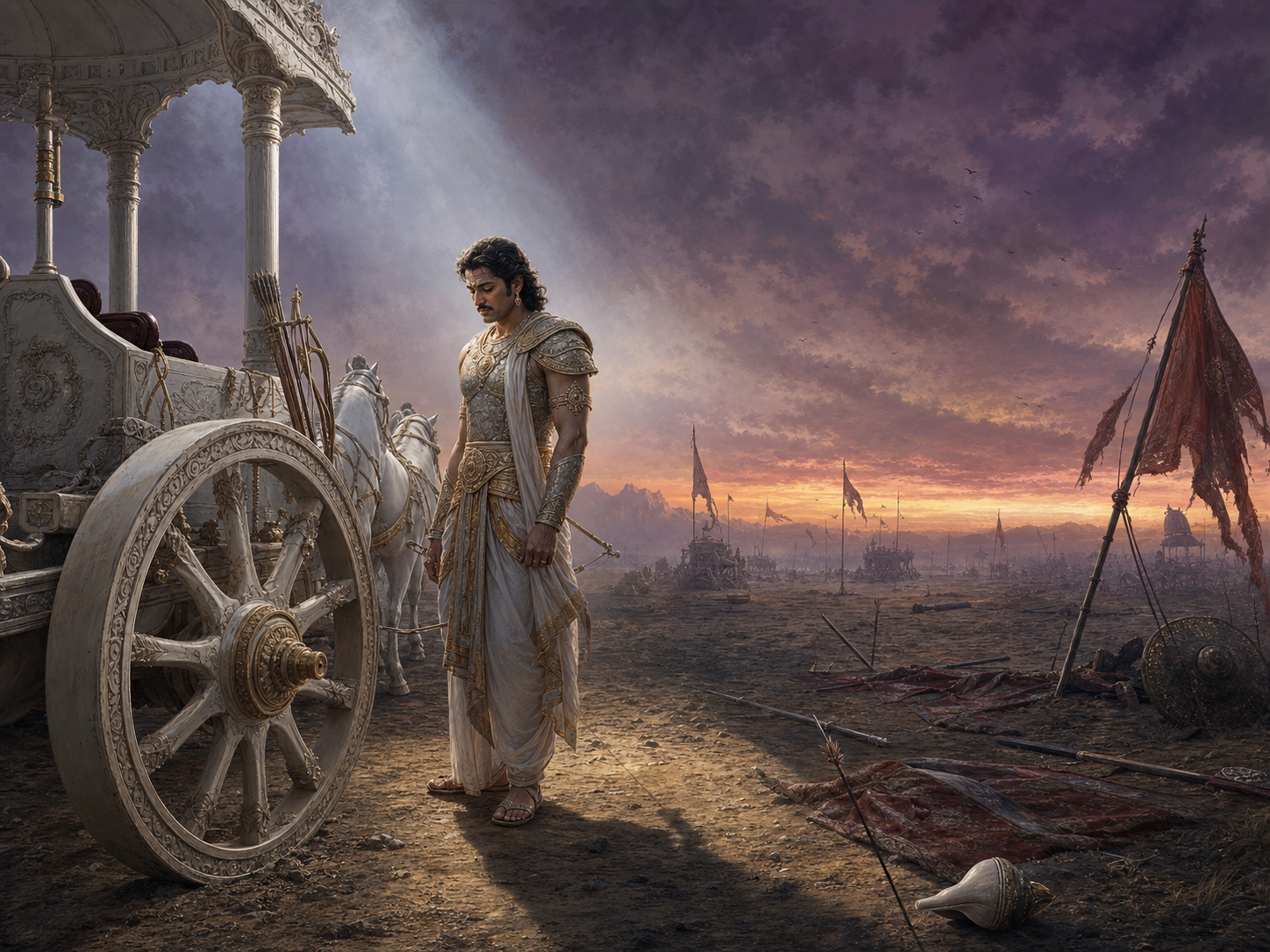
Once perception has been tested, a genuine conflict may remain. The Mahabharata does not promise that clear sight will always reveal an unstained option. Sometimes ordinary duties collide, and every available course carries loss.
The Drona Parva places Yudhishthira inside such a collision. Drona remains devastating while armed and resolute. Bhima kills an elephant named Ashvatthama, after which Yudhishthira announces that Ashvatthama has died while allowing the man-or-elephant qualification to disappear into the battlefield noise. Drona receives the false meaning the stratagem was designed to produce, lays down his weapons, and is killed.
This is more than a puzzle about whether each spoken word was factually accurate. It distinguishes vak-satya, truth in wording, from artha-satya, truth in communicated meaning. A sentence can satisfy the first while violating the second. If you deliberately arrange accurate words so that another person will form a false belief, technical correctness does not make the communication honest.
The point becomes visible in the remembered image of Yudhishthira’s chariot. His commitment to truth had kept it four finger-breadths above the earth; after the deceptive utterance, it touches the ground. Traditional tellings and commentarial streams vary in how strongly they emphasize the levitation, but the descent consistently functions as an outward sign of an inward ethical cost.
Yudhishthira is not Ravana. He is not manufacturing complexity to protect appetite or pride. He faces a collision among satya, kshatra-dharma, rajadharma, and the survival of those for whom he bears responsibility. Yet the epic does not convert necessity into innocence. The strategy may be defensible within the emergency and still diminish the person who carries it out.
That remainder is one of the Mahabharata’s most useful ethical insights. A choice can be justified all things considered without becoming pure in every respect. Consequences do not automatically cleanse the means, just as rigid adherence to one rule does not automatically discharge every wider duty.
Apaddharma therefore means disciplined exception, not moral permission without limits. The later Shanti and Anushasana Parvas examine duties that shift under emergency, but contextual judgment is not the same as relativism. An exception must answer to the seriousness of the danger, the duties in collision, the narrowness of the departure, and the repair owed afterward.
When you hear yourself say that a statement is technically true, ask a better question: What will a reasonable listener believe after hearing it? If your plan depends on the listener missing a qualification, you are using literal truth as a vehicle for deception. Name that fact honestly before deciding whether the emergency could warrant it.
Use this six-question test before departing from a rule

Do not resolve a difficult decision only in your head. Write one answer to each question before you act. The act of writing exposes vague claims of necessity and makes later self-justification harder.
- What is the ordinary duty? Name the rule you would follow outside the crisis: tell the truth, avoid injury, keep a promise, protect a confidence, obey a legitimate role, or refuse participation in wrongdoing. If you cannot name the baseline, you cannot explain the exception.
- What makes this an actual emergency? Identify the concrete harm, who faces it, how the harm would occur, and why ordinary action cannot address it. Embarrassment, loss of advantage, and refusal to admit error do not become apaddharma merely because they feel urgent.
- Which duties genuinely collide? Separate personal obligation from role-based obligation. Svadharma, rajadharma, kshatra-dharma, family loyalty, protection of the vulnerable, and truthfulness may point in different directions. Do not let the loudest duty erase the others without argument.
- Is your perception clear enough to judge? List the facts that support your choice, the facts that weaken it, and the strongest alternative explanation. Then ask whether attachment, aversion, fear, or ahankara changes the way you are weighting them. Apply the same standard to your allies and opponents.
- What is the least deforming means? Exhaust candid speech, correction, delay, limited disclosure, recusal, mediation, or another non-deceptive path before using concealment or manipulation. If departure remains necessary, restrict its scope, duration, audience, and intended effect.
- What ethical debt will remain? Decide before acting what acknowledgment, disclosure, restitution, apology, discipline, or prayaschitta will follow. If you insist that a necessary exception leaves no debt at all, you are already at risk of turning an emergency measure into a habit.
Two stopping rules make this test harder to manipulate. If you cannot state the concrete harm in the second question, keep the ordinary rule. If you have not seriously attempted the least deforming means in the fifth, you have not established necessity. When the main beneficiary is your status or control, return to the perception audit.
The test will not manufacture a painless answer. Its purpose is narrower and more realistic: prevent a preferred result from disguising itself as dharma, and prevent a true emergency from becoming a permanent precedent.
Dissent before the act and repair after it

Vibhishana demonstrates what responsible dissent should look like. He identifies the breach, explains the danger to the ruler and kingdom, and proposes a proportionate remedy: return Sita. He does not confuse kinship with obedience or opposition with revenge. When continued loyalty would require complicity, he seeks refuge with Rama.
Rama’s response supplies the other half of the lesson. Although allies initially suspect the newcomer, Rama binds his power through a vow of protection for one who sincerely seeks refuge. Sharanagati becomes more than private devotion here. It creates a path by which a person may leave an adharmic allegiance, accept a new duty, and participate in restoration.
If you are the dissenter, make your objection testable. Name the act, the violated duty, the foreseeable consequence, and the correction you seek. Avoid attacking motives you cannot know. Decide what non-complicity requires if the correction is refused.
If you hold authority, do not begin by demanding reassurance about loyalty. Ask the dissenter for evidence, the strongest opposing case, and a workable remedy. A court, family, community, or institution that punishes every inconvenient warning eventually loses the ability to distinguish fidelity from flattery. Ravana’s isolation begins before his military defeat: it begins when truth can no longer travel safely through his court.
Where dissent should precede a harmful act, repair must follow an exceptional one. Yudhishthira’s duty does not end when Drona falls. His post-war distress, initial resistance to coronation, and later Ashvamedha can be read as parts of a continuing attempt to face and balance the moral ledger.
A serious repair process should contain four movements:
- Acknowledge the whole act. Do not hide behind the technically accurate fragment or omit the intention that gave it its effect.
- Restore truth when the danger has passed. Correct the false understanding as far as circumstances permit, especially where others made decisions on the basis of it.
- Repair the harm within your power. Restitution, apology, restored standing, or a changed decision process should address those who carried the cost, not merely relieve your conscience.
- Adopt a discipline against repetition. Prayaschitta is not theatrical guilt. Its practical purpose is to return the person to self-command and keep an emergency exception from becoming ordinary character.
Key takeaways
- A painful choice is not automatically a conflict of dharma; first test whether ego, attachment, fear, or group loyalty has distorted your view.
- Truth concerns the understanding you intentionally create, not only the literal accuracy of isolated words.
- Apaddharma permits a narrow response to a genuine emergency; it does not erase the ordinary rule or establish an easy precedent.
- Ethical dissent names the breach, explains the consequences, proposes a remedy, and refuses complicity without turning disagreement into vengeance.
- A difficult act is not ethically complete until its remaining harm has been acknowledged and repaired.
Before your next consequential decision, put the six answers on paper and show them to someone who is free to contradict you. If the exception survives that audit, make it as narrow as possible and decide the repair before you act. The epics do not offer moral cleanliness on demand. They teach you to see clearly, choose without self-deception, and remain answerable for what even a necessary choice leaves behind.
References
- DharmaRenaissance Blog – The Floating Chariot of Yudhishthira: Dharma’s Power, a Necessary Lie, and a Profound Fall
- DharmaRenaissance Blog – Perception Shapes Destiny: Vibhishana and Ravana on Dharma, Devotion, and Right View
