

If you admire Narendra Modi, the temptation at 75 is to offer a tribute. If you distrust him, the temptation is to turn the same milestone into an indictment. Neither response answers the harder question: what changed in Bharat during his decade in government, and which changes are strong enough to survive him?
You can answer that without denying your convictions. Judge the Modi era by altered national defaults, not by the volume of announcements, the intensity of opposition, or the charisma of one leader. That standard reveals substantial transformation, but it also exposes the work that remains unfinished.
Judge the decade by changed defaults, not isolated decisions
A government decision becomes historically important when people reorganise ordinary life around it. The decisive moment is not the launch ceremony. It is the point at which citizens stop treating the change as exceptional.
That is why UPI, direct bank transfers and GST belong near the centre of any assessment of the Modi decade. Their individual merits and implementation costs can still be debated, but political debate has largely shifted from whether these systems should exist to how they should operate. That is a sign of institutional entrenchment.
The same shift can be noticed in smaller expectations. A Chennai-to-Dimapur journey once evoked the prospect of a severely delayed long-distance train; now the first practical move can be a search for a direct flight. The point is not that every route or public service is now satisfactory. It is that connectivity, speed and administrative delivery are judged against a more demanding baseline.
Use a four-part audit whenever you encounter a grand claim about this period:
- Name the old normal. Was the citizen dependent on a broker, an opaque office, a fragmented tax system, an unreliable connection or official discretion?
- Identify the mechanism of change. Was it a law, digital infrastructure, administrative enforcement, political centralisation or a change in national doctrine?
- Look for the new everyday behaviour. Are citizens, businesses and rival political parties now operating inside the changed system?
- Apply the reversal test. Could the next government easily dismantle it, or would reversal impose such a visible cost that even opponents would preserve the basic framework?
This method protects you from two errors. It prevents admiration from becoming a personality cult, and it prevents partisan criticism from pretending that Bharat remained static after 2014.
State capacity became visible in ordinary transactions
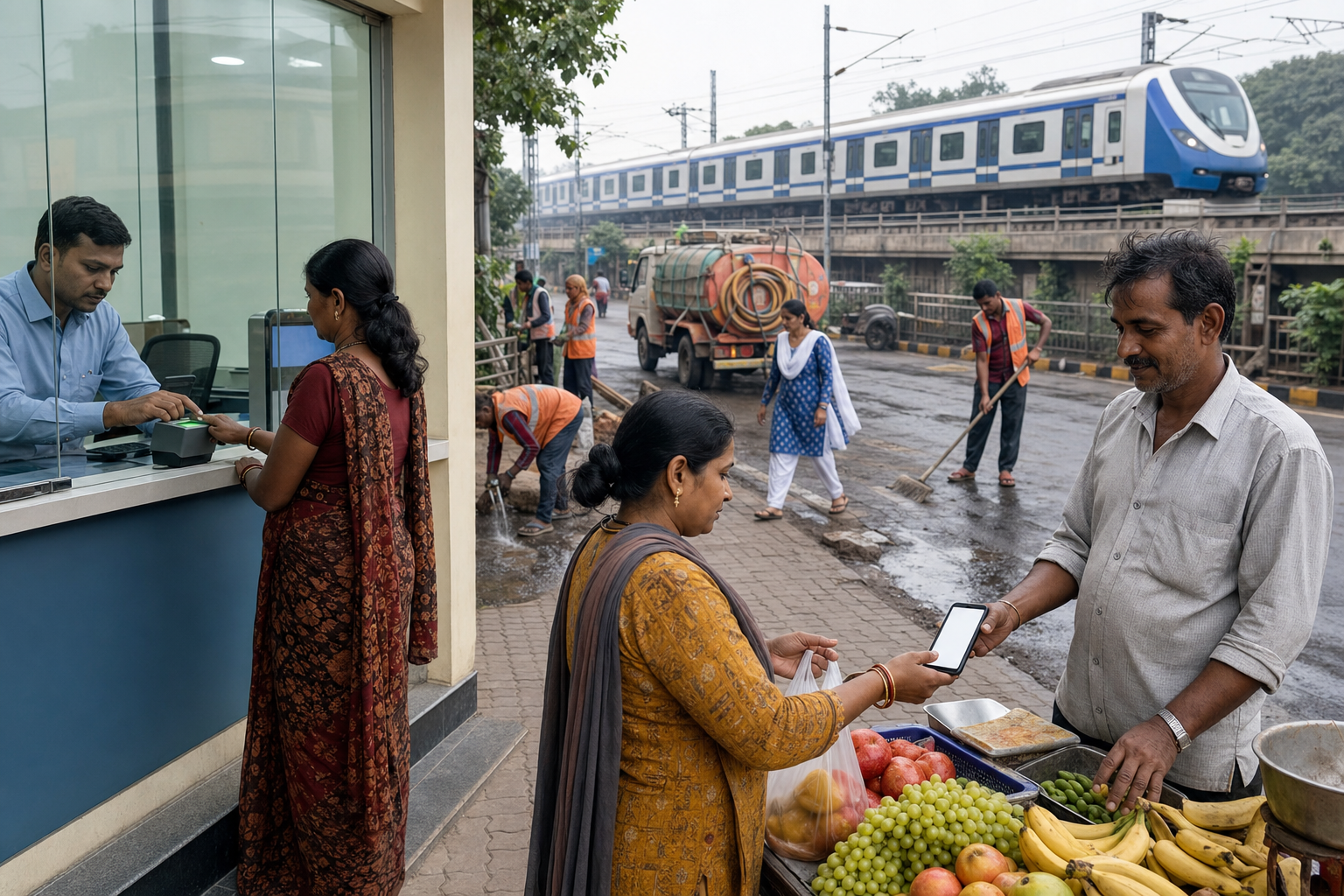
For many citizens, the state used to appear most clearly as a queue, a file, a gatekeeper or a demand for influence. Digital payments and direct transfers changed that relationship by making traceable, system-mediated transactions more normal. Their civilisational importance lies not in the technology alone, but in the reduction of unnecessary human discretion between a public institution and the person it is meant to serve.
GST represents a related change at a different level. Its details remain open to argument, yet the argument now concerns its design and nuances rather than wholesale reversal. When competitors inherit a reform and debate its calibration, the reform has usually crossed from one party’s programme into the country’s governing architecture.
Demonetisation should be placed in a separate analytical category. It demonstrated audacity, central control and a willingness to impose disruption in pursuit of a declared national objective. Those qualities explain the Modi method, but they do not by themselves establish that every consequence was beneficial. Political courage and sound policy outcomes are related questions, not identical ones. A serious supporter should be capable of making that distinction.
The altered atmosphere around corruption also deserves careful treatment. Modi’s supporters see a decisive break from an earlier political culture saturated by major scam headlines and influence-brokers. Reduced scandal visibility matters, especially when paired with more traceable transfers and procurement discipline. But absence of a headline is not proof that corruption has disappeared. The stronger test is whether systems reduce discretion, leave an audit trail, punish violations consistently and make access less dependent on personal connections.
You can test this in your own dealings with the state. Choose one recurring interaction – a payment, benefit, registration or document request – and compare the number of intermediaries, the room for arbitrary delay, the traceability of the transaction and the clarity of the rule. That concrete comparison tells you more about state capacity than a week of political television.
Kartavya gives decolonisation a Dharmic measure
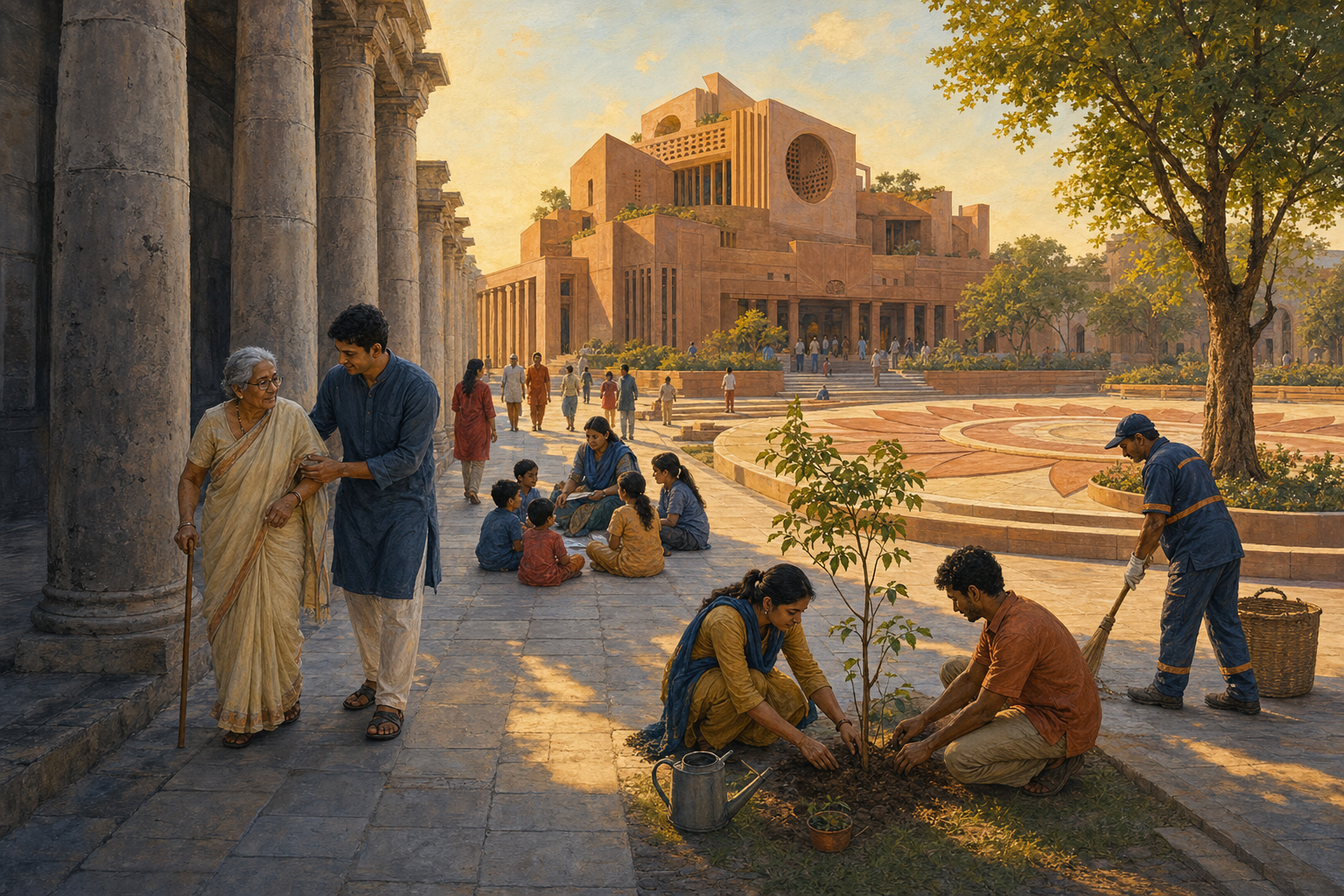
The renaming of Rajpath as Kartavya Path and the Central Secretariat as Kartavya Bhavan is easy to dismiss as symbolism. It is also easy to praise it as if a new signboard completed decolonisation. Both readings are too shallow.
The movement from raj to kartavya changes the moral vocabulary of the state. Raj evokes the elevated avenue of rule; kartavya directs attention to duty. For a Dharmic civilisation, that distinction is meaningful. Dharma cannot be reduced to government service, but duty is one of its practical expressions. Authority is legitimate when it fulfils obligations larger than the comfort, prestige or appetite of the officeholder.
The reported resistance of officials to open offices in Kartavya Bhavan illustrates the institutional tension. Private cabins can become emblems of hierarchy and personal fiefdoms, but an open-office layout is not intrinsically Dharmic and may not suit every kind of confidential work. The relevant question is not whether a bureaucrat has a wall. It is whether administrative privilege is being replaced by responsibility, measurable work and service to the citizen.
Judge every decolonising gesture on three levels. First, language: does it recover a Bharatiya moral category instead of merely translating an imperial one? Second, procedure: does the institution actually change how decisions are made and services delivered? Third, consequence: is failure corrected even when the official belongs to the ruling establishment?
This last test is essential. A Dharmic state is not one in which our preferred elite inherits the privileges of the previous elite. It is one in which power is disciplined by kartavya. Renaming can announce that standard; only conduct can satisfy it.
Security and strategic autonomy need separate scorecards

Modi did not begin from an empty field. Historical fairness requires crediting Atal Bihari Vajpayee’s telecom policy, Golden Quadrilateral, banking and investment reforms, and innovative foreign policy as foundations for what followed. Modi’s political contribution included learning that structural change required a stable parliamentary mandate. Continuity explains the foundations; a decisive majority helps explain the speed and scale of later action.
Security claims should nevertheless be disaggregated. Lumping every achievement under the label of national strength makes careful judgment impossible. Use four ledgers:
- Constitutional integration: Article 370 was abolished through a decisive parliamentary intervention. Judge the action through its durable effects on integration, administration and security, not merely through the drama of the announcement.
- Internal security: Modi’s supporters credit his government with breaking an earlier pattern of recurrent jihadist violence and bringing Maoist terror close to extinction. The return of functioning schools in Gadchiroli is a concrete sign of state presence. To evaluate the wider claim, ask for timelines, geographic coverage, incident patterns and durability rather than relying on either triumphalism or denial.
- Border resolve: Galwan became a test of Bharat’s willingness to confront Chinese pressure. A serious assessment should follow material preparedness, territorial posture and sustained deterrence, not stop at patriotic rhetoric about one confrontation.
- Diplomatic leverage: Pakistan’s growing isolation and Washington’s visible frustration with an India that will not simply comply are presented as evidence of a stronger India-first policy. The useful measure is Bharat’s room to cooperate, disagree and choose partners without surrendering its own interests.
These ledgers keep different kinds of power from being confused. A constitutional decision is not the same as a counterterrorism outcome. A border confrontation is not the same as diplomatic autonomy. Progress in one category cannot conceal weakness in another.
An India-first foreign policy also should not be mistaken for automatic hostility toward one country or permanent attachment to another. Its Dharmic test is steadiness of purpose: does the government distinguish temporary alignments from enduring national interests, and can it bear external displeasure when the two diverge?
At 75, durability matters more than velocity

The Modi era has been marked by audacity, ambition and scale. At 75, however, the most important question is no longer whether one leader can force movement through a resistant system. It is whether the system has learned to move without depending on his constant intervention.
The third term began with a reduced Lok Sabha majority. That makes institutional depth more important. A reform sustained only by one leader’s authority is vulnerable. A reform embedded in law, administrative habit, public expectation and political consensus is much harder to undo.
Succession belongs inside this assessment, not outside it. Every long political tenure produces a class of officials, intellectuals, organisers and public voices aligned with the governing order. The Dharmic question is whether this new elite is cultivated for competence, restraint and service, or merely rewarded for loyalty. Replacing one entitled ecosystem with another would reproduce the old structure under Bharatiya vocabulary.
Civilisational confidence faces the same durability test. A renamed avenue has value when it leads to recovered memory. A recovered memory has value when it produces scholarship, education, institutions and conduct. If confidence remains dependent on electoral slogans, it will fade with electoral fortunes. If it becomes part of how Bharatiyas understand history, duty and national interest, it will outlast any prime minister.
Key takeaways
- Give the greatest weight to changed defaults. UPI, direct transfers and GST matter because daily behaviour and political debate now operate within the systems they created.
- Separate political audacity from policy success. A bold decision reveals governing method, but its benefits still need to be judged through consequences.
- Treat kartavya as a standard of conduct. Bharatiya names matter, but decolonisation becomes real only when authority is disciplined by duty and accountability.
- Score constitutional integration, internal security, border deterrence and diplomatic autonomy separately. They require different evidence and cannot substitute for one another.
- Credit continuity as well as leadership. Vajpayee supplied important foundations; Modi’s stable mandate enabled structural action at greater scale.
- Judge the coming phase by institutional survival. The decisive legacy will be what continues to work when Modi is no longer the system’s central source of momentum.
On this milestone, make your own five-line ledger of the Modi era. For each change you consider historic, write down the old baseline, the mechanism, the consequence for citizens and the likelihood that it will survive a transfer of power. Anything you cannot fill in is still a conviction awaiting evidence. Anything that passes all four tests deserves a place in Bharat’s serious historical memory.
References
