

You may have reached this debate after seeing D.N. Jha treated as either an academic authority or a Marxist ideologue. Neither label tells you whether a particular account of ancient Bharat is true. If you want a Dharmic response that can survive scrutiny, you need to reduce the argument to exact claims, exact passages and exact inferences.
That discipline matters here because the controversy ranges across cow sanctity, food practices, Brahmins, Hindu deities, the Gupta period, Nalanda and school education. A sound verdict in one of those areas does not automatically settle the others. This is how you can examine each dispute without surrendering either your civilizational perspective or your standards of evidence.
Turn the culture-war bundle into seven separate claim files

The case made against Jha bundles several allegations: that he forced Marxist theory onto Indian history, repeatedly foregrounded beef and liquor, displayed hostility toward Brahmins, treated Hindu deities in a vulgar manner, distorted Gupta history, denied Bakhtiyar Khalji’s destruction and burning of Nalanda, and influenced generations through NCERT textbooks.
A long charge sheet can create the impression that its length is itself proof. It is not. You should open a separate file for each allegation:
- Historical framework: Did a Marxist model help explain the evidence, or was the evidence made to conform to the model?
- Dietary history: Did Jha establish the existence of a practice in a defined setting, or generalize it into a civilizational norm?
- Brahmins: Did he criticize particular institutions and actors, or use collective language that warrants a charge of animus?
- Hindu deities: What exactly was written, in what genre, and with what historical purpose?
- Gupta history: Which conclusion is disputed, and which inscriptions, coins, archaeological findings or literary passages bear on it?
- Nalanda: Did he deny an attack, the identity of an attacker, a fire, the extent of destruction, or a proposed chain of causation?
- School education: Which book, edition, class and curriculum carried his interpretation, and what evidence establishes its reach?
Keep those files separate. A demonstrable error about the Gupta period would not, by itself, prove personal hostility toward Brahmins. An indefensible passage about a Hindu deity would not automatically settle a chronological dispute about Nalanda. Each conclusion needs evidence appropriate to that conclusion.
This first move also protects you from guilt by association. Calling an interpretation Marxist does not refute it. Calling its author a professor does not validate it. Labels tell you where to look for assumptions; they do not complete the historical argument.
Build a claim-evidence-inference ledger before choosing a side
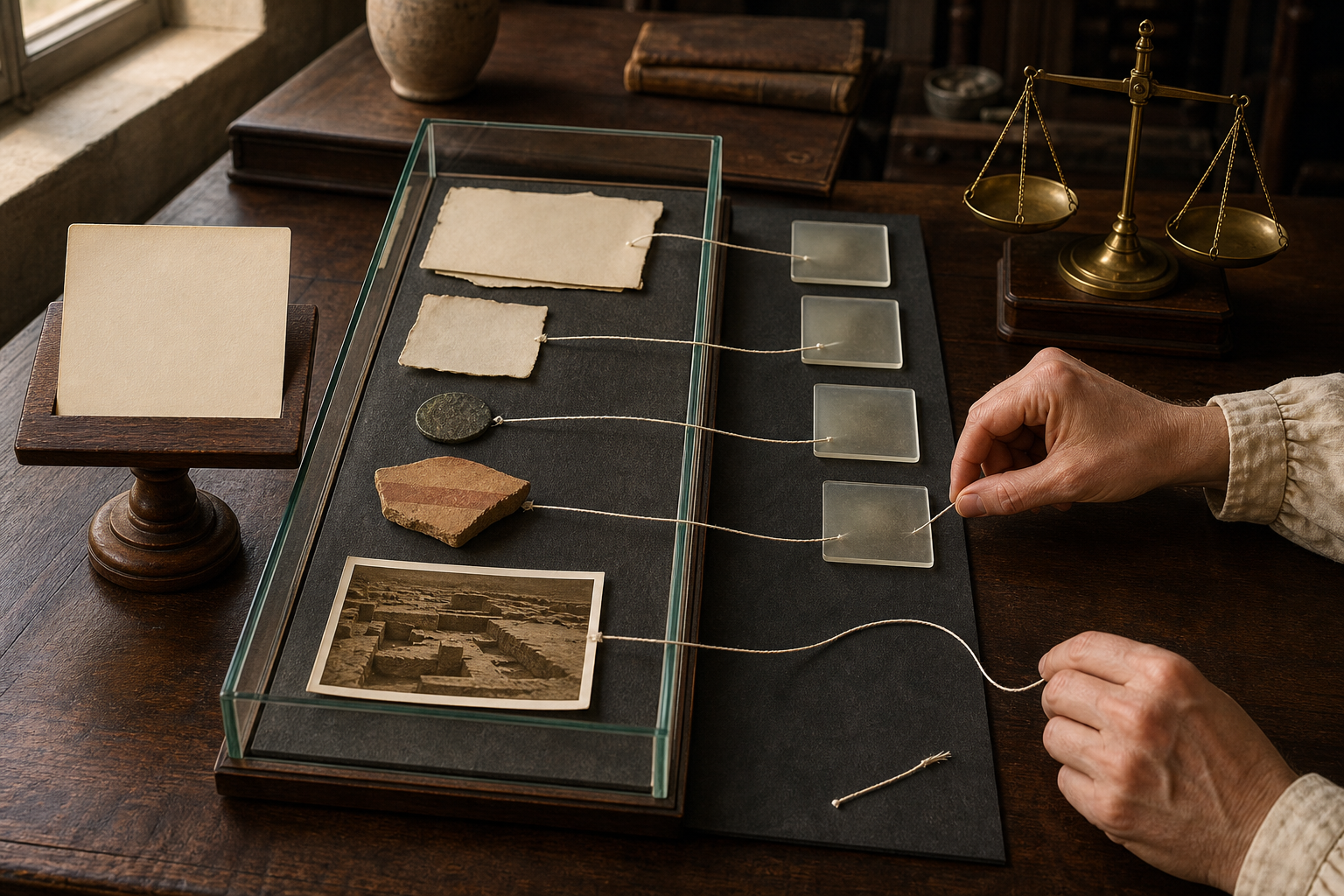
Most historical disputes become clearer when you separate three things: what is being claimed, what the cited evidence directly establishes, and what reasoning carries the historian from one to the other. Use a ledger like this:
| Disputed area | Distinction you must preserve | Minimum evidence to request |
|---|---|---|
| Food and cattle | Occurrence, permission, prevalence and moral approval are different claims | Exact passage, date, place, textual genre, translation and stated scope |
| Brahmins | A named actor, an institution, a social category and every member of a community are not interchangeable | Full quotation, surrounding argument, historical referent and evidence of a repeated pattern |
| Gupta history | A theoretical model is not the same as a conclusion established independently from evidence | The model’s prediction, the cited evidence, contrary evidence and a competing explanation |
| Nalanda | Attack, fire, destruction, abandonment and final decline are separate propositions | Jha’s precise wording, the records he considered, their dates and the evidence allegedly omitted |
| NCERT influence | Authorship, textbook adoption, classroom reach and long-term effect are different stages | Title, edition, class, adoption record, disputed passage and evidence of actual circulation |
Start with the exact quotation. Record enough surrounding text to identify the subject, period, geographical scope and any qualifier such as “may,” “sometimes” or “generally.” A cropped sentence can conceal all four. Record the edition and page as well; page numbers without an edition are often impossible for another reader to verify.
Next, classify the claim. Is it a statement that something occurred, an estimate of how common it was, an explanation of why it occurred, or a moral judgment about it? Evidence sufficient for one class may be useless for another. A passage showing that an act was known does not establish that it was frequent. A prescriptive prohibition does not prove that nobody violated it. A ritual rule does not automatically describe ordinary household practice.
Then trace the citation as far back as you can. If Jha cites another modern historian who cites a translation that rests on a primary text, do not stop at the first footnote. Check whether the translation preserves the relevant noun, verb, agent and qualifier. When the argument depends on a disputed term, compare the proposed meanings rather than quietly choosing the one that produces the preferred conclusion.
Finally, write the inference in one sentence: “Because evidence A shows X, the historian concludes Y.” The weak link often becomes visible at once. If X concerns one ritual, court, region or century while Y concerns all Hindus or all of ancient India, you have found a scope problem. If X occurs later than the event it is supposed to cause, you have found a chronological problem. If several explanations fit X but only one is acknowledged, you have found an alternatives problem.
Test Marxist method without turning “Marxist” into a verdict

Marxist historiography commonly foregrounds material conditions, control of land and surplus, social hierarchy, production and conflict. Those concerns can generate legitimate questions. The methodological failure occurs when the framework dictates what the evidence must mean, or when categories designed for one historical setting are imported into another without justification.
You can make the accusation of “force-fitting” precise by asking five questions:
- Category test: Are terms such as class, feudalism, priesthood or exploitation defined from the evidence, or assumed in advance?
- Chronology test: Are materials from different centuries treated as though they describe one simultaneous social order?
- Coverage test: Does the explanation account for inconvenient evidence, or only for the evidence that fits it?
- Causation test: Is a mechanism shown between material interest and the event being explained, or is motive merely imputed?
- Falsification test: Can you name evidence that would make the historian revise the conclusion? If no imaginable finding could do so, the theory is functioning as dogma.
Apply the same tests to a Dharmic counter-interpretation. Civilizational sympathy can help a historian notice continuities, indigenous categories and sacred meanings that a materialist framework neglects. It can also become an excuse to flatten differences between periods or dismiss unwelcome evidence. A method does not become sound merely because its conclusion is congenial to us.
A practical check is to write the strongest rival explanation beside the preferred one. List what each explanation accounts for, what each leaves unexplained, and what new evidence would distinguish them. If you cannot state the rival view without ridicule, you are not yet ready to refute it.
Handle the charged disputes without sacrificing precision
Cow sanctity and historical food practices
Discussion of The Myth of the Holy Cow is easily reduced to a false choice: either every community in every period followed one unchanging practice, or the cow’s sacred place in Hindu civilization is fictitious. Historical change and civilizational continuity can coexist. Present-day sacred meaning does not require you to prove identical conduct in every ancient setting.
Use five evidentiary rungs when examining a dietary claim:
- Attestation: A text mentions an animal, substance or act.
- Identification: The relevant word has been translated correctly in that passage.
- Authorization: The passage permits, prescribes, condemns or merely describes the act.
- Prevalence: Other evidence shows how widespread the practice was across place, community and time.
- Civilizational meaning: The evidence supports a claim about changing or enduring moral and sacred status.
Evidence on the first rung does not automatically reach the fifth. A narrow ritual exception cannot establish a universal diet. Conversely, later reverence cannot erase an earlier passage simply because it is uncomfortable. The defensible sentence is usually bounded: this evidence supports this practice, among this group, in this context; it does not yet support a claim about all of Bharat.
The allegation that Jha repeatedly foregrounded beef and liquor is also a claim about selection. To establish distortion, identify relevant contrary material, show that it falls within his declared scope, and explain how including it would change the conclusion. Counting references to a subject is not enough; you must show the resulting imbalance in the argument.
Brahmins and representations of Hindu deities
A charge of personal or collective hatred carries a higher burden than a charge of historical error. Themes associated with Brahmanical Intolerance in Early India may warrant close examination, but a provocative title does not establish the author’s motive. You need precise language and a demonstrable pattern.
For every disputed passage, mark its target. Does “Brahmanical” refer to a doctrine, a particular institution, a group exercising power in a named setting, all Brahmins in a period, or Brahmins as people? Those categories cannot be substituted for one another. Criticism of an institution is not logically identical to contempt for every person associated with it. At the same time, sweeping hostility does not become harmless merely because it appears in academic language.
Use the same care with depictions of Hindu deities. Establish whether the language belongs to the historian, a translated primary narrative, a quotation from another scholar, satire, or analytical description. Then ask whether the retelling preserves the genre and theological setting of the original material. A deliberately selective paraphrase can distort without containing a single fabricated word; the distortion lies in what was detached, collapsed or omitted.
If the exact words establish contempt, say so and quote only what is necessary. If they establish an interpretive disagreement, criticize the interpretation. Do not replace one form of civilizational caricature with an unsupported diagnosis of another person’s inner motives.
Nalanda and the problem hidden inside the word “denial”
The charge concerning Bakhtiyar Khalji and Nalanda should be converted into the precise proposition Jha allegedly rejected. Did he dispute the attacker’s presence, damage to the monastic complex, the burning of a library, the scale of destruction, or the claim that a single episode caused Nalanda’s final disappearance? A historian can reject one proposition without rejecting all of them.
Make a chronology before writing your conclusion. For every record, note the event it describes, when the record was created, how close its author was to the event, what the author could have known, and which details appear independently elsewhere. A later record is not automatically false, and silence in one account is not automatically proof that an event never happened. Both require argument.
Next, separate evidence about an attack from evidence about long-term institutional decline. Political violence, loss of patronage, physical destruction and later abandonment may belong to one causal sequence, but they are not synonyms. Your conclusion should identify which link is directly documented and which remains an inference.
NCERT adoption and claims about generational influence
The institutional allegation is that Jha’s work was prescribed through NCERT for decades and shaped students in their formative years. That contains two different claims: curricular adoption and cultural effect. The first can be checked through publication and adoption records. The second requires evidence about circulation, teaching, reception and influence.
Before repeating the allegation as fact, fill in these fields:
- The exact textbook title and edition.
- The class or level for which it was prescribed.
- Jha’s role: sole author, co-author, editor, contributor or cited historian.
- The disputed passage, with its chapter and page.
- The years and jurisdictions in which that edition was actually used.
- The basis for attributing a measurable intellectual effect to it.
If you can establish the first five but not the sixth, use limited language: the interpretation entered a curriculum and had the opportunity to influence students. Do not convert opportunity into a quantified social outcome without evidence. If you cannot establish the edition, passage and adoption record, call the curricular role alleged rather than proven.
Key takeaways for a defensible Dharmic response
- Break the controversy into separate files; do not let one confirmed error prove every other allegation.
- Demand the exact passage, edition, context and scope before accepting either praise or condemnation.
- Separate occurrence from prevalence, description from approval, and textual evidence from civilizational generalization.
- Test Marxist and Dharmic interpretations by the same standards of chronology, explanatory coverage and falsifiability.
- Treat motive claims as harder to prove than factual errors; titles and affiliations are clues to examine, not verdicts.
- Verify textbook adoption independently from claims about its effects on generations of students.
Start with the allegation you are most likely to repeat in public. Build a one-page dossier containing the exact claim, Jha’s exact words, his cited evidence, the disputed inference, the strongest counter-reading and the evidence that could decide between them. If one field is empty, describe the gap instead of filling it with certainty.
A Dharmic historiography worthy of confidence cannot depend on institutional prestige, ideological labels or outrage. It should recover context, respect distinctions and correct distortion passage by passage. That is slower than trading accusations, but it leaves you with an argument another careful reader can verify and use.
References
