
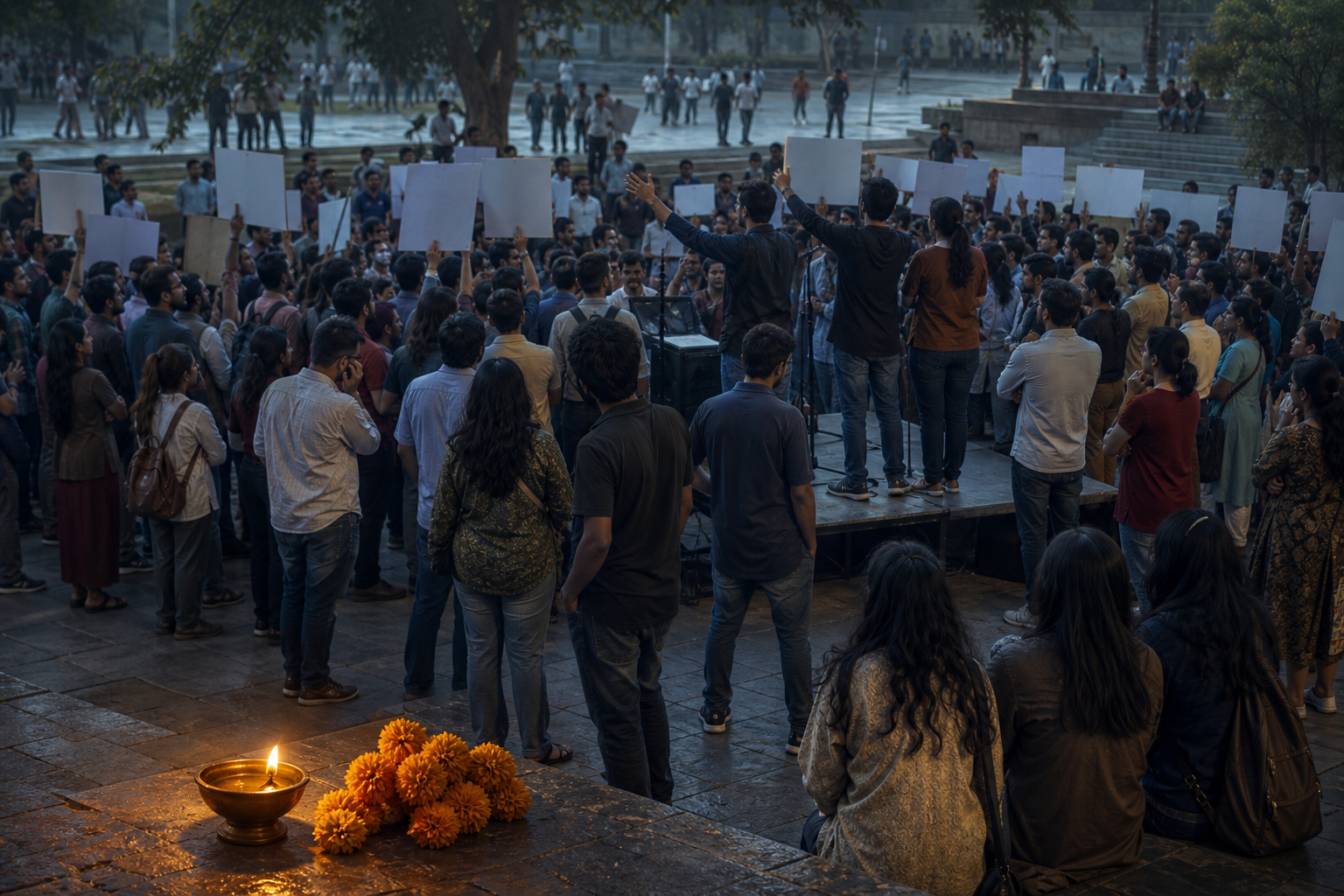
You may have arrived here after seeing one of the viral clips from the Cockroach Janta Party protest and wondering what, exactly, it proves. Was this an unruly student agitation, a collection of tasteless jokes, or a protest culture in which contempt for Hindu identity became acceptable?
You do not have to choose between dismissing every incident and condemning every person in the crowd. There is a more rigorous test: identify what happened, distinguish named speakers from anonymous participants, compare how different religious expressions were treated, and then examine what organizers tolerated after the problem became visible.
Start with the correct test: equal civic dignity
The CJP mobilization at Delhi’s Jantar Mantar in June and July 2026 began around education reform, examination-related controversies, and demands for Union Education Minister Dharmendra Pradhan’s resignation. Those are legitimate subjects for democratic protest. Opposition to the government is not opposition to Hinduism, and sharp criticism of a minister does not become anti-Hindu merely because the minister belongs to the ruling party.
Criticism of a guru, religious institution, custom, scripture, or political use of sacred language is not automatically anti-Hindu either. A democratic culture must leave room for disagreement, satire, disbelief, and internal reform. The relevant boundary is crossed when criticism gives way to targeted contempt, unequal treatment, or intimidation based on Hindu identity.
- Targeted contempt: Hindu deities, worship, symbols, or devotees are reduced to communal punchlines rather than discussed through a substantive argument.
- Unequal rules: one community’s religious slogan is accepted as resistance, while a Hindu response is treated as intrinsically illegitimate or provocative.
- Identity-based exclusion: a person is harassed because saffron clothing, a shikha, a tilak, or another visible marker identifies him as Hindu.
- Movement-level tolerance: organizers, stage managers, or prominent supporters repeatedly permit such conduct, fail to correct it, or reward the people responsible.
The final point matters. One offensive sentence from an unidentified person at a gathering of thousands cannot, by itself, define every participant. A named speaker on the stage carries more weight. Repetition after criticism carries more weight still. The response of organizers determines whether an incident remains a fringe disruption or becomes part of the movement’s public character.
What moved the controversy beyond ordinary political satire
A one-way rule for religious speech
On 20 June, former Delhi University Teachers’ Association president Nandita Narain sang the Faiz Ahmed Faiz line "Bas naam rahega Allah ka" from the CJP stage. The dispute was not simply that an Islamic phrase had been uttered. The sharper concern was the apparent distinction between that phrase as revolutionary expression and "Jai Shri Ram" as an objectionable religious intervention.
Later clips were circulated with the allegation that "Allahu Akbar" and "Nara-e-Takbir" could be heard without comparable resistance, while a participant answering with "Jai Shri Ram" encountered hostility from part of the crowd. A short clip cannot establish the attitude of everyone present, and the sequence before and after a slogan matters. But if the fuller record supports that contrast, the problem is straightforward: the protest was applying different civic rules to equivalent forms of religious expression.
No slogan needs to be prohibited merely because it is religious. Organizers can instead adopt a content-neutral rule: either allow peaceful devotional expression from every community or ask every participant to keep the event focused on its policy demands. What cannot be defended as secularism is permission for one faith combined with indignation at another.
Hindu sacred language became material for ridicule
Several episodes involved more than criticism of education policy. People at or around the protest were accused of making derogatory remarks about puja and Lord Ram, ridiculing Hindu practices through familiar "gau mutra" and "blind faith" tropes, and using images of Hindu deities on their cheeks while daring others or the police to react. The last allegation requires context: wearing a sacred image is not inherently disrespectful. Its meaning depends on the accompanying words, gestures, and purpose. If the image was deliberately used as bait, however, the sacred symbol was being instrumentalized to manufacture outrage rather than express belief.
Former CJP spokesperson Vijeta Dahiya repeatedly said that he did not regard Premanand Maharaj as a "Maharaj." Disagreement over an honorific, standing alone, does not prove hostility toward Hindus. A person can reject a religious teacher’s authority. The incident becomes relevant because it occurred within a wider environment in which Hindu spiritual figures and practices were reportedly approached through derision rather than reasoned criticism.
Kunal Kamra’s political joke contrasting "Sita ke pati" with "Nita ke pati" likewise cannot bear the full charge by itself. Political satire often borrows sacred and cultural references. The proper question is comparative: did the stage permit equally irreverent treatment of every faith, and was Lord Ram invoked to illuminate a political contradiction or simply because Hindu reverence was considered a safe target?
This is how a pattern should be evaluated. Do not inflate a debatable example into conclusive proof. Ask instead why an education protest repeatedly needed jokes, provocations, and ideological performances directed at Hindu sacred life. A stage with a clear policy purpose should be able to discuss examinations, institutional accountability, ministerial responsibility, and student hardship without turning Hindu devotion into background entertainment.
The stronger allegations concerned exclusion and communal disparagement
The most serious allegations did not concern satire. One visibly Hindu youth, identifiable by saffron clothing and a shikha, was reportedly harassed by sections of the crowd. Another protester was recorded saying that Muslims were "lakh guna better" than Hindus and that Muslim friends were preferable to Hindu ones. If the clips are authentic and materially complete, such conduct is not a critique of Hindutva, a government, or a religious doctrine. It is communal disparagement aimed at Hindus as people.
The 20 July phase also brought unrest near the Hanuman temple by Connaught Place. Stone-pelting occurred near the temple, but the information available here does not establish who threw the stones. That uncertainty must be preserved. The temple reportedly shut its gates amid the disturbance and was later vilified online for doing so. Unless evidence shows that the temple endangered someone or acted discriminatorily, closing its gates during nearby unrest is more reasonably understood as a protective decision than as hostility to students.
Actor Prakash Raj’s welcome at the protest added to the perception of a permissive culture because legal complaints had previously been filed over his provocative Ramayana-related remarks. A complaint is not a finding of guilt, and a guest’s presence does not automatically make every attendee responsible for his earlier speech. The relevant question is narrower: when a movement is already facing accusations of contempt toward Hindu beliefs, does it clarify its boundary, or does it continue elevating figures associated with the same controversy?
How to judge the evidence without excusing the pattern
Viral footage rewards the fastest and angriest interpretation. That makes disciplined verification especially important for Hindu advocates. An exaggerated allegation gives opponents an easy way to dismiss a genuine pattern. A precisely stated allegation forces them to answer the conduct itself.
- State one claim at a time. Write down the exact alleged act: a named remark, harassment of a particular person, unequal treatment of slogans, or an incident near a temple. Do not begin with the conclusion that the entire gathering was anti-Hindu.
- Preserve the longest available recording. Save the original link, date, location, and enough footage to include what happened immediately before and after the disputed moment. A repost with a caption is weaker than the original upload.
- Identify the speaker’s relationship to the protest. Distinguish an organizer, spokesperson, invited stage performer, regular supporter, ordinary participant, counter-protester, and unidentified bystander. These roles carry different evidentiary weight.
- Record the surrounding response. Did the crowd cheer, object, remain silent, or appear not to hear? Did stage managers interrupt? Did organizers later condemn, defend, or ignore the incident? This is often the difference between individual misconduct and an institutional pattern.
- Apply a reversal test. Replace the Hindu identity, deity, slogan, or place of worship with its Islamic, Sikh, Buddhist, Jain, or Christian equivalent. If your judgment changes, your standard is communal rather than principled.
- Use calibrated language. Say "the speaker said" when the recording is clear, "the clip appears to show" when context is incomplete, and "the movement tolerated" only when organizer conduct supports that conclusion.
Named, repeated public statements by figures such as Dahiya and stage appearances by Narain or Kamra can be assessed more directly because the speaker and setting are identifiable. Alleged crowd harassment and confrontations over slogans require the original sequence and reliable identification. A movement-wide conclusion requires something further: evidence that organizers knew about the conduct and repeatedly declined to establish an equal standard.
This distinction does not minimize anti-Hindu prejudice. It makes the case against it harder to evade. The strongest argument is not that every unpleasant joke is sacrilege. It is that a civic platform cannot claim secular legitimacy while treating Hindu dignity as negotiable and other religious identities as protected.
What a responsible Hindu response should demand
The aim should be accountability, not a rival spectacle of communal humiliation. You can defend Hindu dignity while also defending students’ right to protest education policy. Refusing that false choice keeps attention on the people who introduced sectarian hostility into a civic cause.
- Build an incident log, not a montage. For each event, record the date, place, exact words or conduct, speaker’s identity, relationship to CJP, original link, longer context, and organizer response. Keep disputed details marked as disputed.
- Ask organizers answerable questions. Were religious slogans governed by one rule? Was the harassment of the visibly Hindu youth investigated or condemned? Were speakers told that communal comparisons and ridicule of devotees were outside the protest’s purpose? Did the movement offer a correction?
- Demand a universal conduct code. Prohibit threats, identity-based harassment, desecration used as provocation, and claims that one religious community is inherently superior. Apply the rule to everyone, including counter-protesters.
- Separate belief criticism from believer harassment. A person may dispute the authority of Premanand Maharaj, reject a ritual, or satirize political invocations of Ram. That freedom does not extend to intimidating someone for a shikha or treating Hindus collectively as inferior companions.
- Do not erase the education grievance. Examination accountability and education reform should be answered on their merits. Returning repeatedly to those demands also reveals who is interested in student welfare and who is using the gathering for sectarian performance.
- Do not retaliate against Muslims or other communities. Communal abuse in response to anti-Hindu abuse reproduces the same wrong and weakens the demand for equal treatment. Address the responsible speaker, organizer, or act.
- Put safety before confrontation. Do not enter a hostile crowd to provoke a reaction, expose private personal information, or threaten participants. Where footage appears to show violence or a credible threat, preserve the complete material from a safe position and send it through the appropriate platform or public-authority channel.
Organizers who want public trust can still act constructively. They can acknowledge specific failures, reject communal superiority claims, publish a neutral rule for religious expression, protect attendees with visible religious identities, and keep future stages focused on education. Silence after repeated controversy is also a choice, and the public is entitled to weigh it.
Key takeaways
- Anti-government speech is not anti-Hindu; the decisive issues are targeted contempt, unequal rules, identity-based harassment, and organizer tolerance.
- The alleged hostility to "Jai Shri Ram" matters because Islamic religious phrases were reportedly treated more permissively. The standard should be the same for every faith.
- Remarks by identifiable stage figures are easier to assess than anonymous crowd clips, but no single joke or disputed clip proves the character of an entire movement.
- Harassment of a person for saffron clothing or a shikha, and statements declaring Muslims inherently better than Hindus, are more serious than debatable satire if the recordings are authentic and complete.
- Hindu advocacy is strongest when it preserves context, distinguishes individuals from organizers, avoids collective blame, and asks precise questions that require a public answer.
If you encounter another CJP clip, your first act should be simple: find the longest version, identify who is speaking, and write the narrowest claim the evidence can support. Then ask whether the same conduct would be tolerated if the religious identities were reversed. That combination of accuracy and equal standards protects Hindu dignity without abandoning dharma in the process.



References
