
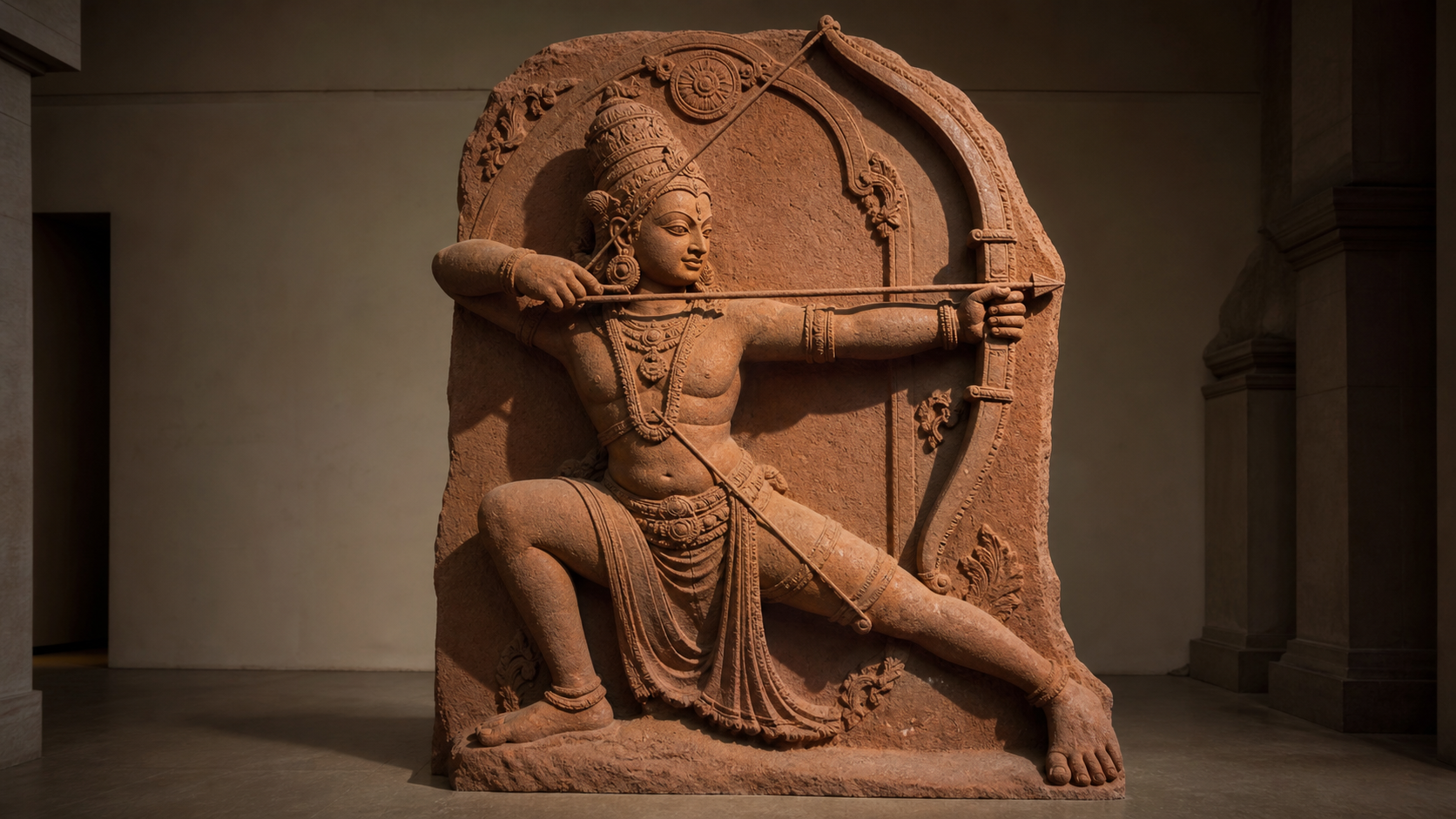
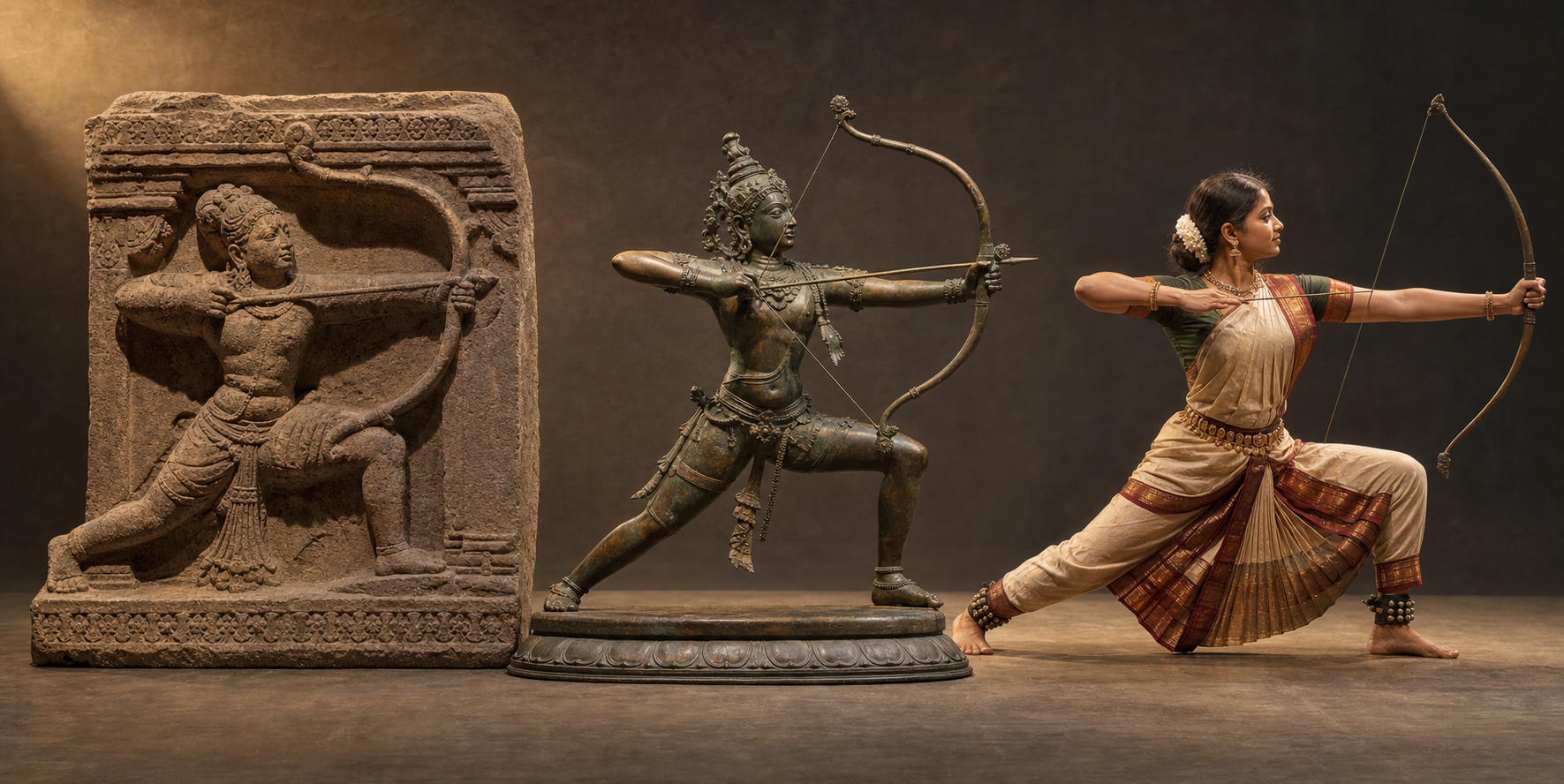
You see a deity with one knee bent, the other leg stretched behind, the torso upright and the arms ready for decisive action. Is the figure dancing, attacking, protecting, or simply striding? In Hindu sacred art, the answer often begins at the feet.
The stance may be ālīḍha, commonly written Alidha: a disciplined posture used to show force that has direction, balance and purpose. Once you know how to recognise it, you can read a temple sculpture or painting more precisely. The legs reveal not only what the deity is about to do, but also how Hindu iconography distinguishes dharmic power from uncontrolled violence.
Identify the stance from the ground upward
Begin with the figure’s own right and left, not the sides of the photograph or sculpture as you face it. In a common South Indian convention, Alidha places the deity’s right leg forward and the left leg behind. The complementary stance, pratyālīḍha or pratilīḍha, reverses that arrangement. Regional workshops did not always apply the convention identically, however, so the forward foot is your first clue rather than a complete identification.
Next, inspect the knees and heels. The forward knee bends so that it can receive weight. The rear leg lengthens and anchors the body, usually giving the impression that the heel is connected firmly to the ground or pedestal. If both legs appear equally straight, casually spread, or unsupported, you may be looking at another posture.
Then trace an imaginary line from the rear foot through the pelvis and chest. A convincing Alidha does not look as though the figure is falling into a lunge. The lowered centre provides stability while the spine remains long. The chest may turn slightly against the direction of the hips, allowing the shoulders to aim a bow, raise a weapon, extend a mudrā or address another figure. This coordinated tension belongs to a connected language of performance, martial preparation and icon-making.
Finally, follow the gaze. In well-integrated sacred art, the eyes, weapon, leading knee and narrative target usually belong to the same action. When the right leg advances, the composition often carries the viewer’s attention toward the viewer’s left, especially in frontal South Indian examples. Use that directional tendency as supporting evidence, not as an inflexible rule.
Use the whole composition to avoid a false match
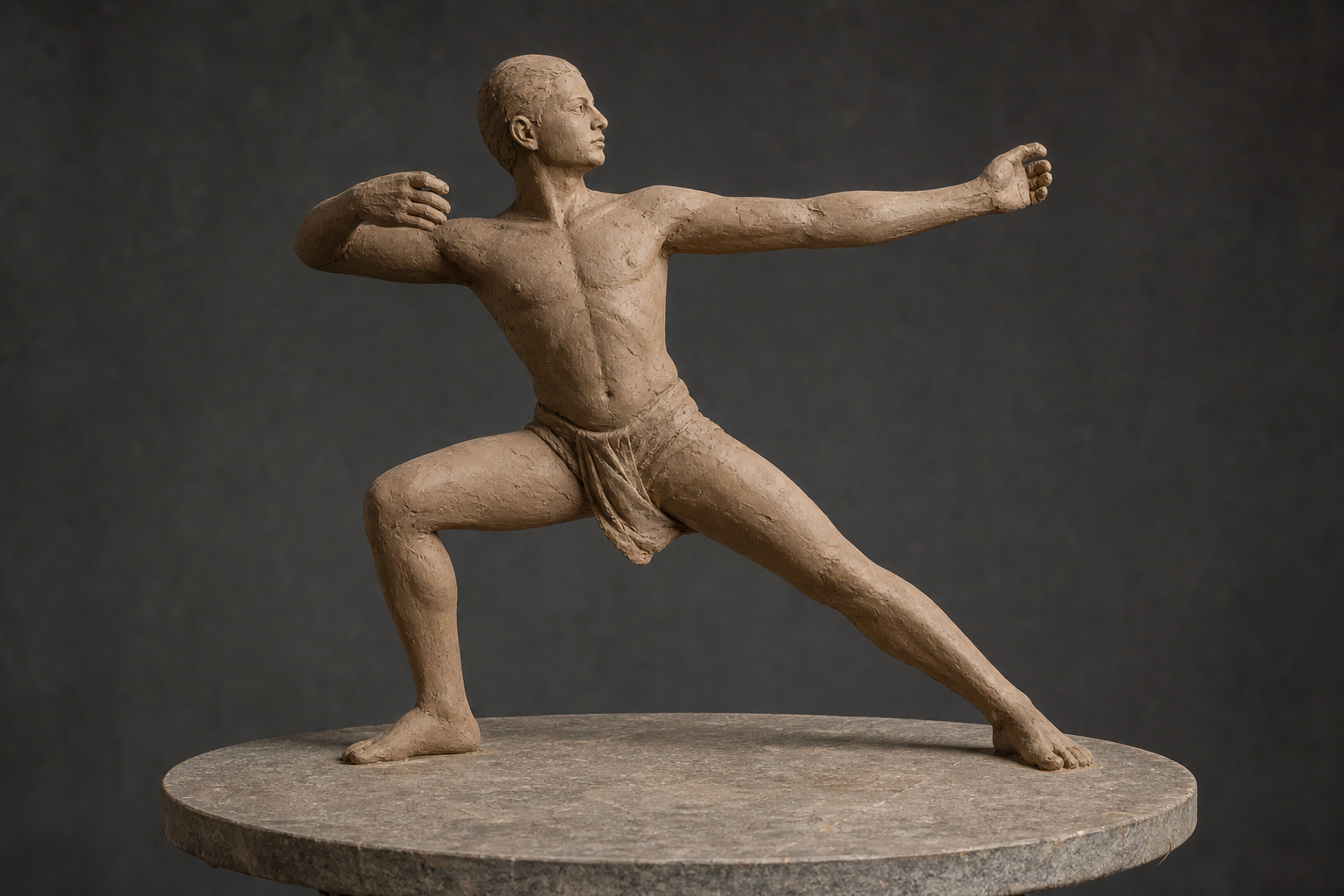
A wide stride alone does not establish Alidha. Sculptures can lose hands, weapons, feet or portions of their pedestals. Paintings can flatten a complex turn of the body. Museum photography can also make the nearer leg look larger and more active than it is. Before assigning a name, check four parts together: the weight-bearing knee, the rooted rear leg, the turn of the torso and the direction of the action.
The nearest alternatives communicate different relationships between the figure and the surrounding world:
| Posture | What you should look for | Usual visual effect |
|---|---|---|
| Alidha | A bent forward leg, an extended rear leg and a torso prepared to act | Directed, controlled readiness |
| Pratyalidha | The complementary leg arrangement, with the forward and rear sides reversed | The same readiness with the narrative vector redirected |
| Samapada | The feet and weight held in an even, symmetrical alignment | Equilibrium, presence and stillness |
| Abhanga or tribhanga | Weight shifted through one or more gentle bends of the body | Grace, rhythm and elegant asymmetry |
| Lalitasana | A seated figure with one leg relaxed rather than driving forward | Ease, sovereignty and approachable authority |
The distinction matters because posture changes the meaning of an attribute. A bow held by a figure in samapada can signify identity or authority. The same bow drawn from Alidha becomes an unfolding event: the deity has selected a target, organised the body and committed to action. Hands tell you what is held; stance tells you what is happening.
You should also resist treating every energetic pose as a formally labelled Alidha. Warriors in the Hoysala reliefs of Belur and Halebidu, for example, can perform a similar visual function without requiring a definite technical identification in every case. It is more accurate to say that a damaged or ambiguous figure is “Alidha-like” when the structure is visible but the full iconographic evidence is not.
The posture shows how dharmic power is governed
Alidha holds apparent opposites in one body. The forward leg advances; the rear leg restrains and stabilises. The arms may display a weapon; the torso remains organised. The figure is active without becoming chaotic. This is why the stance supports both vīra, the heroic mood, and raudra, the fierce mood.
Fierceness in Hindu sacred art is not automatically a celebration of anger. Its meaning depends on target, expression and context. A deity intervening against adharma, protecting a devotee or restoring cosmic order is not simply showing superior strength. The image presents power as answerable to a purpose. Look especially at the face: a composed expression above a forceful stance can be the clearest sign that the body serves discernment rather than rage.
The pose can therefore be read through the paired ideas of sthira, stability, and cala, movement. The rear leg supplies the first; the advancing leg initiates the second. A yogic interpretation may also see grounded awareness associated with mūlādhāra, will associated with maṇipūra, and kinetic rajas brought under lucid sattva. Treat this as an interpretive lens, not as proof that every sculptor assigned a separate doctrinal meaning to each limb.
This distinction protects you from a common misreading of fierce Hindu images. A weapon does not make the image bloodthirsty, just as a peaceful face does not make it passive. The posture asks whether force is controlled, proportionate and directed toward a dharmic end. Alidha’s rearward anchor is essential to that answer: the deity can move because the deity is not being carried away by movement.
Deity, weapon and setting tell you what kind of action
Śiva as Tripurāntaka offers one of the clearest ways to learn the stance. Śiva draws the bow against the three cities of adharma, so the legs operate like an archer’s foundation. The forward knee absorbs the commitment of the shot, the rear leg prevents collapse, and the torso turns so that bow, gaze and target share a trajectory. If you are trying to understand an unfamiliar example, use this archer structure as your mental model.
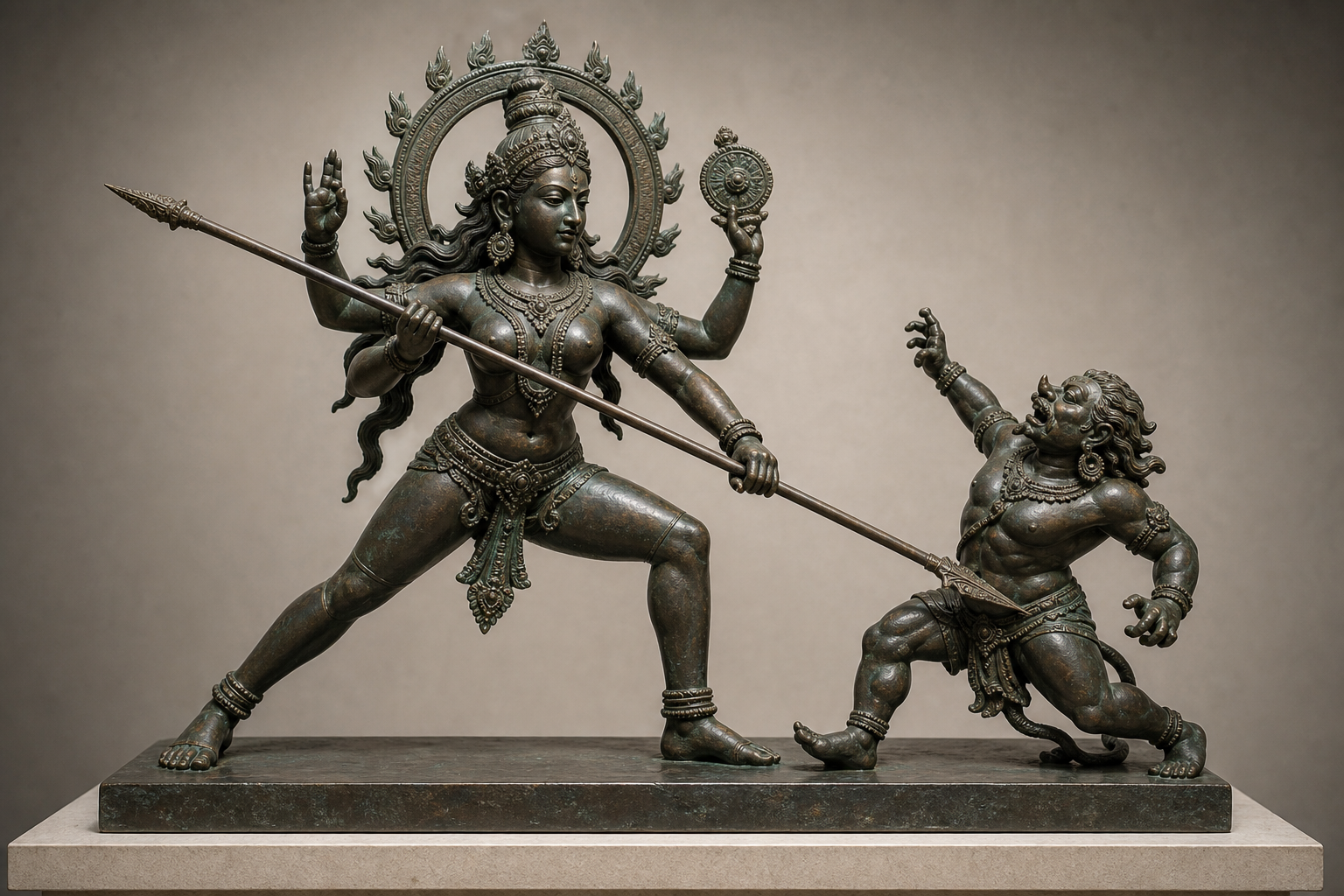
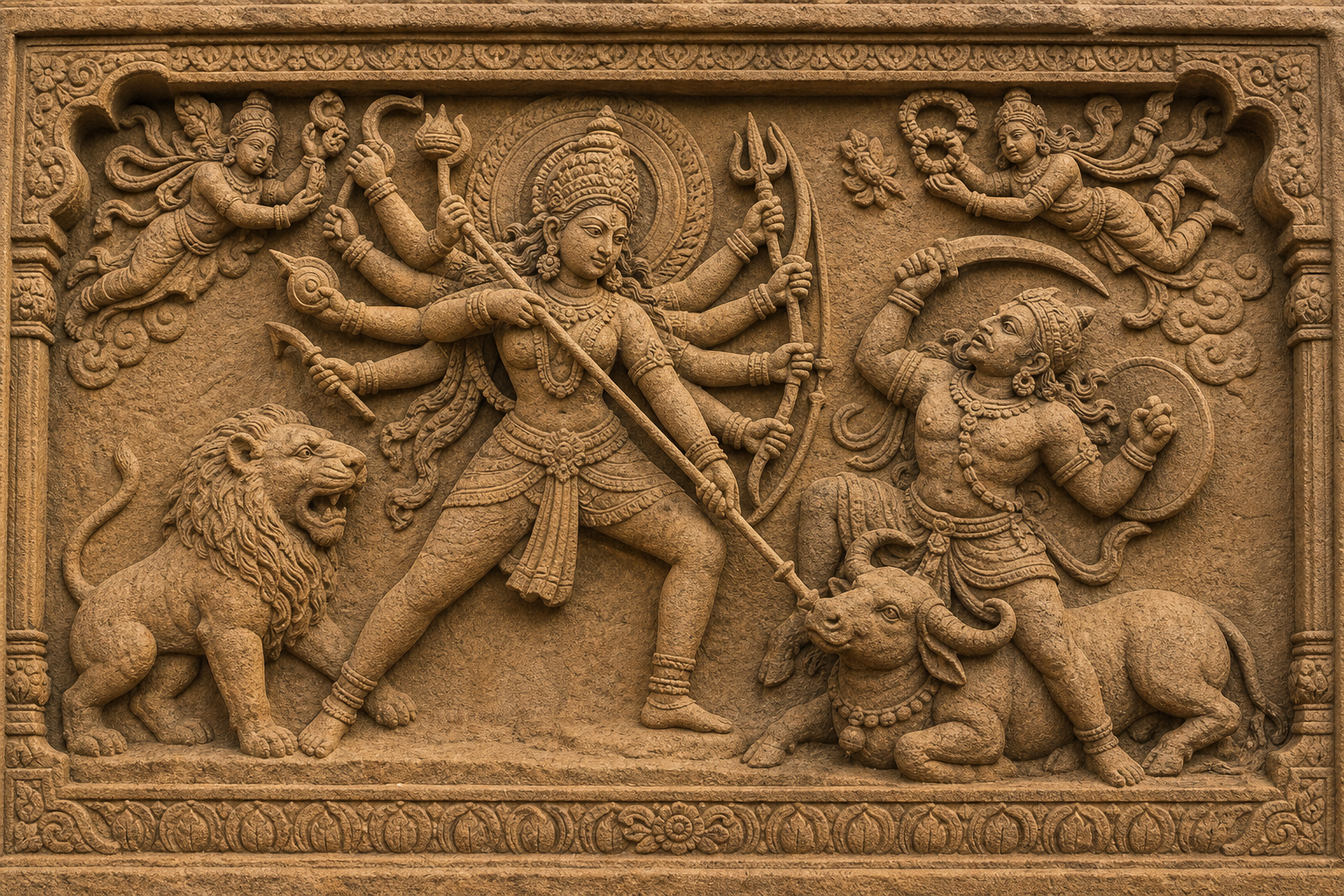
Durgā as Mahiṣāsuramardinī asks for a slightly different reading. Her relationship to Mahiṣa and the pedestal may complicate the clean outline of the stance: one foot can control the adversary while the rest of the body advances. Do not isolate the feet from that encounter. Follow the pressure through the demon, the leading leg, the weapons and Durgā’s face. Heroic and fierce energy can coexist with maternal composure because every element is directed toward protection and the restoration of order.
Skanda or Kārttikeya can use the forward-set stance to communicate martial command. Narasiṃha can use it to organise protective ferocity. Variants within Natarāja imagery can turn a related weight shift into an accented instant within the larger cycle of dance. These examples should confirm an identification through narrative context; they should not lead you to assume that every image of these deities must use Alidha.
The setting can provide another layer of confirmation. The karaṇa panels at Chidambaram preserve a sculptural vocabulary of codified movement. South Indian bronzes use poised asymmetry to project presence even through a slender silhouette, including when an image is carried in procession. At Angkor Wat, striding divine figures show how Indic systems of sacred movement could be adopted and reshaped beyond Bharat. When you encounter Alidha far from its best-known temple settings, examine what the local artist retained and what was adapted.
The posture also belongs to a wider Dharmic visual field. Vajrapāṇi and other wrathful figures in Vajrayāna art can stand in Alidha-asana to embody compassion acting fiercely against obstacles. Jain Tīrthaṅkara images usually centre serenity through padmāsana or kāyotsarga, while some attendant yakṣas and guardians adopt comparable striding forms. Martial disciplines, including Kalaripayattu as well as Sikh shastra-vidyā and Gatka, preserve related principles of grounded readiness. These parallels illuminate a civilisational concern with disciplined force, but they do not make every lunge an identical iconographic formula.
The vocabulary has roots in several technical domains. The Nāṭyaśāstra places Alidha within a system of meaningful movement, and the Abhinaya Darpana carries performance usage forward. The Mānasāra, Mayamata and Śilparatna belong to the craft traditions that guide the making of sacred forms, while Dhanurvedic usage makes the archer’s foundation especially clear. This overlap explains why a stone deity can appear theatrical, martial and theological at once: the same organised body makes action legible in each domain.
Key takeaways: a five-point test
- Name the figure’s anatomical sides. In a common convention, Alidha advances the figure’s right leg; Pratyalidha reverses the legs. Do not rely on the left or right side of the photograph alone.
- Check where the weight goes. Look for a bent leading knee and a lengthened, anchoring rear leg rather than two equally passive feet.
- Trace one line of action. The feet, pelvis, shoulders, weapon or mudrā, face and narrative target should form a coordinated movement.
- Read restraint as part of the power. Alidha most often communicates heroic or righteous action because forward force remains balanced by a stable base.
- Let context confirm the label. Deity, adversary, attribute, pedestal and surrounding scene are stronger evidence together than the legs are in isolation. When important details are missing, “Alidha-like” is the more careful description.
The next time you stand before a sacred image, begin at the rear heel and let your eye travel upward. If the grounded leg, advancing knee, turned torso and steady gaze converge on one purposeful act, you are no longer seeing a deity who merely happens to stand with the feet apart. You are seeing a visual teaching about when power should move and what must govern it.
References
