
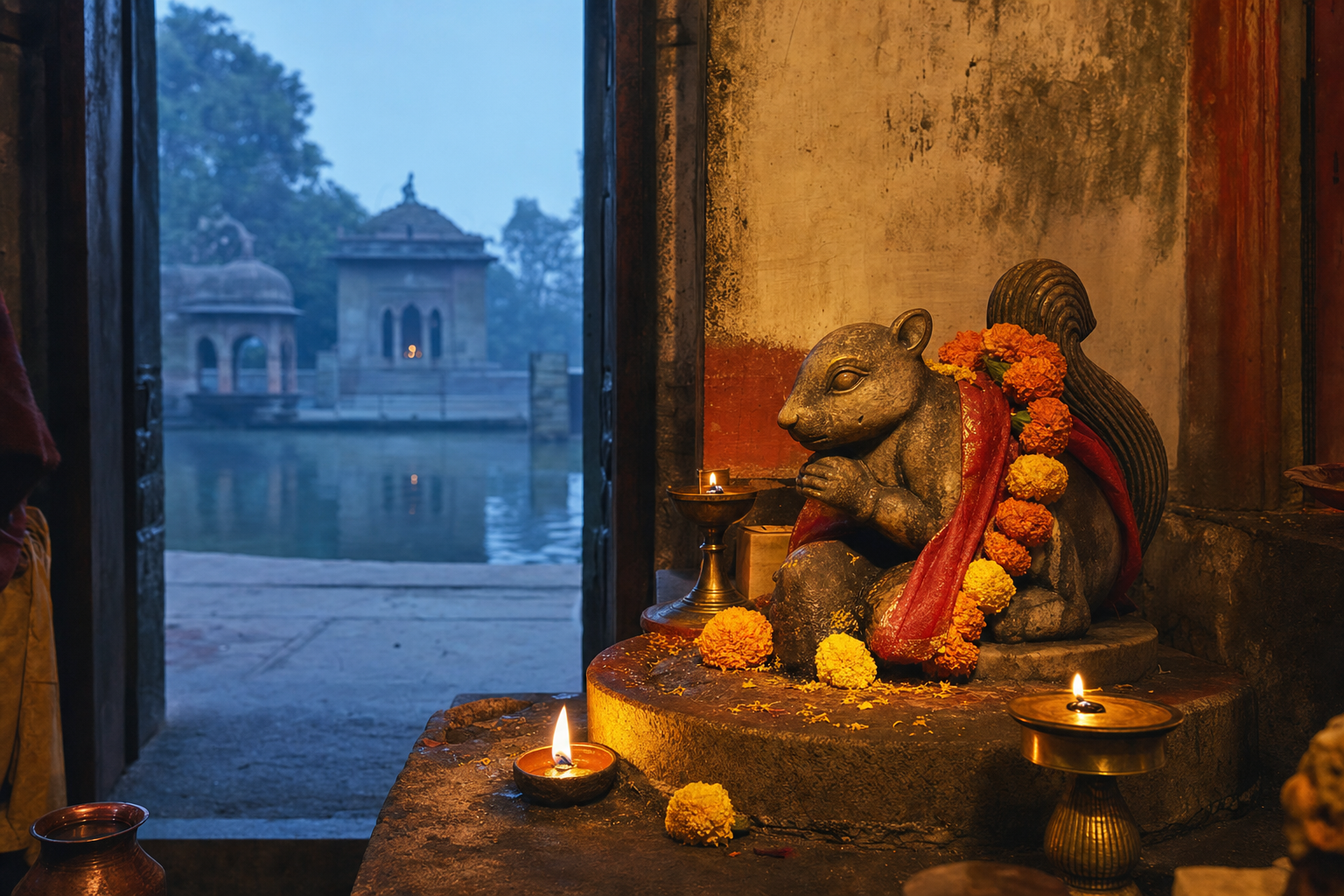
You may reach Achal Taal expecting a familiar murti of Hanuman and then encounter a much rarer image: Gilaharaj Ji Maharaj, Hanuman revered through the form of a squirrel. The immediate question is reasonable. Is this a different deity, a local version of the Rama Setu squirrel, or a symbolic form of Hanuman?
The clearest answer is that Gilaharaj is a distinctive expression of Hanuman-bhakti. The form joins Hanuman’s strength to the squirrel’s humble contribution, teaching you how devotion works when your ability seems smaller than the task before you.
What you are actually seeing at the Gilaharaj shrine
The name begins with an ordinary Hindi word: gilahari, meaning squirrel. At Achal Taal in Aligarh, the squirrel is addressed with the honorific Gilaharaj Ji Maharaj. The regal language turns a small creature into a dignified guardian presence without proposing a deity separate from Hanuman.
That distinction matters. If you treat Gilaharaj merely as an unusual animal idol, you miss the devotional logic. If you insist that Hanuman can be contemplated only through his customary vanara form, you miss the flexibility of Hindu sacred imagery. A divine quality may be approached through human, animal, iconic, or aniconic forms when that form helps the devotee recognise and practise dharma.
Gilaharaj brings particular qualities into the foreground. Hanuman’s might and strategic intelligence remain present, but the squirrel adds tenderness, persistence, and service without concern for status. The image does not make Hanuman smaller. It asks you to look more carefully at what made his greatness possible: complete dedication to Sri Rama rather than attachment to the scale or visibility of his own role.
When you take darshan, therefore, notice the relationship rather than becoming preoccupied with zoological categories. The theological question is not, “Is Hanuman a squirrel instead of a vanara here?” It is, “What does the squirrel reveal about Hanuman’s way of serving?” That question opens the shrine.
Why the squirrel belongs in the memory of Rama Setu
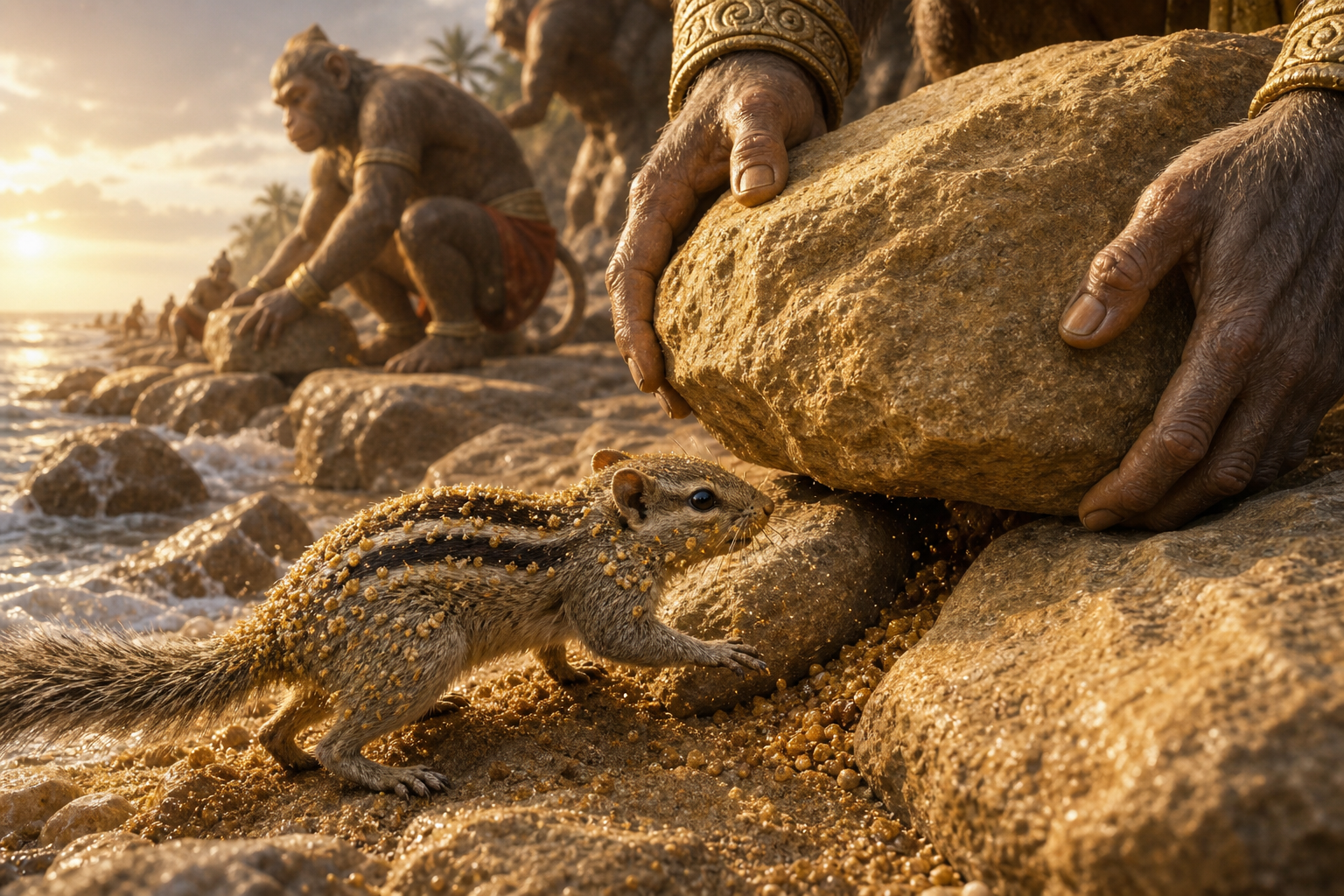
The form draws its emotional force from a beloved Ramayana remembrance. As the vanara sena laboured to build Rama Setu, squirrels are remembered as rolling in sand and shaking the grains into the spaces between the stones. Their bodies could not carry what the vanaras carried, but they could still help close the gaps.
Sri Rama, moved by their devotion, is said to have caressed them. Many tellings connect that touch with the three stripes seen along the back of the Indian palm squirrel. Whether you encounter the story through family narration, temple teaching, or devotional performance, its moral structure is precise: Rama evaluates the sincerity and completeness of an offering, not merely its physical size.
The grains of sand are not presented as a substitute for the great stones. Nor are the stones an excuse to dismiss the sand. Both belong to the same bridge. This corrects two common mistakes in collective dharmic work. The first is pride: believing that a large contribution makes smaller ones irrelevant. The second is helplessness: deciding that a small capacity makes participation pointless.
Gilaharaj stands between those errors. You are not asked to pretend that every contribution has the same scale. You are asked to offer your actual capacity faithfully, where it can close an actual gap. That is why the shrine’s squirrel symbolism fits Hanuman so naturally. Hanuman never measures seva by prestige; he measures it by fidelity to Rama’s purpose.
Read the form as a discipline, not just an inspiring story
Three ideas make the symbolism practical: seva, gratitude, and steadiness. Seva directs attention away from self-display and toward the work that needs doing. Kṛtajnata, or gratitude, teaches you to recognise every sincere contributor. Steadiness prevents devotion from disappearing when the task becomes repetitive or unnoticed.
This gives you a useful test for service. Ask whether the act helps complete something beyond your own reputation. Ask whether you would continue if nobody praised it. Then ask whether you are respecting the capacities of others instead of ranking their devotion by money, strength, education, or public visibility. A Gilaharaj-shaped act of seva may be modest, but it should never be careless or merely symbolic.
The teaching also has a wider Dharmic resonance without making different traditions interchangeable. Buddhist Jataka traditions often let small creatures disclose moral courage. Jain ethics train attention on ahimsa toward even the least powerful forms of life. Sikh langar makes collective service concrete through shared labour and shared nourishment. Gilaharaj expresses the same broad civilisational refusal to equate physical power with spiritual worth, while remaining firmly rooted in Rama-bhakti and Hanuman-bhakti.
This perspective changes how you look at a community. The person sweeping after an observance, filling a water vessel, caring for an animal, teaching one child, or quietly repairing a recurring problem may be placing sand in a structural gap. Respecting that labour is not sentimental politeness. It is recognition that durable dharmic institutions depend on small, repeated acts as well as visible leadership.
Turn the squirrel’s lesson into one concrete act of seva
The easiest way to lose this teaching is to admire the squirrel and leave your own gap untouched. Before or after darshan, name one bridge you are already responsible for helping to build. It could be a family duty, temple activity, neighbourhood need, educational effort, heritage project, or care for a shared natural space.
Then identify the smallest unfinished part that genuinely affects the whole. Do not choose a theatrical gesture. Choose the neglected task whose completion allows other people to proceed: confirming a volunteer roster, cleaning the space after worship, helping one elder reach an event, proofreading a notice, bringing an appropriate offering, or removing litter from a shared area. The squirrel’s grains mattered because they entered gaps in the bridge.
Key takeaways
- Gilaharaj Ji Maharaj is not best understood as a separate deity. The squirrel form is a local devotional lens for contemplating Hanuman’s seva.
- The Rama Setu memory does not claim that small and large contributions are identical. It teaches that both can be necessary when each is directed toward the same dharmic purpose.
- Your most faithful contribution is not automatically the largest one. It is the useful act within your capacity that you can perform carefully and consistently.
- Gratitude belongs to the teaching as much as service. Notice and honour quiet contributors instead of recognising only the most visible work.
- Care for animals and shared spaces can express the shrine’s ethic, but it should be responsible: avoid littering, follow local guidance, and never use devotion as an excuse for unsuitable feeding.
Consistency is the final step. A one-time act may help, but the squirrel embodies tireless participation. Choose a contribution you can repeat without abandoning your other duties. Dharma is strengthened when dependable service replaces occasional enthusiasm.
Visit Achal Taal with the right expectations and etiquette
Gilaharaj Ji Maharaj Temple is an intimate water-edge shrine rather than a monumental complex. Its focal form occupies the garbhagriha, while antechambers and a compact forecourt support darshan and circumambulation. Go prepared to attend to a living local tradition, not to measure the site by architectural scale.
- Use Aligarh as your arrival point. Aligarh Junction is the nearest major railway connection, and local transport can take you toward Achal Taal. If you are coming from Delhi, the road distance is approximately 130-150 kilometres.
- Check the day’s local arrangements before leaving. Morning and evening darshan are customary, but customary timing is not a guaranteed schedule. Tuesdays and Saturdays receive particular Hanuman devotion, so allow more time and follow instructions at the shrine.
- Choose a festival visit deliberately. Hanuman Jayanti, generally observed around Chaitra Purnima in North India, brings heightened activity and extended darshan. Ram Navami and the surrounding auspicious period bring the Rama Setu association more explicitly into worship.
- Offer without improvising. Til oil, sindoor, and laddus are familiar North Indian Hanuman offerings, while Hanuman Chalisa recitation and kirtan are common devotional practices. Follow the temple’s actual procedure rather than assuming every Hanuman shrine handles offerings in the same way.
- Wear modest clothing, keep your conduct quiet near the sanctum, and respect local photography rules. Do not block the compact forecourt or interrupt another devotee’s darshan while trying to examine the unusual form.
- Treat cleanliness as part of worship. Achal Taal is a sacred water setting, so carry away your waste and do not leave packaging after an offering. If you wish to care for squirrels or other local animals, use only suitable food and follow local guidance; refraining from feeding can be more responsible than giving the wrong food.
The waterbody is part of the meaning of the place. Across northern India, temple tanks and reservoirs have linked worship with ablution, processions, fairs, seasonal rhythms, and community life. At Achal Taal, water, path, and shrine create a compact sacred geography: you arrive, recollect the building of a bridge, and decide what kind of participation you will carry home.
Before you leave, choose one useful task that is within your capacity and give it a definite place in your week. That is a more fitting response to Gilaharaj than admiration alone: find the gap, carry your grain of sand, and keep returning to the work.


References
