
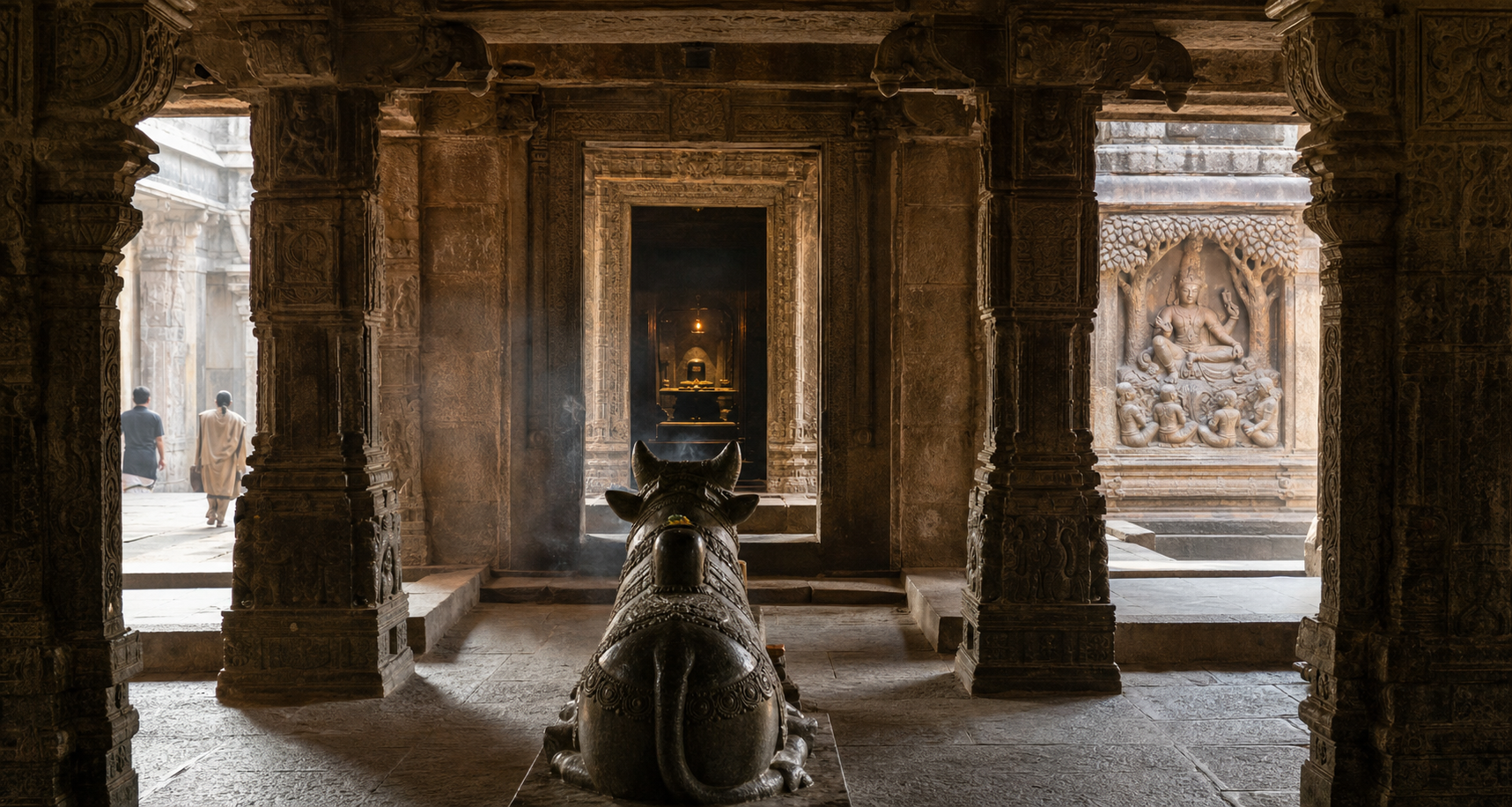
You may know where to bow in a Shiva temple and still wonder why the approach to the sanctum takes the form it does. Why does Nandi sit on the central axis? Why is Dakshinamurti usually encountered away from that direct line? Why must you pass through a succession of thresholds before receiving darshan?
These arrangements are not merely a container for worship. Read with attention, they teach you how to worship: arrive deliberately, relinquish self-importance, steady the mind, receive instruction, and then approach Shiva. The relationship among Dakshinamurti, Nandi, and the sanctum makes that pedagogy especially clear.
The path to the sanctum is a curriculum
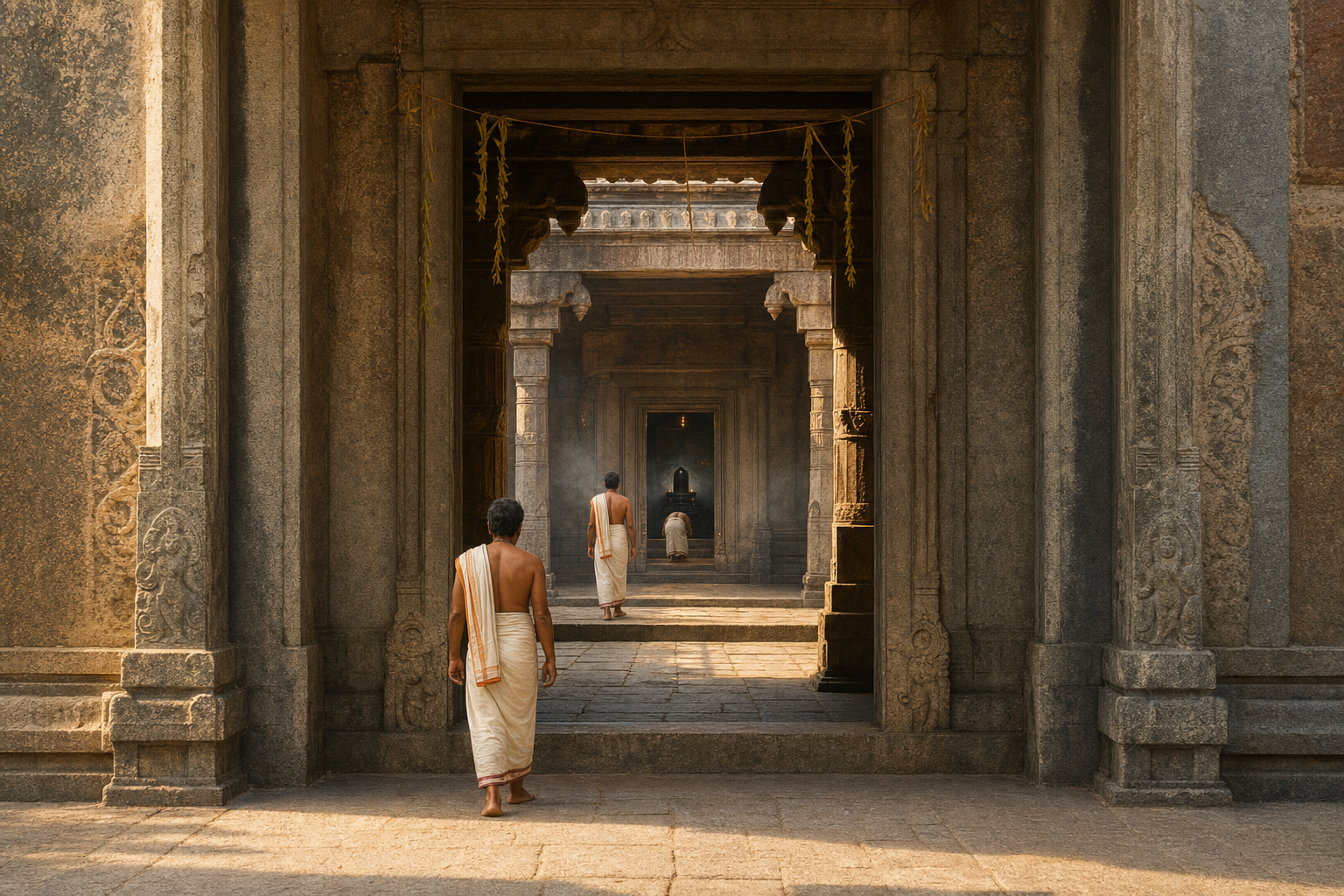
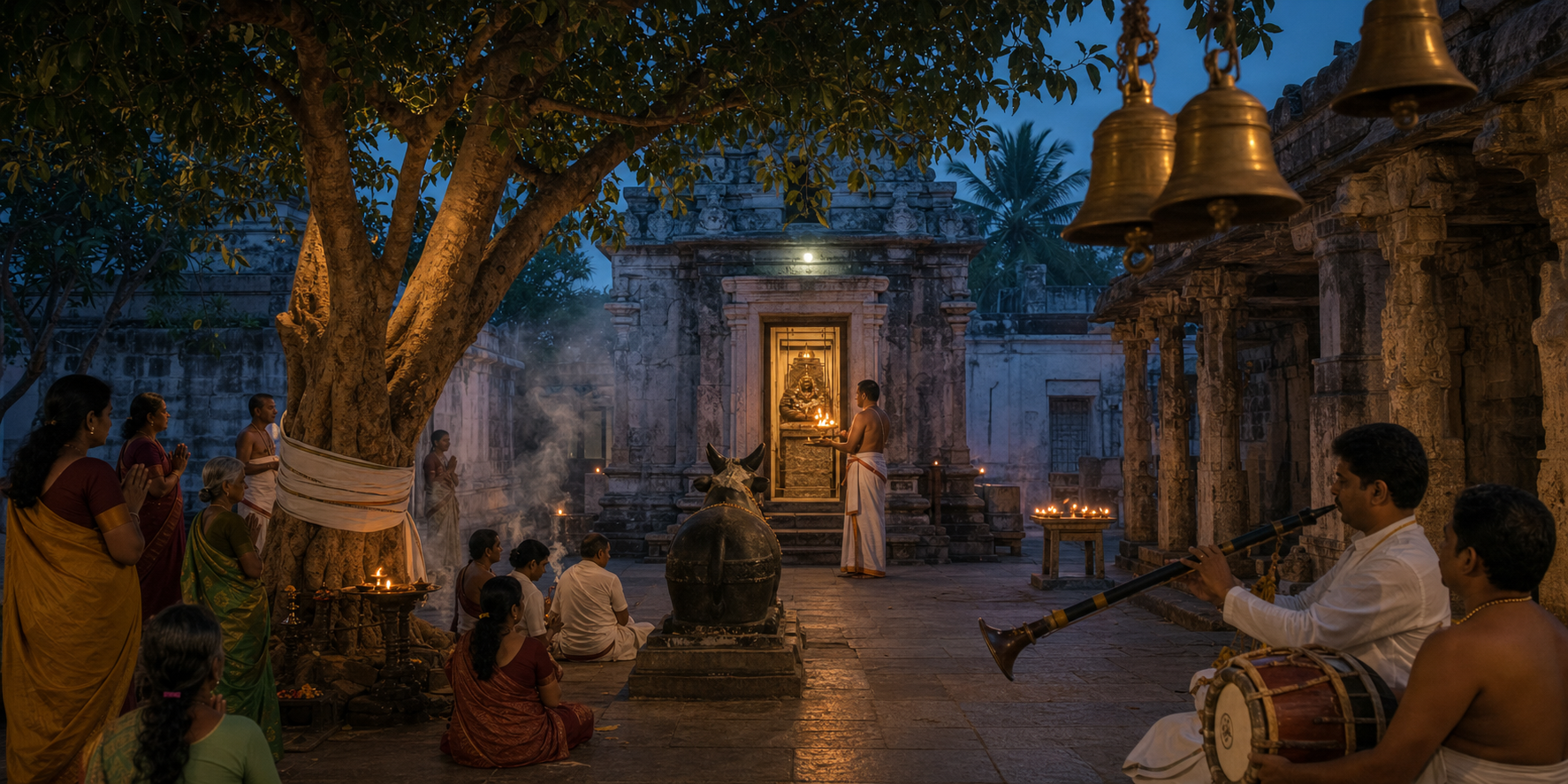
In the axial grammar familiar across the Kaveri delta, the devotee proceeds through the gopuram, bali-peetha, dhvaja-stambha, Nandi, and finally the garbha-griha. The sequence gathers your dispersed attention into a single direction. You move from the public threshold of the temple toward the concentrated stillness of the Shiva-linga.
Do not hurry past these features as though the real temple begins only at the sanctum. Each can become a prompt for an inward action:
- At the gopuram, arrive. Let crossing the threshold interrupt the momentum of errands, conversation, and sightseeing. You have entered a space ordered toward darshan.
- At the bali-peetha, release the acquisitive mind. Notice whether you have come only to obtain a result. Worship can include petition, but it cannot mature if every gesture remains a transaction.
- At the dhvaja-stambha, align your intention. Replace a scattered set of wants with one honest purpose: repentance, gratitude, clarity, devotion, or the strength to perform a duty.
- At Nandi, become steady. His fixed orientation models attention that does not keep turning toward distraction. Yet his story also warns that steadiness without humility can become rigidity.
- At the garbha-griha, accept concentration. The movement of the approach narrows toward the linga. Allow your speech and mental commentary to narrow with it.
This is a discipline, not a code that must be imposed mechanically on every shrine. Temples vary in plan, history, iconographic program, and local custom. If the arrangement differs, do not treat the temple as an imperfect version of a diagram. Ask what its actual route makes you notice, where it slows you down, and how its resident tradition explains the placement.
The important shift is from looking at architecture to letting architecture order your attention. A gateway is then more than an entrance, an axis more than geometry, and the sanctum more than the destination at the end of a queue.
Nandi shows how devotion can become an obstruction
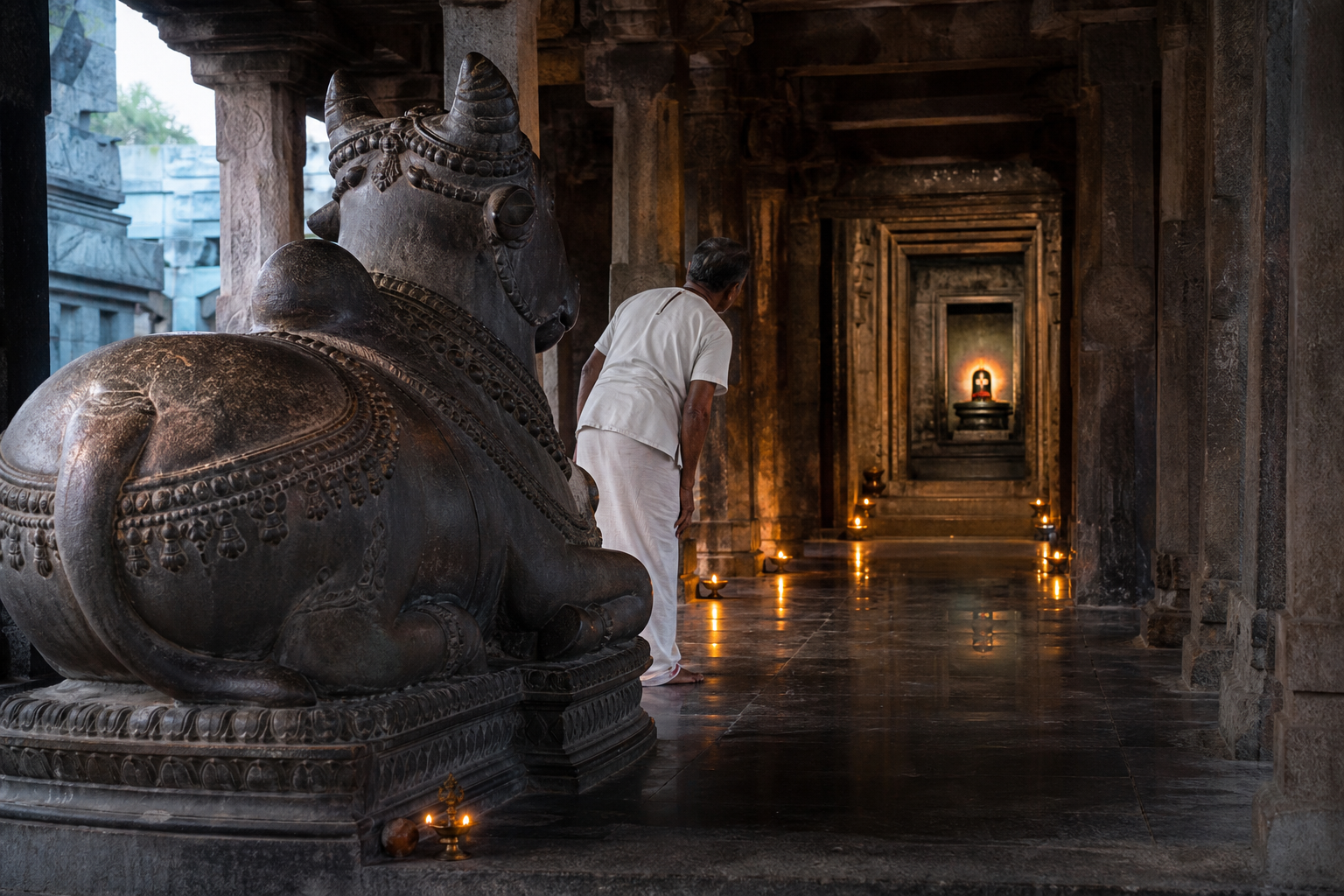
Nandi is Shiva’s vahana and sentinel, but reducing him to a divine vehicle misses his pedagogical force. He is Nandikeshvara, the disciplined disciple whose entire posture is directed toward the Lord. His strength is not restless. His attention is not divided.
At Vadaranyeswarar Temple in Mayiladuthurai, the local sthala-purana gives that familiar image a demanding ethical interpretation. Nandi’s confidence in his sentinel role becomes an unintended obstacle to sincere seekers. He must receive Dakshinamurti’s instruction before guardianship can be purified into service.
This is a place-specific sacred narrative, not a universal account of why every Nandi image occupies its position. Its lesson, however, travels well: a worthy role can still feed the ego. Loyalty can harden into gatekeeping. Knowledge can become a claim to superiority. The person protecting a tradition can begin to behave as though the tradition belongs to him.
You can see the danger wherever responsibility and identity become fused. A temple volunteer may preserve order yet humiliate someone unfamiliar with the custom. A learned devotee may defend doctrine yet refuse correction. A family elder may protect a practice yet leave no room for a younger person to ask a sincere question. In each case, the problem is not service itself. The problem is that the servant has become the obstruction.
Nandi’s redemption is therefore formative rather than punitive. His steadfastness is not discarded. It is illuminated. Once pride yields to the Guru, the same strength that guarded a position can guard dharma without denying another person’s access to grace.
When you stand before Nandi, ask a sharper question than whether your devotion is sincere: Does the way I express devotion help others turn toward the sacred, or does it make them pass through my approval first? That question converts a sculptural encounter into self-examination.
The custom of whispering a prayer into Nandi’s ear carries a related intimacy. The faithful sentinel is trusted to convey the devotee’s inner voice to Shiva. Where the temple observes this practice and the circumstances permit it, use the moment to clarify rather than multiply your requests. Name what is actually troubling you, identify the attachment or pride entangled with it, and place the matter in service of dharma. If local custom or the flow of worship does not permit the gesture, do not force it; reverence includes respect for the living order of the temple.
Dakshinamurti teaches you how to receive knowledge
Nandi’s correction comes through Dakshinamurti, Shiva as the supreme Guru. The teaching is given through presence, orientation, gesture, and silence. This matters because spiritual ignorance is not always caused by a lack of information. Often you already possess plenty of words; what you lack is the inward quiet in which their truth can be recognized.
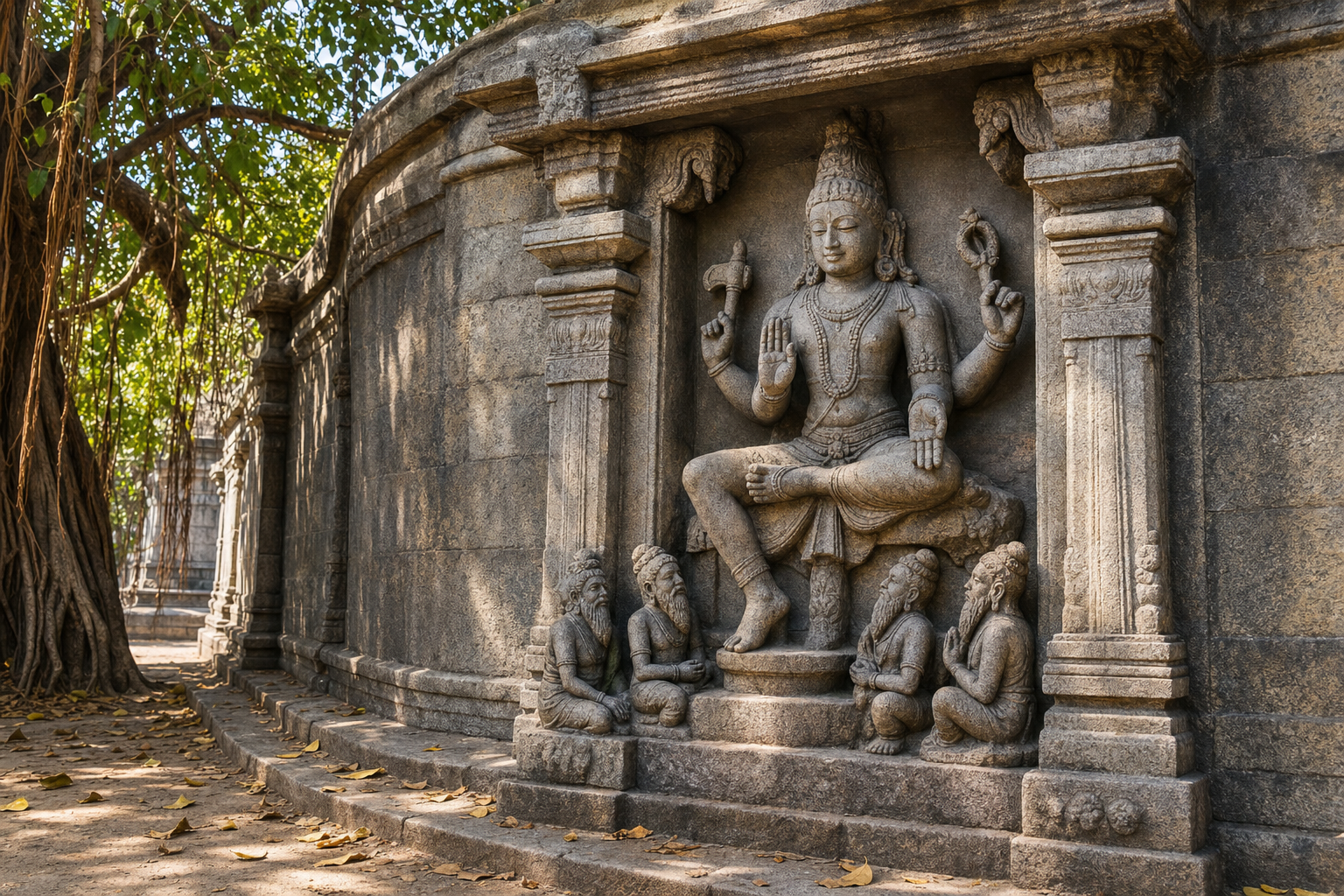
Dakshinamurti faces south within the Shaiva-Agamic iconographic tradition. His hand may display the jnana or vyakhyana mudra. Other hands may hold a scripture, akshamala, fire, or serpent. Apasmara, the figure beneath his foot, embodies forgetfulness and spiritual heedlessness. The banyan, represented as a living tree or sculpted motif, evokes knowledge whose shelter extends beyond a single generation.
When you encounter the shrine, look in a deliberate order:
- Notice the direction. Dakshinamurti’s southward orientation distinguishes the Guru’s presence from the central line along which Nandi faces the linga.
- Read the teaching hand before the objects. The mudra directs attention to knowledge as realization, not merely accumulated information.
- Observe what the other hands actually hold. Iconographic details can vary. Do not become so intent on finding an expected checklist that you stop seeing the murti before you.
- Look beneath the foot. Apasmara is held in check by stabilized awareness. The image does not encourage a fantasy in which one dramatic experience permanently removes every trace of carelessness.
- Look for the banyan. The tree joins rootedness with expansive shelter. Knowledge endures because it is received, embodied, and transmitted.
The name Vadaranyeswarar itself joins vata, the sacred banyan, with aranya, forest, and Ishvara, Lord. The temple’s identity therefore carries the banyan-associated grammar of Dakshinamurti’s teaching. The sthala-vriksha is not incidental greenery. It holds the memory of the kshetra in living form.
Silence here does not mean passivity, vagueness, or refusal to teach. Mauna-vyakhya is instruction in which the disciple must become capable of receiving what argument alone cannot produce. Nandi does not need a larger title or a better explanation of his authority. He needs the self-knowledge that prevents authority from becoming pride.
You can practice that receptivity without pretending that every passing thought is a revelation. Arrive with one sincere question. Stop rehearsing the answer you hope to receive. Attend to the murti’s posture, hand, and stillness. Then notice which part of you immediately begins defending its habits. That defensive movement is often more instructive than another abstract answer.
Apasmara also prevents a common misreading of spiritual progress. Ignorance is not shown receiving polite advice from a distance; it must be restrained. Yet restraint must be maintained. The practical lesson is sober: awareness becomes transformative when it is stabilized in conduct. A moment of clarity that leaves speech, responsibility, and relationships unchanged has not yet completed its work.
Darshan depends on the sightline within you
At Vadaranyeswarar, the remembered relationship among Nandi, Dakshinamurti, and the linga is reinforced by space. The clarity of the sightline from the mandapa toward the sanctum makes visible the teaching that darshan clears when obstruction is removed.
That does not make darshan a search for the best visual angle. Nor does it justify stepping into a restricted area, interrupting worship, or treating the sanctum as a photographic composition. The architectural line is pedagogical because your body must take its proper place within it. You receive the view; you do not possess it.
There are really two sightlines to examine. The outer one runs from Nandi toward the linga. The inner one runs from your intention toward what you claim to revere. The outer line can be perfectly clear while the inner one is blocked by resentment, display, fear, or the desire to control someone else’s devotion.
This is why the temple’s teaching needs several media at once. Architecture establishes an order of approach. The murti embodies disciplined attention. The sthala-purana reveals the ethical danger hidden within a sacred role. Ritual repeats the correction until the body remembers it. Sound then carries the lesson beyond what stone alone can communicate.
The Kaveri temple tradition is not silent in the ordinary sense. Odhuvars recite the Thevaram and Tiruvacakam, binding text, melody, theology, and place. Dakshinamurti’s silence and the temple’s sung liturgy do not contradict each other. The song gives sacred language to the community; the silent Guru prevents language from becoming mere performance.
Ritual time reinforces the same pedagogy. Pradosham places Nandi at the center of Shaiva worship through circumambulation, repentance, renewal, and the hope of Shiva’s forgiving glance. Thursday deepa-aradhana at Dakshinamurti’s shrine draws students, teachers, and seekers of discernment. Maha Shivaratri extends attention through vigil and mantra-japa, while Arudra Darisanam turns toward Nataraja, consciousness represented in ecstatic motion. Stillness, sound, repetition, and movement become different methods of instruction.
A practical way to let the temple teach you
You do not need to decode every sculpture in one visit. Choose one relationship and follow it carefully. For this theme, begin with the axis linking your entrance, Nandi’s attention, and Shiva’s sanctum; then seek Dakshinamurti as the Guru who corrects the disciple’s way of seeing.
- Enter with a diagnostic question. Ask where you may be obstructing something you sincerely claim to serve. Keep the question concrete: a religious responsibility, family duty, teaching role, community position, or area of expertise.
- Walk the axial sequence consciously. At each major threshold, make the corresponding inward movement: arrive, release, align, steady, and receive.
- Pause at Nandi without romanticizing yourself. Identify one strength that has begun to harden. It may be discipline becoming intolerance, loyalty becoming possessiveness, or knowledge becoming condescension.
- Observe Dakshinamurti before interpreting him. Find the direction, mudra, objects, figure beneath the foot, and banyan motif that are actually present. Let the particular murti teach before fitting it into a memorized scheme.
- Receive Shiva’s darshan without competing for it. Respect the queue, the temple’s boundaries, and other devotees. An unobstructed inner sightline cannot be built through inconsiderate behavior.
- Carry one correction out of the temple. Turn insight into a visible act: listen before enforcing, explain without humiliating, relinquish unnecessary control, or make access easier for a sincere seeker.
If you attend during Pradosham, let its rhythm support confession and recommitment rather than using the occasion only to repeat requests. If you visit Dakshinamurti on Thursday, bring a genuine problem of discernment and remain willing for the correction to fall on you rather than on the person you think is wrong. Ritual becomes pedagogy when it changes the disciple’s conduct.
Key takeaways
- A Shiva temple’s axial sequence can train attention as you move from the public threshold toward the stillness of the sanctum.
- Nandi represents steadfast devotion, but the Vadaranyeswarar tradition warns that even loyal guardianship can become an obstacle when joined to pride.
- Dakshinamurti teaches through direction, mudra, iconographic detail, and silence; receiving that teaching requires observation before interpretation.
- Apasmara shows that forgetfulness must be held in check through sustained awareness, not merely displaced by a passing spiritual experience.
- The lesson is completed outside the temple when authority becomes service, knowledge becomes humility, and devotion makes room for another seeker’s darshan.
On your next temple visit, follow one axis rather than trying to master the whole complex. Let Nandi expose one obstruction, let Dakshinamurti correct the mind defending it, and carry that correction into a specific relationship or duty. That is the point at which temple space becomes spiritual instruction.
References
