
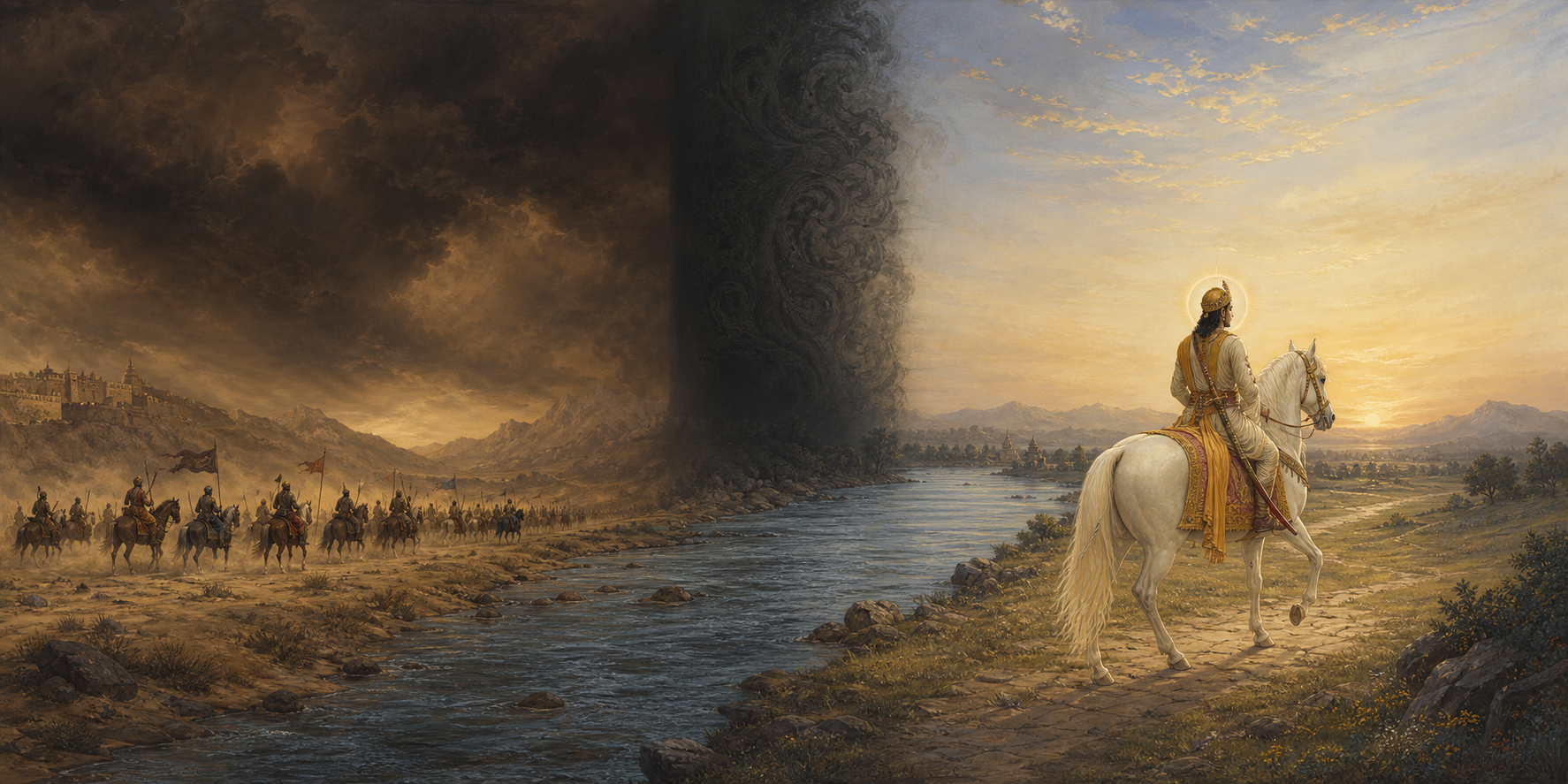
If you have seen Kalki on horseback placed beside warnings about foreign rulers, you may be wondering whether Hindu scripture predicts a literal cavalry invasion at the end of the age. The short answer is no: there is no single scriptural formation called the end-times cavalry.
That label combines different images with different roles. One concerns mleccha rulers as signs of Kali Yuga’s disorder. Another concerns the mounted Kalki as the restorer of dharma. Historical memories of steppe horsemen give the language additional force, but they do not turn these separate strands into a timetable for a modern war. If you keep the actors and their functions distinct, the prophecy becomes clearer and much harder to misuse.
The supposed cavalry consists of two different images
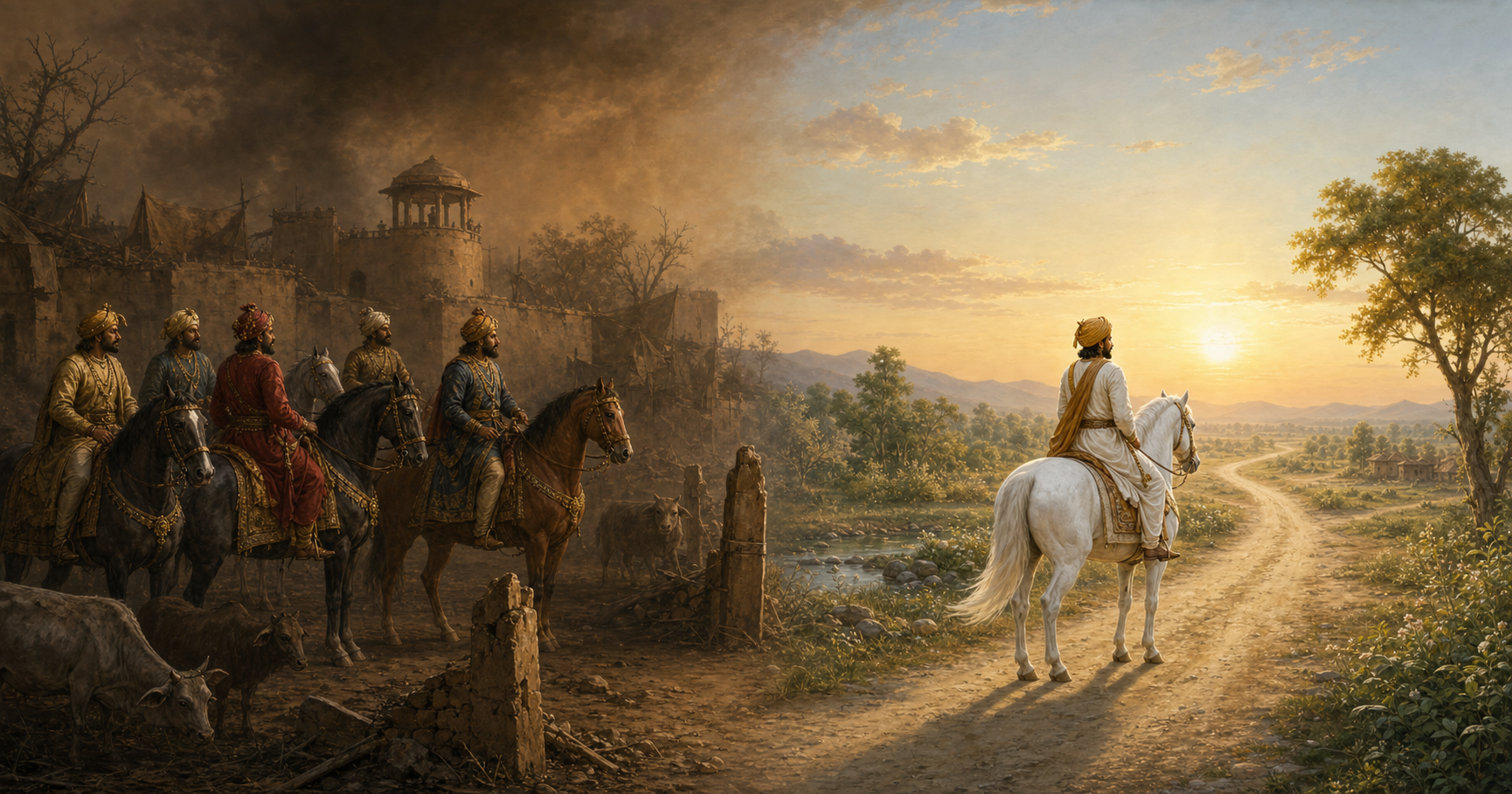
End-times is an imperfect English label for the close of Kali Yuga. Hindu sacred time is cyclical: Satya, Treta, Dvapara, and Kali form a recurring sequence. The close of Kali Yuga is therefore a transition from a degraded order toward renewal, not necessarily the final extinction of the cosmos. Reading it through a strictly linear last-day framework can distort what the images are doing.
| Image | Actor | Function in the narrative | Common misreading |
|---|---|---|---|
| Rule by mlecchas | People treated as outside the established Sanskritic social order | A symptom of political and moral inversion during the dark age | Identifying every modern foreigner, religion, or nation as the same predicted enemy |
| Kalki on horseback | Kalki, the future avatar of Vishnu | The decisive restoration of dharma at the close of Kali Yuga | Turning Kalki’s mount into a prediction of a particular human cavalry formation |
The distinction is basic but decisive. A horse does not automatically imply cavalry, and mleccha rule does not automatically imply that the rulers in question are Kalki’s mounted followers. In one image, disordered sovereignty reveals the condition of the age. In the other, a divinely directed figure ends that condition. The symptom and the remedy cannot be exchanged without reversing the meaning.
Kalki is commonly represented riding a white horse. That makes the mounted figure vivid, but it still does not establish a scriptural prediction about the size, ethnicity, route, weapons, or modern identity of an army. When a contemporary claim supplies those details, ask where they came from. If they cannot be tied to an identified passage, they belong to the interpreter’s scenario rather than to the scripture.
Three layers must be read without collapsing them
1. The moral layer: failed kingship is a sign of Kali
In the Mahabharata, Markandeya warns Yudhishthira that rule by mlecchas belongs to the darkening of the age. This is not merely a complaint that unfamiliar people have crossed a border. Kingship is being judged through dharma. When those without a recognised place in the inherited social order occupy the throne, their rule becomes part of a larger picture of inversion, failed authority, and declining norms.
That context tells you what to look for. The central issue is not the spectacle of horses. It is the loss of legitimate, dharmic rule. A reading that catalogues outsiders while ignoring corruption, injustice, falsehood, or dereliction among insiders has missed the passage’s moral direction. Kali Yuga is not diagnosed solely by who a ruler’s ancestors were; it is disclosed through the condition of rule and society.
Mleccha also requires care. In this Sanskritic vocabulary, it marks people regarded as outside a particular linguistic and social order. It is not a precise equivalent of any one modern race, citizenship, or religious community. Its application changed across places and periods. Before accepting a modern identification, ask the person making it to explain why that historical category should map onto the proposed group and what textual evidence controls the mapping.
2. The historical layer: horse conquerors entered a mixed frontier
Ancient northwestern Bharat had direct experience of mounted peoples arriving from Central Asia and taking political power. Maues, also remembered as the Great Moga, was a Scythian horse archer who became the first of his people to rule an Indian city. That history helps explain why foreign kingship and mounted power could become such charged images.
Yet the surviving details resist a simple story of two sealed civilisations. In the seventy-eighth year of Moga’s reign, on the fifth day of the Macedonian month Panemos, an official named Patika deposited relics of the Buddha near Taxila and established a monastery. His father, Liaka Kusulaka, held the Persian-derived office of satrap. The dedication used Kharoshthi script and Prakrit language. Thus Scythian rule, Persian administration, a Macedonian calendar, local speech, and Buddhist patronage met in one act.
This does not make foreign conquest harmless, nor does it cancel the Sanskritic concern about political displacement. It teaches a narrower and more valuable lesson: scriptural boundary language and lived history are not identical maps. A conqueror can remain foreign in a social classification while his court participates in an Indian religious landscape. Patika’s Buddhist endowment is therefore a warning against treating mleccha as a timeless biological essence or assuming that every person under foreign rule played the same role.
The Taxila setting also helps you notice historical layering without reducing prophecy to journalism. A description of the dark age may preserve anxieties sharpened by real invasions, yet its purpose can still be moral and cosmological. Historical experience gives an image urgency; it does not automatically make every future use of that image a coded prediction of one twenty-first-century conflict.
3. The eschatological layer: Kalki represents restoration
Kalki belongs on the restoring side of the pattern. The mounted avatar embodies decisive movement against entrenched adharma and the renewal of right order. The horse communicates speed, royal power, martial capacity, and the ability to cross a landscape that settled institutions can no longer govern. Those associations help explain the image without requiring you to choose between pure allegory and a detailed military forecast.
That middle position matters. Declaring every element merely symbolic can empty a sacred narrative of its claimed reality. Insisting that every visual feature is a technical specification creates a different error. The responsible question is what the identified text actually commits you to believe. A mount may be integral to Kalki’s manifestation while still giving you no basis for naming a modern regiment, state, community, or date.
How to test a claim that the prophecy is happening now
Claims about fulfilled prophecy often become persuasive by moving quickly from resemblance to identity: a mounted force resembles an old image, therefore it must be that image. Slow the argument down. Use these checks before you repeat it.
- Require an exact textual location. Ask for the work, section or passage, speaker, and surrounding dialogue. A picture, paraphrase, or isolated translated line is not enough to establish the claim.
- Identify the grammatical actor. Determine who rides, who rules, who suffers, and who restores. If the claim merges mleccha rulers with Kalki or his side, it may have exchanged the symptom for the remedy.
- Ask what kind of statement you are reading. A catalogue of Kali Yuga’s social signs, a narrative of restoration, and a historical account do different work. Do not force all three into one chronological battle plan.
- Examine the key word in context. If the argument depends on mleccha, ask how the translator is using it and why the proposed modern equivalent is justified. Barbarian, foreigner, outsider, and non-Vedic are overlapping interpretations, not perfectly interchangeable modern identities.
- Separate what the passage states from what the interpreter adds. Put every supplied date, nation, weapon, direction of attack, and named leader in a second column. If those details are absent from the passage, label them as speculation.
- Test the interpretation against inconvenient evidence. Patika’s Buddhist dedication under Scythian rule complicates an absolute invader-versus-Bharat binary. A sound historical interpretation should explain such evidence rather than silently discard it.
A resemblance can still be meaningful. Hindu narratives repeatedly give readers patterns through which to judge power, decline, and renewal. But pattern recognition is not the same as proof of fulfilment. Say that an event evokes or resembles a scriptural pattern when that is all the evidence supports. Reserve predicted for cases where the relevant text supplies the claimed identifying details.
Key takeaways
- Hindu tradition does not present a single formation called the end-times cavalry.
- Mleccha rule functions as a sign of Kali Yuga’s political and moral disorder; Kalki’s horse belongs to the restoration of dharma.
- The end of Kali Yuga is a transition within cyclical sacred time, not simply the final destruction assumed by some linear end-times models.
- Memories of Scythian and other mounted conquerors help explain the image’s historical force, but they do not identify a present-day enemy.
- A modern fulfilment claim should provide an exact passage and distinguish textual content from added dates, nations, weapons, and speculation.
A dharmic reading should sharpen conduct, not panic
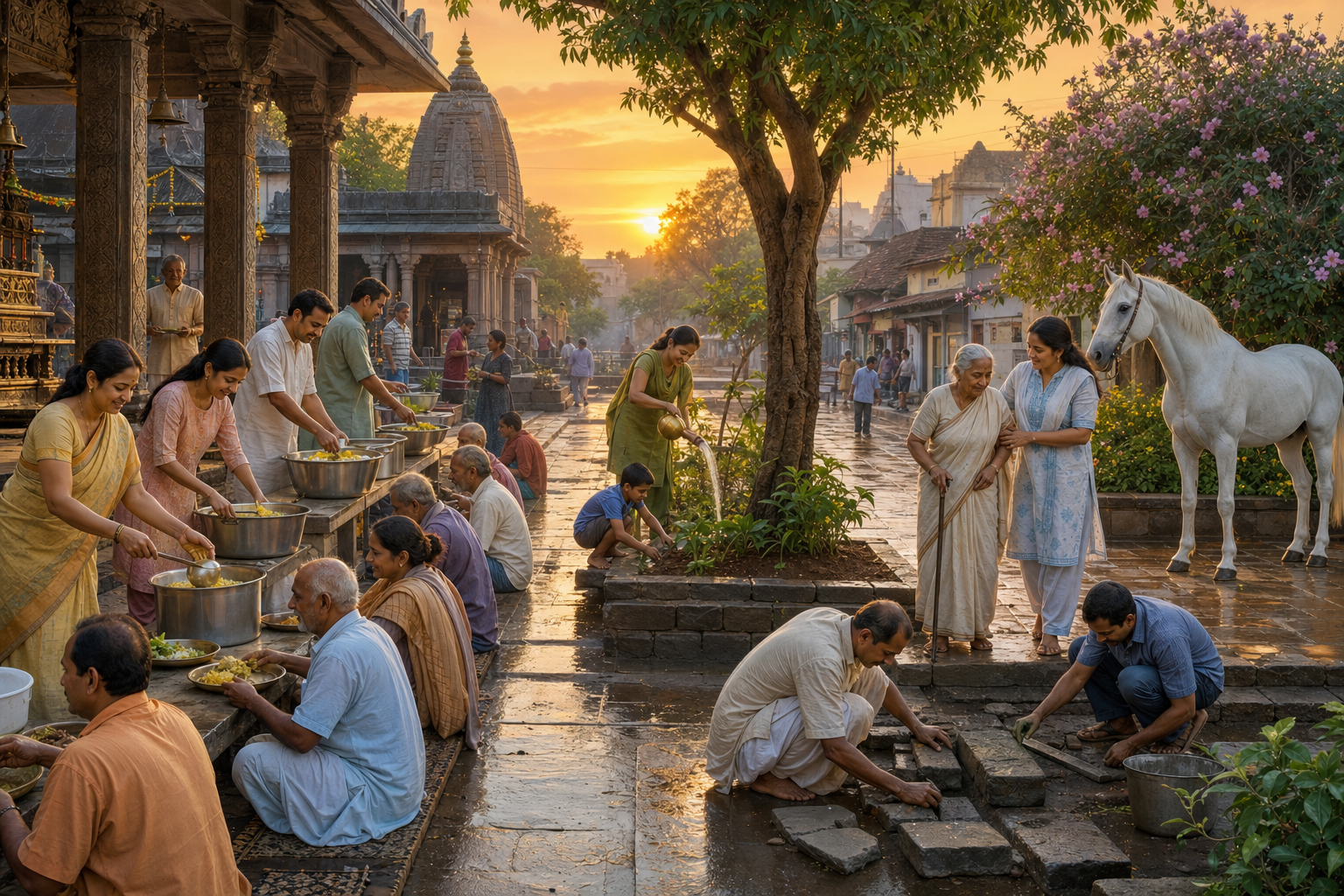
The most useful question is not, Who can we force into the role of the final enemy? It is, What does the diagnosis of Kali require from us? If the passage condemns the collapse of dharmic rule, then truthfulness, discrimination, restraint, courage, protection of the vulnerable, and resistance to adharma matter before any dramatic fulfilment claim does.
Prophecy is not permission to treat a modern population as collectively guilty. The historical world around Taxila was already too entangled for that shortcut: foreign rule, inherited administrative forms, local language, and Buddhist patronage coexisted. A strong pro-dharma reading can recognise invasion and political displacement plainly while still judging people by conduct rather than converting an old social category into indiscriminate hostility.
When the next end-times claim reaches you, write down four things before forwarding it: the text, the speaker, the actor, and the actor’s function. If one is missing, call the claim an interpretation rather than a prophecy fulfilled. Then turn back to the demand that remains valid in every age: notice adharma accurately and choose a proportionate, truthful way to uphold dharma where you actually stand.
References
