
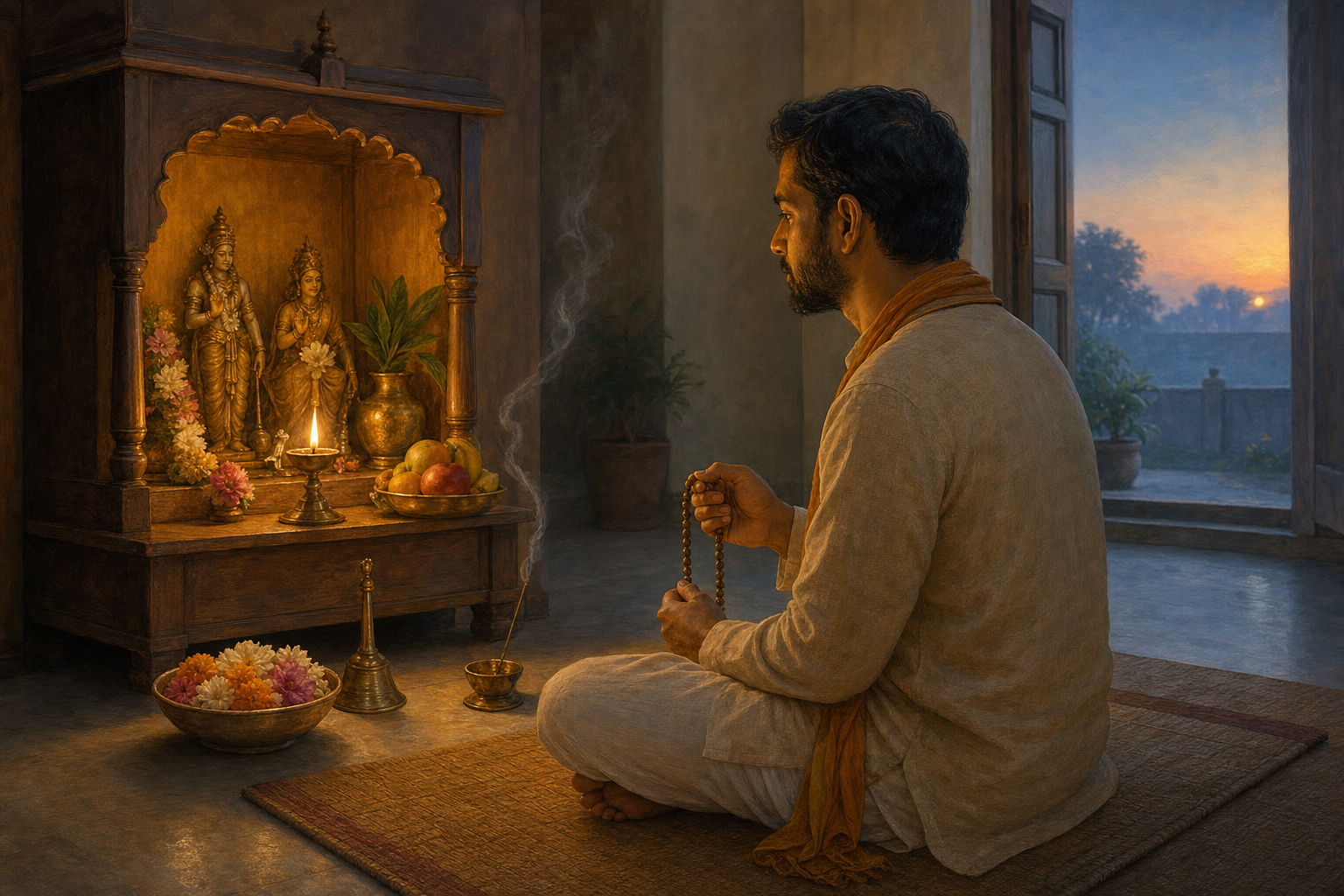
You sit before the lamp, begin your mantra, and discover that half your mind is replaying a conversation while the other half is planning the day. Later, when a difficult choice appears, the calm of the shrine seems unavailable. Worship has not failed. Attention, discernment, and worship have simply been treated as separate activities.
Hindu sadhana joins them into one movement. Attention gathers the mind. Discernment decides what deserves your allegiance. Worship turns that clarified attention toward the sacred and carries it back into conduct. When these disciplines reinforce one another, puja becomes more than an observance and viveka becomes more than intellectual analysis.
Know which inner faculty you are actually training

A useful Hindu map of the inner instrument, or antahkarana, distinguishes four functions. Manas receives, coordinates, and reacts to sensory impressions. Buddhi discriminates and judges. Ahamkara appropriates experience as mine and organizes it around identity. Chitta carries memories, tendencies, and impressions that can reappear before deliberate reasoning begins.
These are not four sealed compartments. They describe movements you can notice. An unpleasant remark reaches manas. Chitta supplies older injuries that resemble it. Ahamkara turns the moment into a threat to status or self-image. Buddhi may then discern a proportionate response, or it may be recruited to justify the reaction already underway. If you can identify that sequence, you no longer have to mistake the first impulse for the final truth.
The Katha Upanishad makes the practical problem vivid through its chariot image: the senses are the horses, the mind is the reins, buddhi is the charioteer, and the Self is the passenger. Strong horses are not the enemy. The danger is movement without intelligent direction. Your task is therefore not to become insensible, but to make perception governable and judgment trustworthy.
- Attention is the capacity to place the mind, notice its departure, and return it without following every impulse.
- Discernment is the capacity to distinguish preference from duty, immediate attraction from lasting good, and a partial truth from the whole situation.
- Worship is the consecration of attention, intention, body, senses, and action to what you recognize as sacred.
Each discipline corrects a weakness in the others. Concentration by itself can serve an unworthy purpose. Clever reasoning without ethical limits can rationalize almost anything. Ritual performed without attention can become a sequence the hands complete while resentment, vanity, or appetite remains untouched.
Before puja or an important decision, identify the mind’s dominant guna. Tamas appears as fog, avoidance, neglect, or the wish to call passivity peace. Rajas appears as urgency, agitation, rehearsed argument, craving, or the need to win. Sattva appears as enough clarity to hear an unwelcome fact, state the real alternatives, and remain answerable to dharma. The Bhagavad Gita 18.37-39 distinguishes these patterns partly by their consequences: what attracts immediately may carry later distress, while what requires discipline at first may mature into well-being.
Do not make a moral interpretation while the mind is at its most tamasic or rajasic if the matter can safely wait. Change the conditions first. Wash, straighten the worship space, step away from competing stimuli, settle the breath, and rest attention on one clear object. This is not evasion. It is preparation for buddhi to function without being dragged by the loudest tendency.
Train attention in the order the mind can follow
Patanjali’s Yoga Sutra 1.2 describes yoga through the stilling of chitta’s fluctuations, while Sutra 1.12 gives abhyasa and vairagya as the paired means. Abhyasa is sustained practice. Vairagya is non-clinging. One teaches you to return; the other prevents every distraction from becoming a command.
Trying to force the mind into blankness usually turns practice into a contest with thought. A more workable sequence follows the movement from outer conditions to steady inward attention:
- Choose a bounded place and a reliable cue. A clean corner, a prepared altar, or the lighting of the lamp tells the mind that scattered activity has ended. Dawn and dusk can serve as natural household anchors, but consistency matters more than imitating a schedule you cannot sustain.
- Settle prana without making breath control a performance. Let breathing become even enough that you can feel an impulse without immediately obeying it. Forced ratios and dramatic retention are unnecessary for this purpose.
- Practice pratyahara. Put the device beyond reach, stop feeding the unfinished conversation, and allow sounds or sensations to exist without turning toward each one. Sensory withdrawal means releasing the senses from compulsive pursuit, not refusing to perceive.
- Give dharana one job. Choose the murti, a mantra, the flame, or another focus recognized in your tradition. Do not keep changing the object because another technique suddenly seems more interesting.
- Allow continuity to deepen toward dhyana. When attention wanders, return without building a second story about being a poor practitioner. The return itself is abhyasa; declining to chase or condemn the distraction is vairagya.
- Close with smriti. Notice what repeatedly captured the mind. If it was a real obligation, give it an appropriate place after worship. If it was a recurring craving, grievance, or fantasy, you have identified material for discernment rather than merely having failed to concentrate.
The first useful measure of progress is not a thoughtless mind. It is a less obedient relationship to distraction. You notice departure sooner, return with less inner argument, and recover more quickly after disturbance. Over time, abhyasa and non-clinging stabilize attention well enough for discernment to operate under pressure.
Vairagya must not be confused with indifference. Refusing to be possessed by anger does not remove your duty to oppose wrongdoing. Releasing anxiety about the result does not release you from careful preparation. Apathy withdraws effort; non-attachment removes egoic captivity so that necessary effort can become steadier.
Let puja educate all five senses

A restless mind rarely becomes collected through argument alone. Puja gives the body and senses an ordered way to participate. Fragrance, touch, form, taste, flame, breath, and sacred sound are not miscellaneous decorations. The five-element and five-sense grammar of worship turns perception away from indiscriminate consumption and toward deliberate offering.
Panchopachara offers a compact household form through gandha, pushpa, dhupa, deepa, and naivedya. The correspondences are intuitive rather than a rigid one-to-one chart; water, sound, touch, and space also enter through purification, mantra, bell, darshana, and the arrangement of the altar. Use the following as a discipline of attention, while retaining the order and meanings taught by your family or sampradaya.
| Offering | What you attend to | What the act rehearses |
|---|---|---|
| Gandha | The fragrance and cool touch of sandal paste or another customary substance | Returning from abstraction to a composed, embodied presence |
| Pushpa | Form, color, freshness, and fragrance | Choosing and offering with care instead of handling sacred materials mechanically |
| Dhupa | Fragrance carried through air and the changing atmosphere of the space | Allowing one sensory cue to recall the mind to worship |
| Deepa | The steady visual form of light and the transforming quality of fire | Linking illumination at the altar with clarity in thought and speech |
| Naivedya | Food, nourishment, and its later reception as prasada | Moving from possession and appetite toward gratitude and sanctified participation |
Water can prepare this sequence through achamana, prokshana, or abhisheka where those acts belong to your practice. Its coolness, sound, and cleansing function gather touch and hearing around purification. Mantra, bell, conch, archana, or kirtan activate sound within akasha, the space in which resonance is heard. The murti provides a stable focus for rupa and darshana, so seeing becomes an encounter requiring reverence rather than a glance that merely gathers information.
The aim is not maximum stimulation. It is ordered perception. If the bell, incense, flowers, and lamp are all present but you rush through them to finish, the senses remain outwardly occupied and inwardly untrained. Slow down at the point where habit takes over. Notice the offering before placing it. Hear the mantra you are reciting. Let the movement of deepa complete its arc before reaching for the next item.
Temple worship may expand into Shodasha Upachara, the sixteenfold sequence of sacred hospitality beginning with invocation and including welcome, cleansing, clothing, fragrance, flowers, light, nourishment, circumambulation, and closure. Its exact order and materials vary by Agama, region, deity, and sampradaya. Do not treat an abbreviated household outline as authority to improvise over a living lineage. When a mantra, mudra, or ritual order requires initiation or instruction, learn it from the appropriate teacher or temple tradition.
Reverence also governs the materials. Use modest quantities, reusable utensils, and local offerings where suitable. Ventilate the room when using dhupa. If smoke irritates someone in the household or the space cannot be ventilated, omit it or use an appropriate smokeless alternative rather than treating smoke exposure as a test of devotion. Compost spent plant offerings where local practice permits. Ahimsa and stewardship should be visible in the way worship is conducted, not only named during prayer.
Carry viveka from the altar to the next difficult choice

Collected attention is preparation, not the final result. The Bhagavad Gita 2.62-63 traces how repeated dwelling can develop into attachment, desire, anger, delusion, loss of memory, and the collapse of discrimination. The sequence matters because a bad decision often begins before the visible outburst. It begins when attention keeps feeding one object and ahamkara converts desire or aversion into a non-negotiable demand.
Viveka interrupts that movement. Vichara examines it. A sound judgment draws on shastra, yukti, and anubhava: received dharmic teaching, disciplined reasoning, and experience honestly remembered. A rule repeated without context can become rigid. Reason detached from ethics can become rationalization. Experience protected from correction can simply repeat an old bias. Use all three.
When the choice matters, use this viveka-vichara discipline:
- Pause and regulate. Step back from the provoking stimulus and settle the breath until you can describe the issue without loading the description in favor of your preferred answer.
- Expose raga and dvesha. Name what you want, what you fear, which person or outcome you already favor, and which inconvenient fact you would rather dismiss.
- Identify the relevant dharma. Sadharana dharma supplies general restraints such as truthfulness and non-harm. Svadharma asks what your actual role requires. Lokasangraha asks how the action affects the stability and welfare of the larger community.
- Map the real options. Include a phased or limited response when the mind is presenting only total victory or total surrender. State the constraints rather than pretending they do not exist.
- Apply the ethical guardrails. Test each option against ahimsa, satya, asteya, responsible restraint, non-greed, purity, contentment, disciplined effort, self-study, and devotion. An effective option that requires deception or exploitation has already failed a central test.
- Trace consequences. Consider immediate and later effects, including legal, social, ecological, relational, and karmic consequences. Ask what kind of habit or inner impression the action will strengthen if repeated.
- Choose and act through nishkama karma. Give the action your full care without making your identity depend on controlling every response or outcome.
- Review through smriti. Record the trigger, motive, decision, result, and what became visible only afterward. Reflection converts an isolated event into training for buddhi.
Suppose an insulting family message provokes an immediate reply. Manas fixes on the words. Chitta supplies every similar grievance. Ahamkara wants to restore status through a sharper blow. Viveka asks different questions: What is actually true? What boundary is required? What does your relationship or role obligate you to say? Which wording preserves truth without manufacturing additional harm? You may answer, delay, or set a firm limit. Non-attachment means relinquishing control over how the other person receives a dharmic response; it does not mean allowing misconduct to continue unnamed.
When a klesha repeatedly tilts judgment, Patanjali’s Yoga Sutra 2.33 recommends pratipaksha-bhavana, cultivating a countervailing orientation. Gratitude can loosen envy. Friendliness can interrupt the pleasure of hostility. Patience can weaken the demand for instant vindication. This is not permission to deny facts or erase boundaries. You are countering the mental poison that distorts your response so buddhi can address the actual situation.
Related dharmic disciplines can sharpen the audit without collapsing distinct traditions into one system. Jain anekantavada asks whether you have absolutized a partial viewpoint. The Buddhist middle way exposes swings between indulgence and punitive excess. Sikh simran, seva, and sangat challenge ego-centered judgment through remembrance, service, and accountable community. Each places freedom on the far side of disciplined attention rather than on the far side of getting whatever the untrained mind wants.
Key takeaways for your next practice
- When the mind is foggy or inflamed, regulate attention before treating its first interpretation as wisdom.
- Give each session one central focus. Returning to it is the practice, not evidence that the practice has gone wrong.
- Use puja materials as cues for deliberate perception and offering, not as items on a checklist.
- Let ahimsa, satya, svadharma, and lokasangraha constrain your options before clever reasoning begins to defend a preference.
- Judge progress by conduct: quicker recovery, less rumination, fewer impulsive reversals, clearer reasons, and greater reliability in speech and action.
- If worship makes the altar beautiful but leaves your dealings harsher, audit intention, attention, and behavior before adding more ritual complexity.
At your next puja, change one point of practice with full attention. Settle the breath, choose one focus, and complete each offering before reaching for the next. When the next difficult decision comes, write down the trigger, your attraction or aversion, the duty you identified, the action you took, and its effect. Keep bringing what you learn back to the shrine. The discipline matures when returning to the sacred and returning to dharmic conduct become the same movement.
References
- DharmaRenaissance Blog – Pure and Trained Mind in Hindu Dharma: A Practical, Science-Backed Guide to Wise Decisions
- DharmaRenaissance Blog – Cosmic Harmony in Daily Puja: Aligning Five Elements and Senses for Transformative Worship
