

You may have come to Bhairava through a temple image, a mantra, or a family practice of feeding a black dog. The immediate question is practical: what does the dog actually mean, and what are you meant to do with that meaning?
The clearest answer is that Bhairava’s dog makes guardianship visible. It points to the gate you must watch, the duty you must perform on time, the fear you must face without becoming cruel, and the living being at the edge of society whom you must not ignore. Reading the image this way turns devotion into a discipline you can practice.
Read the whole image as a map of guardianship

Bhairava is among Shiva’s fiercest manifestations, but fierceness alone does not explain him. He is revered as kṣetrapāla, the guardian of sacred precincts; as Kala Bhairava, lord of time; and as a force that cuts through avidya, or ignorance. These functions meet at the threshold, where confusion has to give way to discernment.
A threshold is not merely a wall. It separates and connects. A temple gate distinguishes consecrated space from the street while allowing the worshipper to enter. A village boundary marks responsibility without erasing the world beyond it. A cremation ground stands between ordinary social life and the reality of death. Bhairava belongs at such edges because an edge demands attention: what may enter, what must be stopped, who needs protection, and who is accountable for neglect.
- A physical threshold is a gate, shrine, home, street, village boundary, or shared public place.
- A temporal threshold is the moment when a duty must be performed rather than postponed.
- An ethical threshold appears when you meet someone vulnerable and must decide whether to help, ignore, or harm.
- An inward threshold is the point where fear, anger, or impulse can either govern you or be directed by discernment.
This is why Kashi’s devotion to Bhairava as Kotwal, the city’s chief guardian, matters. The title expresses authority, but the authority exists to preserve sacred order. Protection here is not permission to dominate. It is a demanding form of service. A true guardian stays alert, exercises restraint, and accepts responsibility for what happens under his watch.
At your next darshan, do not look only at Bhairava’s weapons, skulls, ash, or formidable expression. Notice the dog beside him. Then ask a more difficult question than what boon you want: which threshold has been entrusted to you, and are you actually keeping it?
The black dog is a sentinel, not an omen
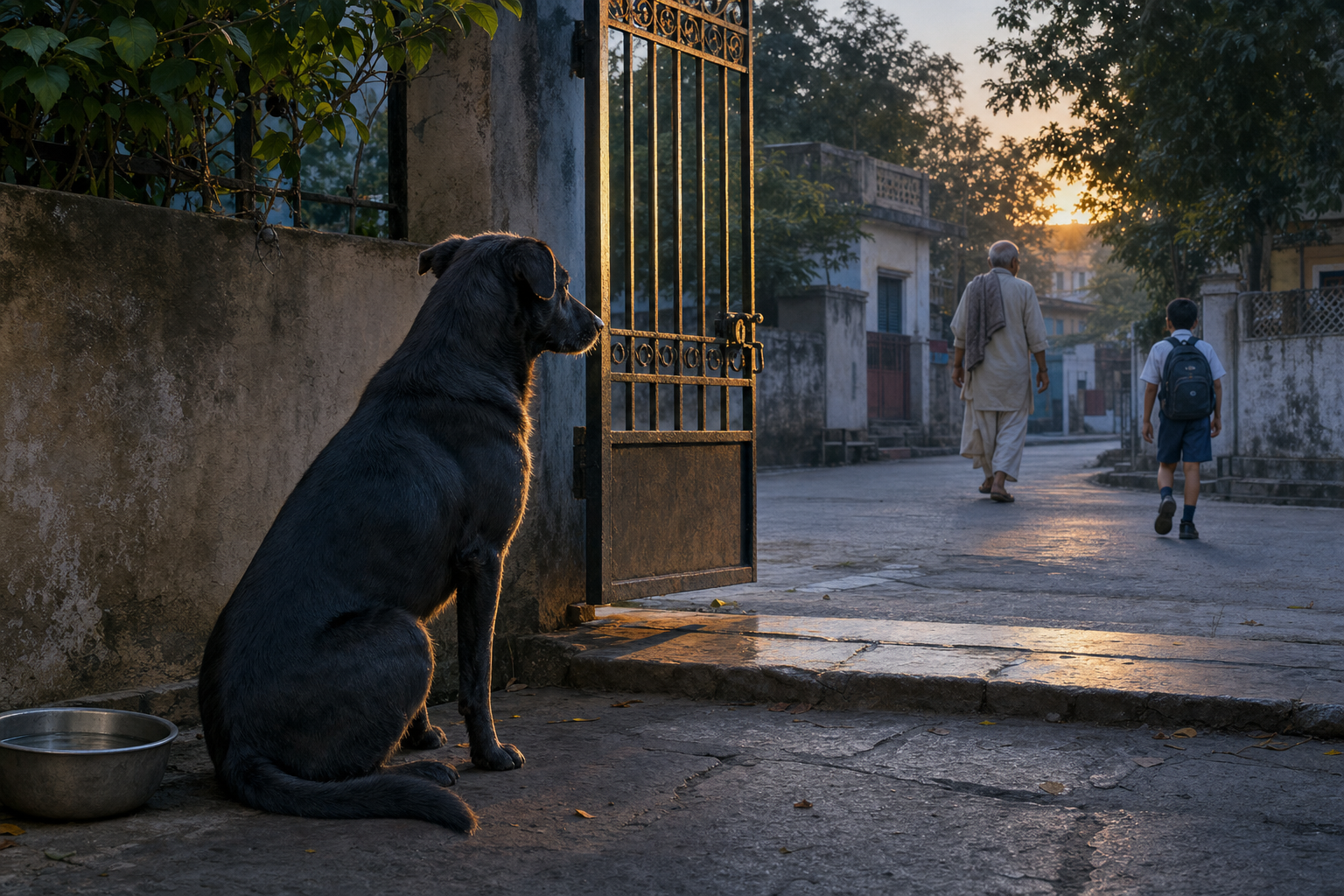
The dog appears in Bhairava iconography as vahana, attendant, and companion. Some temple and oral lore foregrounds this closeness through an epithet rendered Swaswas, presenting Bhairava as one who walks with dogs. Whatever regional name you encounter, the visual grammar is consistent: the guardian is accompanied by an animal associated with watchfulness, loyalty, responsiveness, and life at the margins.
Canine guardianship also has an older Vedic resonance. Rig Veda 10.14 speaks of Yama’s two four-eyed dogs watching the path of the departed. That passage should not be flattened into a claim that every later Bhairava tradition tells the same story. It does, however, show how deeply the dog is associated in Indic memory with vigilance at the boundary between worlds.
The dog’s marginal status is part of the teaching. A scavenger and night-walker can go where respectable society hesitates to look. Bhairava likewise inhabits cremation grounds and confronts what ordinary life tries to hide: mortality, fear, impurity, and the instability of social status. His companionship with the dog therefore reverses a shallow idea of purity. The sacred is not protected by abandoning every being whom society has placed outside the gate.
The frequent black colour carries an interpretive meaning rather than a rule about which dogs matter. One devotional reading treats black as a sign of the capacity to receive and transform dark emotions. Under that reading, the black dog represents courage that can enter the night without being conquered by it. This does not make every black dog a supernatural message, nor does it place black dogs above dogs of other colours.
- The iconographic dog signifies fidelity, vigilance, liminality, and disciplined instinct.
- The living dog is a sentient being whose hunger, fear, injuries, and boundaries remain real.
- The black colour can deepen contemplation, but it must not become a superstition that determines which animal deserves care.
This distinction protects you from two opposite mistakes. One is to reduce the dog to a decorative symbol and neglect actual animals. The other is to romanticise an unfamiliar animal, disregard its signals, and call the resulting carelessness devotion. Sacred regard includes practical respect. If an interpretation makes you less compassionate or less attentive to reality, it has missed the ethical force of Bhairava’s image.
Kala Bhairava asks whether you act at the right time

Threshold guardianship is not only spatial. Kala Bhairava joins guardianship to time. The neglected duty, the delayed apology, the unkept promise, and the boundary you intend to repair someday all reveal the same problem: you recognised what dharma required but failed to respond when the moment arrived.
The alert dog becomes a fitting companion in this aspect. Its symbolic lesson is not restless suspicion. It is readiness. Steadfast practice requires you to notice a call, distinguish it from distraction, and respond before forgetfulness takes possession of the day.
You can use a simple invocation such as Om Kalabhairavaya Namah, or recite the Kalabhairavashtakam, to collect your attention. The mantra is not a substitute for the duty waiting outside your prayer space. Let it function as a bell that ends delay and begins action.
- Name the threshold. Identify the relationship, place, habit, or obligation that presently needs guarding.
- Name the breach. Be precise about whether the problem is fear, anger, distraction, avoidance, weak boundaries, or indifference.
- Choose one timely act. Make the delayed call, clean the neglected shared space, keep the promise, offer the needed help, or say the necessary no.
- Invoke and act. Use prayer to steady attention, then perform the chosen duty while the decision is still clear.
- Review without drama. Ask whether your action made the threshold safer, more truthful, and more compassionate. If it did not, correct it.
This inward reading also clarifies Bhairava’s relationship with instinct. The goal is not to hate or mutilate your animal energies. Fear can become caution. Anger can become protection of a just boundary. Urgency can become disciplined service. But each energy must walk beside discernment rather than dragging it forward. Fierceness becomes dharmic only when it is governed.
Make dog seva safe, steady, and non-transactional
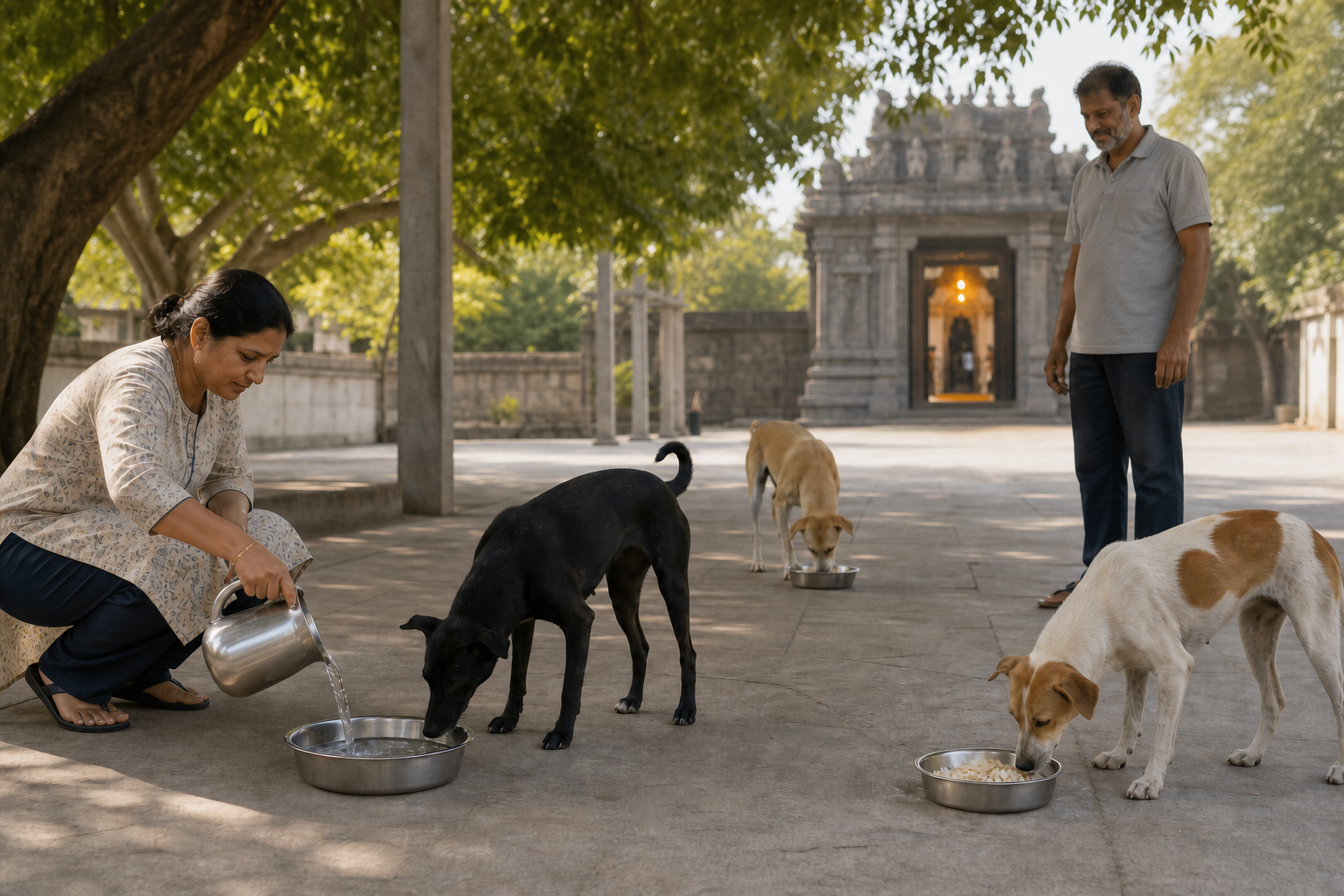
Devotees honour Bhairava through observances such as Bhairava Ashtami, hymns, temple worship, and seva to dogs. Feeding a dog can join ritual attention to concrete compassion, but it should not be treated as the purchase price of divine favour. The animal in front of you is not a ritual object. It has its own needs, fears, and limits.
- Serve the dog you can help responsibly. Do not pass hungry dogs of other colours while searching for a black dog that better matches the icon.
- Choose a safe place. Do not leave food in moving traffic, block a temple entrance, or create conflict at a shared doorway. Follow the rules of the shrine or property.
- Offer suitable food and fresh water calmly. Set them down and allow the animal space. Seva does not require touching the dog.
- Never force physical contact. A frightened, injured, guarding, or unfamiliar dog may bite. Do not corner, lift, embrace, or garland an animal that is trying to withdraw.
- Leave the threshold clean. Remove containers and discarded material. A practice that creates a hygiene problem for neighbours has neglected another part of guardianship.
- Seek capable help when needed. If a dog appears badly injured or cannot be approached safely, contact a local animal-care group rather than attempting untrained handling.
- Prefer consistency to display. Reliable care, shelter support, and respectful attention embody fidelity better than a dramatic act performed only for ritual visibility.
If you are afraid of dogs or cannot approach one safely, you can still support this form of seva. Give food or supplies through people who already care for community dogs, help a shelter, or assist with an injured animal’s care through an experienced local group. Compassion does not require ignoring danger.
Kukur Tihar gives ceremonial expression to gratitude for canine loyalty and service. The larger lesson applies beyond a festival day: an animal should not receive a garland while its ordinary hunger, fear, or abandonment remains invisible. Ceremony teaches dharma only when conduct carries the teaching forward.
The same ethical pattern resonates across the dharmic family without making distinct traditions interchangeable. Buddhist traditions know fierce Dharma protectors such as Mahakala. Jain traditions bring vigilant ahiṁsā into the protection of beings and sacred spaces. Sikh teachings make seva and sarbat da bhala, the welfare of all, measures of lived responsibility. Bhairava’s dog remains a specifically Shaiva image, while the obligation to combine courage, restraint, and care reaches across these traditions.
Key takeaways for a Bhairava devotee
- Bhairava’s dog identifies the threshold as a place of sacred responsibility, not merely danger.
- The dog’s loyalty and alertness represent disciplined attention; its life at the margins directs your gaze toward neglected beings and places.
- Black-dog symbolism is a contemplative interpretation, not a hierarchy of animals and not a licence for omen-making.
- Kṣetrapāla and Kotwal express authority as service: the guardian protects order, exercises restraint, and answers for neglect.
- Kala Bhairava turns devotion toward timely action. A mantra should sharpen duty rather than postpone it.
- Dog seva should be safe, clean, consistent, and responsive to the animal’s boundaries.
Choose one threshold to keep this week. Feed a dog responsibly, support someone already caring for animals, repair a neglected boundary, or fulfil a promise you have delayed. Then return to Bhairava’s image. The dog beside him will no longer look like an accessory. It will look like a question about how faithfully you are walking your own portion of the path.
References
