
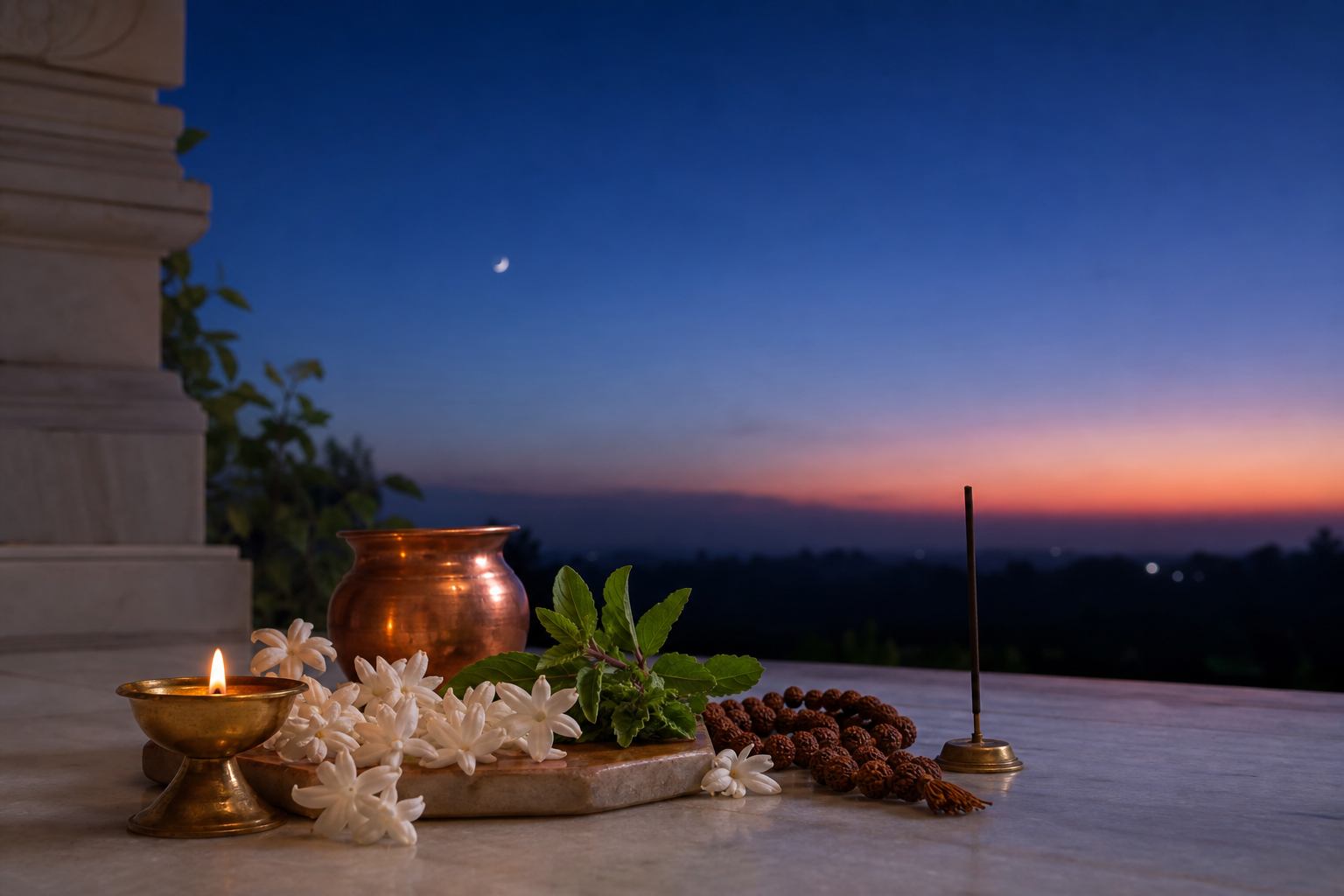
If your calendar marks Wednesday, March 11, 2026, as Ashtami, you still need to know what that means in practice. The day is best approached as a focused vrata: choose one form of worship or restraint, observe it steadily, and resist turning a quiet lunar observance into an overloaded ritual checklist.
For most locations, Krishna Paksha Ashtami is present at sunrise. You can therefore plan the day around japa, meditation, fasting according to capacity, scriptural study and seva. If you need exact times for a temple service, sankalpa, fast or important undertaking, check a Panchang calculated for your location rather than copying another city’s timetable.
Key takeaways for March 11
- Wednesday, March 11, 2026, is observed as Krishna Paksha Ashtami in most regions because Ashtami prevails at local sunrise.
- Krishna Paksha Saptami continues until the listed transition at 12:11 a.m., after which Ashtami occupies the remainder of the date. Treat that clock time as a working reference, not a universal local time.
- Several Shaiva sampradayas observe the monthly Kala Ashtami with devotion to Shiva in his Bhairava aspect. This is lineage-dependent, not a compulsory observance for every Hindu household.
- A Vaishnava household may emphasize Sri Krishna nama-smarana and remembrance of his lilas. A household without a specific Ashtami vrata can choose a simpler discipline of japa, dhyana, svadhyaya, restraint and charity.
- Brahma Muhurta, Abhijit Muhurta, Rahu Kalam, Yamaganda and Gulika must be derived from local solar conditions. Do not copy these periods from a calendar for a different city.
Why March 11 is counted as Ashtami
A tithi is not a fixed civil date. It is one of the lunar divisions determined by the changing angular separation between the Moon and the Sun. Each tithi represents another 12 degrees of separation, but the Moon does not move at a perfectly uniform apparent speed. A tithi can therefore last roughly 19 to 26 hours, beginning or ending in the middle of an ordinary clock day.
That distinction resolves the apparent overlap on March 11. Saptami extends a little past midnight under the timing supplied for the date, and Ashtami follows. Hindu calendars generally assign the ritual character of a day from the tithi prevailing at local sunrise. Since Ashtami is present at sunrise in most places, March 11 is ordinarily listed and observed as Krishna Paksha Ashtami.
If you are awake shortly after midnight, do not assume that a civil date change has automatically produced a tithi change. Conversely, do not organize a formal ritual around 12:11 a.m. unless your local Panchang gives the same boundary. Longitude, time zone and the calculation used by the almanac can shift the displayed clock time.
What the Ashtami label does not tell you
The tithi alone does not determine the day’s Nakshatra, Moon Rashi, Yoga or Karana. Nakshatra comes from the Moon’s position among the 27 stellar divisions, while Moon Rashi identifies its sidereal zodiac sign. These coordinates are also location- and time-sensitive. If a calendar gives you only “Ashtami,” do not infer the missing Panchang limbs or repeat values from another region as though they were local.
For ordinary home japa, that missing detail need not stop you. For a formal sankalpa, samskara, temple service or carefully timed vrata, it matters. Use a reputable regional Nirayana Panchang that identifies its calculation basis; Lahiri ayanamsa is commonly used, but your temple or sampradaya may follow an established local convention.
Choose the observance your tradition actually keeps
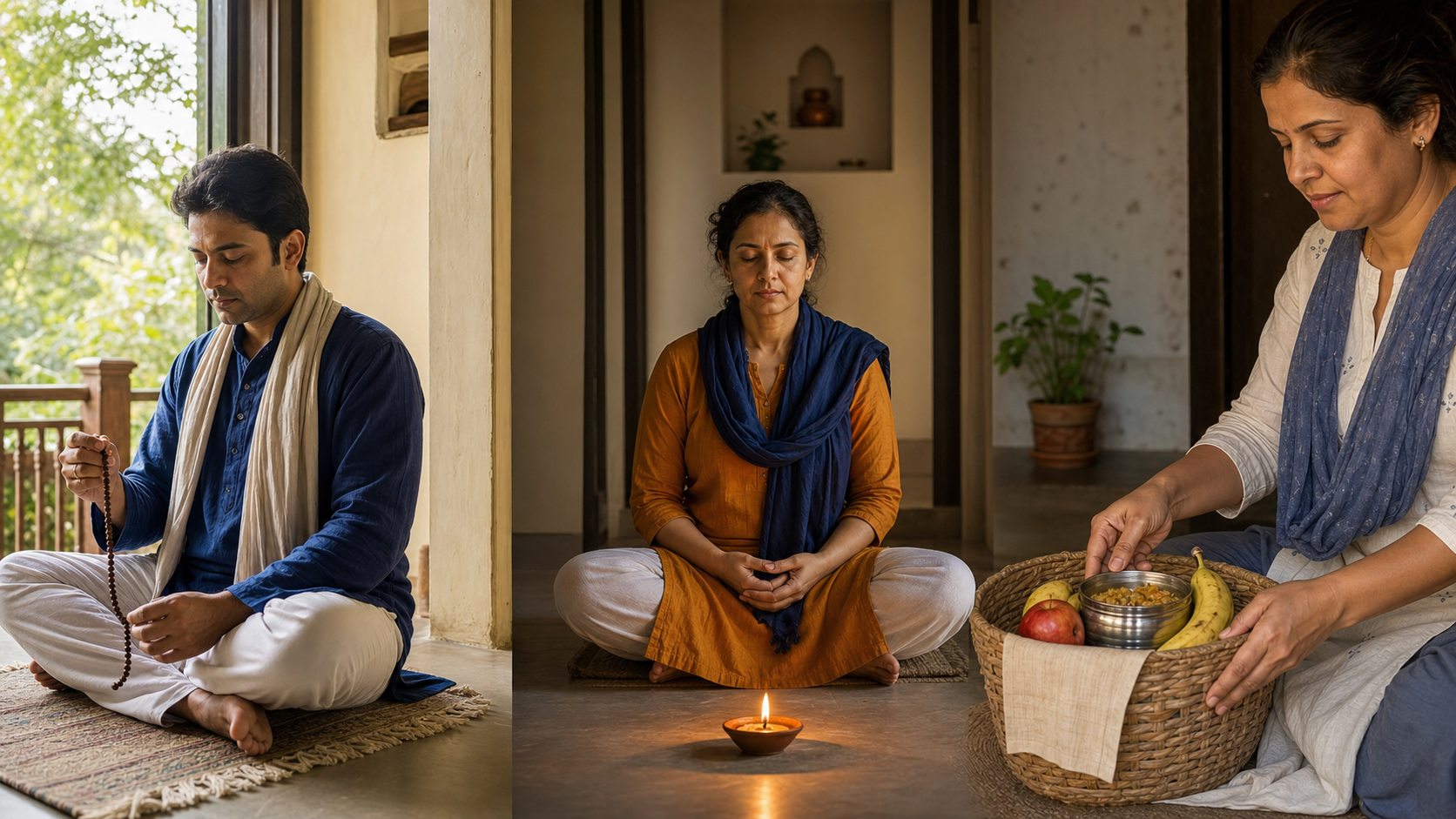
Krishna Paksha is the waning half of the lunar month, and Ashtami stands near its contemplative midpoint. The most natural disciplines are therefore those that reduce distraction and turn attention inward. The useful question is not how many practices you can collect, but which practice you will carry through with sincerity.
For a Kala Ashtami observance
In sampradayas that keep Kala Ashtami, the devotional focus is Bhairava, a form of Shiva. Follow the mantra, puja sequence, dietary discipline and concluding practice recognized by your family, guru-parampara or temple. If you have not received a specific procedure, simple Shiva or Bhairava remembrance, japa, meditation and respectful temple darshan are more coherent than assembling an elaborate rite from unrelated instructions.
Upavasa may be part of the observance, but it is not a test of physical endurance. Keep the form allowed by your lineage and your actual capacity. If food restriction would be unsafe for you, choose a non-dietary vrata such as reduced speech, withdrawal from entertainment, additional japa, study or charity.
For a Vaishnava or Krishna-centered home
You can orient the day toward Sri Krishna through nama-smarana, reading or listening to an appropriate lila, offering satvik food, and making the evening quieter than usual. Use the nama or mantra already honored in your tradition. A modest discipline completed attentively is preferable to adopting unfamiliar ritual details merely because the civil date says Ashtami.
For a simple household Ashtami
If your household does not keep a sectarian Ashtami vrata, build the observance from five clear anchors:
- Make a short sankalpa for one discipline you can maintain until the end of the day.
- Set aside an uninterrupted period for japa or meditation.
- Read a manageable passage from a shastra, Purana or trusted commentary instead of browsing disconnected religious material.
- Practice one visible restraint: speak more carefully, reduce stimulation, eat simply or step away from avoidable conflict.
- Complete one act of seva or quiet generosity without treating it as a performance.
This structure gives the tithi a practical effect. By evening, you should be able to name the discipline you kept, the teaching you studied and the service you performed.
Recognize shared lunar disciplines without erasing differences
The eighth lunar day also has resonance beyond Hindu practice. Buddhist Uposatha observances often include an eighth lunar day, with emphasis on ethical restraint and cultivation. Some Jains undertake Ashtami fasting or use the day to strengthen their anuvratas. Sikh observances now primarily follow the solar Nanakshahi calendar, although Bikrami lunar reckoning remains part of some historical and community contexts.
These are related civilizational rhythms, not interchangeable ceremonies. In a mixed dharmic household or community gathering, the honest common ground is ethical discipline, remembrance, study, service and reduced excess. Let each person retain the forms and vocabulary of their own tradition.
Build the day around local sunrise
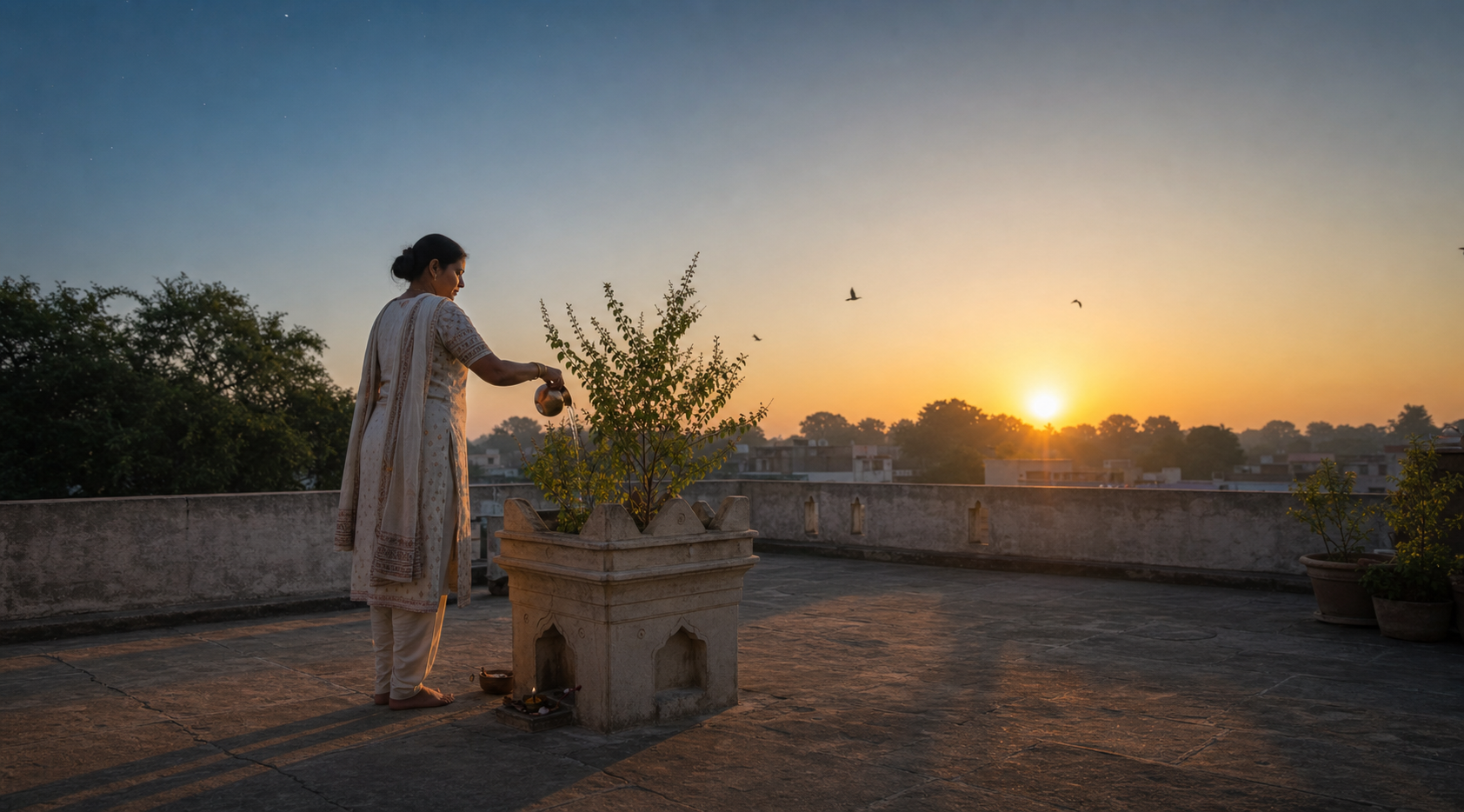
A useful Ashtami schedule follows the shape of the day rather than imposing universal clock times. Adjust the sequence to your responsibilities and to the sunrise where you live.
- The evening before: Confirm the local tithi, decide whether you are keeping Kala Ashtami or a simpler Ashtami discipline, and choose the mantra, reading and form of upavasa or restraint. Preparation prevents the morning from becoming a search for instructions.
- Before sunrise: If feasible, use Brahma Muhurta for meditation, mantra or pranayama. It is approximately the final 96 minutes before local sunrise, so its clock time changes with place and season.
- At or after sunrise: Make your sankalpa and begin the discipline you chose. Ashtami’s presence at sunrise is what gives March 11 its operative tithi designation in most regions.
- During the working day: Carry the vrata into speech, food, attention and conduct. If you cannot perform extended worship, protect one deliberate period for japa and one for svadhyaya.
- Around the middle of the day: Abhijit Muhurta is centered on local solar noon and may be used for an important dharmic beginning when a more specific auspicious window is unavailable. Solar noon is not necessarily 12:00 on the clock.
- In the evening: Return to japa, satsanga, reading or quiet remembrance. Complete your seva and review the vow without turning the review into self-reproach.
If your formal vrata prescribes a particular conclusion or time for breaking a fast, obtain that instruction from your local calendar or sampradaya. No universal parana time can be derived from the civil date alone.
Check the local Panchang before a formal rite
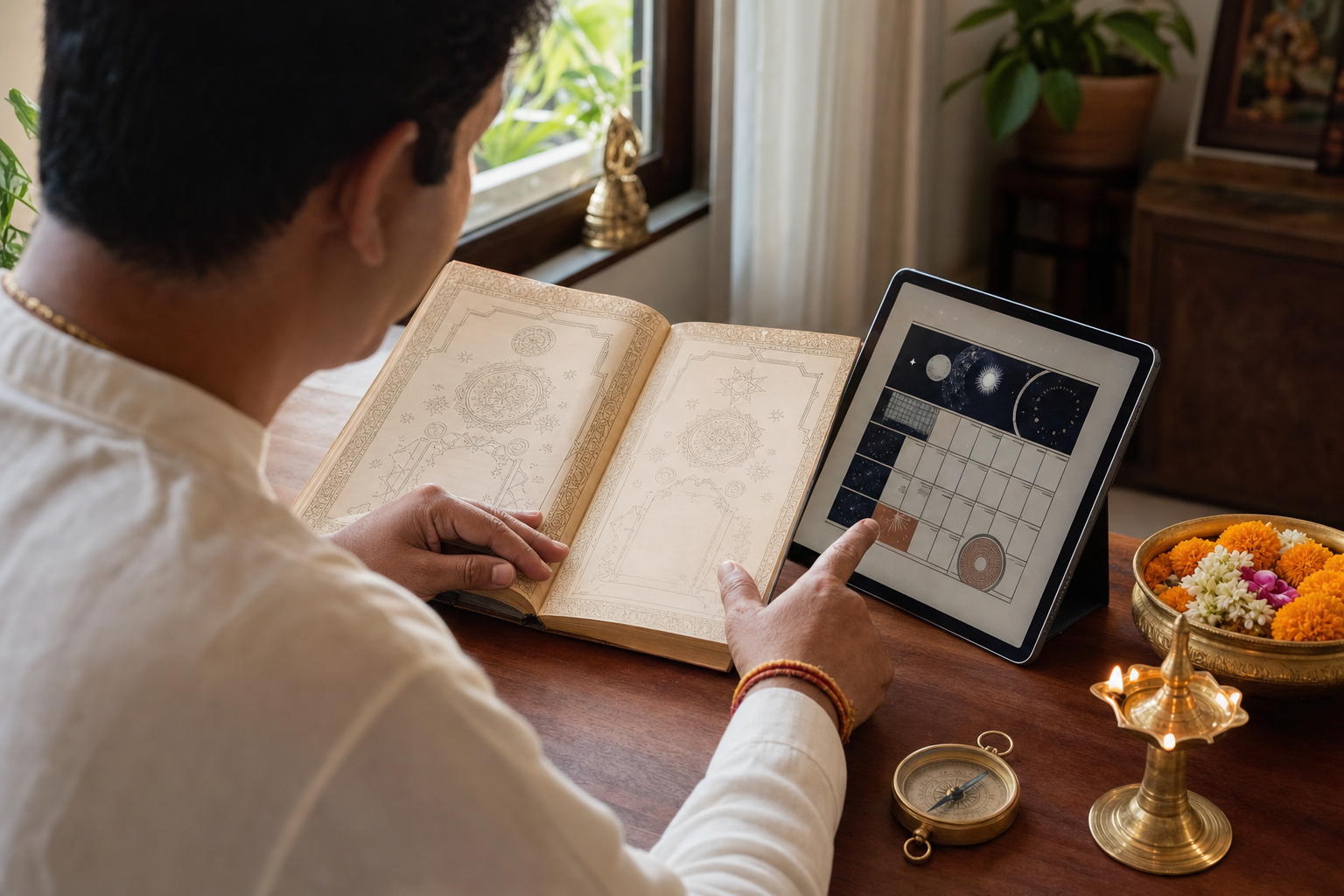
You do not need a full astrological consultation to observe Ashtami at home. You do need local data when the correctness of a sankalpa, temple service, samskara or muhurta depends on precise Panchang conditions. Before fixing such an event, confirm:
- Tithi interval: the local beginning and ending times of Saptami and Ashtami, not merely the date label.
- Sunrise status: whether Ashtami is present at sunrise at your location.
- Nakshatra and Moon Rashi: the Moon’s local sidereal coordinates for the relevant ritual time.
- Yoga and Karana: the remaining Panchang limbs needed for a complete ritual assessment.
- Local day segments: Rahu Kalam, Yamaganda and Gulika, calculated from that day’s sunrise and sunset.
- Muhurta basis: whether a recommended window is tied to local solar noon, sunrise, sunset or another astronomical boundary.
Many practitioners avoid Rahu Kalam, Yamaganda and Gulika when initiating significant undertakings. That does not mean the entire period is spiritually unusable or that established daily worship must stop. Apply the restriction to the kind of beginning for which your tradition recognizes it, and follow temple guidance when a scheduled service falls within such a segment.
If two Panchangs disagree, first compare their location, time zone, ayanamsa and sunrise convention. A difference does not automatically mean that one calendar is careless. For March 11, use the calendar calculated nearest to your place, settle your chosen discipline before the day begins, and give Ashtami to one sustained act of inward attention.
References
