
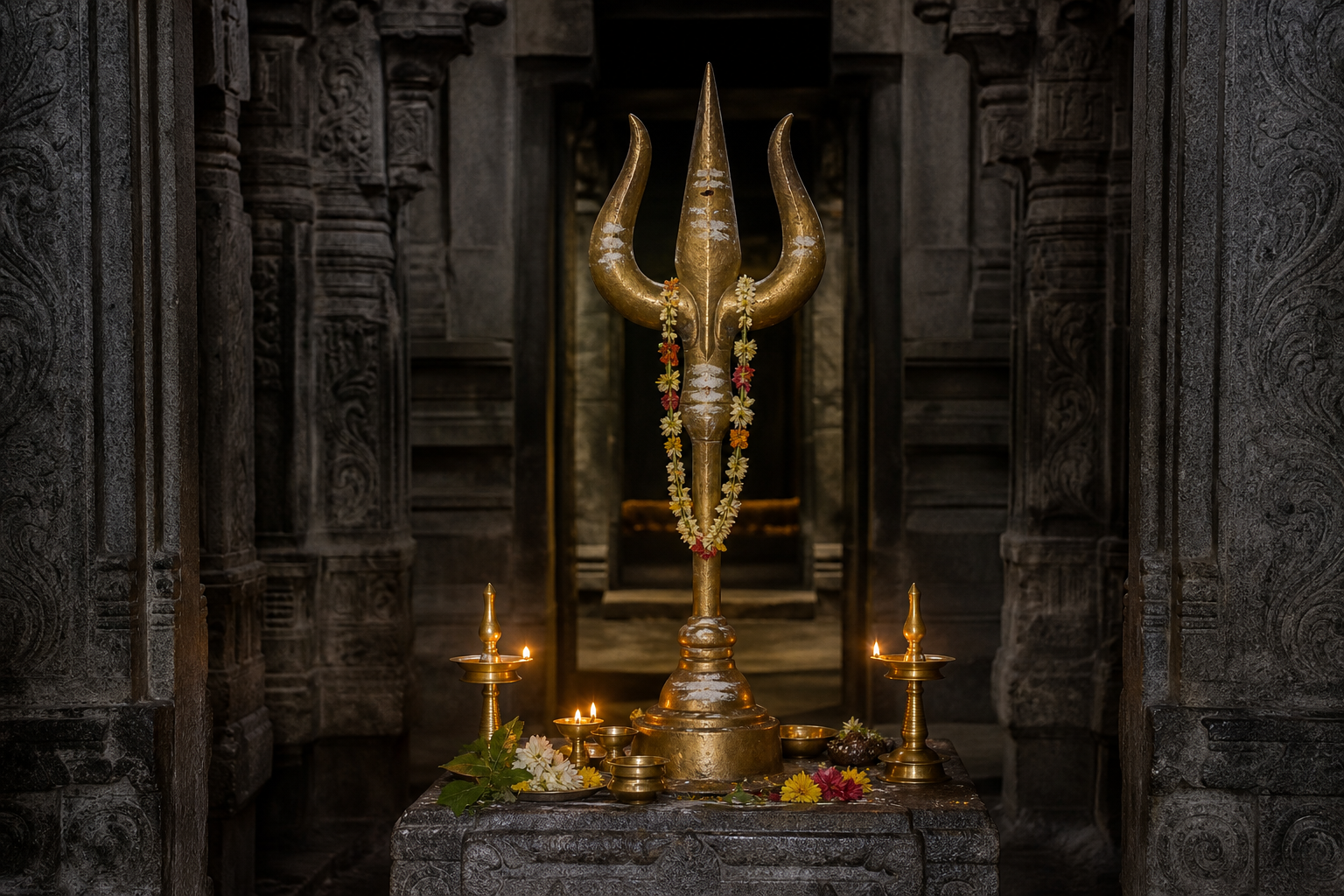
You are standing in a Shaiva temple when a trishula appears to receive the reverence you expected only at the main sanctum. Is it an emblem of Shiva, a ritual implement, or a devata before whom you should take darshan?
In living South Indian Shaiva practice, a trishula may be consecrated and worshipped as an independent deity, known as Astra Devata. Once you understand that distinction, you can approach the form on the temple’s own terms instead of reducing it to decoration or an abstract symbol.
The decisive question is not what the trishula depicts
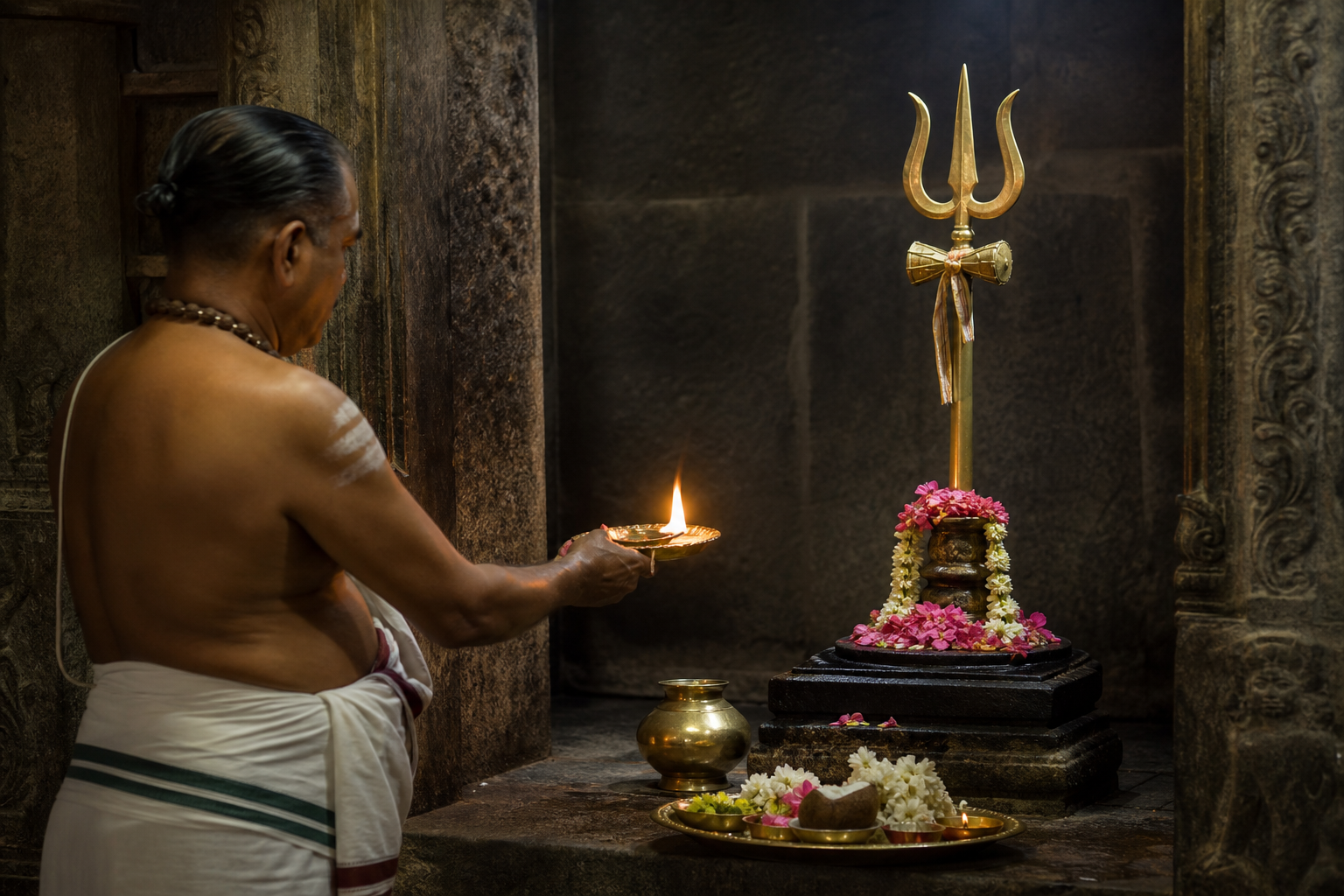
Most visitors recognize the trishula immediately as Shiva’s trident. Recognition, however, does not tell you the ritual status of the particular trishula in front of you. The same familiar form can operate at more than one level.
- As an emblem, the trishula identifies a place, image, or object with Shiva.
- As Shiva’s weapon, it expresses divine power in weapon-form rather than in a humanlike form.
- As Astra Devata, a particular consecrated trishula is addressed and worshipped as sacred presence in its own right.
These meanings need not cancel one another. A consecrated trishula remains Shiva’s recognizable weapon and emblem even while receiving direct worship. What changes is your relationship to it. You are no longer looking only at an object that points beyond itself; you are standing before a form that the temple treats as devata.
This is why appearance alone is an unreliable guide. A trident on a gateway and a trident established for worship may share the same silhouette while holding very different places in temple life. Ask what the temple does with this specific trishula, not merely what tridents mean in general.
Independent worship does not sever the trishula from Shiva
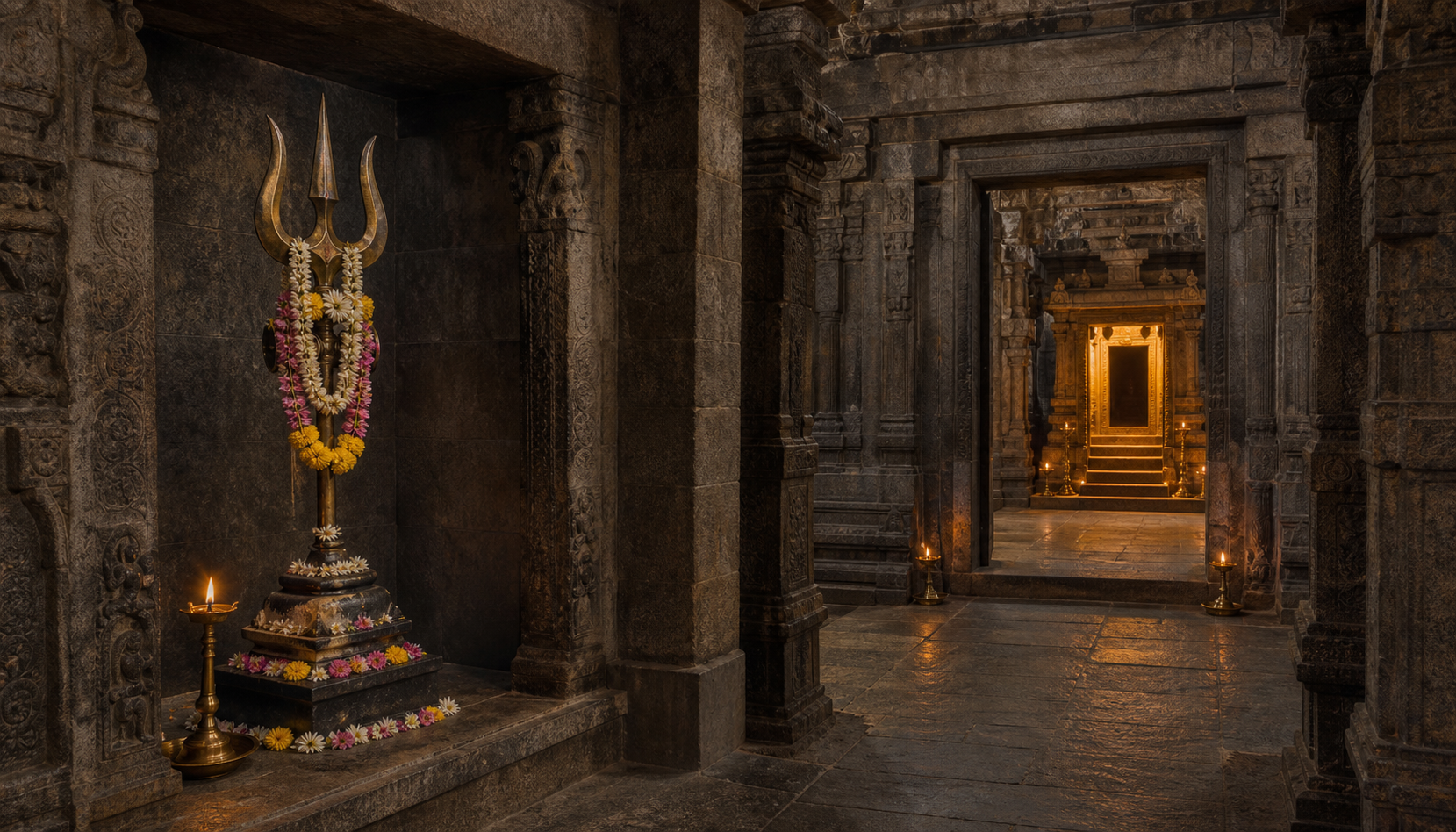
The word “independent” can mislead if it is heard through a rigid choice between object and deity. Here it identifies direct ritual recognition: the trishula is not treated merely as an accessory held by a more important figure. It can itself become the focus of worship.
That does not require you to imagine a rival deity disconnected from Shiva. The identity of the form remains relational: this is Shiva’s trishula. Its distinct ritual standing and its belonging to Shiva can be true at the same time. Temple worship does not have to flatten every manifestation into either “only a symbol” or “a completely separate god.”
The weapon-form also directs your attention toward divine agency. A weapon is associated with power exercised, not power kept as an abstraction. Astra Devata worship therefore asks you to encounter the trishula as more than an illustration of an idea. The material form, its consecration, and the worship offered to it belong together.
For darshan, you do not need to settle every philosophical question about identity and manifestation before offering respect. The practical recognition is simpler: if the temple worships this trishula as Astra Devata, meet it as the temple presents it.
Why the three prongs are not your first interpretive task
The three-pronged form naturally attracts three-part explanations. Such interpretations may be meaningful within a particular teaching, but they cannot establish whether a trishula is Astra Devata. Symbolic geometry answers one kind of question; consecration and worship answer another.
This distinction prevents a common mistake. A visitor sees three points, recalls a favored triad, and assumes the object has been understood. Yet even an elegant interpretation of the prongs says nothing by itself about the status of that particular trishula in that particular temple.
Use a better order of inquiry:
- Identify the setting. Confirm that you are looking at a trishula within a Shaiva ritual context, not merely at a decorative trident-shaped element.
- Ask how the form is named locally. “Is this worshipped as Astra Devata?” is more useful than “What do the three points symbolize?”
- Establish its ritual status. Find out whether the particular trishula is consecrated and receives worship in its own right.
- Then ask about symbolism. Give priority to the explanation preserved by the temple or its tradition instead of imposing a generic three-part formula.
This order matters because a correct general association can still produce a wrong local caption. If you are writing, teaching, or posting a photograph, do not label every Shaiva trident “Astra Devata.” Use that name only when the temple’s treatment of the specific form supports it.
How to approach Astra Devata during a temple visit
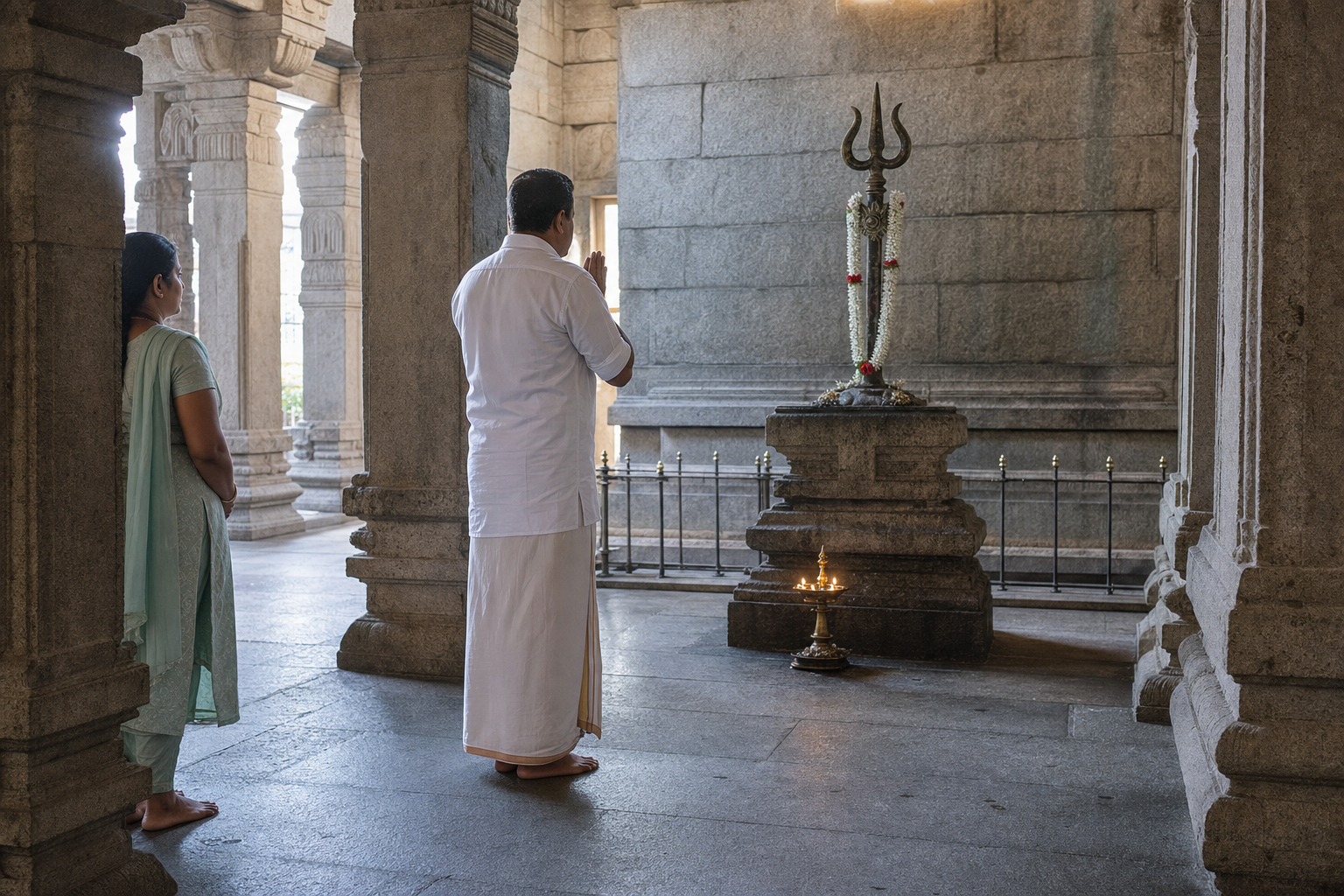
You do not need to arrive with a complete ritual manual. You do need enough restraint to let local practice lead. A few precise choices will keep your conduct aligned with the sacred status of the form.
- Pause before deciding what you are seeing. Notice whether devotees pause there and whether temple personnel direct attention toward the trishula. Observation gives you context, although it is not a substitute for confirmation.
- Ask a narrow question. Ask an archaka or temple representative, “Is this trishula consecrated and worshipped here as Astra Devata, or does it serve another ritual purpose?” That wording distinguishes identity from general symbolism.
- Follow the temple’s sequence. If the temple directs devotees toward the Astra Devata at a particular point, follow that order. Do not replace local instruction with a universal itinerary learned elsewhere.
- Offer respect without assuming access. A namaskara is a restrained response. Do not touch the trishula, place offerings on it, cross a barrier, or imitate a specialized action unless the temple explicitly permits it.
- Describe it accurately afterward. If its status has been confirmed, “the trishula worshipped as Astra Devata” is clearer than “a statue of a trident.” If it has not been confirmed, call it a trishula associated with Shiva and leave the stronger claim open.
The point is not anxiety about making a minor mistake. It is attentiveness. Temple ritual gives a form its lived context, and a visitor shows respect by noticing that context before supplying an explanation.
Key takeaways
- In some South Indian Shaiva temples, a consecrated trishula is worshipped directly as Astra Devata.
- Not every trishula is Astra Devata; the form’s ritual status cannot be inferred from its shape alone.
- Direct worship of the trishula does not make it unrelated to Shiva. Its distinct ritual identity remains grounded in its identity as Shiva’s weapon.
- An interpretation of the three prongs may explain symbolism, but it cannot prove consecration or independent worship.
- When visiting, ask the temple how the particular trishula is established, follow local ritual order, and do not touch or offer anything without permission.
On your next visit to a Shaiva temple, resist the urge to decode the three points first. Ask what the community worships in that exact form. If the answer is Astra Devata, let the temple’s ritual language shape your darshan: stand before the trishula as sacred presence, not merely as an object that represents something elsewhere.
References
