
If you saw that Yati Narsinghanand’s march was stopped and wondered whether police can halt a peaceful procession merely because permission is missing, the honest answer is not a one-word yes or no. The Constitution protects peaceful assembly, but it does not guarantee every route, destination, crowd size or time chosen by an organizer.
For supporters, students and community organizers, the useful question is narrower: was the restriction based on a valid, proportionate public-order measure, or did procedure become an unnecessarily broad barrier to protest? You can begin answering that question by looking for specific records rather than relying on slogans from either side.
Start with the narrow facts, not the loudest claim
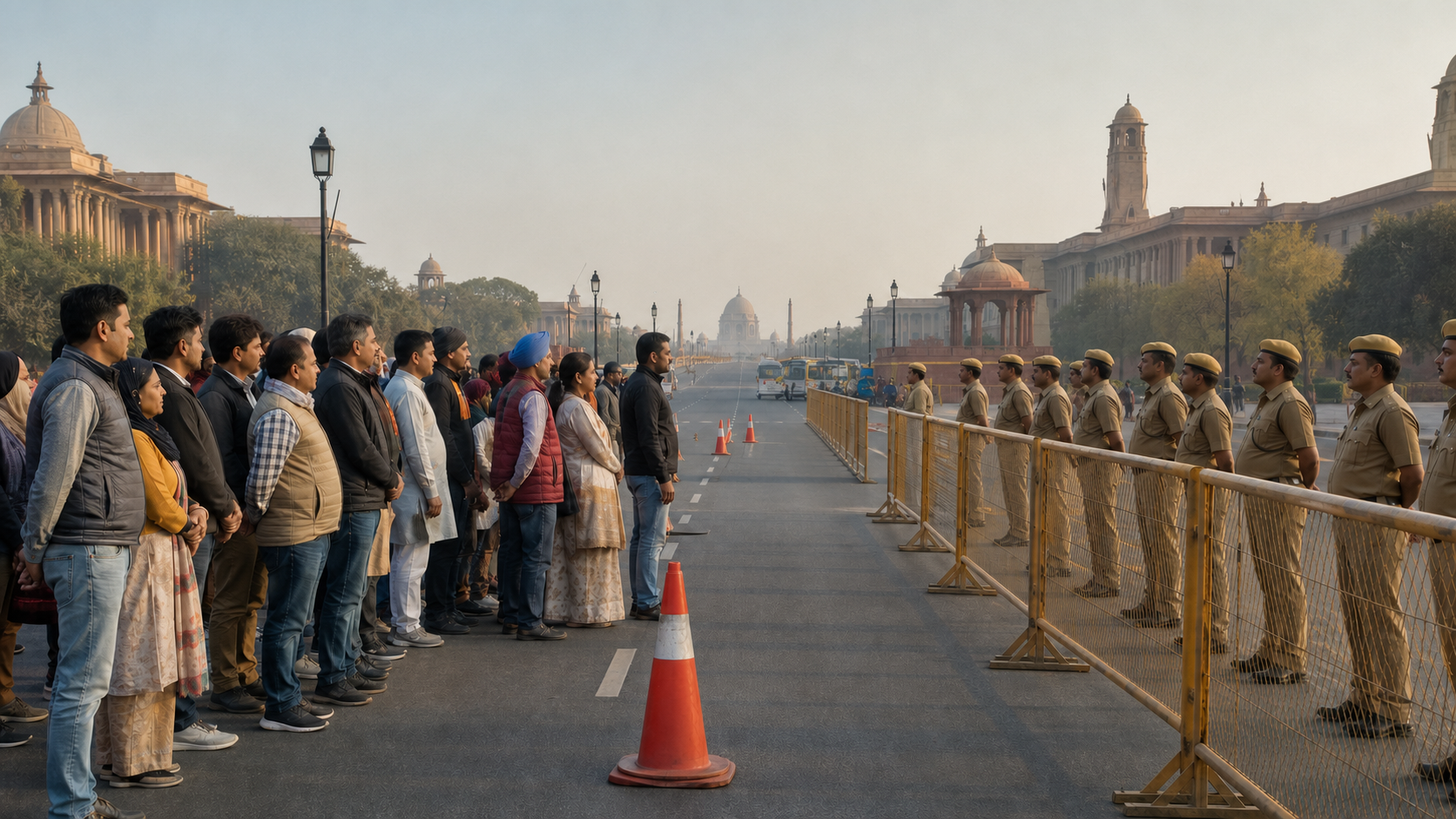
On 7 March 2026, Ghaziabad Police halted a yatra led by Dasna Devi Mandir priest Yati Narsinghanand. The procession was intended to reach Delhi’s Jantar Mantar to protest a proposed UGC Bill. Police at the scene cited the absence of the required permission for the intercity procession and the intended assembly in New Delhi.
That establishes what happened at the roadblock. It does not, by itself, establish that the restriction was constitutionally valid, politically motivated or unlawful. A sound conclusion would require at least three sets of records:
- The organizers’ applications, including when and where they were submitted, the proposed route, expected attendance and requested time.
- Any written approval, refusal, pending-status notice or conditions issued by Ghaziabad and Delhi authorities.
- The text of any prohibitory or public-order direction that applied to the route or destination at the relevant time.
Without those records, two confident claims go beyond the available facts: that police suppressed a duly authorized protest, or that the absence of permission automatically justified every restriction imposed. The defensible statement is that the yatra was stopped over a permissions dispute whose full administrative record is not yet before the reader.
If you support Narsinghanand’s right to lead a peaceful demonstration, documentary precision strengthens your position. Ask whether permission was sought, whether authorities decided the application in time, what reasons were given, and whether a workable alternative was offered. Do not turn a missing document into a conclusion that the document would necessarily support.
One yatra created two separate permission questions
Article 19(1)(b) protects the right of citizens to assemble peacefully and without arms. Article 19(3) permits reasonable restrictions in the interests of public order and the sovereignty and integrity of India. The right is therefore real, but its exercise can be regulated when the state has a lawful and sufficiently specific reason.
It helps to separate three controls that are often blurred together in public debate:
- A permission process sets out the proposed event and allows police to plan for traffic, crowd movement, emergencies and competing uses of public space.
- Conditions attached to an approval may limit the route, hours, attendance, amplification or other operational details.
- A prohibitory order may restrict specified conduct within a defined place and period, whether or not an organizer has separately applied for permission.
The actual instrument matters. A reference to a restriction commonly described as a “Section 144 order” is not enough to settle the issue. You need the order’s text, issuing authority, geographical limits, duration and prohibited conduct. An order covering one locality or time window should not be casually described as a permanent or citywide prohibition.
The planned yatra also crossed an administrative boundary. The moving procession through or from Ghaziabad was one public-order problem; the gathering at Jantar Mantar was another. Jantar Mantar operates as a regulated demonstration venue, where permissions commonly address matters such as participant numbers, time windows, sound and liaison with Delhi Police.
An organizer should therefore plan in two columns: permission to move and permission to assemble. Approval for a starting point does not necessarily authorize the complete route, and permission to gather at the destination does not necessarily authorize a procession arriving from another jurisdiction. A march that depends on both should not begin until the status of both is clear.
Permission is not the source of the constitutional right, but it is not an empty formality either. It is the mechanism through which a large public event is converted from an intention into an operational plan. Authorities, in turn, should not use delay, vague objections or an opaque process to make the right practically unusable.
Use a four-part test to judge an assembly restriction
A restriction should be assessed against facts, not against the popularity of the speaker or cause. The same test should protect a Hindu procession, a student demonstration and any other peaceful civic assembly. Four questions expose most of the real dispute.
- What is the exact legal basis? Identify the authority that acted, the rule or order invoked, and the place, conduct and period it covered. An oral statement at a barricade may explain the immediate police action, but it is not a substitute for the operative record when legality is later examined.
- What concrete public-order concern was being addressed? Route congestion, an inability to manage a projected crowd, emergency-access problems or a conflict at the destination can be relevant. A generic reference to “law and order” deserves further particulars.
- Was the measure closely fitted to that concern? If a smaller gathering, shorter window, different route or stationary protest could manage the risk, a complete stoppage may require a stronger explanation. This is the practical core of proportionality: the restriction should be lawful, necessary and no broader than its objective requires.
- Was the process accountable? Look for a timely decision, written reasons, a contact person and a realistic alternative where the original plan could not be approved. These details reveal whether officials attempted to facilitate peaceful expression or merely ended the conversation.
This test corrects two common misreadings. Peaceful intent does not entitle a crowd to occupy any route without coordination. Conversely, a missing permission does not make every police response reasonable, especially if the application was never decided, the rules were unclear or a less restrictive arrangement was readily available.
A speaker’s reputation should not replace this analysis. Constitutional protection does not depend on universal approval of the person invoking it. At the same time, association with a religious or political cause does not exempt an organizer from neutral safety conditions that are lawfully and consistently applied.
Do not try to test a disputed order by confronting officers at a barricade. Non-compliance can create legal exposure and physical risk before a court has considered the restriction. If you receive a police notice, are named in a case, face detention or intend to challenge a refusal, take the full record to an advocate familiar with the applicable local law. General constitutional principles cannot replace advice on an individual’s facts.
Build the next march to survive administrative scrutiny
Before announcing the event
The strongest time to defend a march is before supporters begin travelling. An organizer should assemble one permissions file containing:
- A named convenor and one liaison authorized to communicate with police in each jurisdiction.
- A route map showing the starting point, roads to be used, jurisdictional boundaries, proposed halts and destination.
- The requested date, starting and finishing times, projected attendance, transport arrangements and any planned sound equipment.
- A destination plan covering entry, dispersal, emergency access, first aid and the management of people who arrive independently.
- A marshal plan identifying volunteers who will keep the route clear, pass instructions to participants and prevent unauthorized deviations.
- A written code of conduct committing participants to peaceful, unarmed assembly, non-incitement, respect for public property and compliance with agreed route and venue conditions.
- Separate acknowledgements from the relevant Ghaziabad and Delhi authorities, with submission dates, reference numbers and contact details.
- Fallback proposals for a stationary gathering, reduced attendance, different time or alternate route if the first plan cannot be approved.
Ask for every decision in writing. If permission is refused, request the reasons and the specific modification that would make the event acceptable. If the application remains pending, say that publicly. Do not label “application submitted” as “permission granted,” because supporters may make travel and legal decisions based on that distinction.
On the day of the march
- Give the police liaison and senior marshals copies of the approvals, conditions, route map and organizer contacts.
- Brief participants on the approved route, destination, dispersal point and the person whose instructions they should follow.
- Keep an evidence log recording important times, official directions and changes to the agreed arrangement. Documentation should be calm and must not obstruct police or emergency work.
- Do not improvise a new route because one road is blocked. A spontaneous diversion can move the crowd outside the scope of an approval and create a fresh safety problem.
- Publish verified updates from one official channel. Unconfirmed messages can send additional people toward a closed route or prohibited location.
If police stop the procession
The nominated liaison, not the entire crowd, should ask four precise questions: Are participants being directed not to proceed? What order or permission condition supports that direction? Does it apply to the whole event or only the proposed route? What alternative location, route or time is available?
Participants should avoid pushing through a cordon, arguing collectively with officers or setting off on an unapproved diversion. Follow immediate safety directions and preserve the dispute for a written representation or legal challenge. Save applications, acknowledgements, notices, messages, recordings and the names or designations of officials where those details are lawfully available. A clean record is more useful than a chaotic confrontation.
Keep the UGC policy demand visible
A permissions dispute can consume all public attention and erase the reason people wanted to assemble. Higher-education reform debates often involve institutional autonomy, centralized oversight, accreditation, funding, faculty recruitment and the relationship with the National Education Policy. Those are issue areas, not proof that a particular proposal contains a particular provision. Before making a claim about the proposed UGC Bill, point to the relevant text.
Prepare a one-page public brief with four fields for each objection:
- The clause or proposal being challenged.
- The institutional or educational consequence organizers expect.
- The evidence or reasoning connecting the clause to that consequence.
- The precise amendment, consultation or clarification being requested.
This keeps students, educators and supporters focused on a decision the government can actually make. It also prevents the event from becoming only a contest over personalities. For Dharmic organizations, disciplined conduct is both practical and principled: satya requires accuracy, ahimsa requires control of the crowd, and civic responsibility requires minimizing avoidable harm to people who are not part of the dispute.
Key takeaways
- The 7 March 2026 yatra was halted after police cited missing permission for both the intercity procession and the intended Jantar Mantar assembly.
- A moving march in Ghaziabad and a gathering in Delhi are separate operational questions; organizers should obtain clear status from both jurisdictions.
- Article 19 protects peaceful, unarmed assembly, while permitting reasonable public-order restrictions. Neither part of that constitutional balance should be ignored.
- Judge a restriction by its exact legal basis, concrete purpose, proportionality and written decision-making process.
- If a march is stopped, avoid confrontation, request the operative basis and any alternative, preserve the record and seek case-specific legal advice where exposure arises.
- A precise, clause-based UGC policy brief will carry the cause further than rhetoric that cannot be checked against the proposal.
If another march is planned, begin with the route file, dual-jurisdiction applications, fallback options and policy brief before publishing the mobilization call. That preparation will not guarantee approval, but it will make any permission request easier to assess, any refusal harder to obscure and any lawful protest safer to conduct.


References
