
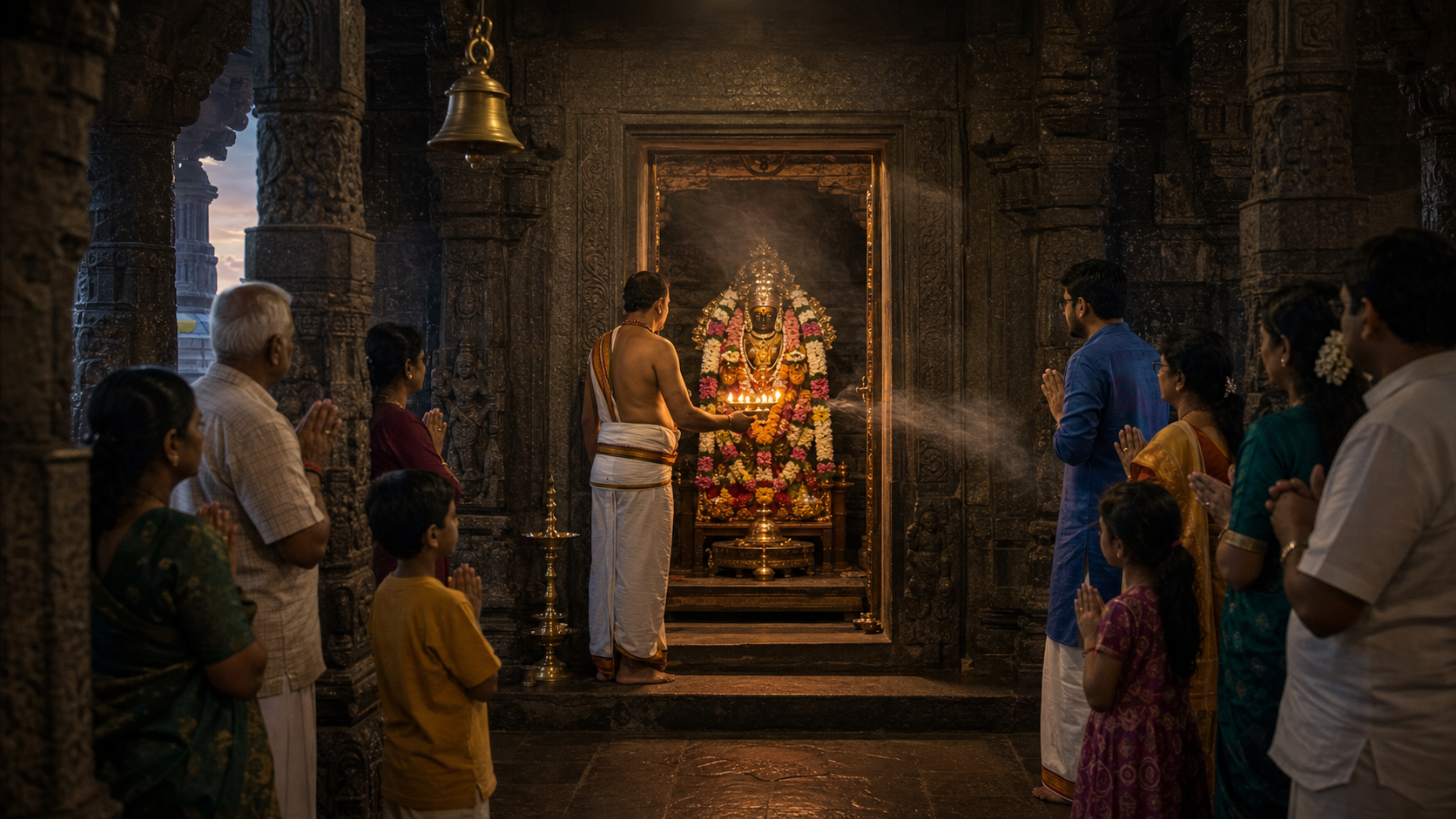
You can enter a temple knowing the deity’s name and still be unsure what you are seeing. Doors close during an offering. Bells sound. The murti is bathed, dressed, fed, carried outside and returned to the sanctum. If every act is dismissed as custom or translated vaguely as symbolism, the sequence remains opaque.
Ask a more useful question: what claim about reality is this action making, and what kind of person is it training you to become? Temple ritual does not merely illustrate doctrine formulated elsewhere. It makes commitments about divine presence, ordered time, reciprocity, embodiment and community repeatable. Once you learn to follow the actions and their sequence, puja becomes legible even when you do not know every mantra.
Read the ritual first as hospitality offered to a real presence
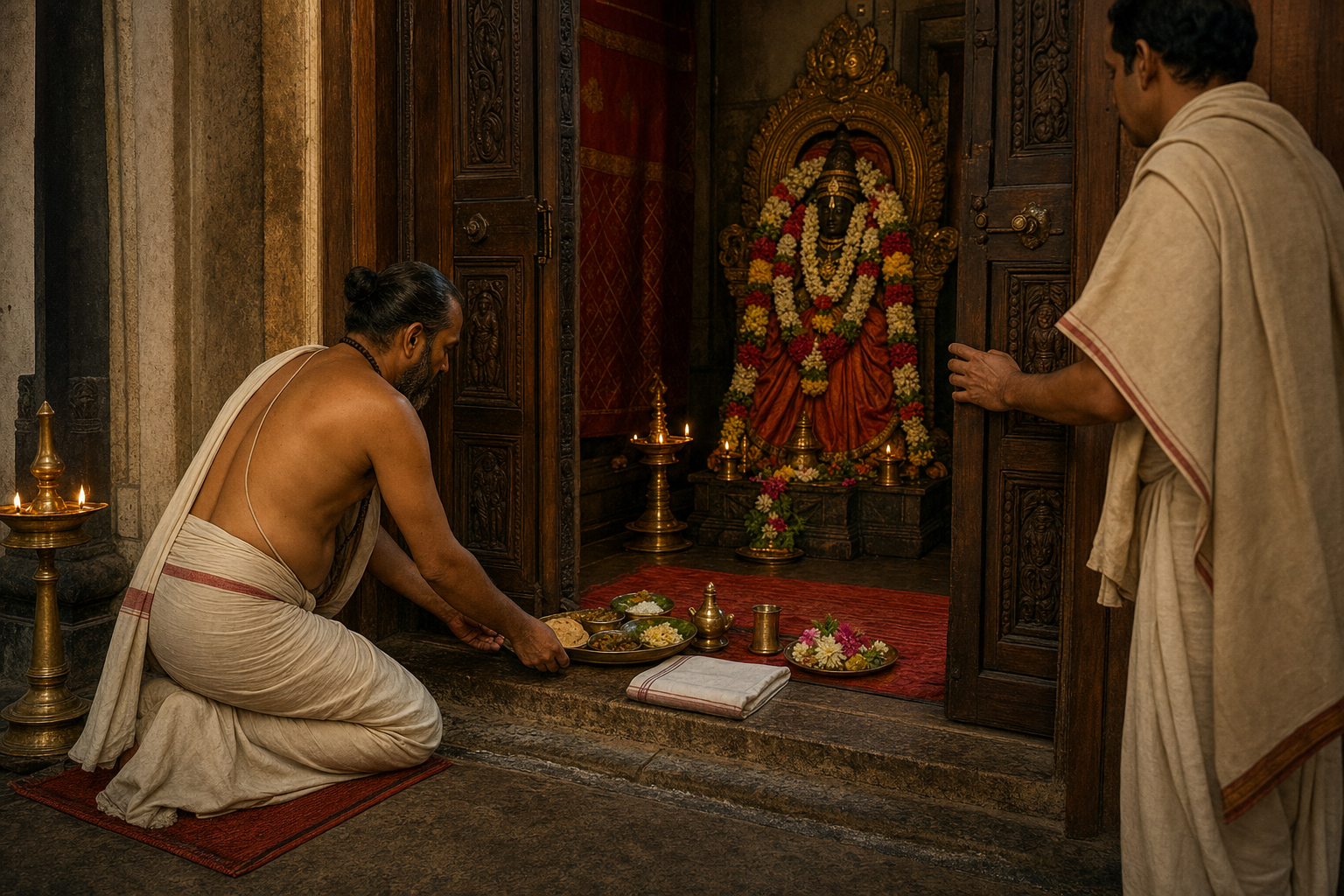
Begin with how the deity is being treated. Within the ritual world of a temple, a consecrated murti is not approached as an inert object waiting to be decoded. The deity receives a place, water, bathing, clothing, fragrance, light and food. Devotion therefore takes the form of service before it becomes an explanation.
The classical shodashopachara sequence names sixteen forms of service: avahana, or invocation; asana, a seat; padya, water for the feet; arghya, honorific water; achamana, water for sipping rites; snana or abhisheka, bathing; vastra, clothing; gandha, fragrance; pushpa, flowers; dhupa, incense; deepa, the lamp; naivedya, food; tambula, betel; stotra, praise; pradakshina, circumambulation; and namaskara, prostration.
You may not see all sixteen services presented separately. A temple can combine actions, emphasize particular offerings or conduct part of the worship beyond public view. The value of the sequence is not that it gives you a universal checklist. It reveals the governing relationship: the Divine is welcomed, cared for, honored, nourished and approached with reverence.
This is already theology. The sequence asserts that divine presence deserves concrete care, that material things can become vehicles of devotion, and that the body participates in knowing. The devotee does not merely hold a belief about reverence. The devotee stands, waits, offers, sees, circumambulates, bows and receives.
On your next visit, resist the urge to assign a hidden code to every object. Follow the ritual verbs instead. Notice when the deity is uncovered, bathed, adorned, fed or shown a lamp. Ask what kind of relationship that verb establishes. A flower may carry several associations, but the immediately visible fact is that it is being given. The offering makes devotion an act rather than a private sentiment.
Repetition and procession turn sacred order into a habit
A temple timetable can look like an administrative convenience. It is more than that. When worship recurs at fixed points, time itself is placed in relation to the deity. Dawn, midday and evening are no longer interchangeable hours. Each acquires a devotional character through what is done within it.
At Guruvayur, the daily arc begins before dawn with Nirmalyam, when the previous night’s garlands and ornaments are ceremonially removed. Usha Pooja and Usha Seeveli follow. Panthiradi Pooja is associated with a shadow-length marker, Ucha Pooja completes the midday phase, and Athazha Pooja, Athazha Seeveli and Thripuka bring the evening worship toward closure. The sequence gives the sacred day a beginning, a development and a completion.
Repetition does not mean that nothing happens. It means that the relationship does not have to be invented afresh according to someone’s mood. The devotee returns to an order already in motion. Priests inherit duties that existed before their individual tenure. A pilgrim who arrives only once enters a rhythm maintained every day.
Three ritual registers help you place what you see. Nitya worship sustains the daily cycle. Naimittika worship responds to a particular occasion in the calendar. Kamya worship is undertaken in connection with a personal desire, vow or sought-for blessing. Confusing these registers produces poor interpretations. A votive Tulabharam does not define every act of daily worship, while the scale of a festival should not make an ordinary lamp offering seem spiritually negligible.
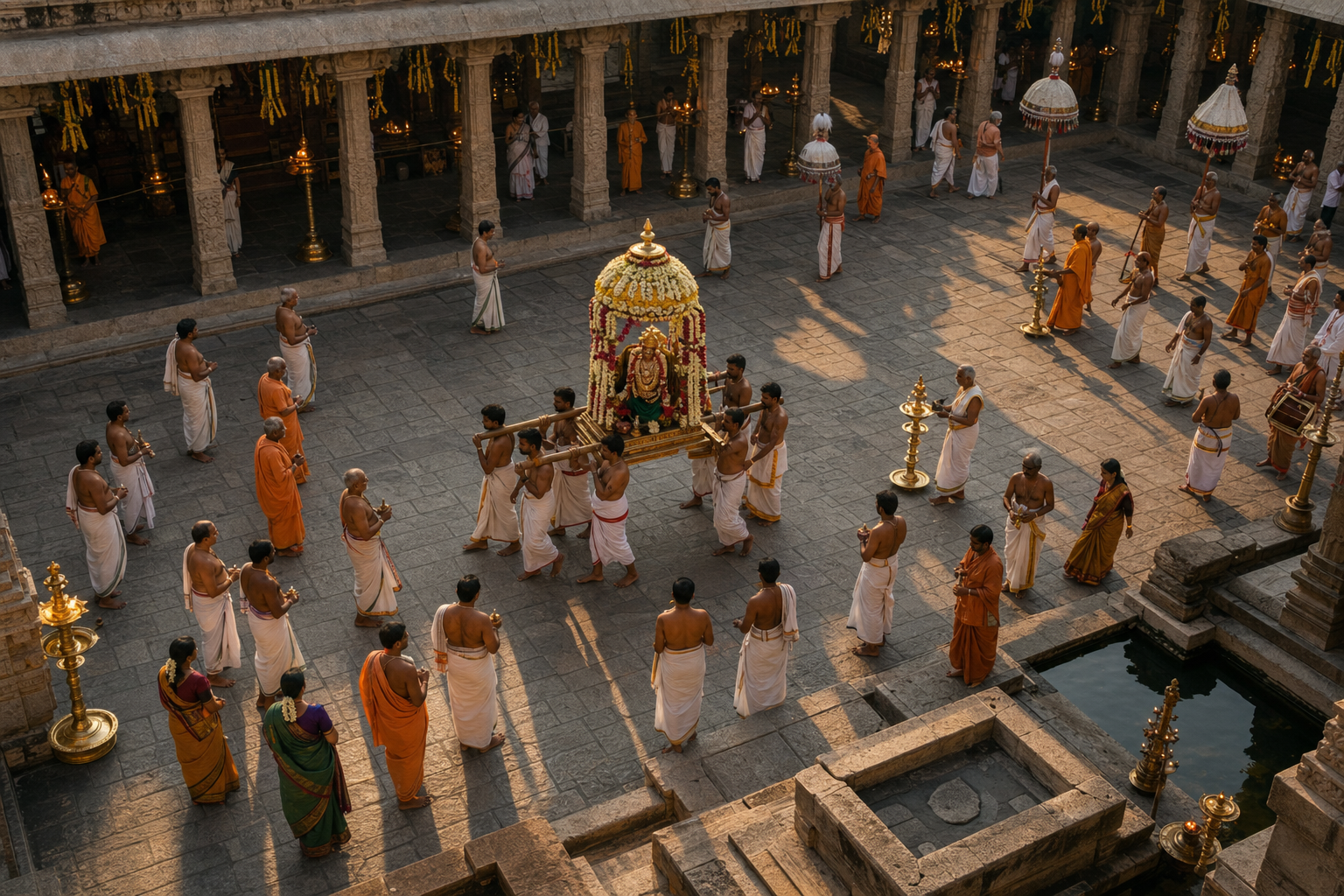
Movement adds another layer. During Seeveli in the Kerala temple setting, the deity is carried along the circumambulatory path and bali is offered at subsidiary altars. The Lord’s ritual presence reaches the parivara-devatas and guardians of sacred space. The theological center does not disappear, but it turns outward and acknowledges an ordered field of relationships around it.
The same principle appears institutionally. In Kerala’s temple-tantra system, the thantri bears chief ritual authority, while the melsanthi and supporting priests execute daily worship. Manuals such as the Tantrasamuchaya preserve procedures for purification, consecration, worship and festival cycles. Precision here is not bureaucracy imposed upon spirituality. It protects a shared form of service from becoming dependent on one officiant’s preferences.
When you encounter a ritual, place it on three clocks before interpreting it: the daily cycle, the festival calendar and the devotee’s personal vow. Then watch whether the action remains within the sanctum or carries divine presence into a wider space. This will tell you whether the rite is sustaining continuity, marking an occasion, answering a particular aspiration or extending the temple’s sacred order beyond its center.
The senses carry theology instead of distracting from it
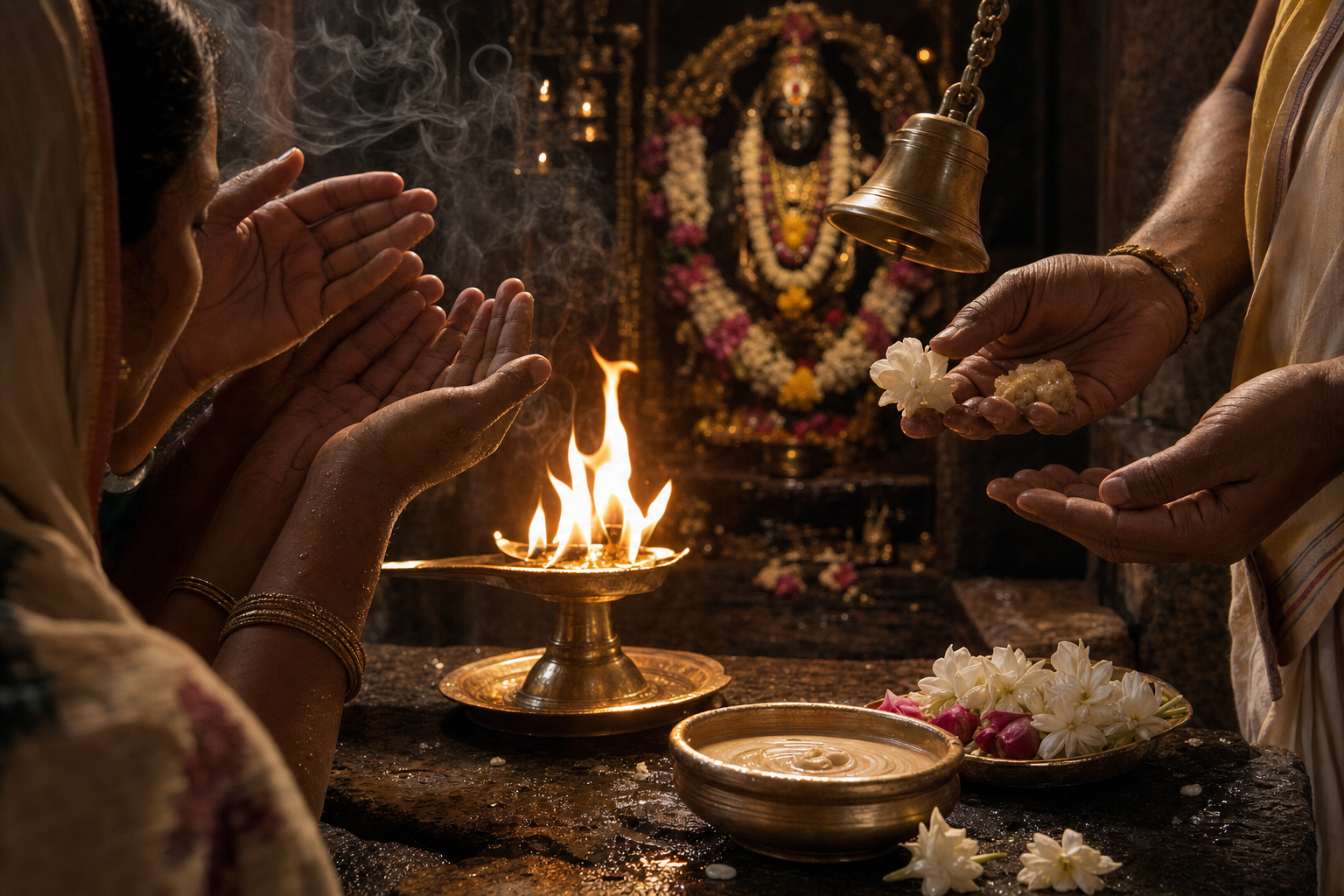
Water, sandal paste, flowers, food, lamps, incense, music and movement are not decorations added after the serious religious work is done. They are among the means by which that work occurs. Temple worship addresses sight, smell, taste, touch, hearing, posture and memory because a human being does not live by abstract propositions alone.
Abhisheka makes this especially clear. The deity is bathed, then adorned. Panchamrita typically brings together milk, curd, ghee, honey and sugar; other prescribed substances may follow according to the temple and occasion. Alankara then presents the form through clothing, ornaments, flowers or sandal paste. Care is made visible through a disciplined transformation of appearance.
Naivedya offers an even clearer example of why sequence matters. Food is prepared under rules governing ingredient integrity and cleanliness. It is presented before it is consumed. When it returns as prasada, the material may look familiar, but its relational status has changed: it has first been offered and is now received as grace. Calling prasada merely distributed food removes the action that gives it meaning.
This is a ritual and theological transformation, not a claim that a laboratory measurement must detect a different substance. The relevant change concerns relation: who gave, who received and in what order. That distinction helps you avoid two opposite mistakes, dismissing prasada as nothing but food or forcing a devotional claim into a scientific category it was not designed to occupy.
Sound works in a similar way. At Guruvayur, chenda and ilathalam patterns, Vedic recitation and synchronized processional movement organize collective attention. A bell or drum is therefore not only producing atmosphere. It can mark a transition, coordinate bodies and gather scattered attention around a sacred action.
Use three passes when you observe a sensory rite. First notice the material change: what was poured, lit, removed, adorned or shared? Then notice the relationship: who acts for whom, and who receives afterward? Finally notice the discipline: what habits of care, restraint, patience or attention does the action require? This method is more reliable than assigning one fixed symbolic meaning to every color, ingredient or sound.
Traditional memory associates Guruvayur’s ordered liturgy with Adi Shankaracharya and his wider work of harmonization, but epigraphic support is uneven from shrine to shrine. The responsible conclusion is narrow and important: disciplined external worship and Advaita Vedanta are treated as compatible. It is not safe to infer that every detail in the present schedule was personally authored by Shankaracharya. When you hear a sweeping historical origin claim, ask whether it rests on an inscription, a ritual manual or the temple’s inherited memory.
Festival drama makes duty, power and repair publicly visible
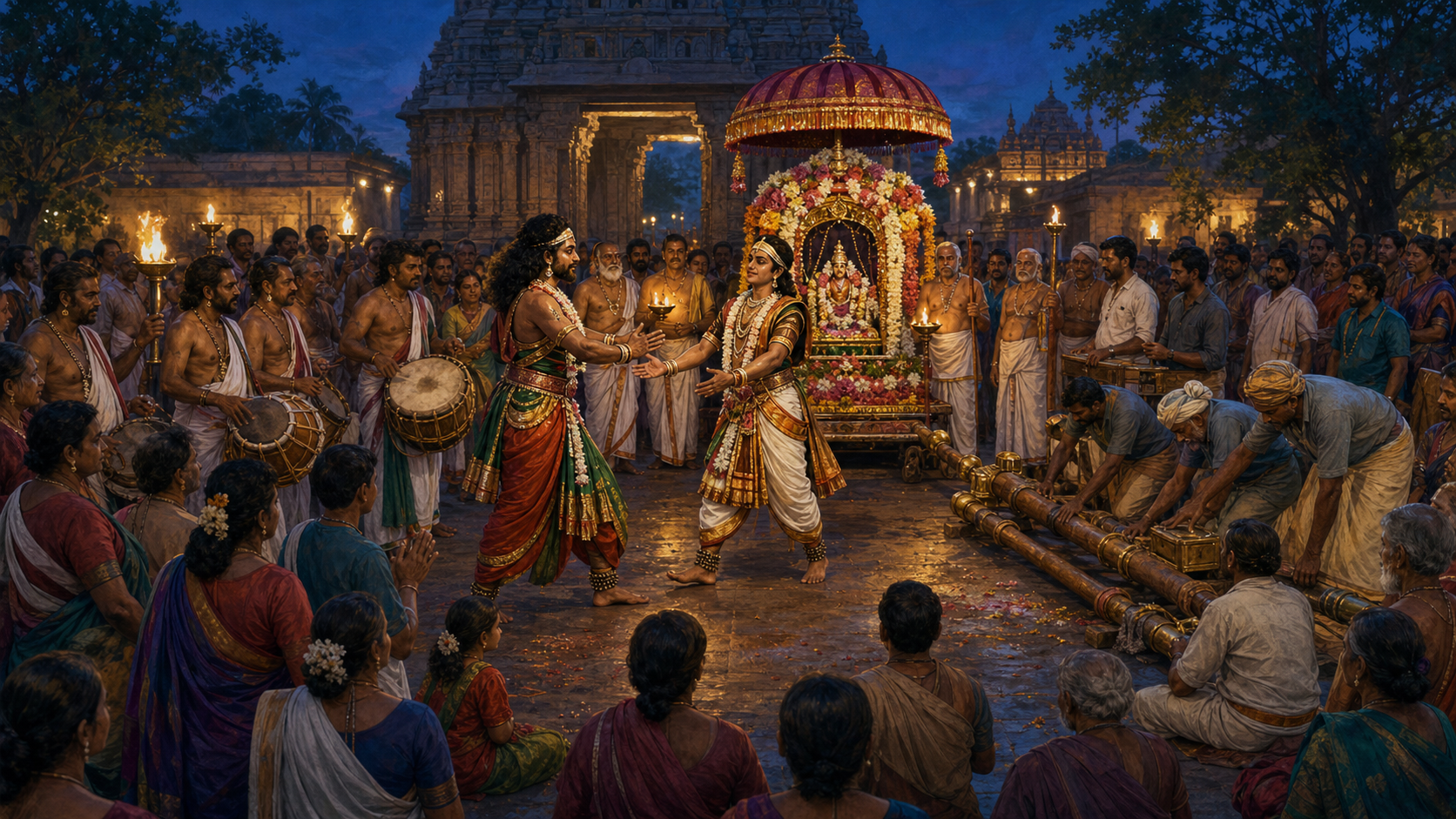
Some temple rituals teach through a dramatic change in relationship rather than through a sequence of offerings. A deity leaves, a gate closes, a grievance is expressed or a return is delayed. These actions cannot be interpreted well as isolated spectacles. Their meaning lies in the complete arc from established order through disruption to restoration.
Puri’s Rath Yatra provides a precise example. On Ashadha Shukla Dwitiya, Jagannath, Balabhadra and Subhadra travel from the Srimandir to the Gundicha Temple. Lakshmi remains at the Srimandir. On Ashadha Shukla Panchami, Hera Panchami, she goes in procession to see Jagannath. The doors close before she enters the Adapa Mandapa, and on her return her servitors damage a small wooden part of Jagannath’s Nandighosa chariot.
The gesture is controlled and liturgical. Removed from its setting, it could look like a comic act of retaliation. Within the full sequence, it makes Lakshmi’s grievance public and gives it a recognized form. Her displeasure, described through mana or rosha, is neither ignored nor allowed to become the final condition of the divine household.
The return does not erase what happened. At Niladri Bije, Lakshmi bars Jagannath’s re-entry at the Lion Gate. Servitors enact the Lakshmi-Narayana Bachanika, a ritual exchange of questions, answers and assurances. Rasagola appears among the offerings associated with reconciliation. The gate opens only after the broken relationship has been addressed.
Reducing this to a tale about an angry wife diminishes Lakshmi and misses the theology. She is Shri, the sovereign power of auspicious order, not an accessory waiting silently at home. Jagannath’s return must acknowledge her standing. The sequence makes a demanding ethical claim: affection does not cancel responsibility, grievance need not destroy relationship, and reunion requires repair rather than mere physical return.
The same festival places political rank under a theological measure. In chhera pahanra, the Gajapati Maharaja sweeps the chariot platforms. The ruler’s authority is not denied, but before the Divine it is expressed as seva. Power becomes accountable through service, just as Jagannath’s freedom of movement remains answerable to the order embodied by Lakshmi.
When you watch ritual drama, ask four things in sequence. What was the established order? What disrupted it? Who is permitted to object or stop the action? What must happen before restoration? At Puri, the closed doors, damaged chariot piece, barred gateway, ritual dialogue and sweet offering belong to one theological sentence. Isolating any one gesture destroys its grammar.
Do not turn the sequence into a generic relationship lesson too quickly. It remains a liturgy of Jagannath and Lakshmi, enacted in a particular temple world by designated servitors. Its ethical force grows from that theological setting. Respecting the local form gives you a stronger insight into accountability than extracting a slogan and discarding the deities, calendar and sacred geography that make the action intelligible.
A six-question method for reading any temple rite
You do not need to master an entire ritual system before your next darshan. You do need to observe in the right order. These questions will help you distinguish what the rite actually does from an interpretation imposed too quickly from outside.
Key takeaways for your next temple visit
- Where am I? Name the deity, the particular form, the temple and the regional or sectarian setting. Guruvayur’s Vaishnava center operates through a Kerala temple-tantra grammar; Puri’s festival belongs to the distinctive world of Jagannath. Shared Hindu principles do not erase local liturgies.
- What kind of rite is this? Decide whether you are seeing recurring daily worship, an occasion-based observance or a vow connected with a devotee’s desire. Do not use an exceptional festival to describe the whole daily tradition.
- What is the full sequence? Record the beginning, the decisive transition and the closure. Bathing followed by adornment says more than either act alone. Food offered and returned has a different meaning from food merely handed out.
- What crosses a boundary? Watch what enters or leaves the sanctum, what travels in procession, what is offered and returned, and which gate opens or closes. Boundaries reveal changes in access, relation and sacred status.
- Who carries responsibility? Notice the distinct work of ritual authorities, daily priests, servitors, artisans, rulers and devotees. A temple’s theology is also preserved through assigned duties, material standards and continuity across generations.
- What kind of claim am I making? Separate an insider theological meaning from an ethical application, an institutional function and a historical assertion. All four may be worthwhile, but one does not automatically prove another. Preserve the difference between inherited temple memory and independently established history.
On your next visit, choose one rite instead of trying to decode the entire temple. Notice its first act, its turning point and its completion. If conversation is appropriate, ask a priest or knowledgeable devotee one narrow question: what is being completed at this moment, or why does this offering return to the worshipper? A precise local answer will teach you more than a catalogue of universal symbols.
If you can see how the relationship changes from the beginning of the rite to its end, you have begun to read temple ritual as lived theology. Return to the same sequence when you can. Repeated attention is fitting here, because repetition is one of the principal ways the temple teaches.
References
- DharmaRenaissance Blog – Adi Shankaracharya at Guruvayur: The Meticulous Reforms That Still Shape Daily Worship
- DharmaRenaissance Blog – Why Suvarna Mahalakshmi ‘Gets Angry’ at Puri Rath Yatra: Hera Panchami to Niladri Bije
