

You may have paused before a stone serpent beneath a tree, a cobra hood above a linga, or Vishnu resting on immense coils and wondered what you were meant to see. Is the serpent an animal, a deity, a warning, or a symbol of inner energy? In Hindu tradition, it can participate in all four meanings, but context determines which one comes forward.
Once you know how to read that context, Naga devotion stops looking like an isolated act of snake worship. It becomes a disciplined way of thinking about cosmic order, water and land, dangerous power, moral restraint, and the obligations human beings carry toward lives they don’t control.
Read the serpent on three levels at once

The first mistake is to force every Naga into one category. A living snake, a Naga king in an Itihasa, a serpent canopy in temple sculpture, and kundalini in yogic practice are connected by a shared sacred vocabulary. They are not interchangeable.
Begin with three levels:
- The living level: Snakes inhabit fields, groves, water edges, and other places where human settlement meets a less controllable natural world. Naga shrines near wells, tanks, fields, and trees turn respect for those boundaries into religious practice.
- The divine and narrative level: Nagas appear as intelligent beings with lineages, rulers, loyalties, grievances, and duties. Ananta, Vasuki, and Takshaka do not perform the same role, so the word Naga should not flatten them into a single generic serpent.
- The cosmic and interior level: Coils can represent continuity, latent power, ordered energy, and realities hidden beneath ordinary perception. In yoga, the serpent becomes a map of consciousness; in Vishnu iconography, it becomes the support of worlds.
These levels strengthen one another. The divine guardian of water makes a community more attentive to an actual water source. The danger of a living snake gives moral weight to stories about power and restraint. The coiled form seen in nature supplies an image for energy that is present but not yet expressed. Still, you should resist saying that a Naga is merely a metaphor. Hindu sacred imagery rarely needs the divine, natural, and philosophical meanings to cancel one another.
The Sarpa Suktam places serpents within an inhabited and sacred cosmos. Honour offered to them concerns the safety of dwellings, fields, waters, and communities. Appeasement in this setting is not simply panic before venom. It acknowledges that human life depends on powers and habitats that cannot be treated as disposable.
Purānic cosmology adds another important correction. Atala, Vitala, Sutala, Talātala, Mahātala, Rasātala, and Pātāla are the seven nether domains associated with a richly layered universe. Naga realms are portrayed with waters, gems, palaces, and their own forms of sovereignty. Therefore, “below” should not automatically be read as “evil.” When a Naga comes from Pātāla, the image can indicate hidden wealth, deep water, or a guarded threshold rather than a demonic identity.
Three Naga stories provide the clearest interpretive key

You do not need to memorize every Naga genealogy before entering a temple. Three narratives will give you a reliable foundation because each presents serpentine power in a different relationship to dharma.
Ananta-Sesha: the support that remains
Vishnu’s repose upon Ananta-Sesha is not an image of a deity defeating a monster. The serpent supports him. During pralaya, when the manifest order withdraws, Vishnu rests upon the endless Naga over the cosmic waters. The coils hold unexpressed possibility; their continuity suggests time and existence extending beyond one visible cycle.
The names themselves guide the reading. Ananta points to the endless, while Sesha carries the sense of what remains. The composition therefore asks you to notice stability beneath change. Vishnu is at rest, not in distress, and the many hoods form a sovereign canopy rather than a threat. When you encounter an Ananta-sayana image, look first at the relationship among repose, water, and support. That visual grammar matters more than treating the serpent as decorative background.
Vasuki: power placed in common service
During the Samudra Manthana, devas and asuras use Vasuki as the living rope around Mount Mandara. The churning brings forth amrita, medicinal treasures, and sacred gifts, but it also releases halāhala, the terrible poison that Shiva contains.
This episode makes Vasuki indispensable rather than incidental. Cosmic gain requires a force capable of bearing tension between rival sides. It also carries a warning: a great undertaking may release danger before it yields nectar. Cooperation does not remove responsibility for the poison produced along the way. Someone must recognize it, contain it, and prevent the cost from being pushed onto the whole world.
That is a practical dharmic test you can apply beyond the story. When an institution celebrates what it has extracted but ignores the harm created during extraction, it remembers the amrita and forgets the halāhala. Vasuki’s place in the churning keeps both outcomes in view.
Takshaka and Astika: justice stopped before it becomes extermination
The Mahābhārata’s serpent sacrifice begins in grief and vengeance. King Janamejaya seeks the destruction of serpents after the death associated with Takshaka. The rite expands punishment from a particular offender to an entire class of beings, until the sage Astika intervenes and brings it to an end.
The decisive act of dharma is restraint. Astika does not deny that injury occurred; he prevents grievance from becoming indiscriminate annihilation. If you want to understand why a tradition can acknowledge the danger of serpents while still protecting them from destruction, this is the central episode. Reverence does not require pretending that Nagas are harmless. It requires proportion, discernment, and a refusal to turn fear into collective punishment.
The three narratives now form a usable pattern: Ananta supports order, Vasuki makes transformation possible, and Astika protects a threatened lineage from excess. “Sacred serpent” therefore does not name one simple quality. It names power brought into a dharmic relationship.
Let the location tell you what the Naga is doing
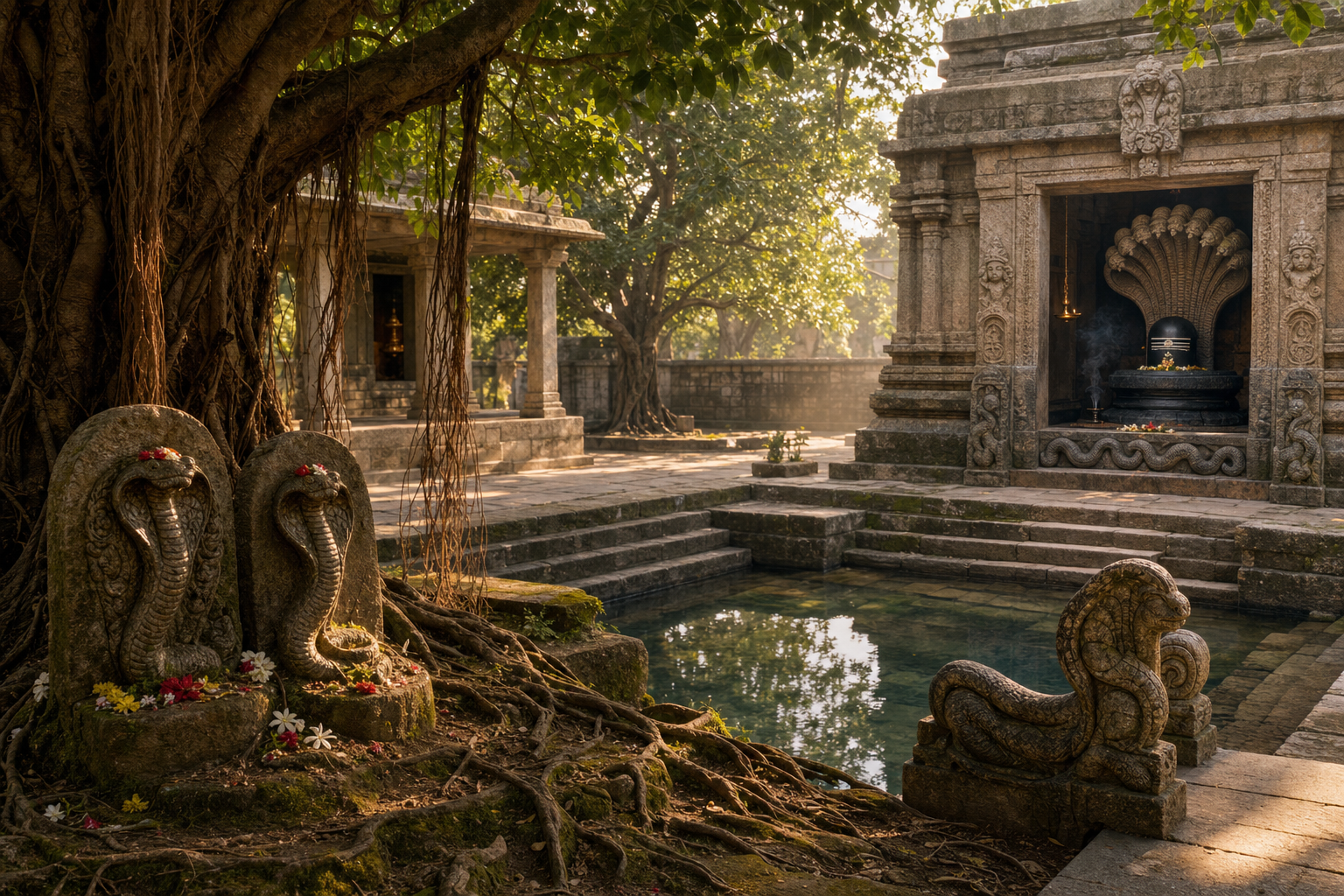
When you see Naga imagery, identify the setting before assigning a meaning. The same serpentine form changes emphasis according to the deity, posture, architecture, and landscape around it.
- Vishnu reclining on a serpent: Read the image through Ananta-Sesha, cosmic water, continuity, and support through dissolution.
- A cobra canopy over a linga: The Naga marks protected sacred power and Shiva’s sovereignty over dangerous or vital forces. It is not the same narrative as Vishnu’s repose.
- Paired serpents or serpent forms at a gateway: Their position emphasizes passage. They guard the movement from ordinary space into consecrated space.
- An independent Naga stone near a tree, grove, field, tank, or well: Local guardianship comes to the foreground. Water, fertility, household continuity, land boundaries, and the integrity of the habitat may matter more here than a single pan-Indian myth.
- A many-hooded canopy: Protection and sovereignty are usually safer first readings than aggression. Do not identify a particular Naga solely from the number of hoods; the deity, local tradition, and temple account supply the necessary context.
This location-first method prevents two common errors. One is calling every sacred serpent Adi Sesha. Hindu narratives also remember Vasuki, Takshaka, Karkotaka, Padma, Mahāpadma, Shankhapāla, Kulika, Dhritarāshtra, and other Naga figures and lineages. The other is imposing an abstract yogic explanation on a shrine whose primary function is the protection of a water source or community boundary.
Kerala’s Naga-kāvu traditions preserve serpent groves as living sanctuaries. Restrictions on intrusion are not empty taboos when they allow moisture, plants, seeds, pollinators, amphibians, and reptiles to persist within a settled landscape. A grove-edge offering and a rule against clearing the interior translate reverence into a limit on human use. If you visit such a place, respecting the boundary is itself part of the worship.
The calendar is regional rather than mechanically uniform. Nāga Pañchamī is observed in many parts of Bharat; Nagula Chavithi is prominent in Andhra-Telangana; Nag Chaturthi appears elsewhere; and Mannarasala Aayilyam in Kerala and the Kukke Subramanya traditions of Karnataka carry their own ritual lineages. Do not assume that one household’s procedure applies everywhere. Follow the sampradāya of the shrine, family, or region you are actually participating in.
The wider Dharmic world also helps you recognize the image without erasing theological differences. Mucalinda shelters the Buddha after enlightenment, making the Naga canopy an image of protective stillness. The many-hooded serpent above Jain Tirthankara Pārshvanātha is associated with protection and ahimsa. These are not merely alternate names for a Hindu deity. They show a shared Indic visual language in which serpentine power can shelter spiritual attainment rather than oppose it.
Practise devotion without turning a snake into a ritual object

The clearest way to honour Nagas is to direct worship toward the consecrated image, shrine, or Naga stone while allowing living snakes to remain wild. Devotion becomes distorted when an animal is captured, handled, crowded, or force-fed for the sake of a ritual display.
- Use an established place of worship. Offer prayer at a temple, household shrine, grove-edge altar, or recognized Naga stone. Do not approach a wild snake to complete a vrata.
- Keep offerings simple and appropriate to the shrine. Flowers, a lamp, turmeric, and simple prasāda fit many Naga observances, but local rules take priority. Place offerings only where the priest or custodian permits them, especially in a protected grove.
- Do not feed milk to a living snake. Pouring or forcing milk on snakes can harm the animals, and close contact also creates an obvious risk for the person attempting it. A symbolic offering at an image is not permission to handle wildlife.
- Respond to an unexpected snake with distance, not ritual improvisation. Keep people and pets away and contact a trained local wildlife responder. Do not try to capture or kill it. The restraint praised in Naga tradition should govern the encounter itself.
- Protect what the shrine protects. Avoid dumping waste near a tank, uprooting vegetation around a Naga stone, clearing a sacred grove, or contaminating offerings with plastic. If the tradition associates Nagas with water and habitat, a ritual that damages those things contradicts its own meaning.
- Carry the vrata into conduct. Dāna, japa, seva, care for water, and restraint in conflict give the observance an ethical consequence. The worship is incomplete if fear is temporarily soothed while the underlying habits of harm remain unchanged.
Do not turn kundalini into a claim about every Naga
In yogic anatomy, kundalini is represented as coiled at the mūlādhāra and rising through sushumnā as idā and pingalā are harmonized. The sequence of mūlādhāra, svādhishthāna, manipūra, anāhata, vishuddha, ājñā, and sahasrāra belongs to a disciplined map of practice involving ethical restraints, observances, posture, breath, attention, meditation, and absorption.
This subtle map should not be presented as modern neurophysiology, and it should not swallow every other serpent meaning. A village Naga shrine beside a well may primarily concern water, land, fertility, lineage, and protection. Calling it “just kundalini” can obscure the local duty encoded in the shrine. Conversely, reducing kundalini to an anatomical mechanism strips a soteriological practice of its ethical and contemplative frame.
If you practise within a yogic lineage, let yama and niyama remain the foundation. Serpent symbolism points to energy under discipline, not a reason to chase dramatic sensations or make biomedical claims the tradition itself does not establish.
Do not let Naga astrology become a sentence of doom
Popular Jyotisha discussions use terms such as sarpa-dosha and kāla-sarpa-yoga, but classical texts and lineages do not give these ideas uniform emphasis. Kāla-sarpa-yoga is a later construct, so a frightening label should not be treated as a universally accepted verdict on a person’s marriage, health, children, or future.
Before accepting an expensive or fear-driven remedy, ask four concrete questions: Which lineage or text defines the condition? What exact planetary configuration is being used? Is the interpretation shared across schools? What change in conduct is the remedy meant to cultivate? A responsible reading redirects anxiety toward dāna, vrata, japa, seva, and accountable action. It does not use Naga symbolism to declare that suffering is unavoidable.
Key takeaways
- Nagas can be divine beings, cosmic supports, guardians of water and thresholds, and symbols of interior power; none of these meanings alone exhausts the tradition.
- Read the setting before interpreting the serpent. Vishnu’s couch, Shiva’s linga, a temple gateway, and a grove-side Naga stone perform different sacred work.
- Ananta-Sesha teaches support through cosmic change, Vasuki shows power serving transformation, and Astika’s intervention limits vengeance before it becomes extermination.
- Regional Naga festivals and shrine customs are not identical. Follow the actual temple, family, or local sampradāya rather than inventing a universal procedure.
- Worship the consecrated image and leave living snakes wild. Do not capture, handle, or feed milk to them.
- Kundalini and Jyotisha belong within disciplined traditions. Neither should be used to reduce every Naga image to one meaning or to frighten a person with fatalistic claims.
The next time you meet a Naga image, pause before naming it. Ask what it supports, what boundary it guards, and what kind of restraint it asks from you. At a shrine, offer simply, follow the local custom, and leave the surrounding life undisturbed. That movement from fascination to responsible relationship is where Naga reverence becomes living dharma.
References
