
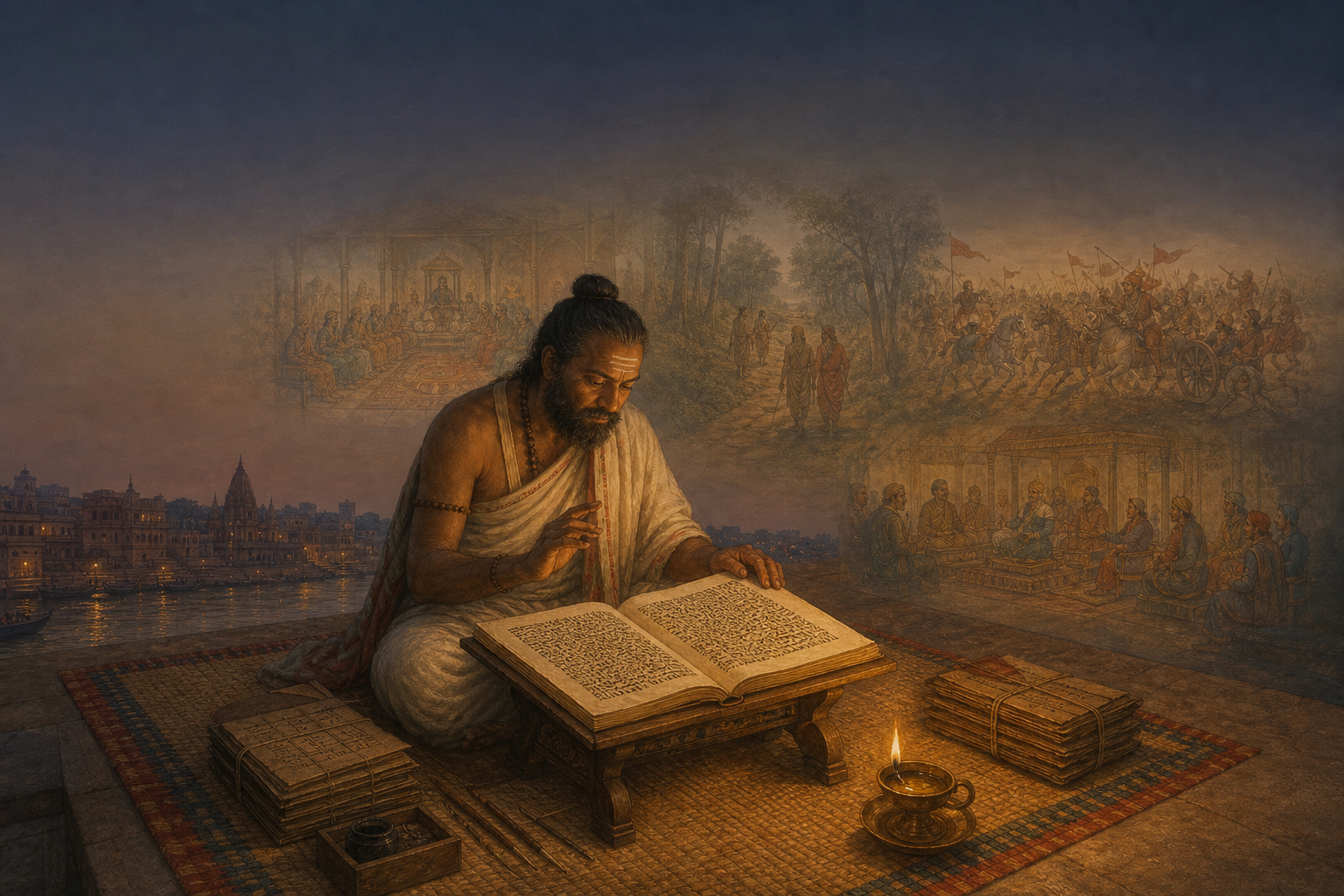
You reach a difficult Mahabharata passage and understand what happened, yet the dharmic judgment remains unsettled. One character invokes duty, another exposes an injustice, and neither a literal translation nor a familiar moral slogan tells you how to weigh their claims.
Nilakantha Chaturdhara gives you a disciplined way through that difficulty. His Sanskrit explanations connect words, speakers, narrative context, philosophical principles, and the purpose of dharma. If you use those layers in the right order, you can read the epic without forcing every tension into a simple rule or dismissing every tension as a contradiction.
First identify the kind of difficulty you are facing
Readers often ask a philosophical question before resolving a linguistic or narrative one. That reverses the proper order. A conclusion about dharma cannot be secure if it rests on a misunderstood compound, an uncertain textual reading, or a speech detached from its immediate dispute.
Nilakantha was an early modern Sanskrit scholar, commonly placed in the 17th century. Traditional accounts associate him with a learned lineage that included Lakshmanarya, Narayana, and Dhiresha, although the surviving biographical record is limited. His authority for a reader therefore rests less on an elaborate life story than on the precision and range of his interpretive work.
Before consulting his explanation, classify your problem under one of four headings:
- Word: Is a Sanskrit term, compound, idiom, or grammatical relationship unclear?
- Reading: Does Nilakantha preserve a pāṭhabheda, or variant reading, that differs from the text in front of you?
- Scene: Does the statement make sense only after you identify its speaker, audience, motive, or link to an earlier event?
- Purpose: Is the real question about tātparya, the intended teaching that organizes the passage as a whole?
This classification prevents a common mistake. Suppose the difficulty is lexical, but you immediately invoke Vedānta to solve it. You may produce an impressive interpretation while never establishing what the sentence means. Conversely, if the words are clear but the conduct remains morally troubling, another dictionary definition will not resolve the problem. You must move to context and purpose.
Treat Nilakantha as a major interpretive witness, not as permission to stop thinking. Generations of paṇḍits relied on his explanations, and later editors carried their influence into widely read print recensions of the Mahabharata. That history gives his judgments substantial weight. It does not erase textual variants, alternative philosophical readings, or the need to distinguish his early modern synthesis from every possible meaning available within the epic.
Use a four-pass method instead of reading the gloss in isolation
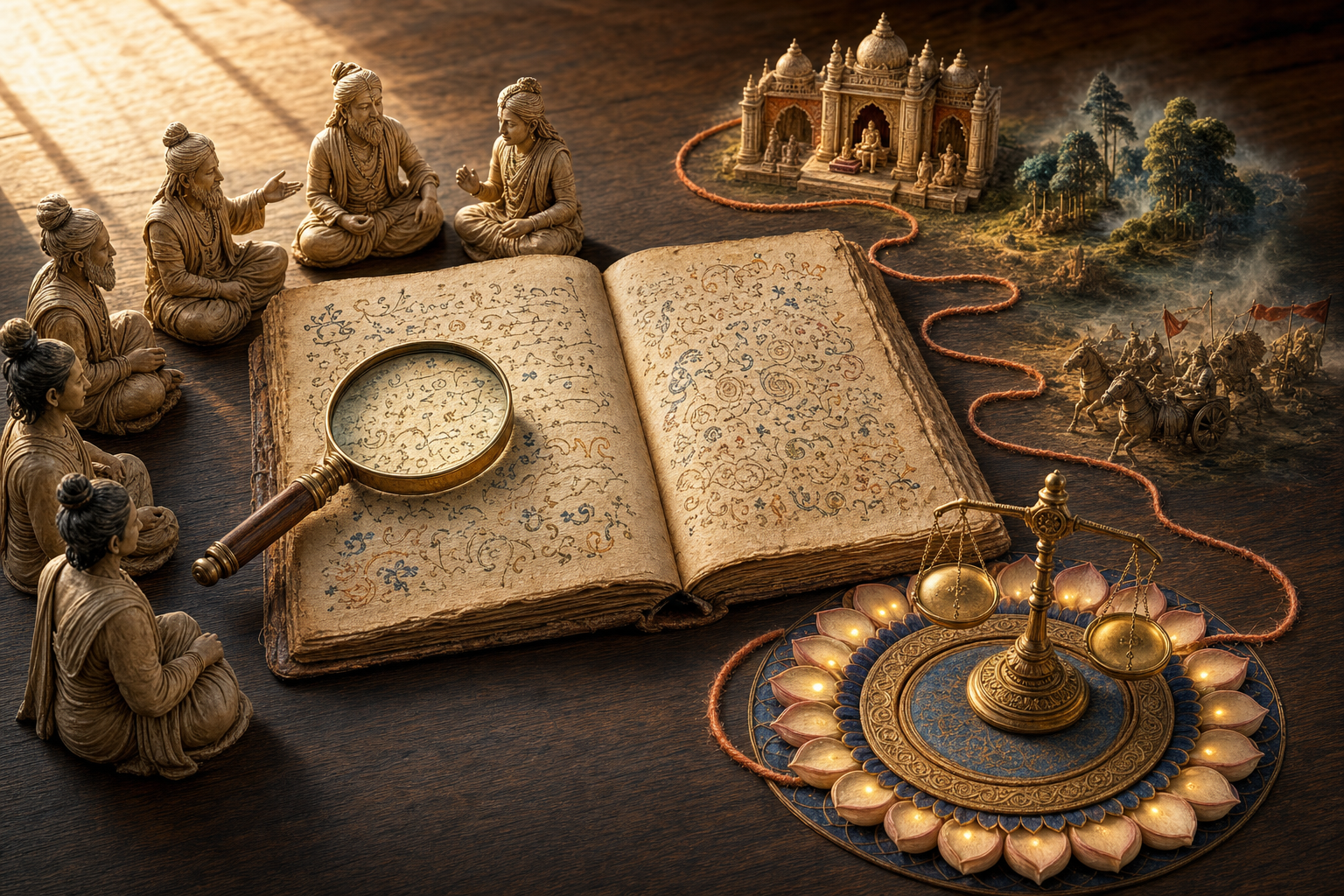
You will get more from the Bhāratabhāvadīpa if you keep the relevant Mahabharata passage open and work through it in four passes. A notebook page divided into four sections is enough; the value lies in keeping different kinds of evidence separate until you are ready to combine them.
- Reconstruct the scene. Write down who is speaking, to whom, under what pressure, and in response to which question or action. Summarize the immediate dispute in one sentence. Do not interpret the entire parva yet.
- Mark the verbal hinge. Identify the word or clause on which the meaning turns. Record Nilakantha’s parsing, semantic distinction, etymological explanation, or alternate reading. If your edition has different wording, keep both readings visible rather than silently combining them.
- Trace the narrative bridge. Ask which earlier event, promise, relationship, or recurring theme makes the present speech intelligible. Note whether Nilakantha is explaining the speaker’s intention, reconciling an apparent discontinuity, or drawing attention to a thematic echo.
- State the dharmic claim with limits. Write the principle in conditional language: who is being instructed, in what circumstances, toward what end, and under which restraints? Then ask whether the passage concerns ordinary duty, an exceptional crisis, governance, renunciation, liberation, or more than one of these at once.
The second pass matters because Nilakantha regularly attends to variant readings, difficult compounds, idiom, etymology, and semantic nuance. A single Sanskrit term can carry juridical, ritual, and metaphysical force in different settings. Do not assume that its meaning in one parva can be transferred unchanged into another. Write the local sense first; compare broader uses afterward.
The third pass protects you from treating a character’s speech as a freestanding commandment. The Mahabharata presents counsel through kings, warriors, ascetics, householders, relatives, adversaries, and divine figures. Speaker and circumstance are part of the meaning. Nilakantha often restores continuity by attending to intention and narrative connection, so add at least one line of context before extracting a moral rule.
The fourth pass is where vyākhyāna becomes more than word explanation. Nilakantha seeks coherence without stripping the story of its dilemmas. Your final note should therefore preserve the tension that produced the teaching. If your conclusion makes every character obviously right or obviously foolish, check whether you have replaced the epic’s moral drama with a slogan.
Test the method on Draupadi’s question and Krishna’s diplomacy
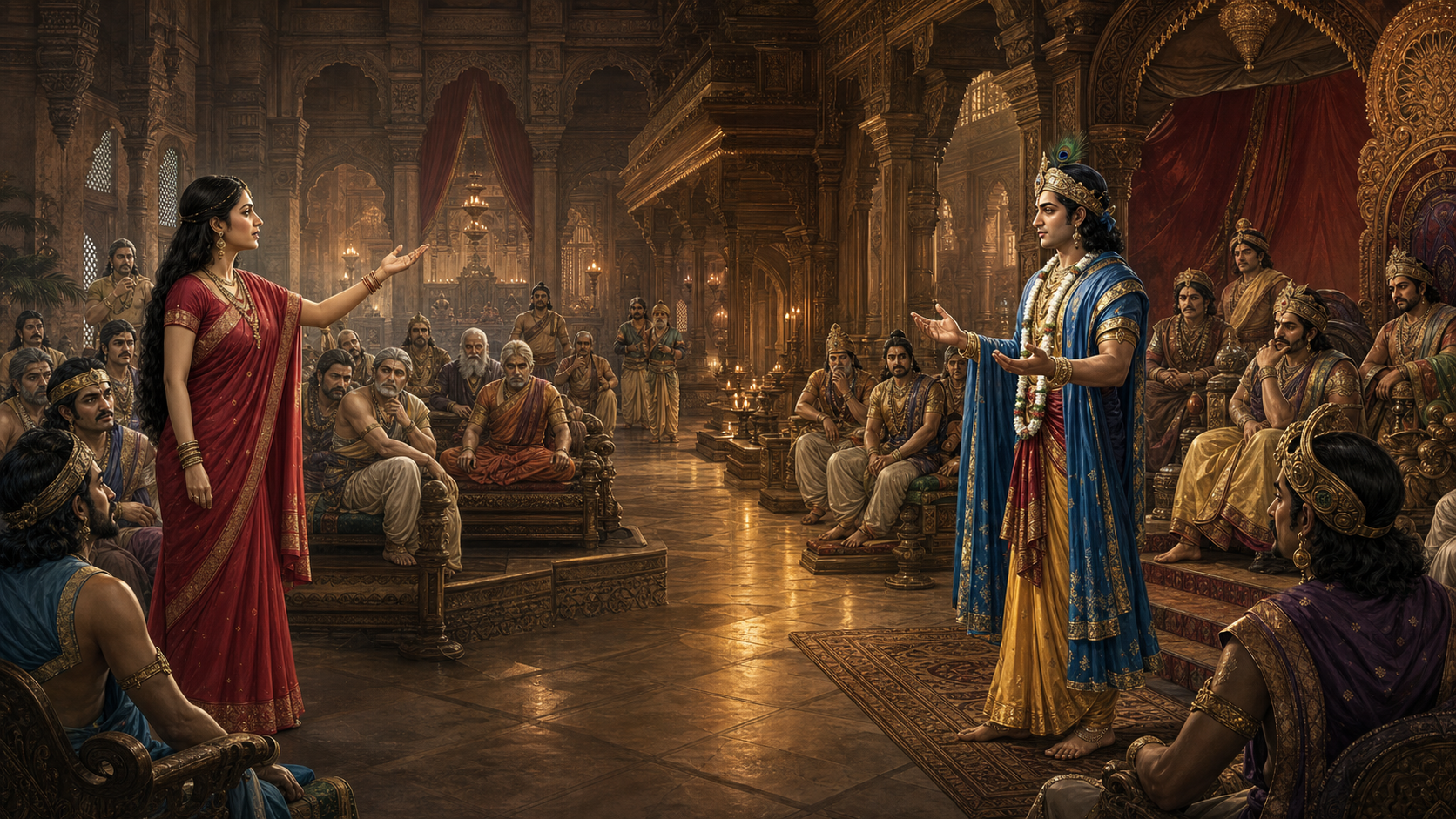
Two episodes show why the order of reading matters. One tests whether procedure can conceal injustice. The other tests what responsibility requires before conflict becomes unavoidable. Both yield practical questions, but neither should be reduced to a modern analogy detached from its narrative setting.
Draupadi: procedure is not the same as justice
In the Sabha Parva, Draupadi’s interrogation of the dice-game forces the assembly to examine the legality and moral substance of what has occurred. Nilakantha draws attention to the difference between outward procedural correctness and dharma’s deeper demand for justice. That distinction is the interpretive hinge.
When you read the exchange, do not begin with the general statement that gambling is wrong or that social custom must always be obeyed. Put the contested procedure under four tests:
- What rule or custom is being invoked to validate the act?
- What prior condition could undermine the legitimacy of that invocation?
- Who bears the harm while others debate the technical point?
- Does the procedure serve dharma’s just purpose, or has procedure become a shelter for adharma?
This gives you a useful ethical distinction. Formal compliance answers whether recognized steps were followed. Substantive justice asks whether those steps could create a valid and righteous outcome in the circumstances. The Sabha’s failure is not made less serious by the presence of rules, elders, or debate. Institutional form cannot by itself sanctify an unjust result.
You can carry that distinction into family, community, or public decision-making without pretending that the dice hall supplies a ready-made ruling for every present dispute. Ask whether a procedure protects the vulnerable party, whether decision-makers are confronting the underlying wrong, and whether appeals to custom are clarifying responsibility or evading it.
Krishna: patience before force is disciplined action
In the Udyoga Parva, Krishna’s diplomatic effort shows that restraint is not indecision. Nilakantha foregrounds dialogue, proportionality, and ethical patience before conflict. Peace is pursued seriously, but not by denying injustice or abandoning responsibility.
Use the episode as a sequence for judging a proposed use of power:
- Name the just claim clearly. Vague appeals to peace can obscure what has to be repaired.
- Attempt dialogue before escalation. The attempt must be genuine, not a ritual performed after the decision for conflict has already been made.
- Test proportionality. The response should be governed by the wrong being addressed, not by anger or prestige.
- Exercise patience without surrendering moral clarity. Delay is dharmic only when it serves understanding, restraint, or a just settlement.
- Recognize force as constrained, not self-justifying. Even a righteous cause does not turn every possible means into dharma-yuddha.
This sequence is especially useful when someone frames the choice as immediate submission or immediate confrontation. Krishna’s diplomacy opens a morally serious space between those poles. Before endorsing escalation, ask what dialogue has actually been attempted, what proportionate outcome remains possible, and which restraints will continue to apply if negotiation fails.
Connect philosophy to choice without flattening the epic

Nilakantha reads across Vedānta, Sāṃkhya, and Yoga, especially where questions of ātman, karma, and moksha shape human conduct. He does not leave these as detached abstractions. Their meaning becomes visible in the decisions, burdens, and failures of figures such as Yudhiṣṭhira, Bhīṣma, and Karna. You should therefore ask what a philosophical explanation changes in the character’s field of action.
Use four questions when a gloss turns philosophical:
- Self: What mistaken identification or understanding of ātman is being corrected?
- Action: How does the explanation clarify agency, obligation, attachment, or the operation of karma?
- Discipline: What restraint, steadiness, knowledge, or practice is required before the teaching can be lived?
- End: Is the immediate goal better conduct within the world, freedom from bondage, or a relationship between the two?
This approach stops you from using a philosophical label as a substitute for interpretation. Simply writing “Vedānta” beside a passage tells you very little. Writing that a particular understanding of the self changes how a character bears grief, performs duty, or relinquishes attachment shows how metaphysics is functioning inside the narrative.
It also helps you approach the Mahabharata’s resonances across Dharmic traditions with precision. Ahiṃsā and karuṇā can enter a meaningful conversation with Jain and Buddhist ethics; seva, sat, and disciplined action can resonate with Sikh teaching. These affinities concern shared moral concerns such as restraint, compassion, truth, responsibility, and liberation. They do not establish that Hindu, Buddhist, Jain, and Sikh accounts of self, bondage, karma, or liberation are doctrinally identical.
When making a cross-tradition comparison, label its level. Is the similarity ethical, practical, metaphysical, or soteriological? Then name the actual term and passage under discussion. That one habit lets you recognize Dharmic kinship without turning distinct traditions into interchangeable vocabularies.
Key takeaways for your next reading session
- Diagnose the difficulty before interpreting it: word, textual reading, narrative context, or intended teaching.
- Read the Mahabharata passage first and Nilakantha’s explanation beside it; do not detach the gloss from its speaker and scene.
- Keep variant readings separate until you understand how each one changes the sentence or argument.
- Move from language to context and only then to philosophy or dharma.
- Test procedure against substantive justice in the Sabha Parva and escalation against dialogue, patience, and proportionality in the Udyoga Parva.
- Use Vedānta, Sāṃkhya, and Yoga to clarify action, agency, discipline, and liberation, not merely to attach school names to a passage.
- Treat Nilakantha as an influential interpreter whose reasoning must be followed, not as a label that ends discussion.
Begin with one passage that already troubles you. Give it a single page with four headings: scene, verbal hinge, narrative bridge, and dharmic claim. If you cannot fill one heading, that gap tells you exactly what to investigate next.
After several passages, compare your pages. You will start to notice which terms change with context, which ethical tensions recur, and where philosophical teaching alters practical judgment. That is when Nilakantha becomes most useful: not as a shortcut around the Mahabharata’s difficulty, but as training in how to remain precise while the epic asks you to think more deeply.
References
