

You may have arrived at Kalachakra because a cycle in your own life is changing. Something needs to begin, something worth keeping is becoming unstable, or something finished is refusing to leave. The useful question is not only what the wheel symbolizes. It is which movement of time is active, and what dharma asks of you within it.
A Hindu reading through Pañcakṛtya, the five divine functions, turns Kalachakra into a practical map. Creation, preservation, dissolution, concealment, and grace are not five remote events at the edges of cosmic history. They are five activities occurring within the cosmos, a community, a ritual, a decision, and your own awareness.
The crucial distinction: five functions, not five consecutive eras

Kalachakra joins kāla, time, with cakra, wheel. The image directs your attention away from a purely linear model in which the past disappears and every change is simply new. A wheel returns, but it does not stand still. Sunrise, lunar phases, seasons, ritual observances, human generations, and the arising and passing of thought all display recurrence with transformation.
In this Hindu frame, time is not an empty container in which meaningful things happen. It participates in order, consequence, disclosure, and return. The Bhagavad Gita’s declaration kālaḥ asmi presents time as divine power rather than inert duration. The Vedic idea of ṛta likewise helps us see why measure, rhythm, ethical order, and cosmic regularity belong in the same field of meaning.
Precision matters here. Hindu traditions preserve several ways of enumerating time and its cycles. The fivefold interpretation of Kalachakra is an application of Pañcakṛtya, not a claim that every Hindu use of Kalachakra must contain exactly five literal wheels. Nor is it a complete account of Buddhist uses of the term. The lens here is specifically a Hindu theological and contemplative one.
The five functions are also not five yugas or five stages that wait politely for one another. Every act of creation already requires some preservation; every preserved form is also changing; every ending clears conditions for another beginning. Concealment limits what can presently be known, while grace can disclose a deeper meaning within any of the other four movements.
| Function | Direct meaning | Common divine association | Question for discernment |
|---|---|---|---|
| Sṛṣṭi | Bringing forth | Brahmā or creative Śakti | What needs to receive form? |
| Sthiti | Sustaining | Viṣṇu | What must be tended faithfully? |
| Saṁhāra | Drawing in or dissolving | Rudra or Śiva | What has completed its work? |
| Tirodhāna | Concealing or veiling | Īśvara in some Śaiva mappings; Māyā in Śākta interpretation | What remains hidden, assumed, or misunderstood? |
| Anugraha | Grace or revelation | Sadāśiva or the compassionate Divine | What has become clear, and how should you respond? |
Indian calendrical practice supplies a complementary, observational map. Tithi, pakṣa, māsa, ṛtu, ayana, and varṣa place the day within nested lunar, seasonal, and annual cycles. The pañcāṅga therefore does more than label dates: it helps situate observance within patterned time. Those calendar divisions should not be confused with the five divine functions. The calendar measures recurring conditions; Pañcakṛtya interprets what manifestation is doing within them.
How to recognize each movement of the wheel
Sṛṣṭi: give possibility a dharmic form
Sṛṣṭi is the emergence of form, distinction, measure, and rhythm from potential. Its human expression is not novelty for novelty’s sake. A dharmic beginning gathers scattered energy around an intelligible purpose.
Dawn, the first movement of breath, the opening syllable of japa, and āvāhana at the commencement of worship all make this function perceptible. Each beginning establishes a field in which something can unfold. If you are starting a practice, project, or responsibility, do not begin with a pile of activity. Write one sentence that identifies what you are bringing into form and whom or what it is meant to serve. If the purpose cannot be stated, the impulse may not yet be ready for embodiment.
You can also test a proposed beginning by asking whether it contains the seed of a sustainable rhythm. A plan that depends on permanent excitement belongs to impulse more than Sṛṣṭi. Sound creation establishes enough measure for Sthiti to take over.
Sthiti: preserve the pattern without freezing it
Sthiti sustains the conditions under which a created form can fulfill its purpose. The recurrence of seasons, the continuity of living systems, the steadiness of posture, and the regularity of nityakarma all express this preserving power. Midday serves as a fitting image: what began has reached fullness and must now be nourished.
This function corrects a familiar error. Preservation is not passive resistance to change. It is stewardship. You preserve the purpose by tending the pattern, while allowing the outer arrangement to adapt when adaptation protects that purpose.
For any commitment, identify three things: the smallest repeatable action, the time or condition that prompts it, and the person responsible for maintaining it. This applies as readily to daily japa as to a temple committee or cultural initiative. If a new undertaking has no rhythm, prompt, or custodian, its creation is incomplete.
Saṁhāra: end the form whose work is complete
Saṁhāra is dissolution, but not destruction without meaning. It gathers names and forms back when their work is finished. That return makes renewal possible. Śiva’s transforming fire and the circle of flames around Nataraja prevent us from confusing permanence with sacredness.
In personal practice, the unforced exhalation offers a simple bodily reminder: release belongs to the rhythm of life. Twilight and Pradoṣa likewise direct attention toward completion. An ending can be honored without being treated as either defeat or catastrophe.
When you recognize this movement, name the exact form that has completed its work. It may be a rule, a role, a schedule, a possession, or a method rather than the underlying duty itself. Then distinguish conscious dissolution from neglect. Saṁhāra completes obligations, preserves what must be learned, and releases what no longer carries dharma forward. Abandoning a responsibility without that reckoning is not sacred letting go.
Tirodhāna: admit what the present view cannot reveal
Tirodhāna is concealment or veiling. It is easy to misread this function as a cosmic mistake or as simple deception. Its subtler meaning is that finite beings encounter reality through partial perspectives. That limitation makes seeking, learning, history, choice, and spiritual discipline possible.
Night and winter symbolize this movement because apparent inactivity can contain incubation. In Śākta language, Māyā does not merely place a false object in front of you; it conditions how the whole field of manifestation is perceived. In some Śaiva mappings, Īśvara presides over this concealing function. The theological vocabulary varies, but the practical discipline is consistent: do not turn a partial view into an absolute claim.
For a decision, divide a page into three columns: known, assumed, and presently unseen. Put every important claim in one of them. If a choice depends on something in the third column, continue with reversible preparation but delay the irreversible part that requires certainty. Applied inwardly, ask which attachment, fear, or preferred conclusion may be narrowing your sight. Humility before the veil is clearer than either gullibility or cynicism.
Anugraha: let revelation change the next action
Anugraha is grace, disclosure, and release. It is not merely the arrival of pleasant circumstances. Grace can appear as the recognition that a finite form is rooted in a reality larger than itself. Study can clarify what confusion obscured. Sevā can loosen a cramped sense of self. A lucid pause in contemplative practice can reveal awareness without its usual grasping.
In Śaiva mappings, Sadāśiva is frequently associated with this liberating function. Its fullest horizon is mokṣa: time is no longer experienced only as the force that takes things away, because the ground of awareness is not exhausted by the forms moving through time.
To recognize Anugraha without becoming sentimental, ask two linked questions: what has genuinely become visible, and what conduct follows from seeing it? Write the answer as an action. If an apparent insight requires no change in attention, relationship, duty, or practice, examine whether you are calling a passing feeling revelation. Grace is received inwardly, but it becomes legible through alignment.
Nataraja keeps the five functions in one field of vision
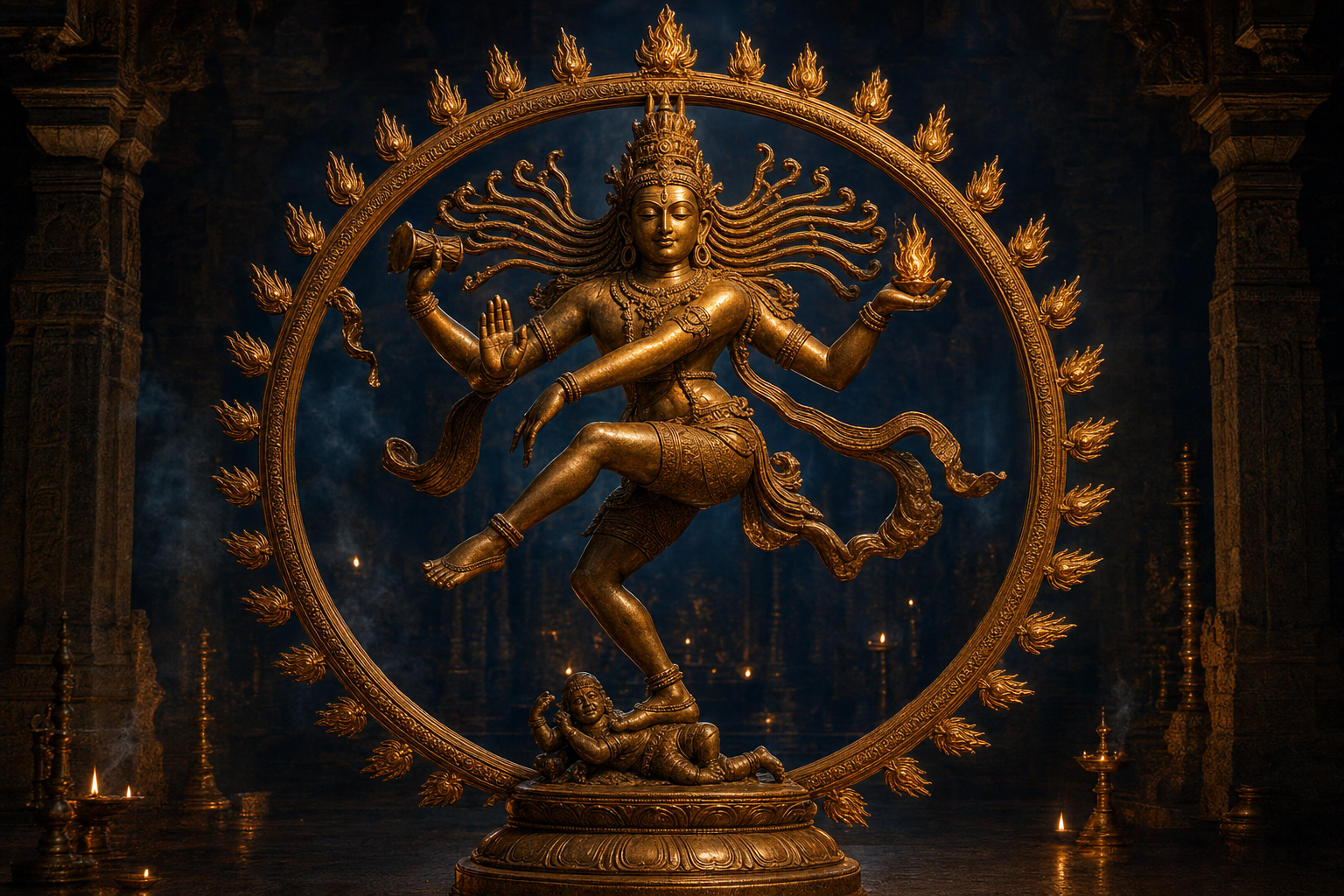
Nataraja offers the most concentrated way to contemplate why these functions cannot be separated. The prabhāmaṇḍala, the encircling aureole of flames, establishes the wheel of time. The ḍamaru sounds emergence and rhythm. The flame performs dissolution. The dancing body sustains order in motion rather than by becoming motionless.
The planted foot subdues forgetfulness, reminding you that obscuration is not overcome by pretending it does not exist. The abhaya hand communicates fearlessness, while the raised foot points toward release. Creation, maintenance, dissolution, veiling, and grace are therefore held within one dance. No single gesture explains the whole image, and no one function can be made sovereign without distorting the cycle.
The same unity takes different theological forms across Hindu traditions. In Śrīvidyā, Lalitā Tripurasundarī embodies the sovereignty of Śakti over the artistry of manifestation, concealment, and revelation. Pañcarātra articulations emphasize complementary principles of manifestation, maintenance, order, and renewal. Such differences matter. The fivefold grammar can illuminate several sampradāyas without erasing the distinctive language or practice architecture of any one of them.
When you contemplate Nataraja, notice which gesture you instinctively prefer and which you would rather ignore. Creation without preservation produces abandoned beginnings. Preservation without dissolution hardens into stagnation. Dissolution without reverence becomes destructiveness. Attention to concealment without openness to grace becomes paralysis. Talk of grace without disciplined engagement with the other functions becomes wishful thinking.
Hold the whole form in view for a few quiet moments. Then ask which neglected function would restore balance to the matter presently before you. This is a contemplative use of the icon, not a replacement for the ritual teaching of a sampradāya or guru.
A five-question practice for decisions and sādhanā
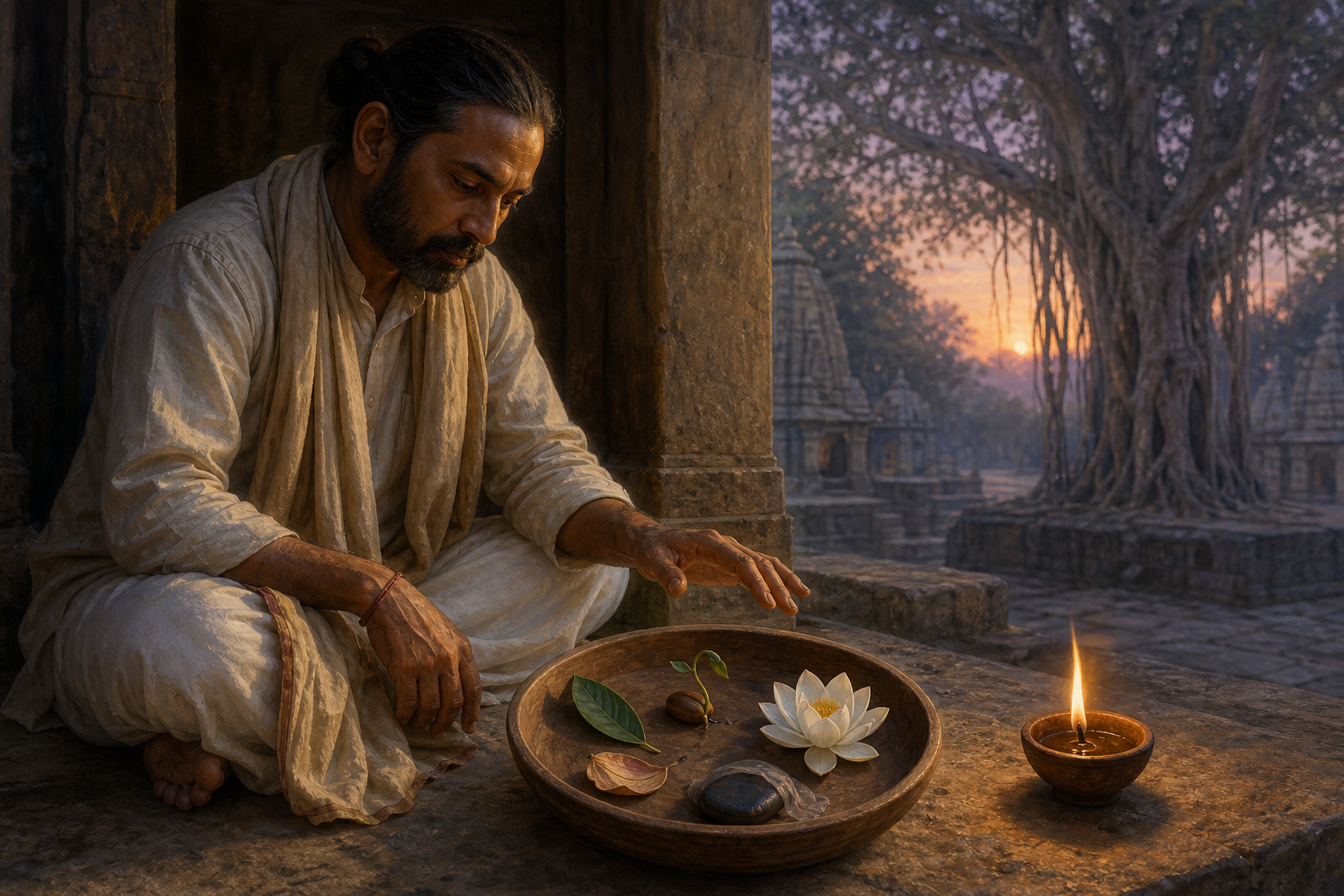
Choose one live situation rather than trying to evaluate your entire life. It might be an irregular spiritual practice, a new community undertaking, a responsibility you are carrying too long, or a decision blocked by incomplete knowledge. Give the exercise one page and answer in concrete terms.
- Sṛṣṭi: What needs to be brought into form now? Name one observable first act, not an aspiration.
- Sthiti: What rhythm, boundary, resource, or person will sustain it? Remove any plan that depends only on enthusiasm.
- Saṁhāra: What form has finished its work? State what must be completed, preserved as learning, and then released.
- Tirodhāna: What do you not yet see clearly? Separate evidence from assumption and mark the part of the decision that should remain reversible.
- Anugraha: What has already been disclosed through this cycle? Convert that insight into one act aligned with dharma.
Suppose your japa has become irregular. Sṛṣṭi asks you to re-establish a clear intention and prepare for the next recitation. Sthiti asks for a repeatable time and place. Saṁhāra may require releasing an elaborate routine that can no longer be maintained, without abandoning the mantra itself. Tirodhāna asks whether the obstacle is truly lack of time or an unexamined resistance. Anugraha asks what the practice has already shown you and how that understanding should reshape the routine.
The exercise works because it prevents one diagnosis from swallowing the whole situation. A stalled undertaking does not always need more creative energy. It may need maintenance, an ending, an honest admission of uncertainty, or receptivity to something already revealed. The wheel gives you five distinct questions before you reach for one familiar answer.
Key takeaways
- Kalachakra means the wheel of time; the fivefold Hindu reading comes from Pañcakṛtya, the five divine functions.
- Sṛṣṭi, Sthiti, Saṁhāra, Tirodhāna, and Anugraha mean creation, preservation, dissolution, concealment, and grace or revelation.
- The functions are simultaneous and interdependent, not five consecutive cosmic periods.
- Calendar cycles measure recurring conditions, while Pañcakṛtya supplies a theological grammar for interpreting change within those conditions.
- Nataraja unites the five movements in one image: rhythm, sustenance, fire, the overcoming of forgetfulness, fearlessness, and release.
- You can apply the framework by asking what must begin, what must be sustained, what must end, what remains hidden, and what revelation now requires of you.
Take one unresolved matter today and answer those five questions in writing. Do not force every answer to appear at once. Act on the function that is clear, keep uncertain steps reversible, and return to the page when the wheel discloses what you could not yet see.
References
