
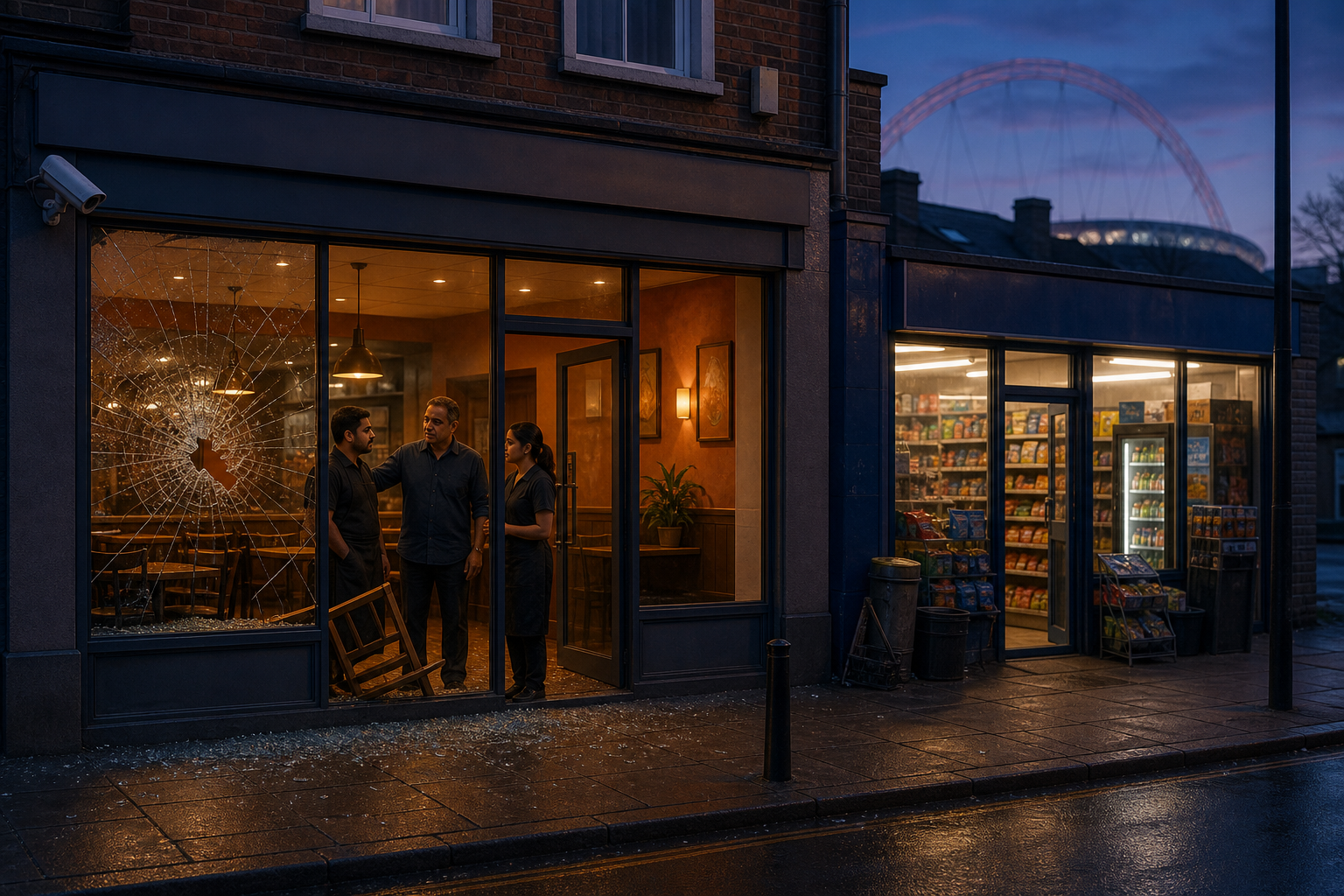
If you run an Indian-owned shop or restaurant in Wembley, the immediate question is not whether an online argument has identified the attackers. It is whether your staff are safe, your evidence will survive, and the authorities can see any pattern connecting one incident to another.
You do not have to choose between naming possible Hinduphobia and insisting on verified facts. You can do both. The practical response is to separate what has been observed from what has merely been alleged, report every indicator of hostility, and make your premises harder to attack without turning them into an unwelcoming fortress.
Key takeaways
- Local accounts and footage indicate that Indian-owned premises in Wembley were damaged, but the identities and motives of the offenders still require police verification.
- If an attack is happening or anyone is in danger, retreat to safety and call 999. Do not confront or pursue the offenders.
- Export original CCTV promptly, retain its metadata, record a precise timeline, obtain a crime reference number, and preserve the exact words or symbols that may indicate racial or religious hostility.
- Do not publish unverified names, affiliations, or edited clips. Public speculation can expose bystanders, spread communal blame, and interfere with an investigation.
- Test your CCTV retention and export process, improve lighting and sightlines, and connect with neighbouring traders, police, the council, your BID or BCRP before another incident occurs.
What is established, and what remains unproved
Circulating footage and local accounts described masked groups entering Wembley businesses, damaging furniture and property, and then leaving. Manek Chowk was reported to have been attacked twice within days. At Panesar Food and Wine, crates of produce were reportedly thrown into the street. These are serious allegations involving identifiable premises, not a vague claim that trouble occurred somewhere in London.
The limits of the evidence matter just as much. The precise sequence of events, the identities of the people involved, and their motives remained subject to police verification. No arrests had been publicly confirmed at the stage covered by the reports. A related disturbance during Holi celebrations in Harrow, raised by MP Bob Blackman, forms part of the atmosphere of concern but does not by itself prove that the same people or motive were involved.
Video can establish actions, clothing, direction of travel and damage. It does not automatically establish ideology. A claim of Hinduphobic, anti-Indian, sectarian or far-right motivation requires supporting indicators such as words used during the offence, symbols displayed, messages sent beforehand, deliberate selection of a religious or ethnic target, or a pattern connecting repeated incidents. Police can combine those details with CCTV, witness statements and other intelligence.
This distinction should strengthen the community’s response, not weaken it. Minimising a possible hate crime before it has been investigated is irresponsible. Declaring a motive or communal identity as settled before the evidence supports it is equally irresponsible. Use three labels when discussing any circulating claim:
- Confirmed: directly visible in an original recording, personally witnessed, or formally stated by the relevant authority.
- Reported: attributed to a named witness or business but not yet independently verified.
- Inferred: a proposed explanation based on context rather than direct evidence.
Do not allow an inference to become a confirmed fact simply because it has been reposted many times. Repetition measures reach, not reliability.
What to do during an attack and in the first hours afterward
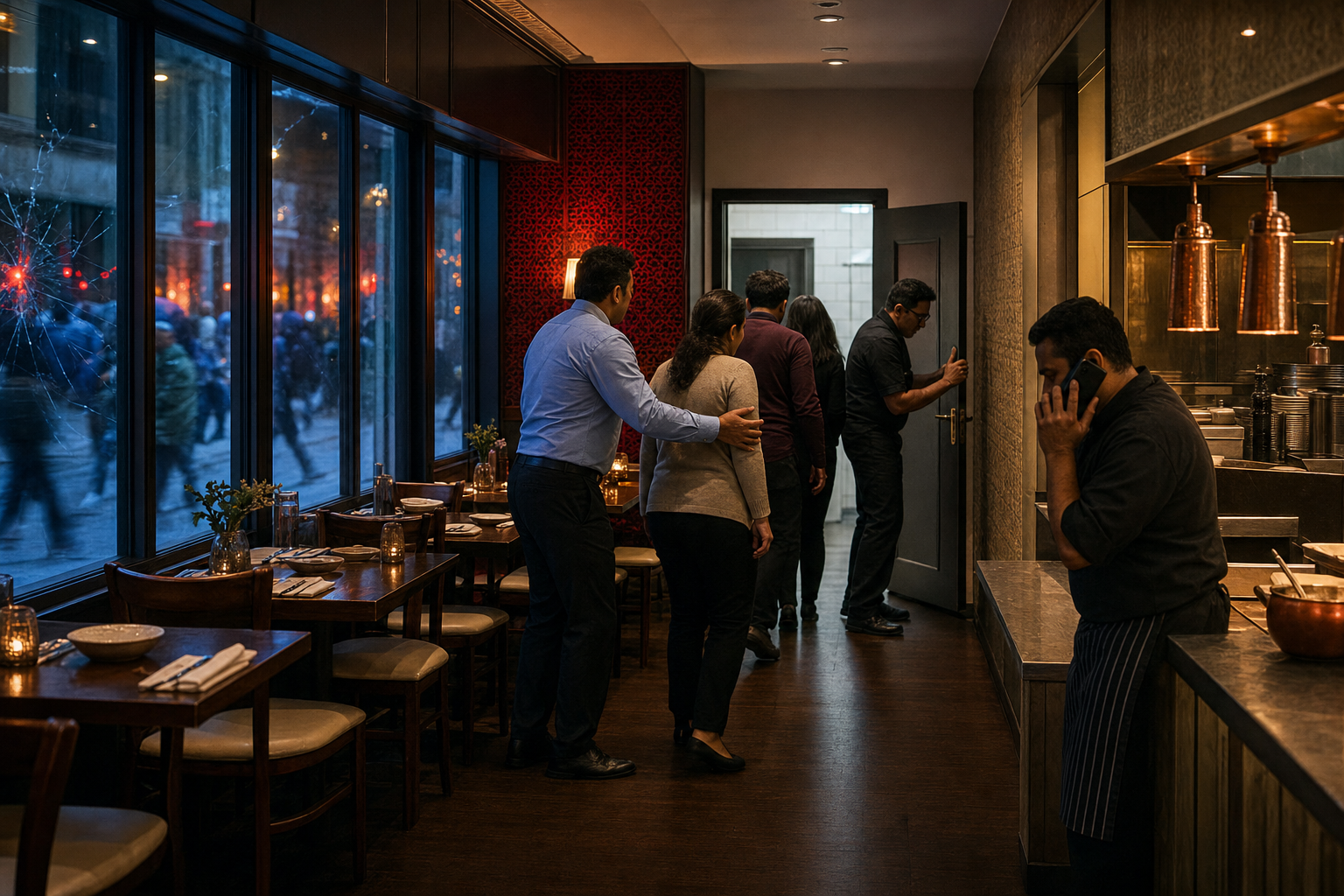
Protect people before property
If offenders are present, violence is occurring, or someone faces an immediate threat, call 999. Move customers and staff away from the entrance and from glass, and use a safer exit or lockable internal area if one is available. Do not block an offender’s escape, attempt to recover stock, or follow the group into the street. Furniture and merchandise can be replaced; an encounter outside may escalate beyond the view of your cameras and put staff at greater risk.
Staff should know this response before a crisis. Agree on a short internal instruction that means: withdraw, call the police, and do not confront. Identify who normally checks customer areas, who guides people toward safety, and who calls 999. The purpose is not to stage a security operation. It is to prevent several frightened people from making conflicting decisions.
Create an evidence package, not a social-media montage
Once everyone is safe, work through the following sequence:
- Report the incident. Use 999 for an emergency and 101 for a non-urgent police report. Obtain the crime reference number and keep it with the business record, insurer correspondence and evidence files.
- Preserve the original recordings. Export CCTV from the entrances, till area, interior and exterior cameras before the system overwrites it. Retain the native file where possible rather than saving only a compressed screen recording.
- Keep context around the incident. Preserve enough footage before and after the damage to show arrivals, behaviour, direction of travel and possible vehicles. Do not retain only the most dramatic few seconds.
- Protect metadata and make working copies. Keep an untouched original and use a duplicate for viewing or sharing. If someone technically competent is available, recording a SHA-256 hash can help demonstrate that a file has not changed. A hash does not prove that the scene is authentic; it helps establish that a particular digital file remained unaltered.
- Write a timeline. Record when the group was first noticed, when entry or damage occurred, when police were called, when the offenders left, and what staff did. Distinguish the camera’s displayed time from the actual time if the system clock is wrong.
- Collect independent recollections. Ask each witness to write what they personally saw or heard while the memory is fresh. Preserve contact details, but do not coordinate wording or encourage witnesses to fill gaps in one another’s accounts.
- Document the damage safely. Photograph entrances, locks, glazing, furniture and stock before repairs where practical. Do not leave broken glass, blocked exits, exposed wiring or spoiled food in place merely to preserve a scene; remove immediate hazards after documenting them and following police instructions.
- Notify the insurer. Provide the crime reference number and ask what evidence is required before disposal, cleaning or permanent repair. Keep invoices, stock-loss records and photographs of temporary security work.
Do not repeatedly trim, caption or transcode the only copy of a video. Do not send the sole original through a messaging platform that may compress it. Police and insurers need a stable record, while public viewers usually see only an edited fragment.
Report the possible hate element precisely
Under the Crime and Disorder Act 1998, specified offences can be treated as racially or religiously aggravated when the required hostility is demonstrated. The Public Order Act 1986, as amended by the Racial and Religious Hatred Act 2006, also addresses certain forms of threatening conduct intended to stir up religious hatred. You do not need to decide which offence or charge applies. Police investigate the conduct and context; prosecutors determine whether the evidence meets the relevant legal test.
Tell the police exactly why you suspect hostility. Record the words used, the language in which they were spoken, gestures, symbols, references to Hindu identity or Indian ethnicity, previous threats, and whether the same business was repeatedly selected. Preserve the speaker’s exact words rather than replacing them with a general label such as abusive language. If you did not hear the words yourself, identify who did.
True Vision provides a route for reporting suspected hate incidents and hate crime. Crimestoppers can receive anonymous information. These options supplement an emergency call; they do not replace 999 when someone is in immediate danger.
Make the next rapid-entry attack harder
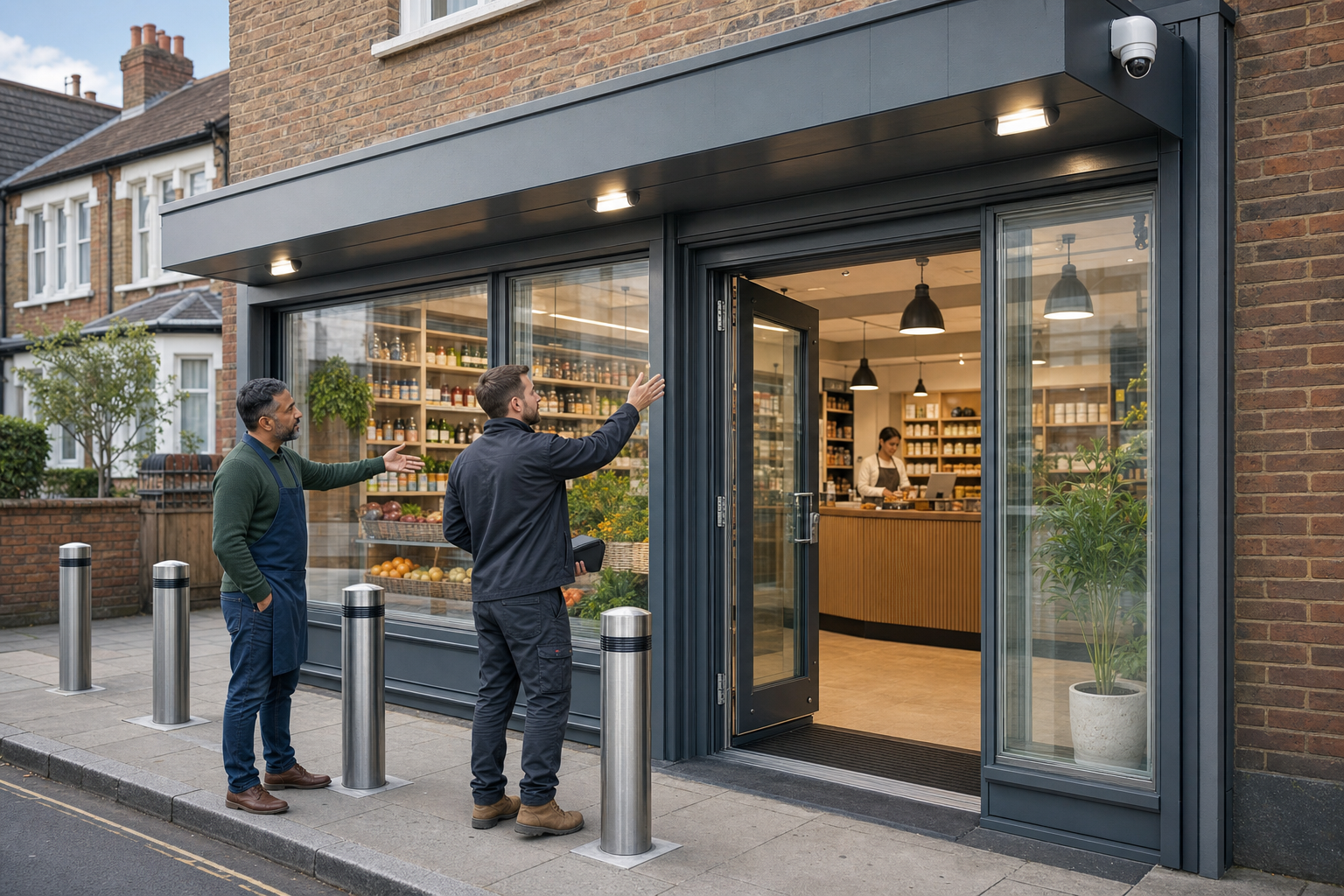
A security review should begin with the way an offender approaches, enters, causes damage and leaves. This is the practical logic behind Crime Prevention Through Environmental Design: remove concealment, improve observation, slow unauthorised entry and give staff a safer response route.
- Check sightlines from inside and outside. Move displays, posters or stacked goods that prevent staff from seeing the entrance or stop passers-by and cameras from seeing inside. Preserve privacy where needed, but do not create avoidable blind spots at the door.
- Inspect lighting after dark. Look for glare that silhouettes faces, unlit approach routes and reflections that make CCTV unusable. Review actual recorded footage rather than assuming that a bright fitting produces an identifiable image.
- Place cameras for identification as well as overview. Wide views show movement; entrance and till-facing views are more likely to capture faces and clothing. Exterior coverage should include the immediate approach and departure route without intruding unnecessarily into private property.
- Test retention and export. At least 30 days of CCTV retention is a useful aim where feasible, but the displayed setting is not enough. Confirm how many days are actually stored at the current resolution and camera count, and perform a test export so staff are not learning the system after an attack.
- Correct timestamps. Check that the date, time and time-zone handling on each recorder are accurate. If they cannot be corrected immediately, document the difference so investigators can align footage from neighbouring premises.
- Delay forced entry proportionately. Professionally installed glazing, shutters, doors and locks can reduce the opportunity for rapid vandalism. Ask an accredited security professional about Secured by Design standards and safe installation; improvised barriers can obstruct escape routes or create fire risks.
- Plan opening and closing routines. Avoid leaving one worker alone with the door unsecured while cash, stock or waste is being moved. Make sure staff know the safer exit, the location from which to call police, and who has access to the CCTV system.
- Prepare an incident folder. Keep the non-emergency police route, insurer details, alarm and CCTV instructions, landlord or maintenance contacts, and a blank incident log where authorised staff can reach them.
The aim is not maximum hardware. It is to remove the easiest opportunities and shorten the time between danger, reporting and usable evidence. A camera that nobody can export, or a shutter that traps staff behind damaged glazing, is not a complete security measure.
Turn isolated shop reports into a credible community response
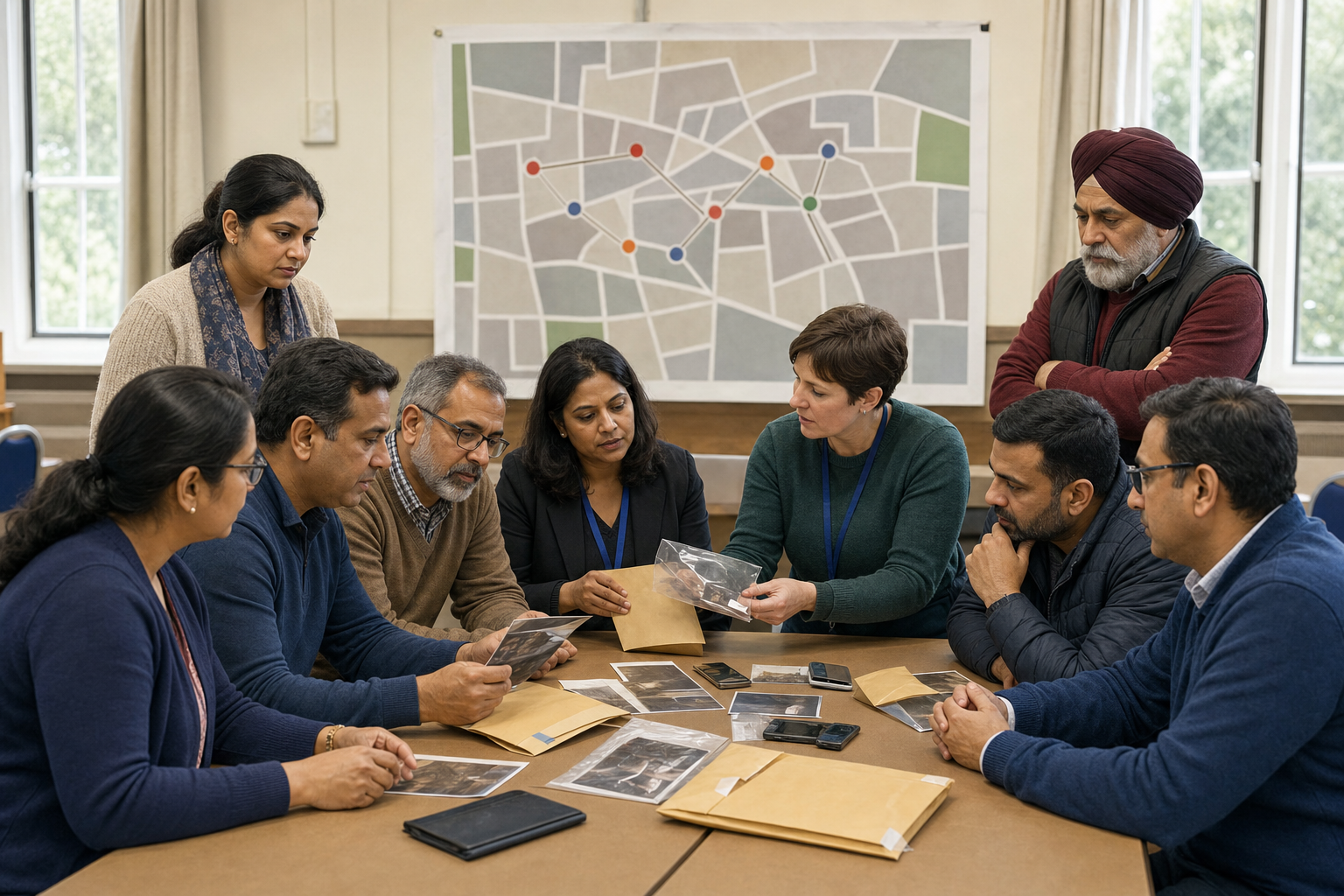
A single business sees one doorway. A functioning trader network can see repeated clothing, methods, routes, timings and targets across a neighbourhood. That wider view is valuable only if the network controls rumours.
Create a verified trader channel with a simple posting format: exact location, observed time, what was personally seen, whether danger is still present, whether police have been called, and the crime reference number if it is appropriate to share. Mark second-hand information as unverified. Do not publish names, home addresses, religious affiliations or accusations against identifiable people without confirmation.
Ask the local Business Improvement District, Business Crime Reduction Partnership, council Community Safety Partnership and Safer Neighbourhoods Team for concrete coordination. Useful requests include a named evidence contact, a review of repeated locations and time windows, joint safety walks, advice on camera coverage, and clarity about how businesses should submit related crime reference numbers. Brent Council’s condemnation of the violence and request for information should be followed by a process that traders can actually use.
Community solidarity also needs a clear moral boundary. Hindu, Sikh, Jain, Buddhist and Muslim representatives can jointly oppose attacks on businesses without prejudging who committed them. Rejecting collective blame does not require silence about Hinduphobia. It means naming religious hostility when the evidence supports it while refusing to assign guilt to an entire faith or ethnicity.
This is where Dharmic principles become operational. Ahiṃsā requires disciplined non-escalation, not passivity in the face of violence. Satya requires accurate testimony, not the most shareable allegation. Karuṇā requires care for frightened staff, injured people and affected families without turning neighbours into proxies for unknown offenders. These principles protect both justice and social trust.
Before your next opening shift, do three things: test one CCTV export, place the emergency and insurer contacts where staff can find them, and agree on the instruction everyone will follow if a hostile group enters. Then contact the neighbouring businesses and establish a verified reporting channel. That small amount of preparation can turn a frightening, confused response into a safer and more credible one.
References
