

If you have wondered why Garuda’s birth begins with an insult at a yajna rather than with the opening of Vinata’s egg, that apparent detour is the key to the whole account. Garuda is not simply born powerful. He embodies power accumulated through tapas, provoked by arrogance, and redirected before it becomes a rival sovereignty.
This gives you a precise way to think about justified anger. Dharma does not require the injured person to become powerless, nor does it treat every forceful response as righteous. It asks a harder question: can the energy raised against a real wrong be given a form that corrects the disorder without reproducing it?
The conflict begins before Vinata’s egg opens

Prajapati Kashyapa is conducting a sacred yajna with the assistance of many rishis. Among them are the sixty thousand thumb-sized Balakhilya ascetics. Their bodies appear negligible beside Indra’s celestial majesty, but their tapas has given them immense spiritual potency. The contrast is deliberate: visible scale and real power are not the same thing.
Retellings vary in whether Indra openly mocks the Balakhilyas or treats them with dismissive neglect. The moral failure is the same. Indra measures the rishis by appearance and rank, then mistakes his office for proof of his intrinsic superiority. The guardian of order thereby commits a disorder of perception.
The Balakhilyas respond by forming a sankalpa to bring forth another Indra, one greater than the existing king of the devas. Sankalpa here means more than a passing wish. It is a purpose supplied with the disciplined energy of austerity and directed through sacrifice. Their answer is therefore not an angry remark that will disappear when tempers cool. It has the capacity to become an objective result.
This is why the episode should not be reduced to the familiar lesson that pride is bad. Indra’s pride creates a genuine crisis because the people he disregards possess the power to answer him. The Balakhilyas have a just grievance, but the literal fruit of their vow could produce competing claimants to sovereignty among the devas. A necessary office and an unworthy act by its present holder have become entangled.
That distinction matters whenever you confront failed leadership. Condemning a ruler’s conduct is not the same as declaring every function of the office illegitimate. Conversely, defending the office cannot mean protecting its holder from accountability. Kashyapa’s task is to preserve both truths at once.
Kashyapa redirects the fruit without denying the wrong
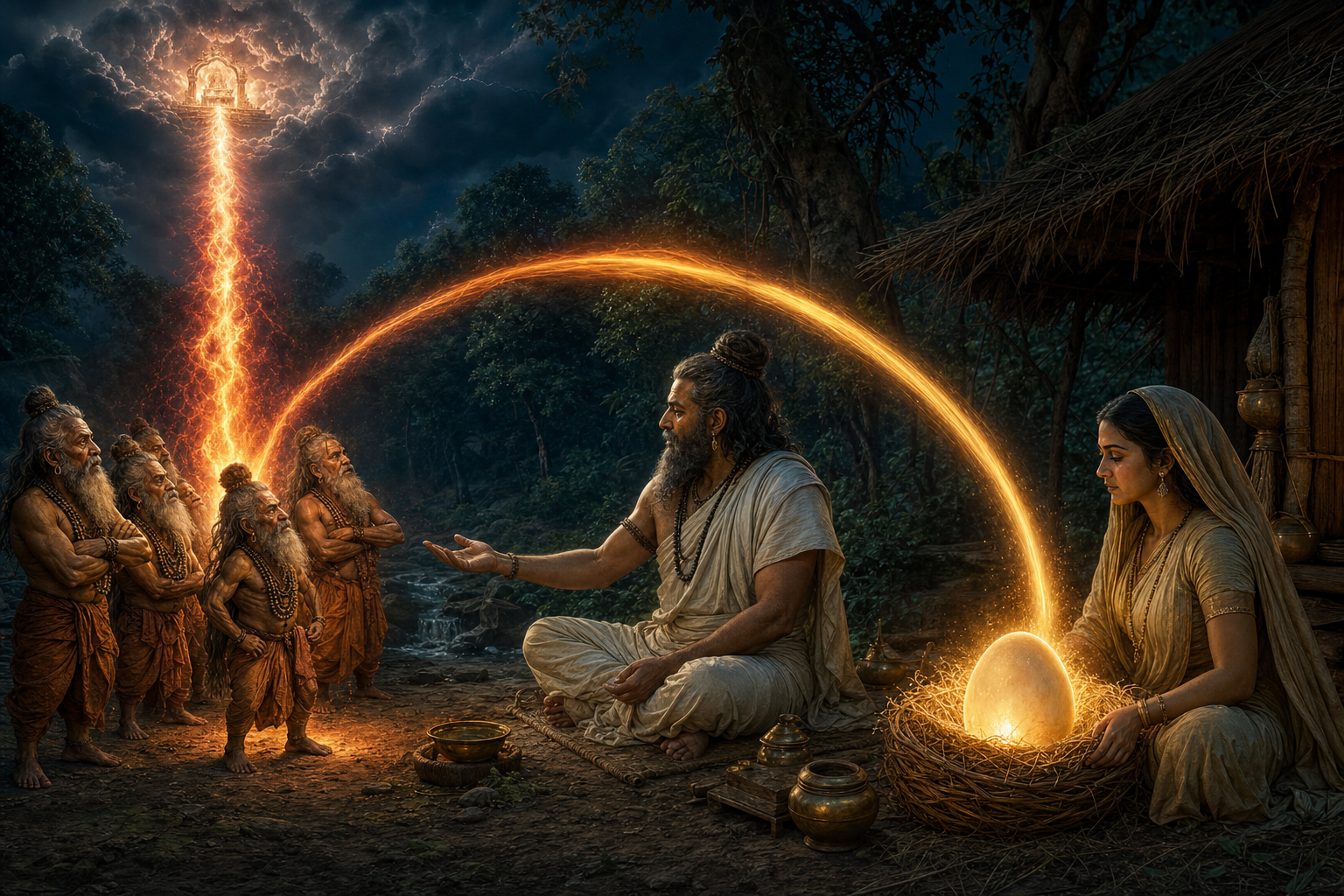
Indra becomes alarmed and turns to Kashyapa. Kashyapa does not tell the Balakhilyas that their tapas is insignificant, that their grievance is imaginary, or that harmony requires their surrender. He also does not allow the punishment of one arrogant ruler to endanger the larger order entrusted to the devas. His mediation proceeds through four exact moves.
- The wrong remains visible. Indra’s status does not erase his contempt, and the small stature of the Balakhilyas does not diminish it.
- The office is separated from the officeholder’s lapse. Indra must be corrected, but the function of deva sovereignty still has a legitimate place in cosmic order.
- The sankalpa is retuned. The sages agree that the fruit of their rite will not be another king competing in Indra’s own domain. It will be pakshi-indra, the sovereign of birds.
- The accumulated power is allowed to bear fruit. The Balakhilyas do not abandon their achievement. Their tapas receives an embodied result in Garuda.
This is redirection, not cancellation. The force is neither suppressed nor allowed to strike its first target without discrimination. Its destination changes while its moral seriousness and potency remain intact. Garuda can therefore rival Indra in stature without becoming a second claimant to the same throne.
The agreement also depends on voluntary movement from every side. Indra must become humble enough to seek counsel. The Balakhilyas must remain attached to the principle they are defending rather than to the pleasure of humiliating Indra. Kashyapa can propose a dharmic form, but mediation works because those holding the power consent to redirect it.
That last point prevents a convenient misreading. A superior cannot invoke harmony merely to neutralize people who have been wronged. If the grievance disappears from view, the injured side loses its agency, or the promised new role is purely ornamental, no meaningful redirection has occurred. The Balakhilyas retain both their spiritual achievement and their ability to determine its fruit.
The episode also distinguishes tapas from raw outrage. Tapas is disciplined potency accumulated through restraint, commitment, and sustained practice. Anger may reveal where a boundary has been violated, but anger alone does not acquire the authority of tapas. The sages can accept a changed outcome precisely because their resolve is governed by principle rather than appetite.
Garuda’s two origins explain both his purpose and his character

Garuda has what may initially look like two birth stories. The Balakhilyas’ redirected sacrifice explains why a being equal in splendour to Indra should arise as king of birds. Kashyapa and Vinata supply the familial line through which that purpose takes embodied form. These are not competing accounts. One describes the direction of the power; the other describes its gestation and birth.
Vinata lays two eggs and becomes impatient with their long maturation. She breaks the first too early, bringing forth Aruna before his development is complete. Aruna will become the charioteer of Surya, but he warns his mother to leave the second egg undisturbed. Garuda emerges only after the required period has passed.
The sequence adds an essential limit to the teaching about redirection: changing the aim does not make fruition instantaneous. Vinata’s impatience produces an incomplete birth, while patience allows the second egg to yield Garuda in his fullness. A worthy destination still requires the proper time and conditions. You cannot compensate for a premature process merely by claiming a righteous intention.
Garuda’s subsequent conduct shows what the redirected power was meant to become. Vinata has been enslaved after Kadru secures victory in the wager over the celestial horse Uccaihshravas through deceit. The nagas demand amrita as the price of Vinata’s freedom. Garuda’s quest is therefore not a raid undertaken to enlarge his own dominion. He seeks the nectar to discharge a filial duty and end an injustice against his mother.
His strength is immense, but it is repeatedly placed under ethical constraint. Kashyapa counsels him about how to act even while overcoming formidable obstacles. Garuda penetrates the protections around the amrita and withstands the devas, yet he does not confuse the ability to seize something with an unlimited right to possess or consume it.
The encounter with Indra makes that restraint unmistakable. When Indra hurls the vajra, Garuda accepts the weapon’s strike out of regard for the rishi Dadhichi, whose bones gave the vajra its power. He is not injured, but he does not use his invulnerability to mock either the weapon or the sacrifice behind it. Indra, in turn, recognizes that he is facing comparable power rather than a creature to be dismissed.
The resulting settlement completes the work begun at Kashyapa’s yajna. Vishnu grants Garuda immortality without requiring him to drink the amrita and establishes him as vahana and standard-bearer. Garuda places the nectar before the nagas to fulfil the condition for Vinata’s release, while Indra subsequently reclaims it. Indra also accords Garuda the right to prey upon serpents. The distribution of the final gains is as important as the victory itself:
- Vinata is released from an unjust bondage.
- The Balakhilyas’ tapas produces a sovereign being of extraordinary stature.
- Garuda receives immortality and an enduring place beside Vishnu without consuming the nectar.
- Indra retains the legitimate office of king among the devas, but can no longer dismiss Garuda as insignificant.
- The devas retain custody of the amrita rather than losing it through the settlement.
No participant receives every imaginable advantage, but every legitimate claim finds a place. The word indra consequently appears as a function of sovereign excellence rather than a personal monopoly. Garuda becomes pakshi-indra, not a failed imitation of the deva king. His greatness is made complementary to Indra’s domain rather than subordinate in worth or competitive in office.
Service to Vishnu does not diminish that sovereignty. It reveals its mature direction. Garuda is powerful enough to stand above the ordinary contest for amrita, yet disciplined enough to carry a purpose greater than self-preservation. His role as vahana is therefore not the domestication of a dangerous force. It is the alignment of that force with dharma.
Use the story to test a response to failed leadership
We should resist turning a sacred narrative into a shallow management slogan. Even so, the episode trains judgement. It is especially useful when you must respond to a leader who has humiliated someone, ignored a quiet but capable group, or used legitimate rank as permission for contempt.
Before choosing a response, write down answers to the following questions. The order matters because it keeps the original wrong visible while preventing the remedy from becoming a copy of it.
- What exact principle was violated? Name the neglected duty or unjust treatment, not merely the personalities involved. The Balakhilyas’ size is incidental; contempt for spiritual worth is the problem.
- What fruit is your present resolve trying to produce? Ask whether you want correction, protection, useful authority, replacement, humiliation, or revenge. A vague demand for justice can conceal a very specific desire to create a rival.
- What legitimate function must survive? Separate the value of an institution, office, family obligation, or community practice from the misconduct of the person currently associated with it.
- Can the concentrated ability receive a real domain of its own? Look for a defined responsibility in which neglected competence can serve a needed purpose. A title without authority, resources, boundaries, or accountability is pacification, not redirection.
- What constraints will prove that the new power serves dharma? Garuda’s purpose is demonstrated by what he refuses to do: he does not drink the amrita, retain it for personal supremacy, or turn comparable strength into a campaign to seize Indra’s office.
- Has the person bearing the cost consented? Kashyapa does not secretly divert the sages’ fruit. The Balakhilyas agree to the changed sankalpa. A settlement imposed upon the injured side may preserve appearances while leaving the original adharma untouched.
Suppose a capable contributor in a temple, cultural organization, or community project has been dismissed because their role appears minor. Telling that person to suppress the grievance for unity would repeat Indra’s error. Creating a rival centre devoted only to defeating the existing leadership may reproduce its pride. The Garuda pattern points toward a harder alternative: acknowledge the wrong, preserve whatever function remains legitimate, and establish a substantive field in which the neglected ability can carry responsibility under clear dharmic limits.
Two tests will tell you whether this is genuine. First, the new domain must solve a real need rather than hide a difficult person out of sight. Second, its success must not depend on the old leader’s humiliation. If either condition fails, resentment has probably been renamed rather than transformed.
The account also tells leaders what to notice before conflict reaches that stage. Do not estimate capacity from visibility, physical scale, institutional rank, or a quiet manner. Do not assume that people without executive office possess no consequential power. And when your own contempt has caused the rupture, seeking mediation is not a loss of authority. Indra preserves his legitimate place only after he stops treating recognition of another’s greatness as an existential defeat.
Key takeaways
- Garuda’s birth begins with Indra’s dismissal of the Balakhilya rishis because the story is about the right use of power before it is about physical birth.
- Kashyapa does not suppress the sages’ tapas. He redirects its intended fruit from a rival deva king to pakshi-indra, a sovereign in a complementary domain.
- Vinata’s two eggs add the discipline of time: even rightly directed power can be damaged by premature action.
- Garuda’s quest for amrita is governed by filial dharma, restraint, and a finite purpose rather than hunger for personal supremacy.
- A dharmic settlement preserves legitimate order, gives injured potency a substantive form, and requires consent from those being asked to redirect their resolve.
The next time justified anger gathers around a failure of leadership, do not begin by asking how to make the anger disappear. Identify the truth that gives it force, the rightful order worth preserving, and the worthy form in which that force can mature. Garuda’s birth begins at the moment destructive rivalry is given a more exact destination.
References
