
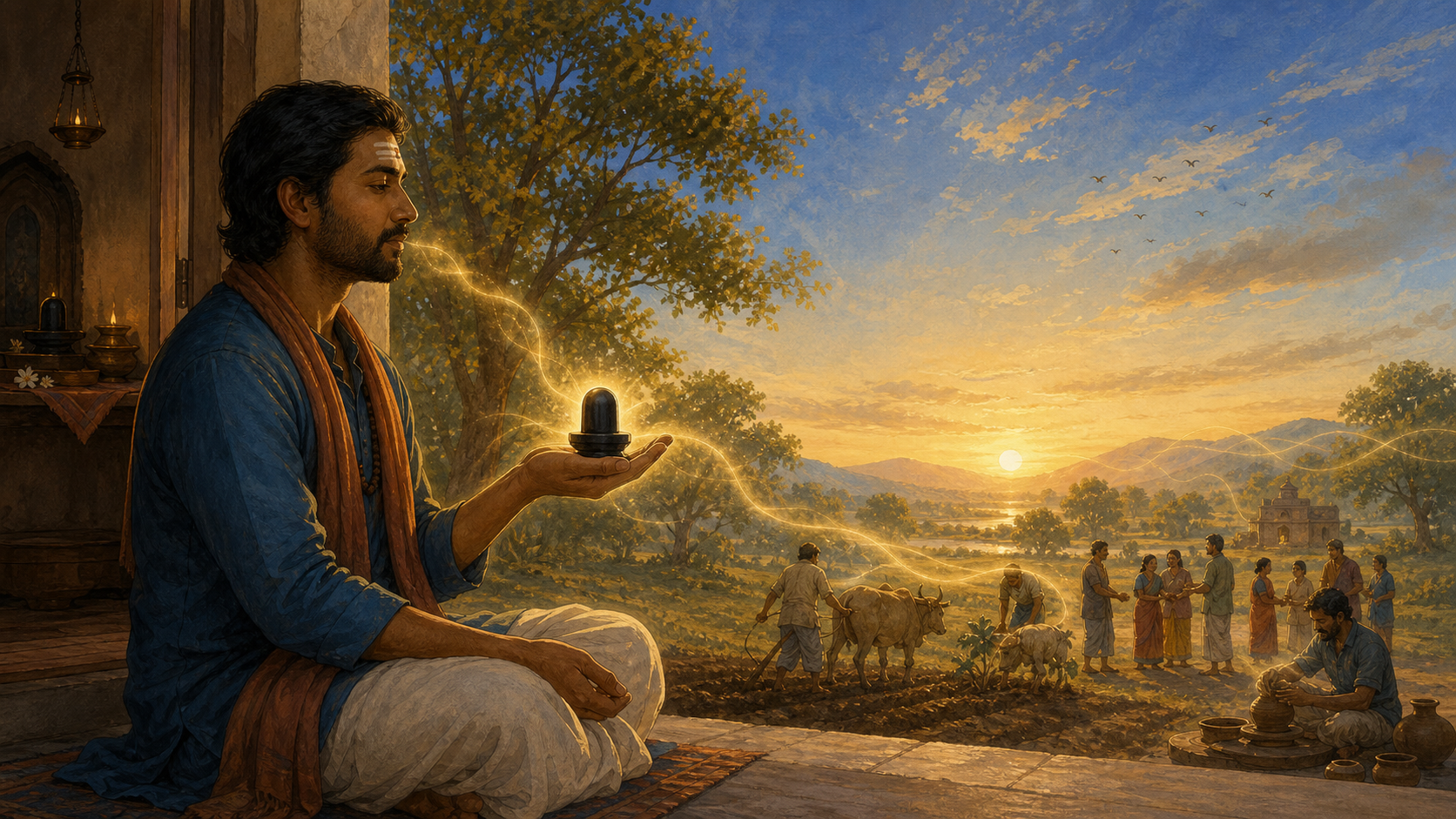
If you worship an Ishta-linga yet understand Shiva as infinite and present everywhere, an honest question soon arises: why focus on one small, visible sign of a reality that has no boundary?
Lingasthala resolves that tension. The linga is not a container that confines Shiva. It is the stable locus through which you learn to recognize Shiva in worship, breath, living teachers, community, work and finally consciousness itself. The movement is not away from the linga, but from seeing it as an external object to knowing what it reveals.
Lingasthala names a field of realization, not another object
Linga carries the sense of a mark or sign. Sthala means a ground, site or locus. Lingasthala can therefore be understood as the ground upon which the sign of Shiva performs its spiritual work. It includes a sacred place, but it cannot be reduced to a geographical location. It also names the interior field in which the devotee’s relationship with the linga matures into recognition.
This is best used as an interpretive lens for Virashaiva practice, not as the name of a seventh stage added to the six stages of Shatsthala. The familiar stages are Bhakta, Maheshwara, Prasadi, Pranalingi, Sharana and Aikya. The linga remains the axis throughout that sixfold maturation.
The distinction matters because two opposite misunderstandings are common. One confines Shiva to a consecrated object. The other decides that a formless Absolute makes the object unnecessary. Virashaiva practice accepts neither conclusion. The linga gives the senses somewhere to rest without claiming that the Infinite ends at the boundary of the form.
This is how saguna and nirguna belong together. Shiva may be approached through a perceptible sign, mantra and ritual while remaining beyond every attribute and concept. The form does not compete with formlessness. Properly approached, it educates attention until form becomes transparent to the reality it signifies.
Key takeaways
- Lingasthala is the field in which the linga becomes a means of realization; it is not merely a temple location or an additional Shatsthala stage.
- The Ishta-linga, Jangama and Sthavara-linga direct attention toward personal, living and communal dimensions of Shiva’s presence.
- Shatsthala describes a maturing relationship, from devotion and service through grace, inward realization, surrender and Aikya.
- Non-dual language is tested in conduct. Kayaka turns work into worship, while dasoha turns what you receive and produce toward selfless offering.
- The goal is not to discard the linga after gaining an idea of formlessness. It is to recognize the boundless through the sign and then carry that recognition into life.
The three modes of linga tell you where to look

Virashaiva practice commonly distinguishes three modalities of the linga: Ishta, Jangama and Sthavara. They should not be treated as rival objects or ranked as though one cancels the others. Together they prevent spiritual life from becoming merely private, merely institutional or merely conceptual.
| Mode | Where it meets you | What it trains | A useful diagnostic question |
|---|---|---|---|
| Ishta-linga | The personal, portable linga worn on the body and approached in daily worship | Intimacy, recollection and sustained attention to Shiva | Am I meeting the linga as a sacred presence, or merely carrying it as a possession? |
| Jangama | Living wisdom embodied in spiritual teachers and the realized community | Receptivity, service and recognition that Shiva cannot be confined to private experience | Does my practice make me more capable of listening, serving and recognizing dignity in another person? |
| Sthavara-linga | The immovable linga established in a temple | Participation in a shared sacred cosmos and continuity with communal worship | Can I honor the sanctum fully without imagining that Shiva exists only inside it? |
The Ishta-linga brings the relationship close enough to accompany ordinary life. The Sthavara-linga situates that intimacy within temple, tradition and community. Jangama prevents both from becoming a relationship between an isolated individual and a silent object. It confronts you with living presence, instruction and responsibility.
Notice the practical balance. If you honor only the Sthavara-linga, worship can remain tied to visits and locations. If you speak only of an inward linga, devotion can become whatever your mind prefers. If you reduce Jangama to admiration of personalities, you miss its demand to recognize living wisdom. The three modalities keep personal practice, living fellowship and sacred space in conversation.
Shatsthala changes the devotee’s relationship with the linga
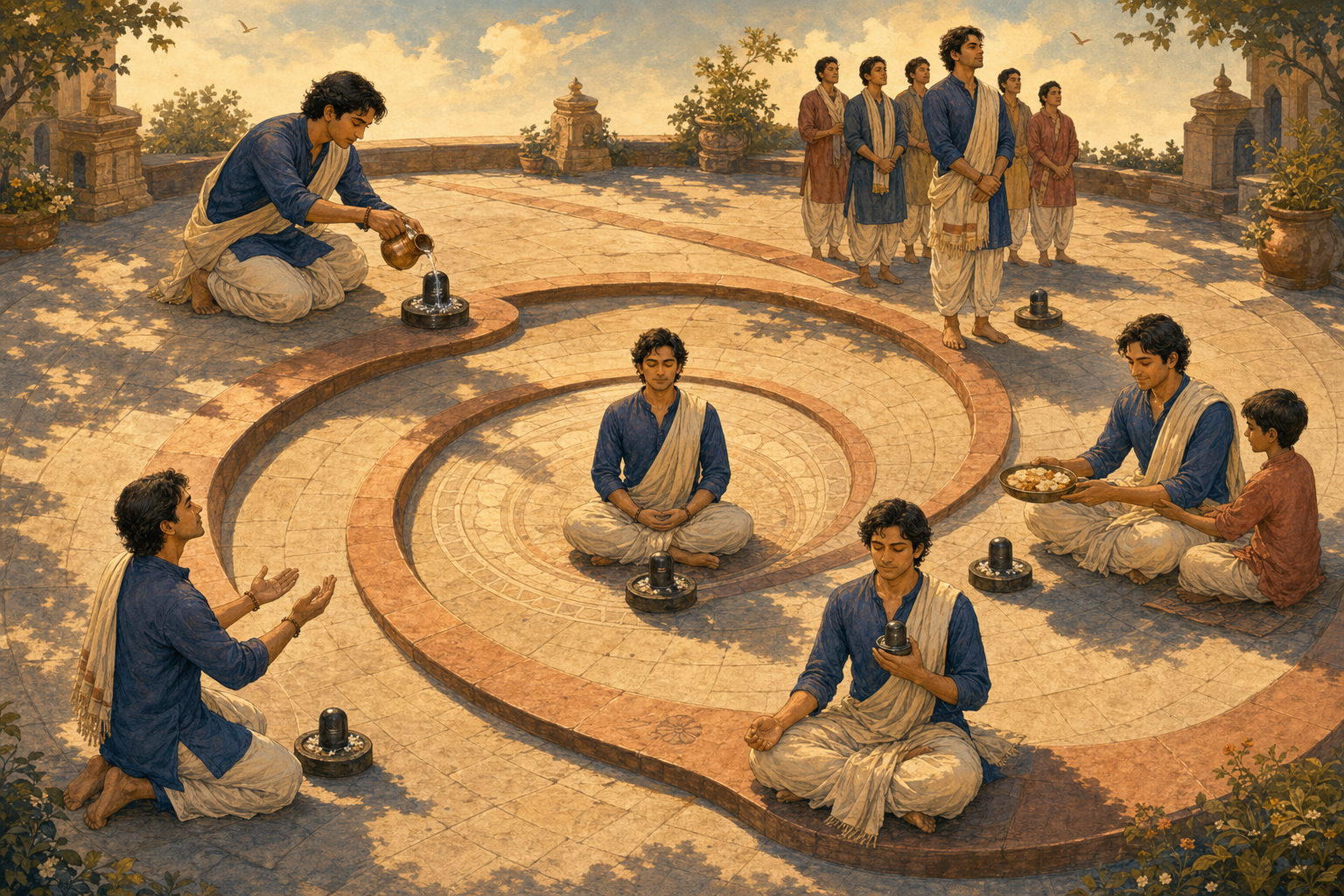
Shatsthala is often translated as a path of six stages, but you will understand it better if you watch what changes from one stage to the next. The decisive movement is relational. Shiva first appears as the One you worship. Grace is then received and assimilated. The linga is recognized within life and breath. Surrender deepens. In Aikya, the separation between the individual and Supreme no longer has the final word.
- Bhakta: The path begins with devotion. The linga is approached with reverence, remembrance and service. The immediate task is not to manufacture an exalted experience; it is to establish a sincere relationship that can survive distraction.
- Maheshwara: Devotion acquires steadiness and ethical consequence. Shiva is no longer reserved for a ritual interval. Your conduct must begin to answer to the One you worship.
- Prasadi: Grace is received rather than claimed as a personal achievement. The seeker’s posture shifts from spiritual acquisition toward gratitude and assimilation. What is given must alter how life is lived.
- Pranalingi: Linga-awareness becomes inward and vital. Breath and life-force are approached as gateways to the presence that had first been addressed through an external focus. This does not make the Ishta-linga obsolete; it reveals the depth toward which its worship was pointing.
- Sharana: Surrender matures. The effort to preserve an entirely independent spiritual identity weakens as the devotee takes refuge in Shiva.
- Aikya: The movement culminates in unity. Shiva is no longer known only as an object standing before the worshipper, but as the boundless reality in which worshipper, worship and linga have their being.
Do not turn this sequence into a badge system. Claiming a stage is much easier than embodying it. A better question is: where does separation still govern my conduct? You may speak confidently about Aikya while treating work, other people or the natural world as spiritually irrelevant. That gap shows where the teaching has not yet become anubhava, direct realization.
This is also the sense in which the linga can function as a means of knowing. It does not supply information in the way a verbal proposition does. Repeated attention, mantra, breath and reverence refine the instrument of perception. What was initially believed about Shiva is gradually examined in experience: the visible sign is known within awareness, and awareness itself is recognized as inseparable from the reality to which the sign points.
A daily way to practise the movement from sign to presence
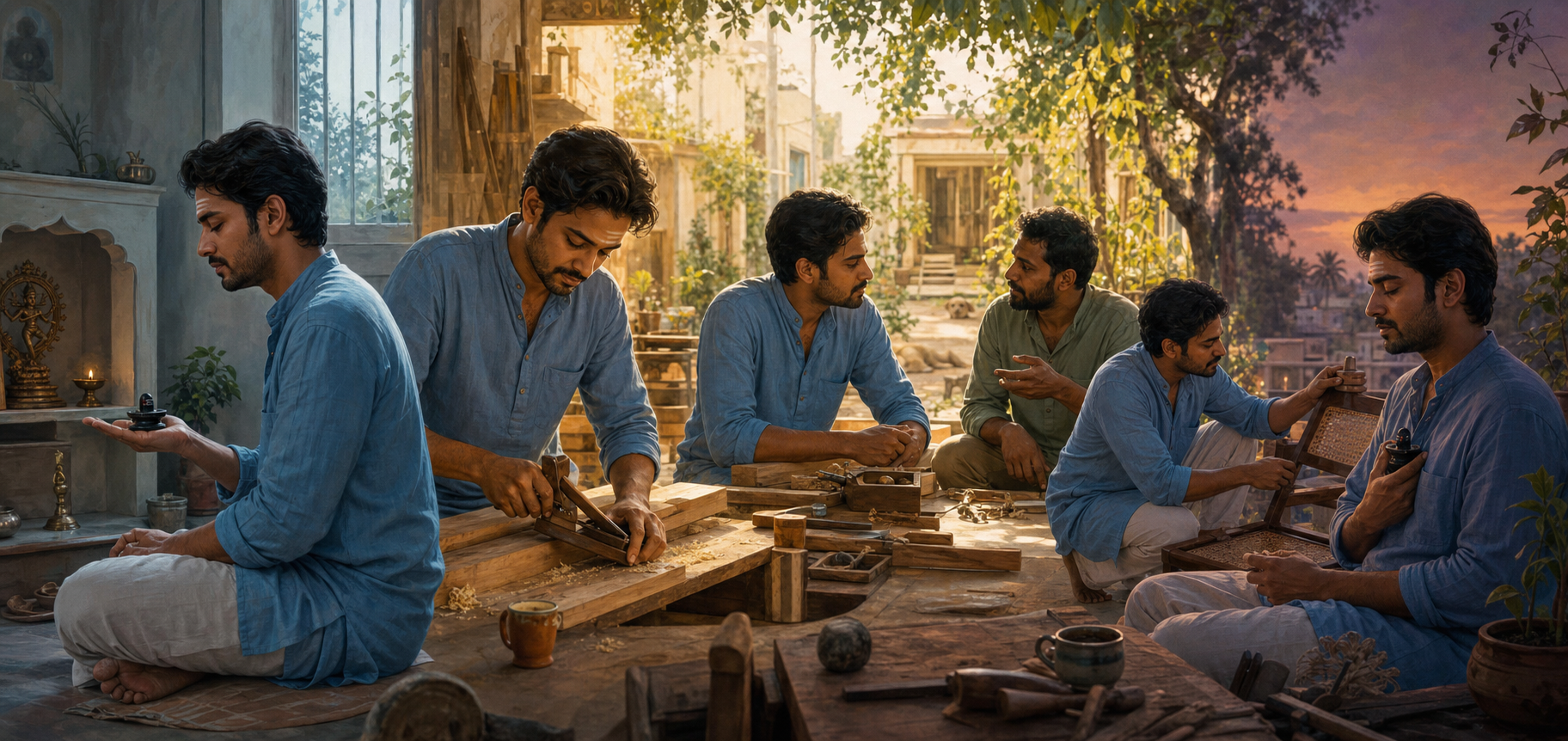
If you have received a particular ritual discipline from a guru or community, follow that discipline rather than replacing it with a generic meditation routine. The sequence below is a contemplative framework for understanding what your worship is doing. It can help you notice the inward movement already implicit in Lingachara.
- Begin with the actual linga. Bring the Ishta-linga into the position used in your established worship. Notice its form, weight and presence. Do not hurry past the concrete sign in search of an abstract idea.
- Let vision become attention. Rest your gaze gently on the linga if this accords with your practice. The purpose of such focus is collected awareness, not strain. When the mind wanders, return without turning distraction into a moral failure.
- Join attention to mantra. Repeat Namah Shivaya, or Om Namah Shivaya as received in your practice. Let the mantra become an act of bowing rather than background sound. Hear each repetition instead of counting mechanically.
- Notice breath without forcing it. As the breath settles, recognize that the same life which chants and worships is itself held within Shiva. Pranalingi is not a contest in breath control. The point is to discover that linga-awareness need not disappear when the visible rite becomes quiet.
- Open from the object to the field. Notice the linga, mantra, breath and the awareness in which they appear. Do not declare them identical as a philosophical shortcut. Simply observe whether the boundary between sacred object and attentive presence feels as absolute as it did at the beginning.
- Carry the worship into one real obligation. Name the work that awaits you and the offering your work can support. This is where kayaka and dasoha prevent contemplation from becoming a private mood. The next task becomes a test of remembrance.
Virashaiva discipline does not consist of concentration alone. The Panchacharas provide constitutive codes of conduct, while the Ashtavaranas surround the seeker with protective observances. Sacred ash, Rudraksha, mantra and continuing remembrance have value because they repeatedly redirect attention and conduct toward Shiva. Outer observance without inward attention can become mechanical; inward claims without disciplined observance can become self-authorizing. Lingasthala holds the two together.
Do not measure a sitting by unusual sensations, a quiet breath or a temporary feeling of expansion. Those experiences may come and go. Look instead for continuity. Does remembrance return during work? Does irritation loosen before it becomes harmful speech? Does receiving grace make you more willing to offer? These are more demanding tests than a pleasant ritual state because they reveal whether worship has crossed into life.
Keep non-duality honest through work, service and distinction

Virashaiva non-duality is not permission to dismiss differences before they have been ethically faced. The sharana movement that crystallized in twelfth-century Karnataka joined spiritual realization to dialogue, dignified labor and offering. Basavanna’s emphasis on kayaka, work as worship, and dasoha, selfless offering, places a hard test before every metaphysical claim: what does your realization do to the way you work and share?
At the Anubhava Mantapa, women and men from varied social backgrounds participated in an open culture of spiritual dialogue. That setting was not incidental to the philosophy. It showed that encounter, labor and community belong inside the field of realization. If your understanding of Lingasthala makes daily responsibility seem beneath spiritual life, it has separated the teaching from the social discipline through which the sharanas embodied it.
- Do not confuse aniconic form with absence of meaning. The linga’s restraint is precisely what lets it direct the mind beyond a single anthropomorphic image while remaining perceptible and worshipful.
- Do not reduce linga and yoni to a merely physical reading. Their conjunction signifies Shiva and Shakti, consciousness and creative power, as an inseparable reality expressed through manifestation.
- Do not use Aikya to make ethics secondary. If the language of oneness makes you less accountable to other people, work or service, it is functioning as an escape rather than realization.
- Do not flatten every non-dual tradition into one doctrine. Similar vocabulary can conceal important differences in theology, practice and the status given to consciousness, grace and emptiness.
Virashaiva thought can converse with Advaita Vedanta, Kashmir Shaivism, Shaiva Siddhanta and Buddhist reflection without becoming interchangeable with any of them. Advaita affirms the non-difference of Self and Brahman. Kashmir Shaivism emphasizes recognition of innate Shiva-nature. Shaiva Siddhanta gives disciplined ritual and grace a decisive place. Virashaiva practice reaches non-dual realization through its linga-centered relationship, Shiva-Shakti vision, sharana inheritance and integration of worship with work and offering.
The same care is needed with shunya. In Virashaiva expression, especially around the world of the Shunya Sampadane, it does not mean a barren nothing. It indicates a fullness from which forms arise and into which they return, understood through the Shaiva reality of auspicious consciousness. That permits a respectful conversation with Buddhist shunyata, but not a casual claim that the two terms carry exactly the same metaphysical commitment.
At your next worship, watch one transition closely. Begin with the linga as the sacred sign before you. Notice whether mantra and breath disclose a wider field of presence. Then take that remembrance into the first piece of work or service that follows. Keep the form, deepen the recognition and let conduct show whether the distance between linga and life is actually becoming smaller.
References
