
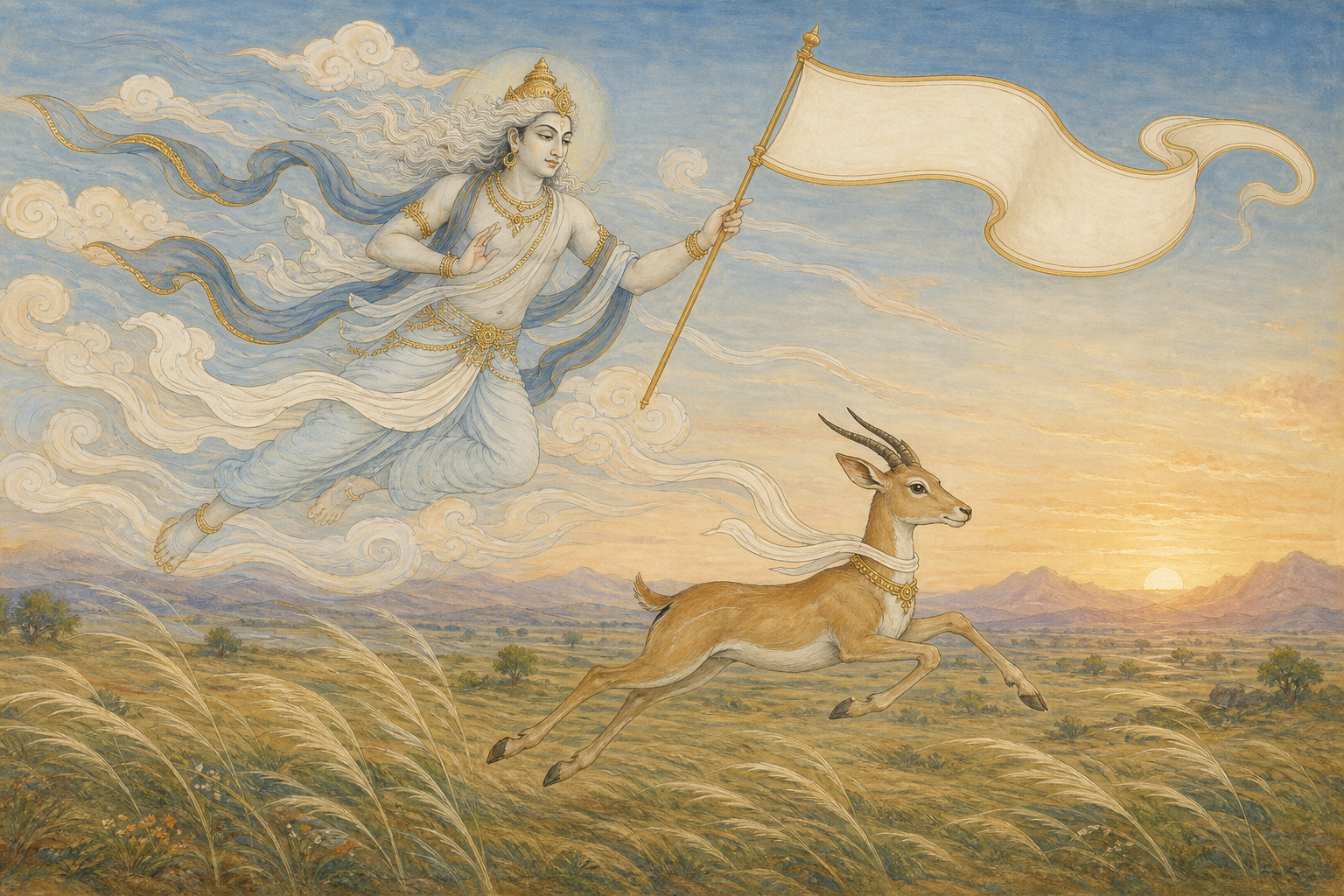
You may have noticed a slender, deerlike animal beneath Vayu in a temple image or devotional illustration and wondered what it is doing there. Calling it a symbol of speed is not wrong, but it leaves out the part that matters for your yoga: this is speed governed by alertness, economy, and direction.
Read carefully, Vayu’s gazelle becomes a practical diagram of prana. It shows you how vital movement can remain light without becoming restless, responsive without becoming reactive, and swift without becoming hurried.
Read the vahana before trying to name the species
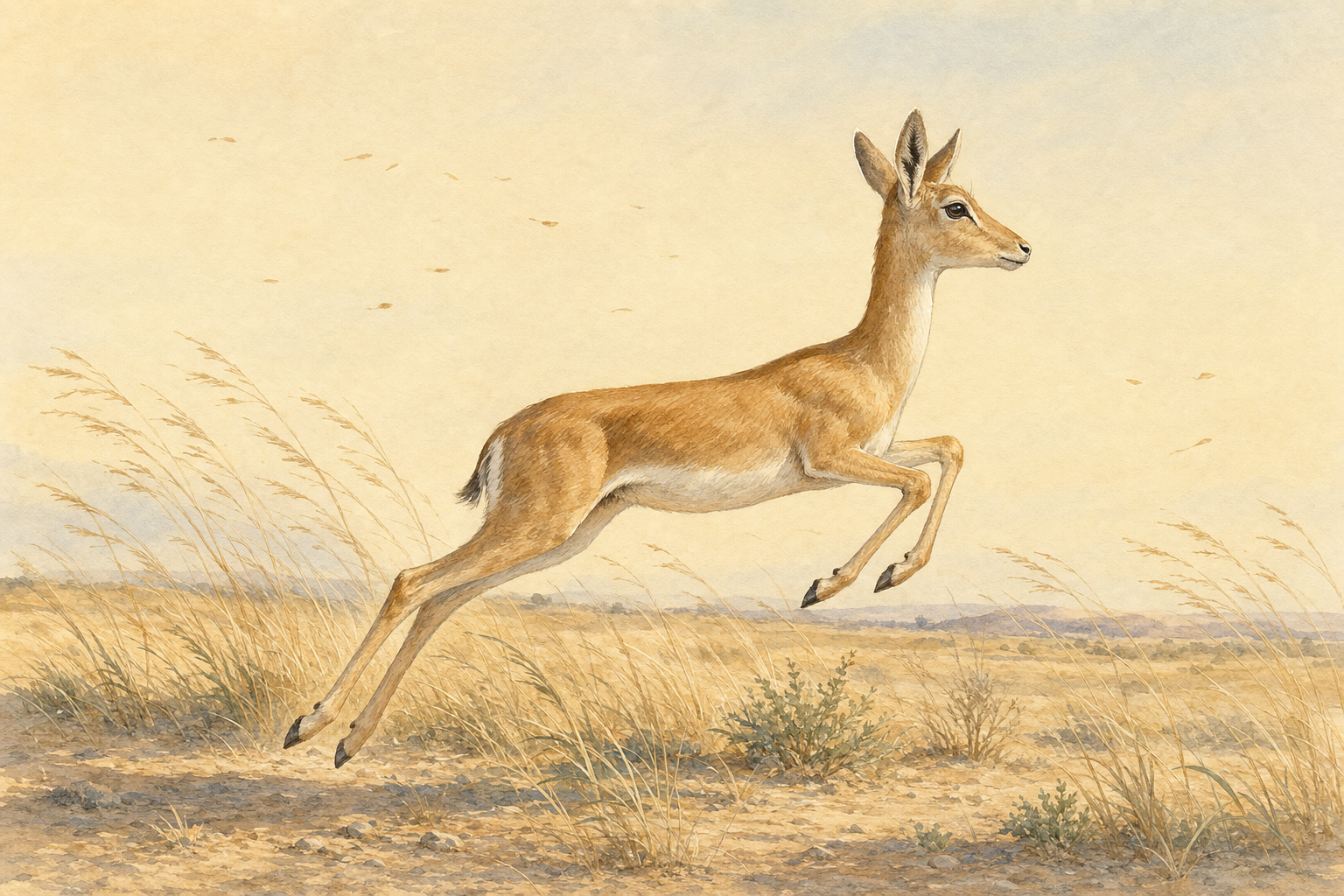
A vahana is often translated as a deity’s vehicle, but it does more than carry a divine figure. It makes an otherwise subtle quality visible. Agni’s ram evokes vigor and heat; Varuna’s makara belongs to depth and liminality. Vayu’s gazelle or antelope gives visible form to wind that arrives quickly, changes direction effortlessly, and touches the world without fastening itself to anything.
The first interpretive rule is therefore simple: do not treat the animal as decorative transport. Look at the relationship between deity and vehicle. The animal’s light frame, readiness, sensitive attention, and capacity for sudden movement tell you how Vayu acts. The point is not raw force. It is unobstructed force that wastes little motion.
The second rule is to leave room for iconographic variation. Vayu is not confined to one universally fixed mount. He may appear with an antelope or gazelle, or in a chariot associated with swift steeds or antelopes. Vedic praise stresses his precedence and rapid arrival, including his being called early to the soma offering, without requiring every later artist or regional tradition to use one identical composition.
This matters when you identify an unfamiliar image. A deerlike animal alone does not prove that the figure is Vayu. Check the whole ensemble, any caption, the ritual setting, and the attributes of the deity. Describe the creature as a mriga, gazelle, or antelope when the carving does not support zoological precision. Iconography communicates through recognizable qualities; it is not a wildlife field plate.
- Notice alertness before speed: the mriga is ready because it is attentive.
- Notice economy before spectacle: its movement is effective without appearing heavy.
- Notice direction before distance: a sudden turn can matter more than a long run.
- Notice context before identification: the same animal family can carry different meanings elsewhere in Dharmic art.
The word mriga also carries associations of seeking and tracking. That introduces a second layer. Your mind is constantly seeking something: an object, an answer, a sensation, a threat, or an imagined completion. Mriga-trishna, the mirage pursued as though it were water, shows what happens when seeking loses discernment. Vayu mounted upon the mriga reverses that disorder. Breath does not chase the mind; disciplined prana gives the seeker direction.
The five vayus turn the image into a map of practice

Vayu is cosmic wind, while prana is the vital movement through which that principle becomes intimate to embodied life. Breath is the most immediate way you encounter it, but prana in yogic thought is not merely the volume of air in your lungs. It is the organizing vitality expressed through receiving, releasing, assimilating, rising, and circulating.
Yogic physiology distinguishes five principal movements of vital wind. The gazelle provides a memorable way to contemplate them without mistaking the metaphor for literal anatomy.
| Vayu | Traditional movement | Gazelle image to contemplate |
|---|---|---|
| Prana | Inward and nourishing | The receptive intake and alert poise before movement |
| Apana | Downward and eliminating | Firm contact with the ground that makes a clean leap possible |
| Samana | Inward and assimilative | Efficient conversion of gathered energy into coordinated action |
| Udana | Upward and expressive | The lift that carries the body from earth toward open space |
| Vyana | Pervasive and integrative | Whole-body coordination through every turn, landing, and stride |
The table is useful only if it changes what you notice. During practice, ask where movement is failing. Are you trying to rise without first establishing the ground? Are you taking in more instruction, food, sensation, or emotion than you can assimilate? Is your outward expression disconnected from the rest of your body? The five-vayu framework helps you ask a precise question instead of vaguely concluding that your energy is low or blocked.
The auxiliary winds, traditionally named naga, kurma, krikara, devadatta, and dhananjaya, draw attention to smaller bodily events such as blinking, yawning, sneezing, belching, and lingering vital processes. You do not need to suppress these reflexes or build dramatic claims around them. Notice how quickly the body adjusts before conscious thought intervenes. A blink, nostril movement, or shift of posture can reveal agitation earlier than an elaborate mental explanation can.
This is one of the gazelle’s most useful lessons: mastery often appears in a small adjustment made at the right moment. In asana, that may mean changing the distribution of weight before forcing a deeper shape. In meditation, it may mean softening the jaw as soon as strain appears. In conversation, it may mean allowing one natural breath before answering defensively.
Turn the symbol into a safe breath contemplation
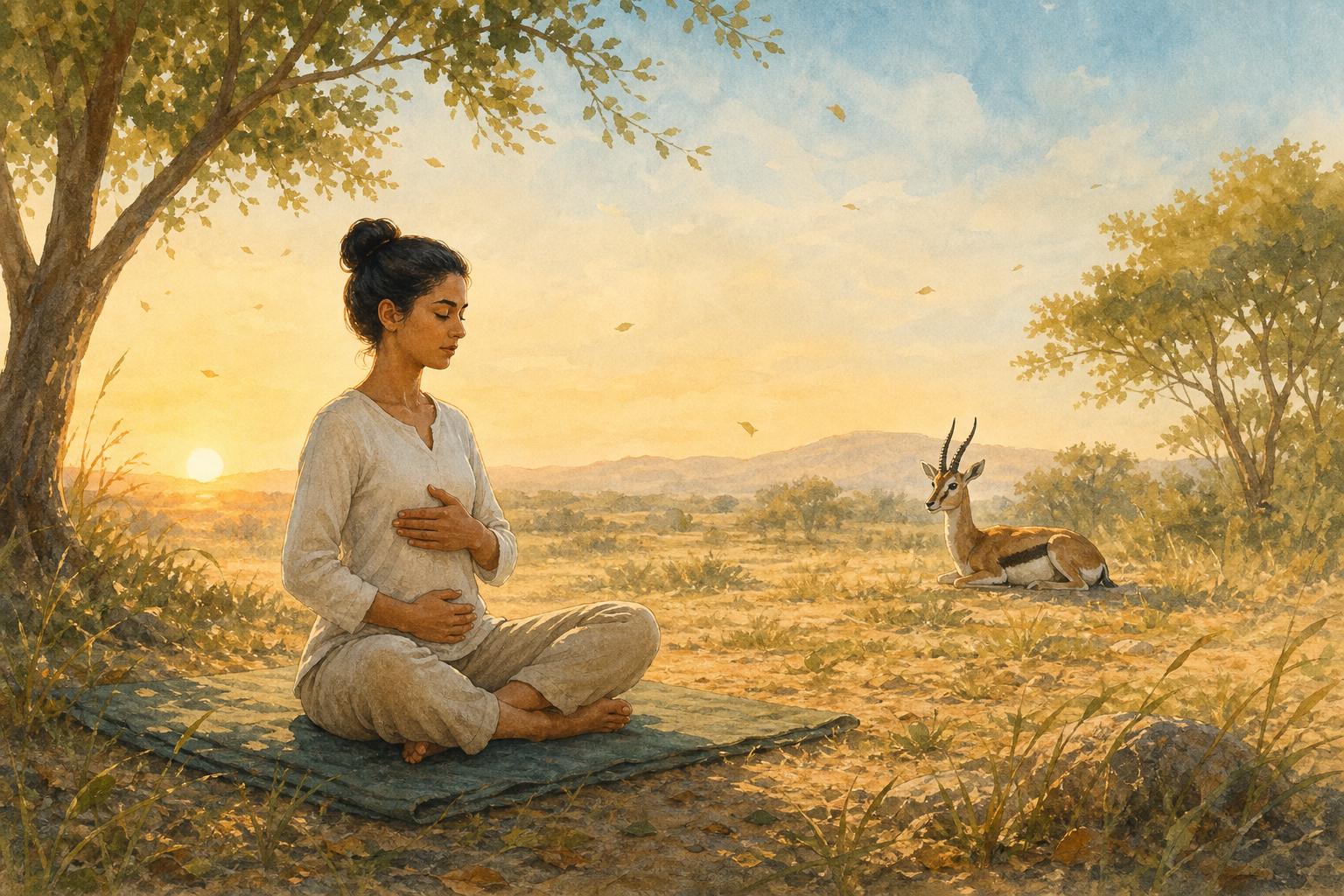
You do not need an advanced pranayama sequence to work with Vayu’s gazelle. Begin with natural breathing and use the image to refine attention. The aim is not to manufacture an unusual state. It is to recognize unnecessary effort and recover directed movement.
- Sit on a stable, non-harming surface. A cotton or kusha-grass mat preserves the traditional concern for an appropriate seat without requiring animal skin.
- Let your breathing proceed naturally. Notice the inhalation arriving, the exhalation descending and releasing, and the quiet change of direction between them.
- Feel your points of contact with the ground. Treat that support as the apana quality that allows lightness rather than as heaviness to escape.
- Observe whether the torso, face, and limbs participate as one field. This is a practical way to contemplate vyana as integration.
- Bring one pending action to mind. Decide whether it calls for receptive attention, grounding, assimilation, clear expression, or whole-body coordination.
- Rise and perform that action with the smallest sufficient effort. Let the practice end in conduct rather than in a private sensation.
Do not force the pauses between breaths. Kumbhaka, deliberate breath retention, is a distinct skill rather than a test of devotion or willpower. If shaping the breath produces strain, dizziness, or air hunger, release the technique and return to ordinary breathing. More intensity does not make the gazelle a better symbol; poise is the symbol.
You can apply the same logic to asana transitions. Before moving, establish the ground. During movement, remove effort that does not serve the direction. On arrival, let the whole body organize rather than collapsing into the most flexible joint. Before the next transition, become still enough to know where you are going. That sequence converts speed into timing.
The daily-life application is equally concrete. When you feel an urge to reply immediately, distinguish swiftness from haste. A swift response comes from clear perception and sufficient preparation. Haste is movement used to escape the discomfort of waiting. Vayu’s mriga teaches the first, not the second.
Keep related deer and wind symbols distinct
Dharmic traditions reuse natural forms without giving every occurrence an identical meaning. Recognizing a family resemblance is fruitful; collapsing all the symbols into one is not.
Mrigashira Nakshatra, the Deer or Gazelle Head, shares the mriga’s curiosity, refinement, and seeking quality. Its classical deity, however, is Soma rather than Vayu. Use the overlap to compare modes of seeking: Mrigashira can focus your attention on gentle inquiry, while Vayu’s gazelle emphasizes the disciplined vitality that carries inquiry into action. Do not cite the nakshatra as proof that the gazelle belongs exclusively to Vayu.
The deer flanking the Dharmachakra at Sarnath belong to another setting. They evoke the Deer Park, receptive listening, and the first turning of the Wheel of Dharma. Buddhist mindfulness of breathing and contemplation of the wind element create a meaningful resonance with Vayu and prana, but resonance is not identity. When you encounter those deer, read them through the Buddha’s teaching setting rather than importing a Hindu vahana into the scene.
Jain reflection on air-bodied beings presses the wind image toward ethics. Air that appears empty or inert is treated as a domain of life deserving care. The practical meeting point with Vayu’s gazelle is ahimsa expressed through restrained movement, speech, consumption, and use of living environments. The traditions reach that concern through different theological frameworks, and preserving those distinctions makes the shared ethical intuition more meaningful.
The meditation seat offers a direct ethical choice. Deer skin has historical associations with ascetic steadiness and insulation, but you do not need to reproduce the material in order to preserve the teaching. Cotton, woven plant fiber, or kusha grass can provide a stable seat while keeping ahimsa in view. The symbol should refine conduct toward living beings, not become an excuse to possess their remains.
Temple experience can deepen the same understanding. At a Vayu-linked sacred setting such as Sri Kalahasti, incense, flame, sound, and your own breathing make invisible movement perceptible. Rather than searching only for a particular animal sculpture, watch how air carries fragrance, bends flame, and supports chant. The gazelle is one visual doorway into a theology already active throughout the ritual environment.
Key takeaways
- Vayu’s gazelle represents alert, economical, and unobstructed movement, not speed for its own sake.
- Vayu has more than one iconographic form, so identify him from the full context rather than from a deerlike animal alone.
- The five vayus help you distinguish receiving, grounding, assimilating, rising, and integrating instead of treating prana as a vague quantity of energy.
- Natural, unforced breathing is enough for contemplation; breath retention should never become a contest with the body.
- Mrigashira’s deer, Sarnath’s deer, and Vayu’s mriga are related through imagery but retain different ritual and theological meanings.
- Ahimsa belongs in the interpretation: use non-animal meditation surfaces and let sensitivity to subtle life shape your movement.
The next time you see Vayu with the mriga, do not stop at the label beneath the image. Ask what is grounded, what is alert, what is moving, and what remains free of unnecessary weight. Then choose one transition in your day – entering an asana, beginning worship, or answering a difficult remark – and let one unforced breath establish your direction before you move. That is how iconography becomes abhyasa rather than information.
References
