
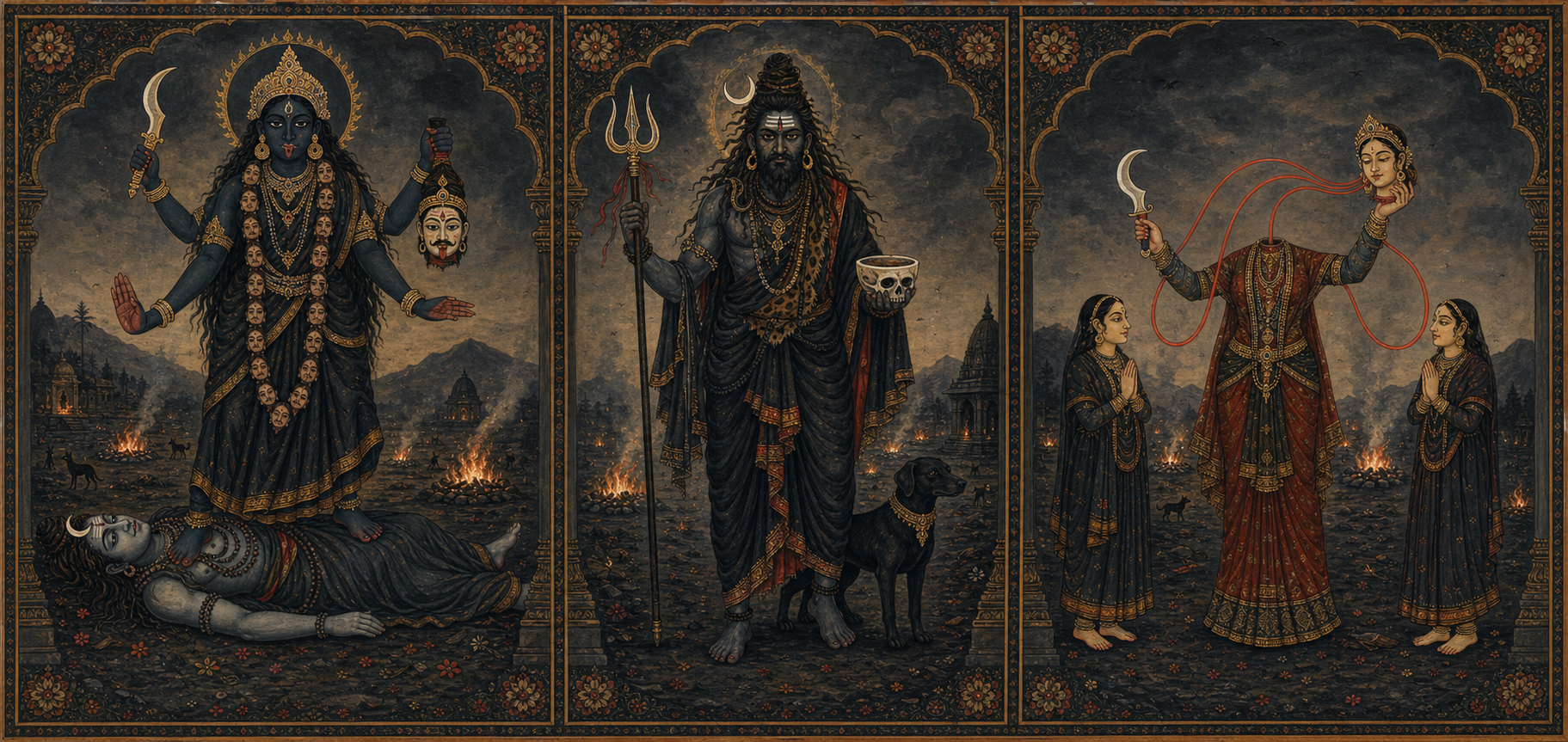
If skulls in Tantric art make you wonder whether you are looking at death worship, black magic, or glorified violence, begin with a simpler question: where is the skull, and what is being done with it? A bowl, a garland, a severed head, and a ritual seat do not communicate the same teaching.
You do not need to romanticize the frightening image or explain it away. You need to read its visual grammar. Once you can distinguish mortality, surrendered speech, humbled pride, and severed identification, the skull becomes less sensational and more demanding: it asks what you are still pretending will not change.
The skull’s position tells you what it is doing
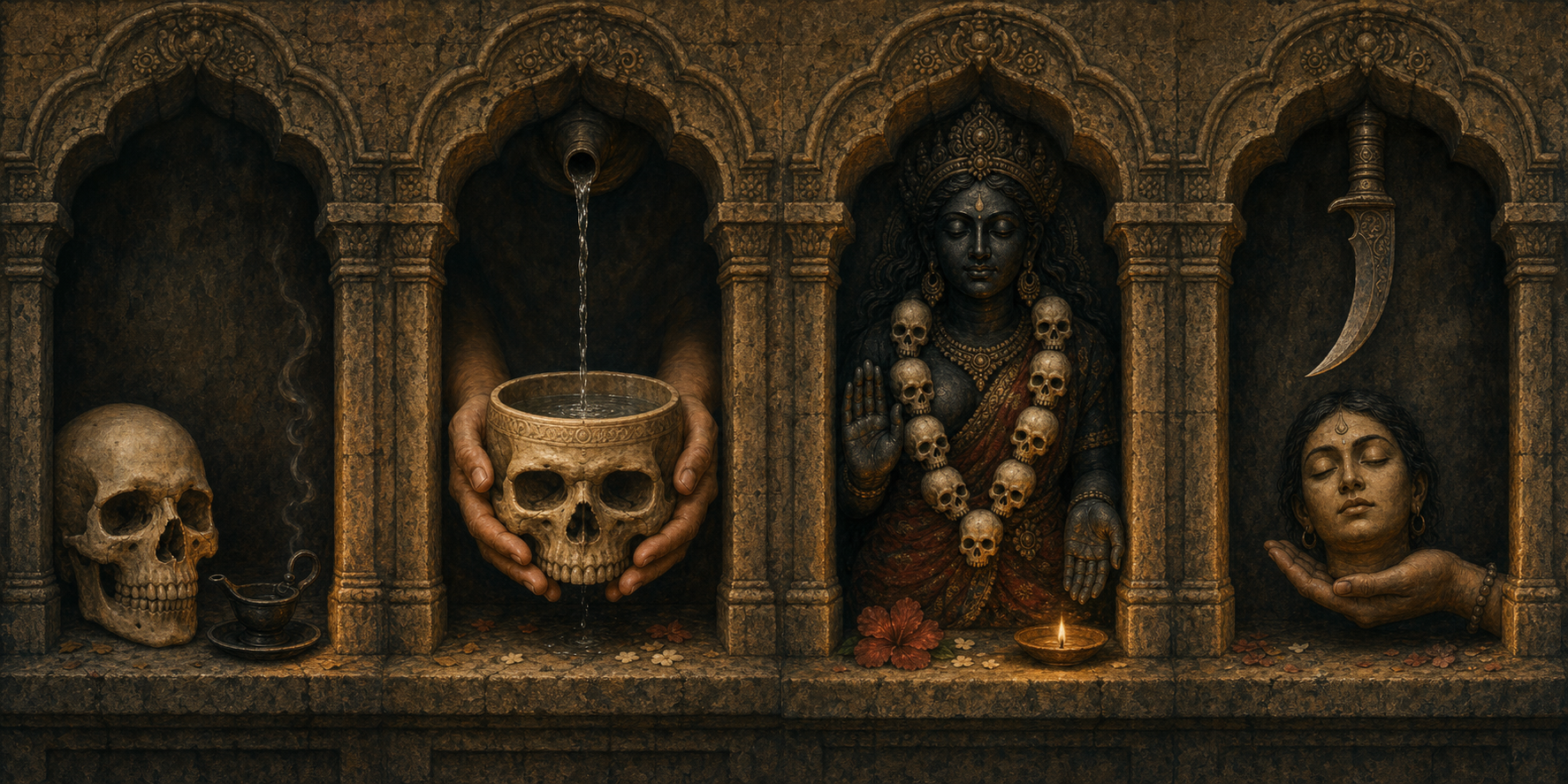
There is no single Tantric meaning called “the skull.” Its function changes with its form and placement. Four forms provide a reliable starting point.
| Form | What you see | First question to ask |
|---|---|---|
| Kapala | A skull used as a bowl or vessel | What is being received, offered, or transformed? |
| Mundamala | A garland or necklace of skulls or heads | Which identities, words, or mental constructions have lost their authority? |
| Severed head | A head cut from the body, sometimes by the deity herself | What claim of egoic ownership is being interrupted? |
| Panchamundi Asana | A seat associated with five skulls | Which fivefold structure is being placed beneath awareness rather than allowed to govern it? |
The kapala is a vessel. That matters because a vessel does not merely announce death; it receives something. In Shaiva imagery it can represent the acceptance of experience without vanity or preference. In Vajrayana settings it may hold amrita, turning the remnant of mortality into a vessel of awakened wisdom. When you see a kapala, do not stop at “death.” Look at its contents, its bearer, and the gesture in which it is held.
The mundamala makes plurality important. One skull recalls that a person dies. A garland shows identity after identity reduced to the same condition. Around Kali’s neck, the heads are also traditionally connected with the Sanskrit varnamala, the sequence of letters from which words and inner commentary are formed. Kali is often portrayed with 50 or 51 heads linked to this alphabetic symbolism. The count can vary with the convention being followed, so do not force a letter-by-letter calculation onto every stylized image. The dependable insight is that speech itself is offered to the Goddess and brought to silence.
A severed head shifts the emphasis from mortality to identification. The head represents the place from which we ordinarily say, “I think, I decide, I control.” Its removal dramatizes the collapse of that claim. It is an inward severance of ahamkara, not permission to injure a body.
The Panchamundi Asana presents five skulls as a foundation. The five have received several readings: the pancha-kosha, or five sheaths; the pancha-mahabhuta, or five great elements; and five afflictive forces. These are alternative interpretive frames, not pieces that must be combined into one secret code. In each frame, the practitioner sits above changing constituents rather than mistaking them for sovereign selfhood.
Kali, Bhairava, and Chinnamasta stage different inner acts
The same broad theme – liberation from clinging – takes a different dramatic form in each deity. Reading those differences prevents the vague conclusion that every fierce image merely means “destroy the ego.”
Kali wears what no longer rules consciousness
Kali does not hide the evidence of impermanence. She wears it. Her mundamala therefore signifies more than victory over external enemies. The heads can be read as the identities, names, and sentences through which the ego repeatedly constructs its world.
This makes the connection with the Sanskrit alphabet practical. Your inner monologue depends on words: “They should respect me,” “I cannot lose this,” “This role proves who I am.” The garland places the building blocks of such commentary around the Goddess’s neck. Speech has not been declared evil; its claim to define Reality has been curtailed.
Kali’s position upon Shiva completes the image. Dynamic Shakti moves, acts, creates, and dissolves; Shiva indicates the changeless awareness in which that movement appears. The scene need not be reduced to a modern contest over which figure defeats the other. Its force lies in the relation between power and stillness. When mental commentary is surrendered, awareness does not have to be manufactured. It becomes noticeable.
When you stand before Kali, notice the first sentence your mind produces about her. Fearful, dismissive, fascinated, or devotional, it is still a sentence. Let it pass before producing another. That small gap gives you a direct taste of what the garland asks from speech.
Bhairava carries the consequence of pride
Bhairava’s kapala is connected with the narrative in which Shiva severs Brahma’s fifth head and undertakes the Kapala-vrata, wandering with the skull. Symbolically, the fifth head represents inflated authorship: the self enthroned as its own creator, judge, and final authority. The skull becomes the carried consequence of that pride.
This is why Bhairava’s fearlessness should not be confused with swagger. Swagger needs an audience and an inferior. Bhairava’s instruction cuts mada, pride, and damba, pretension. A person who cannot admit error, accept loss of status, or receive an unpleasant fact is still governed by fear, however forceful that person appears.
You can apply the kapala’s question before defending your reputation: “What fact am I refusing because it does not flatter the person I imagine myself to be?” Receive that fact as the bowl receives its contents. Humility here is not self-belittlement. It is the ability to see without arranging every perception around personal importance.
Chinnamasta cuts the claimant, not the flow of life
Chinnamasta is self-decapitated. Three streams of blood issue from her neck, nourishing the Goddess and her attendants, Dakini and Varnini. The image is shocking, but its internal action is nourishment rather than assault. Life continues to flow when the habitual claimant to life has been removed.
A common yogic interpretation relates the three streams to ida, pingala, and sushumna, the three currents of prana. Treat that as a contemplative correspondence, not as the only possible reading or a literal anatomical claim. Its value is precise: energy ordinarily divided by grasping and resistance is pictured as returning to an unobstructed center.
Chinnamasta therefore poses a sharper question than “Will I die?” She asks, “Can action, vitality, and generosity continue without my demand to possess them?” Her answer is not passivity. The streams feed three recipients. Surrender becomes a source of life rather than withdrawal from it.
The cremation ground removes the identities society protects

Skull imagery became especially prominent in Shaiva and Shakta Tantric formations between the sixth and twelfth centuries CE. Kapalika and Kaula traditions gave the smashana, the cremation ground, an important contemplative place. This setting is not incidental scenery. It is where titles, possessions, bodily attractiveness, and social rank lose their persuasive force.
The smashana makes anitya, impermanence, impossible to keep at a polite distance. Yet the aim is not to become numb or morbid. The practitioner meets aversion without running from it and watches fear arise as a changing event. Courage in this setting is vira-bhava: the capacity to remain present without turning terror into cruelty, denial, or spectacle.
Related imagery appears in Vajrayana Buddhism. Dakinis and mahasiddhas carry the kapala, sometimes as a vessel of amrita, while charnel-ground disciplines bring impermanence, anatta, and shunyata into direct contemplation. The intended fruit is not nihilism. Emptiness frees compassionate wisdom, bodhicitta, from the demand to protect a permanent ego.
Shared imagery does not make Hindu and Buddhist Tantra doctrinally interchangeable. A Hindu reading may emphasize Shakti, witnessing awareness, and moksha. A Buddhist reading may emphasize dependent, empty experience and the absence of a permanent self. The visual method converges at one practical point: what you cling to as fixed cannot bear close examination.
The wider Dharmic resonance should also be handled carefully. Jain iconography rarely relies on skulls, but Jain discipline addresses the pride, deceit, possessiveness, and passions that obscure kevala-jnana. Sikh teaching confronts haumai through nimrata, simran, seva, equality, and life in the sangat. The skull does not have to be retroactively inserted into Jain or Sikh practice for a shared ethical insight to appear. Distinct paths can agree that self-importance must yield to disciplined conduct.
This distinction matters when you encounter claims that every Dharmic tradition secretly teaches the same doctrine. Unity does not require erasing vocabulary, metaphysics, or practice. A better test of kinship is ethical fruit: less pride, less grasping, more compassion, and greater readiness to serve.
A disciplined way to read and use the symbol
You can read an unfamiliar Tantric image without pretending to possess an initiation or reducing it to decoration. Work from what the image actually gives you.
- Name the object precisely. Is it a kapala, a mundamala, a severed head, or a five-skull seat? “There is a skull” is only the beginning.
- Observe the relationship. A deity may hold, wear, sit upon, drink from, or generate the image. The action determines whether the emphasis falls on reception, mastery, speech, identity, or transformation.
- Separate what is visible from what is interpretive. Three streams in a Chinnamasta image are visible. Their correspondence with ida, pingala, and sushumna is an interpretation. Five skulls are visible in a Panchamundi Asana; whether they represent sheaths, elements, or afflictions depends on the framework.
- Turn the image inward. Ask which attachment in you matches the depicted action. Kali may expose compulsive commentary; Bhairava may expose status-pride; Chinnamasta may expose the need to claim every action as “mine.”
- Test the reading in conduct. A sound interpretation should make you more truthful, steady, humble, and compassionate. If it encourages contempt, theatrical transgression, or fascination with harming others, you have abandoned the symbol’s liberating purpose.
A brief mortality-and-response practice
Marana-smriti, remembrance of death, can be kept simple. Bring to mind that your body, reputation, possessions, and current conflict will all change. Do not manufacture horror. Let mortality clarify what deserves your next action.
- Notice a moment of mada: the urge to win, look superior, conceal an error, or secure admiration.
- Name it plainly without turning the observation into another form of self-condemnation.
- Exhale and release your identification with the defensive story. If phat is already part of a practice you have been taught, it can mark this inward cutting; otherwise, an unadorned exhalation is sufficient.
- Relax the jaw, shoulders, and belly so that the body’s tension does not keep rehearsing the argument.
- Choose the next response by karuna. Correct the mistake, listen, apologize, set a necessary boundary, or remain silent according to what Dharma requires.
Kali and Bhairava offer two useful variations. With Kali, imagine the letters of your inner commentary returning to her garland until no further sentence is needed. With Bhairava, imagine the kapala receiving the day’s pleasant and unpleasant experiences without rejecting one or clutching the other. In both cases, the point is not to achieve a dramatic altered state. It is to weaken the reflex that makes every event a referendum on “me.”
Do not imitate what you have only learned to recognize
Iconographic understanding is not authorization to reproduce transgressive rites, handle human remains, enter cremation grounds for experimentation, or improvise an esoteric sadhana. Practices involving fierce deities and ritual boundary-crossing traditionally require maturity, ethical preparation, and competent guidance. Yama, niyama, reverence, and responsibility are not preliminary decorations; they prevent spiritual ambition from disguising another form of ego.
Decapitation must likewise remain an inward metaphor. Its legitimate target is false identification, not a body – your own or anyone else’s. Safe engagement begins with studying the icon, remembering mortality, observing pride, and changing the conduct through which pride affects other people.
Key takeaways
- A skull in Tantra is not automatically a symbol of evil, violence, or death worship. Its form, placement, bearer, and action determine its function.
- The kapala receives and transforms; the mundamala subordinates names and mental speech; the severed head interrupts egoic ownership; the Panchamundi Asana places changing fivefold structures beneath awareness.
- Kali, Bhairava, and Chinnamasta are not interchangeable. They confront compulsive commentary, prideful self-authorship, and possessive identification through different visual acts.
- Alternative correspondences should remain distinct. The five skulls may be read through sheaths, elements, or afflictions; Chinnamasta’s streams are often correlated with ida, pingala, and sushumna.
- Hindu, Buddhist, Jain, and Sikh traditions retain real doctrinal and practical differences even where they converge in opposing pride, attachment, and delusion.
- The ethical test is decisive: a valid reading should deepen humility, courage, compassion, and service. It never licenses physical harm or reckless ritual imitation.
The next time you encounter a skull in a temple, manuscript, or museum, resist the urge to label the entire image “dark.” Identify the form, follow its action, and ask what attachment it places under scrutiny. Then carry one answer into your next difficult exchange. If the image helps you defend less, see more clearly, and act with greater compassion, you have begun to read it from the inside.
References
