
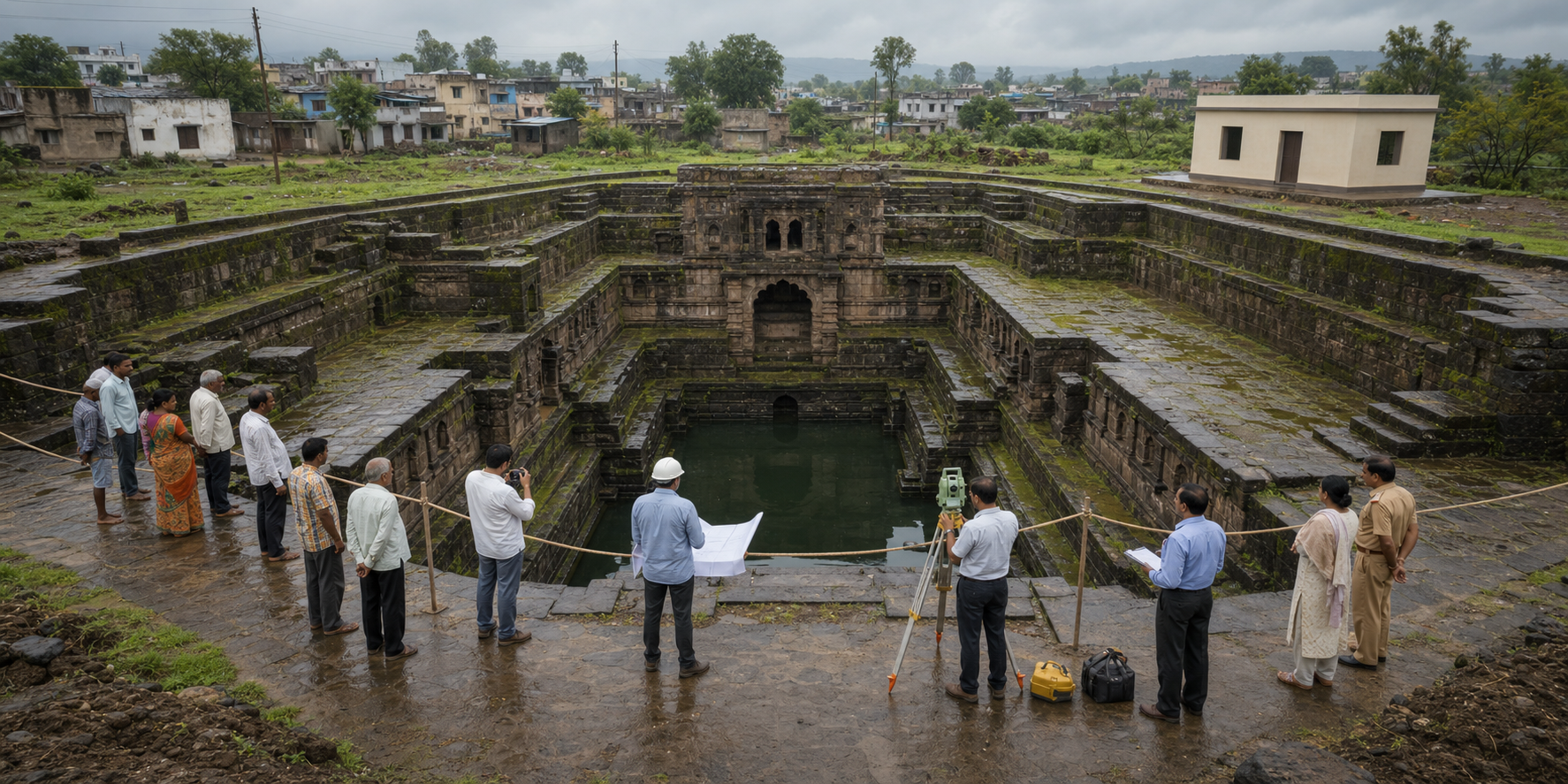
You may have reached the Manchar dispute wanting two things at once: protection for an old barav and a resolution that does not turn a heritage question into a communal confrontation. You do not have to choose between them.
Community members have reported a recently constructed structure identified as a dargah, together with a Waqf claim at or near the stepwell. Those reports justify urgent scrutiny, but they do not by themselves establish the date of construction, ownership of the parcel, legal Waqf status, or whether permission was granted. The strongest pro-heritage response is therefore precise: prevent further alteration, secure certified records, document the barav professionally, and require every claimant and authority to follow due process.
Key takeaways
- Describe the barav as traditionally associated with the Pandavas unless archaeological work establishes a date. Oral memory demonstrates cultural value; it is not a substitute for chronology.
- Ask the competent authority for a written status quo against digging, building, demolition, desilting, or alteration while title, permissions, and heritage status are checked.
- Build four separate files: land and boundary records, Waqf records, heritage records, and construction-permission records. No single document answers all four questions.
- Treat a Waqf assertion as a claim requiring verification, not as automatic proof of title. Apply the same evidentiary discipline to every counterclaim.
- Protecting the stepwell does not have to wait for the final ownership decision. Temporary fencing, structural assessment, measured documentation, and controlled access can proceed through competent authorities without prejudging the dispute.
- Do not let volunteers remove, relocate, repair, or demolish anything. Such action can damage historic fabric, destroy evidence, create safety risks, and expose participants to legal consequences.
Separate the four claims before arguing any one of them
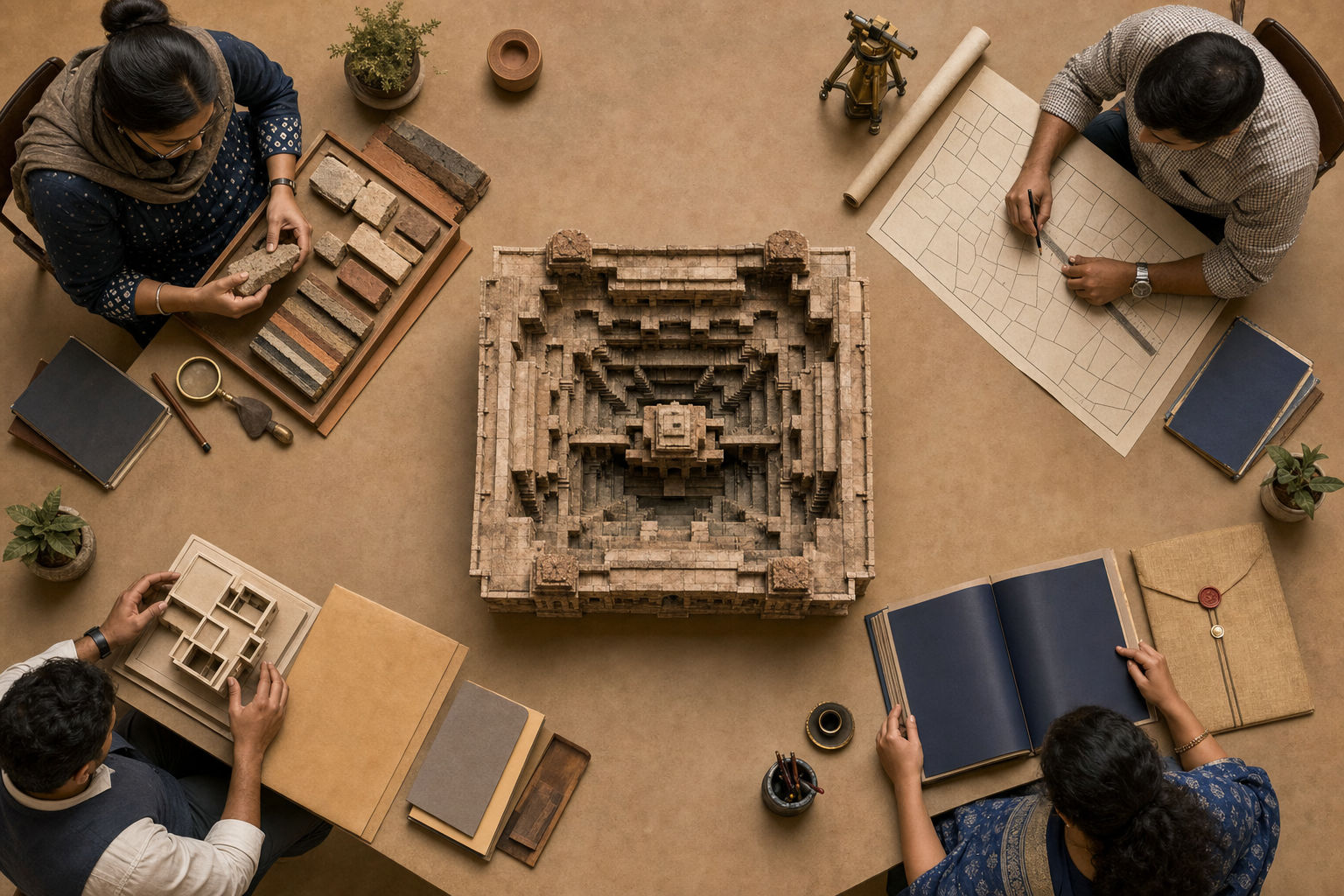
The public debate can sound like one question – who owns the site? In practice, four different propositions must be tested. Mixing them together makes a weak case look strong and a strong conservation case look partisan.
1. How old is the barav?
Calling the structure “Pandava-era” records a significant local tradition. Across Bharat, communities often associate visibly ancient places with the Pandavas. That association should be documented respectfully, but it should not be converted into an archaeological date without evidence.
A defensible chronology requires specialists to examine the plan, masonry, stair geometry, landings, edge treatments, mortar, later repairs, and the relationship between deposits and structural phases. Deccan baravs may be square, rectangular, or octagonal, and comparisons involving basalt ashlar, dry masonry, lime mortar, pillared elements, and construction technique can help place a structure within a broad period. Where suitable material survives, stratigraphy, mortar analysis, thermoluminescence, or radiocarbon analysis of associated organic matter may refine that assessment. Until then, use “traditionally regarded as Pandava-era,” not “proved to have been built by the Pandavas.”
2. What land does the dispute actually cover?
A photograph cannot establish whether the stepwell, its retaining walls, an access path, and the reported new structure occupy one parcel or several. Obtain the survey or gat number, an official village or cadastral map, the current 7/12 extract, relevant mutation entries, and the boundary description used by each claimant. Place those records over a measured site plan.
The 7/12 extract is an important indicator of classification, possession history, recorded use, and encumbrances, but it should not be treated as the entire title adjudication. A mismatch between the written area, mapped boundary, and physical occupation is a reason for an official joint measurement, not a reason for activists to draw their own final boundary.
3. Is there a valid Waqf record for this exact parcel?
A verbal assertion, signboard, recent use, or general entry referring to a larger locality does not settle the status of the barav parcel. Ask for the certified register entry, survey and inquiry record, applicable notification or Gazette publication, date of entry, property description, map, boundaries, and the instrument or basis relied upon for dedication. Then compare every identifier and boundary with the revenue and cadastral records.
The central question is not whether Waqf property can exist; plainly it can. The question is whether the statutory record applies to this precise land and whether notice, inquiry, registration, objections, and adjudication were handled under the law applicable to the case. A Waqf claim does not automatically extinguish an earlier public purpose, government interest, communal-water use, or heritage protection. Nor should the absence of one paper be advertised as a final victory before the complete file is obtained.
4. Was the reported construction lawfully approved?
Ownership and permission are different questions. Even a person or institution with a legitimate interest in land may need development approval before erecting a permanent structure, especially beside a waterbody, on common land, or within a protected heritage precinct. Request the application, sanctioned plan, permission order, site inspection, conditions, and any notice or enforcement file held by the Gram Panchayat or Municipal Council and the revenue administration.
Until those records are checked, call it “the reported structure” or “the structure identified locally as a dargah.” Do not label it an illegal encroachment as though an authority or court has already decided the matter. If permission is absent or the work violates applicable controls, the competent authority should issue notice and take lawful action. A crowd should not attempt removal.
Build an evidence file that can survive official scrutiny
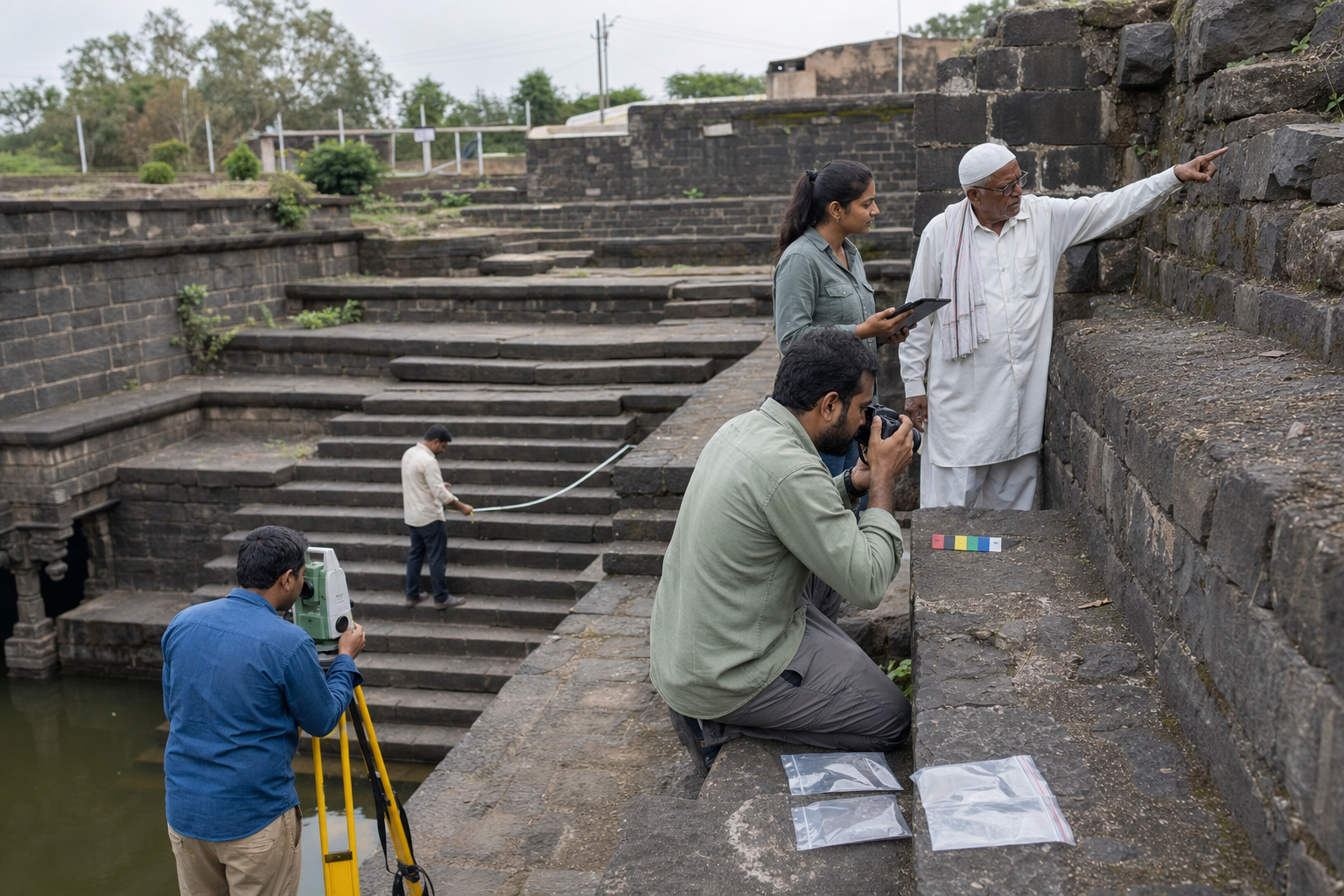
A large petition with uncertain claims is less useful than a small, indexed file containing certified records, dated photographs, and unanswered written requests. We would begin with one master chronology and give every item a simple reference number.
- Identify the site precisely. Record the village, taluka, district, survey or gat number, coordinates, approach route, stepwell footprint, adjoining plots, and the position of every recent addition. Mark uncertain boundaries as uncertain.
- Create a dated visual baseline. Photograph all elevations, stairs, landings, water level, masonry joints, silt, vegetation, drainage routes, cracks, displaced stones, inscriptions, later plaster, railings, and nearby construction. Keep original files and metadata. A professional measured survey and photogrammetric model are preferable to social-media images alone.
- Request certified land records. Collect the 7/12 extract, mutation entries, official map, classification and use entries, and any order changing the land’s recorded status. Ask for a joint measurement if the documentary and physical boundaries do not align.
- Request the complete Waqf record. Seek the exact property entry, description, area, boundaries, supporting inquiry or survey file, applicable publication, objections, orders, and subsequent changes. Do not accept a cropped screenshot that omits the property schedule or date.
- Request heritage records. Ask the Maharashtra Directorate of Archaeology and Museums whether the barav is notified, listed, inventoried, surveyed, or under consideration. Ask the Archaeological Survey of India whether central protection or a controlled monument precinct applies.
- Request construction records. Ask the local authority to confirm in writing whether it approved the reported structure and any excavation, filling, utility connection, access change, or alteration affecting the waterbody.
- Record oral history separately. Take dated accounts from elders and long-time residents about earlier access, water use, worship, repairs, names, paths, and the appearance of the site. Keep each person’s account distinct rather than merging recollections into a single supposedly unanimous story.
- Log every submission. Preserve the inward number, receipt, date, office, officer, attachment list, and response deadline for each representation. If documents conflict, place them side by side and ask the issuing authorities to reconcile them in writing.
A useful subject line is: “Request for joint inspection, preservation status quo, and record verification concerning the barav at [survey or gat number], Manchar.” The first representation should seek three concrete outcomes: no further physical alteration, a joint inspection by the relevant local, revenue, and archaeology officers, and certified disclosure of the records on which each official position depends.
Keep advocacy copies and evidentiary originals separate. Annotate copies, not certified documents. Avoid filters, captions, or edits on original photographs. If an image is shared publicly, publish the date, viewing direction, and location on the site plan so another person can understand what it proves.
Follow four legal tracks without confusing their purposes
The dispute sits at the meeting point of land administration, Waqf governance, heritage protection, and development control. Success on one track does not automatically decide the others. Use the following map to direct each question to the right record and authority.
| Question to decide | Evidence to obtain | Authority to approach | What not to assume |
|---|---|---|---|
| What parcel contains the barav and adjoining construction? | 7/12 extract, mutation entries, official cadastral or village map, joint measurement and boundary description | Tahsildar, revenue officers and District Collector | That a revenue entry, photograph or privately drawn map settles title by itself |
| Does a Waqf record cover this exact parcel? | Certified register entry, survey or inquiry file, applicable publication, property schedule, date, area and boundaries | Competent Waqf authority and the forum prescribed by current law | That an assertion or similarly named property elsewhere covers the stepwell automatically |
| Is the barav protected or eligible for heritage action? | Protection notification, listing or inventory entry, archaeological assessment and official monument limits | Maharashtra Directorate of Archaeology and Museums; ASI where central protection is relevant | That traditional antiquity alone activates every statutory buffer |
| Was new work approved and compliant? | Application, sanctioned plan, permission order, inspection record, conditions, notices and enforcement file | Gram Panchayat or Municipal Council, planning authority and revenue administration | That ownership eliminates the need for planning, waterbody or heritage permission |
If ASI confirms that central protection and the relevant AMASR controls apply, the cited construction regime may include a 100-metre prohibited area and a further 200-metre regulated area, where applicable. Do not draw those circles from the visible edge of the well and present them as legally settled. First obtain the protection notification, official monument boundary, applicable measurement point, and written confirmation of the controls in force.
State-level protection under the Maharashtra Ancient Monuments and Archaeological Sites and Remains Act, local development control under the MRTP framework, and waterbody or public-land rules may remain relevant even when the site is not centrally protected. Formal protection can also be sought rather than merely assumed.
Heritage protection is not a disguised title award. An authority can restrict damaging work, document historic fabric, and require conservation while the ownership question remains unresolved. That distinction is especially valuable at Manchar: it allows immediate protection without forcing an archaeology officer to decide a land claim or a revenue officer to date masonry.
Legal procedure and jurisdiction can change through amendments and court decisions. Filing in the wrong forum can waste time and may affect legal rights. Before submitting an objection, appeal, tribunal case, or civil proceeding, have a Maharashtra lawyer familiar with land, heritage, and Waqf disputes verify the current statute, competent forum, standing, notice requirements, and deadlines. Public advocacy is not a substitute for case-specific legal advice.
Protect the barav now, then work through a 90-day plan
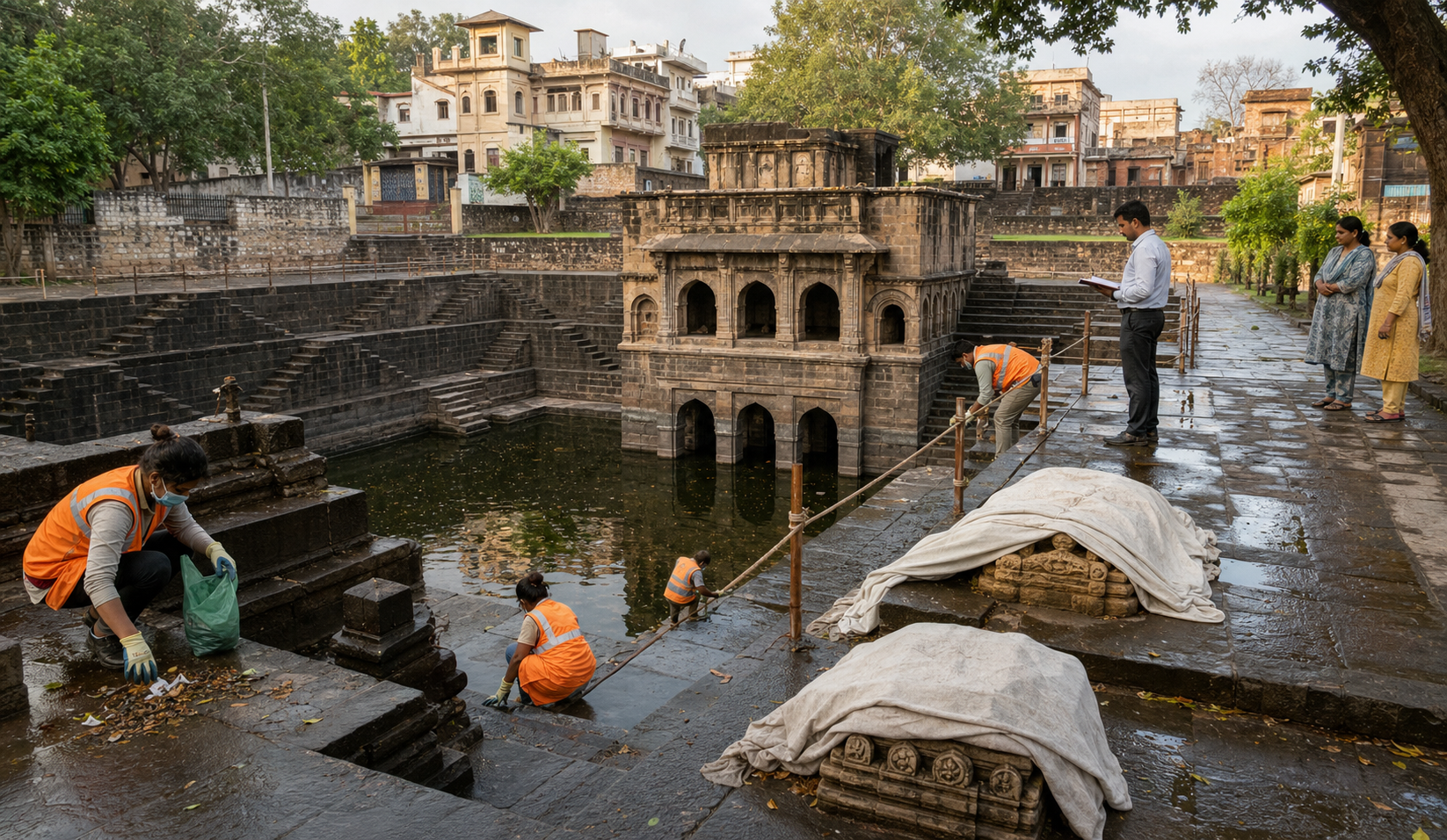
A barav is more than old masonry. It is a purpose-built water system associated with domestic use, agriculture, pilgrimage halts, groundwater recharge and seasonal resilience. Losing its steps, catchment, inlet, retaining wall, or access route can destroy both cultural meaning and hydraulic function. Conservation should therefore cover the entire water structure and its working landscape, not only the stones that look monumental in a photograph.
Use reversible protection while inquiries are pending
- Ask the competent authority to install temporary edge protection and warning signs where falls are possible, while preserving historic fabric and traditional access as far as safety permits.
- Keep construction material, vehicles, waste, ritual residue, and dumped soil away from the steps, water, inlets, retaining walls, and suspected buried fabric.
- Arrange a structural review before allowing groups onto cracked stairs or platforms. A visually solid basalt wall can still be undermined by water movement, root growth, displaced stones, or excavation.
- Do not conduct an enthusiastic mass desilting drive before archaeological and hydro-ecological assessment. Uncontrolled digging can erase deposits that help date the site, destabilize lower masonry, or alter recharge and drainage.
- When conservation is authorized, favour minimum intervention: controlled vegetation removal, planned desilting, drainage correction, compatible lime-mortar repointing, and careful edge protection. Avoid hard cement repairs or cosmetic rebuilding that conceals old joints and traps moisture.
- Require a before-and-after record for every intervention, including the material removed, mortar specification, replaced stones, drainage changes, responsible professional, and approving authority.
The same caution applies to the reported dargah structure. No private group should damage, shift, enlarge, decorate, or remove it while its status is being examined. If authorities determine after notice and due process that an addition is non-compliant, relocation or removal must be conducted under a lawful order and professional supervision, with safeguards for the historic barav.
A workable 30-60-90-day sequence
- Days 1-30: preserve and document. Seek a written status quo, safety barriers, a joint inspection, precise site mapping, measured photographs, a structural risk review, and a preliminary hydro-ecological assessment. Create the master document index and convene a local heritage committee. The aim is to prevent the physical and evidentiary position from changing while records are requested.
- Days 31-60: reconcile the records. Obtain and compare the 7/12 extract, mutation history, cadastral boundary, Waqf property schedule and supporting file, construction permissions, and any heritage listing or notification. Put discrepancies into a written comparison rather than resolving them through slogans. Ask each responsible office for a signed response on the point within its jurisdiction.
- Days 61-90: move from verification to orders. Request a written interim conservation plan, a decision on any stop-work or enforcement process, a timetable for archaeological assessment, and publication of a non-confidential record index. If title or Waqf status remains contested, place it before the competent forum identified under current law while maintaining physical protection of the barav.
Make dharmic stewardship disciplined and inclusive
Hindus, Buddhists, Jains, and Sikhs share deep civilizational regard for water, restraint, service, and the protection of places that sustain community life. A dharmic response should make those values visible through conduct: accurate speech, care for the vulnerable structure, patience with evidence, and refusal to let anger destroy what the campaign seeks to save.
A local heritage committee can include representatives of these dharmic traditions, archaeologists or conservation professionals, water specialists, youth volunteers, long-time residents, and nearby people of every belief. Its mandate should be narrow and written: maintain the evidence index, coordinate approved cleanliness and safety work, observe site changes, collect oral histories, and communicate with authorities. It should not declare title, conduct worship-status adjudication, obstruct lawful access, or authorize physical alterations.
Public language matters. Challenge a document by naming the missing date, boundary, signature, notification, or permission. Challenge an official delay by citing the inward number and unanswered request. Do not attack a community, speculate about motives, or publish unverified personal accusations. Precision makes the heritage case harder to dismiss and keeps attention on the barav.
If you are preparing a representation now, ask for three things in writing: an immediate bar on further alteration, a joint inspection with archaeology and revenue participation, and certified verification of the four record sets. That turns concern into a process the authorities can answer. Manchar’s barav will be best defended by an exact boundary, an intact evidence trail, professional conservation, and the same standard of proof for every claimant.
References
