
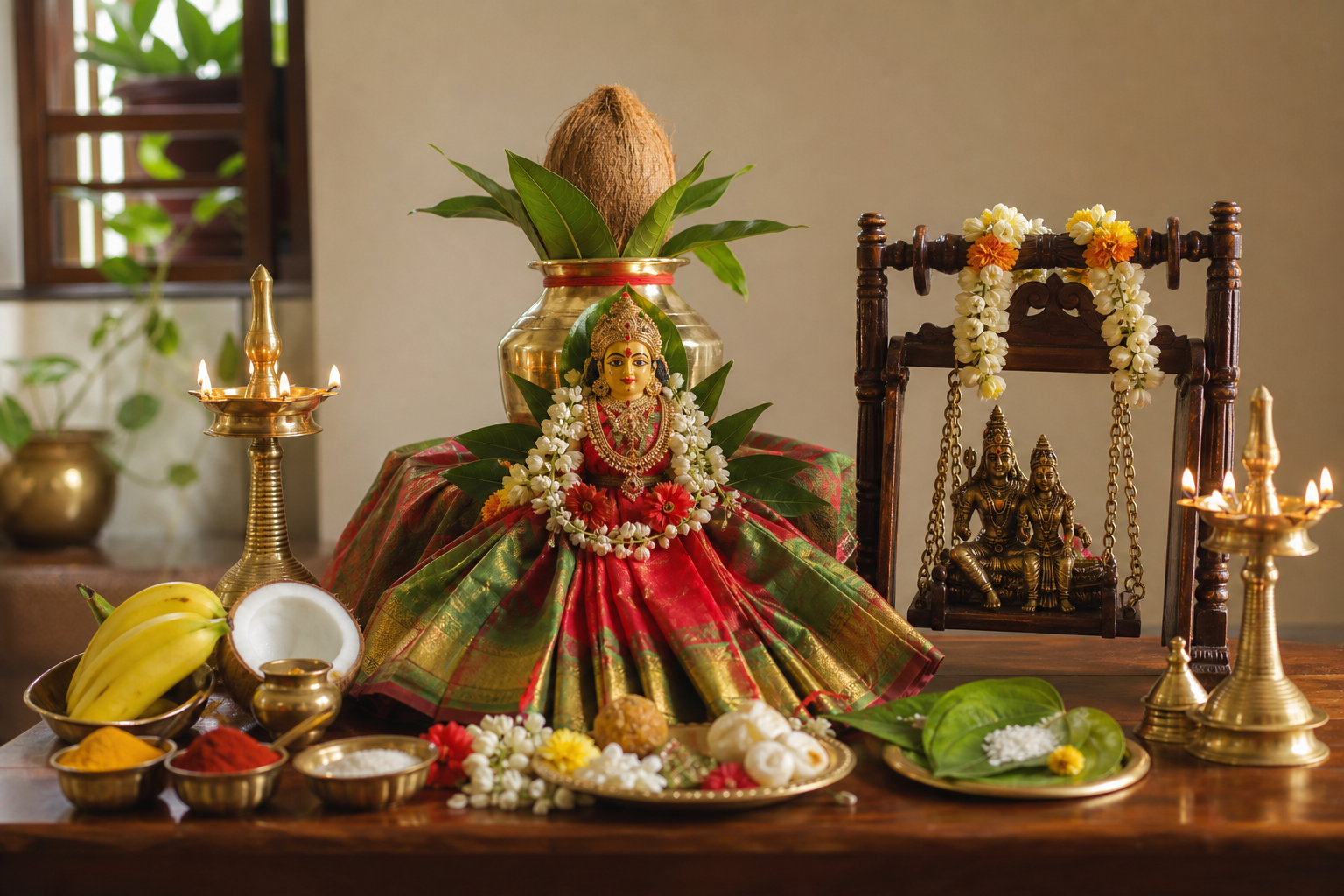
You may know that Gauri Tritiya is approaching yet still be unsure whether you should perform Soubhagya Gauri Vrata, Shiva Dolotsavam, or both. The distinction is simple: the vrata is the vow-centred worship of Gauri, while Dolotsavam is the gentle swing offering to Shiva and Parvati that can become its culminating act.
If your prayer concerns marriage, family harmony, or the hope for a child, this observance gives that hope a disciplined Dharmic form. Treat it as worship, ethical resolve, and an occasion for the family to stand together—not as a bargain with the Divine or a guarantee of a particular result.
Know which observance you are undertaking
Soubhagya Gauri Vrata centres on Devi Gauri as the giver of auspiciousness, steadiness, family welfare, and blessed companionship. In this setting, sowbhagya means more than material luck. It points to a household sustained by mutual care, truthful conduct, courage, and dharma.
Shiva Dolotsavam places Shiva and Parvati on a dola, or swing, and rocks the divine couple gently during mantra-japa. Shiva represents still consciousness at the centre of movement; Gauri represents the creative power through which life is nourished. The movement of the swing can therefore be contemplated as the rhythm of manifestation, rest, renewal, and balance.
You do not need to conduct two unrelated pujas. A combined home observance can follow one clear sequence: invoke Ganesha, establish Gauri, worship Shiva and Parvati, perform abhishekam where appropriate, recite the vrata-katha and mantras, conduct Dolotsavam, and conclude with naivedya, arati, prasada, and dana.
- If you are observing only Soubhagya Gauri Vrata, establish Pasupu Gauri or your customary image of Devi and complete the Gauri puja with katha, naivedya, and arati.
- If you are adding Shiva Dolotsavam, include a Shivalinga with Parvati or a Shiva-Parvati image and prepare a secure symbolic swing.
- If your family has an inherited paddhati, preserve its mantras, order of offerings, and rules about fasting. The sequence below is a practical household framework, not a replacement for sampradaya.
Married women traditionally lead this vrata in many homes, especially when praying for sowbhagya or santana. Unmarried devotees may worship for worthy companionship and inner steadiness, while husbands, elders, and other family members may participate. A couple praying for a child can make a joint sankalpa; the burden of that hope need not be placed upon the woman alone.
Choose the Tritiya tithi before choosing a clock time
The calendar anchor for this form of Shiva Dolotsavam is Chaitra Shukla Tritiya, also called Gauri Tritiya or Chaitra Shudda Thadiya in some regional usage. Tithi does not begin and end at civil midnight, and its relationship to sunrise can vary by location. Do not copy a date or clock time from a calendar prepared for another city.
For reference, most Indian panchangas placed the 2026 observance on March 21. That date should not be carried into another year or assumed to govern every location. For the year and place in which you will worship, check a regional panchangam or a nearby temple notice.
- First confirm when Tritiya begins and ends in your location.
- Then check whether your family observes the tithi prevailing at sunrise or follows another inherited rule.
- Prefer a calm morning period after sunrise when Tritiya is in force.
- If your Shaiva tradition permits evening worship, pradosha-kala can be used while Tritiya still prevails.
- If your household avoids Rahu Kalam for the principal sankalpa and invocation, place those steps outside it. Abhijit Muhurat may serve as a fallback only where your custom accepts it.
This order matters. Tithi establishes the ritual day; family practice determines how that tithi is applied; the daily muhurta helps you choose a suitable period within it. A generic auspicious hour should not displace the correct local Tritiya.
Prepare an altar that matches the puja you can sustain
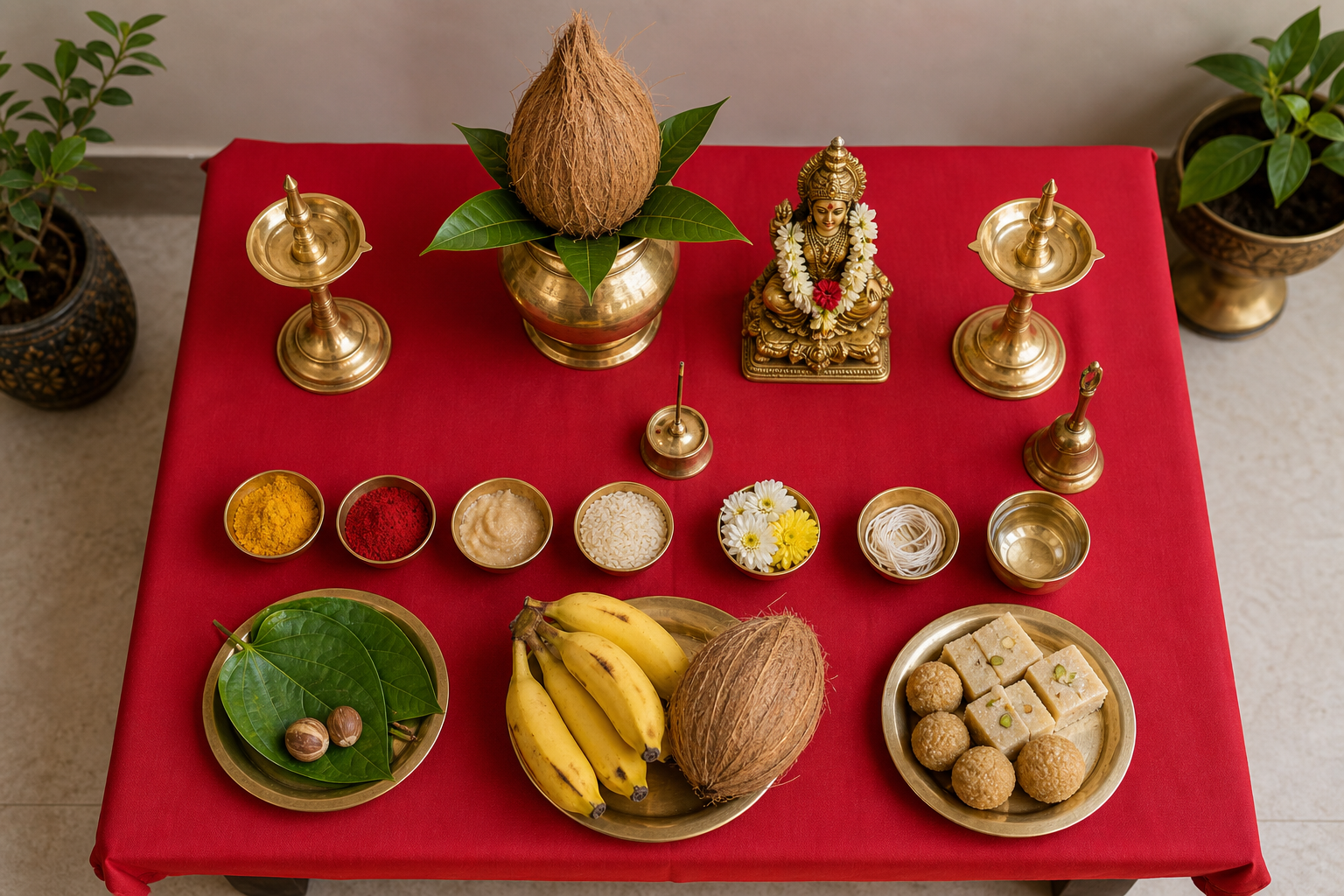
A small, attentive puja is preferable to an elaborate arrangement that leaves you rushed. Decide in advance whether you are performing Panchopachara, the five principal offerings, or a fuller Shodashopachara sequence. Once that choice is made, collect only what the sequence requires.
A simple combined altar
- A Shivalinga with Parvati or a Shiva-Parvati image suitable for worship
- Pasupu Gauri, made as a small conical turmeric form, or the customary metal, clay, or framed image of Gauri
- A stable miniature swing, cradle-stand, or symbolic dola platform
- A clean peetha or altar board, preferably arranged so that you face east or north
- A lamp, clean water, sandal paste, turmeric, kumkum, akshata, flowers, and bilva leaves
- Fruit or one home-cooked sattvika preparation for naivedya
- The Soubhagya Gauri Vrata-katha used by your family, or a familiar Gauri stotra or namavali
Items for a fuller observance
- A kalasha, water, rice, mango leaves, a coconut, and a coin if these belong to your household procedure
- Panchamrita made from milk, yogurt, ghee, honey, and sugar for a Shivalinga or wet-safe murti
- Incense, camphor, a small white or yellow cloth, garlands, betel leaves, and betel nuts
- Seasonal fruit and a sattvika preparation such as sweet pongal, payasam or kheer, chalimidi, paramannam, panakam, or vadapappu
- Turmeric, kumkum, flowers, tambula, green bangles, grain, clothing, or dakshina for respectful giving
A traditional setup may begin with a kolam or muggu beneath the peetha. The kalasha can be partly filled with clean water, a few grains of rice, a coin, and a small amount of turmeric, then crowned with mango leaves and a coconut. Pasupu Gauri may be placed on a betel leaf or over a bed of rice beside it.
Test the swing before the puja. A heavy Shivalinga should not be balanced on an improvised or unstable structure. If the murti could fall, use a sturdy cradle-stand, rock a secure platform only slightly, or perform the dola mentally. Also distinguish between objects that can receive liquid abhishekam and those that cannot: a turmeric Gauri normally receives gentle symbolic sprinkling, while paper images and delicate finishes should remain dry.
Follow this home vidhanam from sankalpa to visarjana
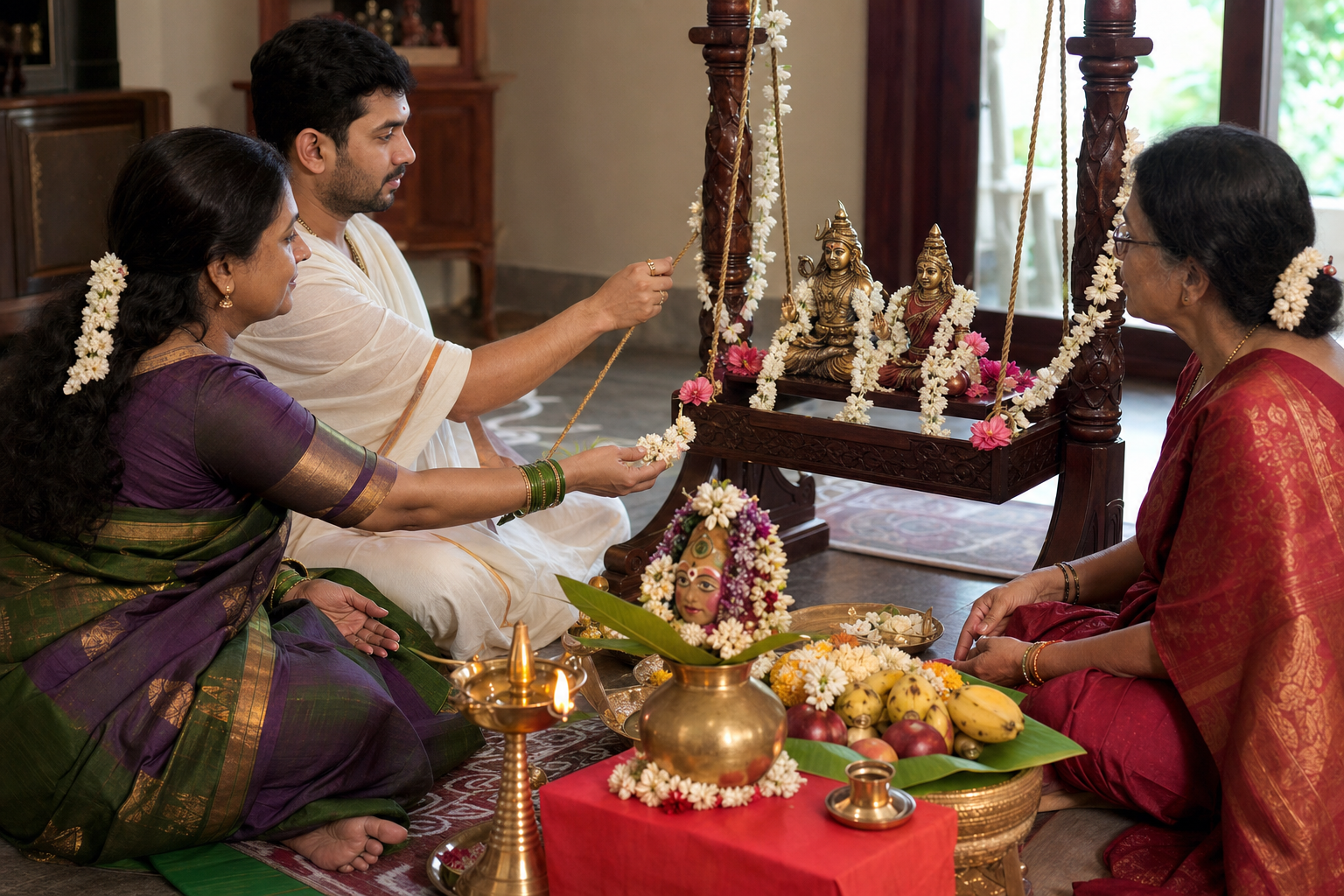
Set out the altar and puja materials before the worship period begins. This prevents the central stretch of japa and dhyana from being broken by searches for leaves, matches, vessels, or naivedya.
- Prepare the place. Clean the puja area, draw the kolam or muggu if customary, arrange the peetha and dola, and light the lamp. Sit quietly for a few breaths so that the vrata begins with attention rather than haste.
- Perform purification and sankalpa. Complete achamana and pranayama if you know the family procedure. State your name, gotra if known, location, and Chaitra Shukla Tritiya. A plain-language resolve is sufficient: On this Gauri Tritiya, I undertake Soubhagya Gauri Vrata with Shiva Dolotsavam for marital harmony, family welfare, santana-prapti if that is your prayer, clarity in dharma, and the welfare of all beings. Choose intentions you can hold sincerely instead of turning the sankalpa into a long wish list.
- Invoke Ganesha. Offer a brief Ganesha dhyana, flower, akshata, and prayer for the removal of obstacles. The purpose is to establish an orderly beginning, not to create a second elaborate ceremony.
- Establish the kalasha and Gauri. Perform kalasha-sthapana if it belongs to your practice. Invite Gauri to the Pasupu Gauri or chosen image through avahana, then offer asana. Symbolically offer padyam, arghyam, and achamaniyam if following the expanded form.
- Worship Gauri. For Panchopachara, offer gandha, flowers, incense, lamp, and naivedya. For a fuller puja, add symbolic snana, vastra, alankara, and tambula. Sprinkle Pasupu Gauri lightly rather than pouring a full stream over the turmeric form.
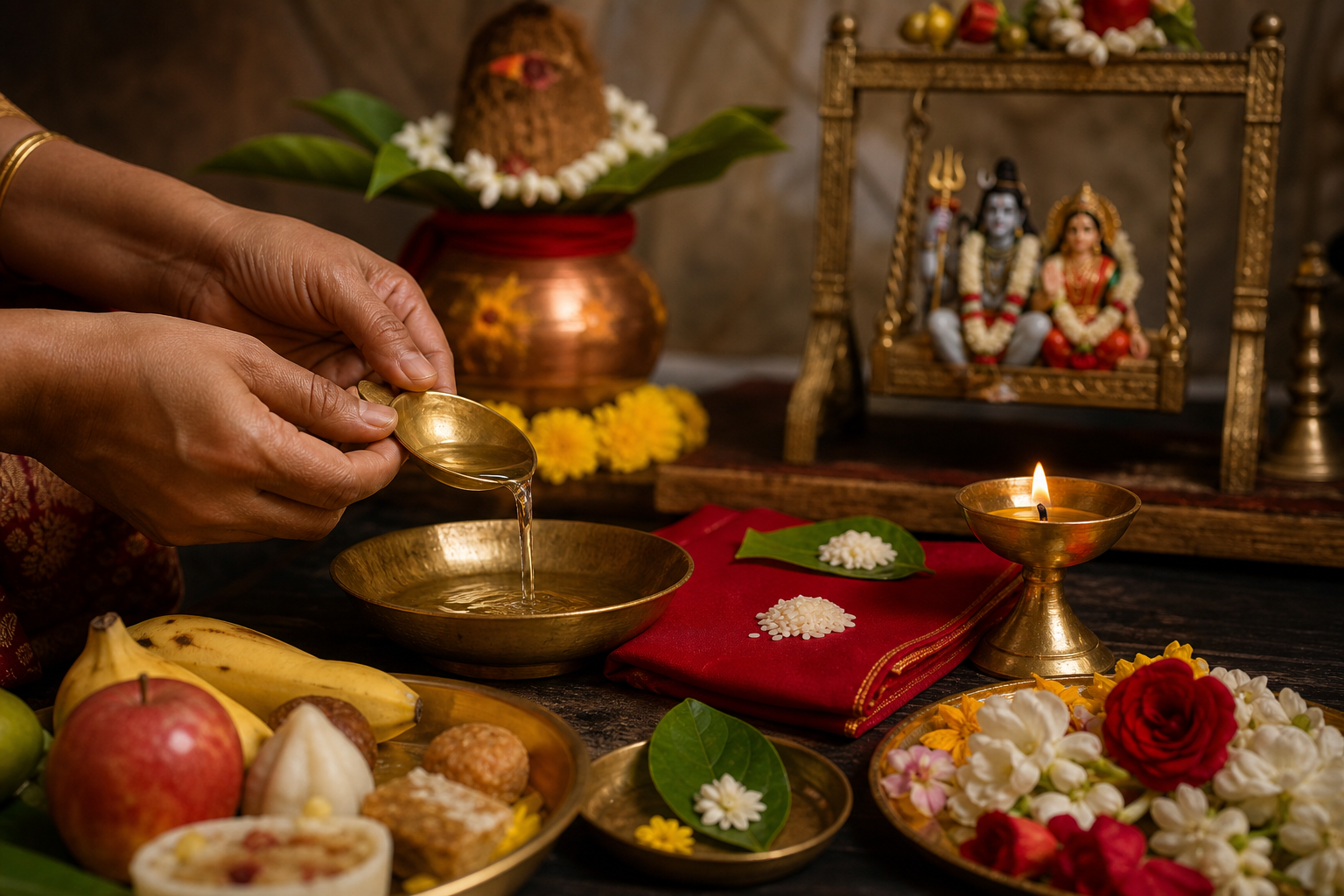
- Perform Shiva abhishekam. Bathe a suitable Shivalinga with clean water and then panchamrita, finishing with a pure-water rinse. If you use a framed image or a murti whose material is not suitable for liquids, make a symbolic water offering in a separate vessel instead.
- Offer alankara, mantra, and katha. Apply sandal paste where appropriate and offer flowers and bilva leaves. Some homes use 11, 21, or 27 bilva leaves, but these counts are customary options rather than the essence of the worship. Chant Om Gauryai Namah or Om Parvatyai Namah, and repeat Om Namah Shivaya 11, 27, 54, or 108 times according to your capacity. Recite your recognized Soubhagya Gauri Vrata-katha, Gauri Ashtottara Shata Namavali, or another familiar Devi text. If you do not possess a trusted katha, do not invent one; sincere nama-japa and dhyana form a complete devotional offering.
- Conduct Shiva Dolotsavam. Place the Shiva-Parvati representation on the secure dola and move it gently while repeating Om Namah Shivaya. A household may offer 27 or 108 soft movements, but you may also swing without counting. Keep the movement small and composed. The point is to contemplate harmony between stillness and Shakti, not to create spectacle.
- Offer naivedya and arati. Present fruit, sweets, or the sattvika food prepared for the day. One carefully prepared offering is enough. Follow it with diparadhana or arati, prostration, and kshamapana—a prayer asking forgiveness for errors or omissions. Share the food only after it has been offered as prasada.
- Complete dana and visarjana. Give food, grain, clothing, or dakshina within your means. Where suhasini worship is customary, offer turmeric, kumkum, flowers, bangles, or tambula only with the recipient’s consent and dignity. Respectfully conclude Devi’s invoked presence. Kalasha water may be sipped as prasada and sprinkled around the home. Pasupu Gauri may be dissolved in clean water at home or returned to the earth near Tulasi or another appropriate plant; do not leave it in a public water body.
The inner discipline should continue after arati. If your sankalpa asks for harmony, pair it with a concrete household commitment: speak without contempt during disagreement, share a neglected responsibility, or set aside unhurried time for a difficult conversation. If it asks for santana, let husband and wife carry the prayer and the practical responsibilities together. The swing then becomes more than a ritual object; it teaches how movement can remain centred.
Keep the material expression equally coherent. Use local seasonal flowers when possible, avoid disposable plastic decorations, distribute prasada in reusable vessels, and consider planting or caring for a bilva sapling. A fertility-centred prayer should leave the surrounding sources of life better protected, not burdened with ritual waste.
Questions that prevent common mistakes
Is a physical swing mandatory?
No. A secure symbolic swing or gently rocked cradle-stand is sufficient. If neither is safe or available, keep the murti firmly installed and visualize the dola during mantra-japa. Bhava should never be used as a reason to put a sacred image at risk of falling.
Should a woman praying for a child perform it alone?
No. Although women traditionally lead this observance in many regions, a couple may make the sankalpa and chant together. Family members can help prepare naivedya, arrange the altar, recite the names of Devi, or undertake dana. Joint participation makes the prayer a shared responsibility rather than a judgment upon one person.
Are 11 bilva leaves and 108 swings compulsory?
No single count governs every regional practice. Bilva offerings may be made in counts such as 11, 21, or 27, while japa and gentle swings may use 11, 27, 54, or 108 according to the act and household custom. Decide the count before beginning so you are not distracted, but do not mistake arithmetic for devotion.
How strictly should you fast, and can the vrata replace fertility care?
Upavasa may range from phalahara—fruit and milk—to one light sattvika meal after puja; some traditions observe a stricter fast. Pregnant or nursing women, older people, and anyone managing a health condition should adapt the fast responsibly. Restraint in food, speech, entertainment, and agitation can preserve the vrata’s purpose without unsafe austerity.
A prayer for santana is a sacred expression of hope, not a medical treatment or a promise of conception. If you are pursuing pregnancy or facing fertility concerns, continue appropriate medical care. The vrata can accompany that path through prayer, mutual support, and steadiness; it should not delay professional evaluation or place blame on either spouse.
Your next step is practical: confirm the local Tritiya window, decide whether you will use the simple or fuller altar, and write your sankalpa before the day arrives. With those three decisions made, you can enter the puja without confusion and give your attention to Gauri and Shiva rather than to logistics.
References
- DharmaRenaissance Blog — Shiva Dolotsavam on Gauri Tritiya: Sacred Swing Ritual for Fertility, Harmony, and Hope (2026)
- DharmaRenaissance Blog — Soubhagya Gauri Vratam Vidhanam: Precise Puja Steps, Auspicious Timings, Meanings, and Benefits
