
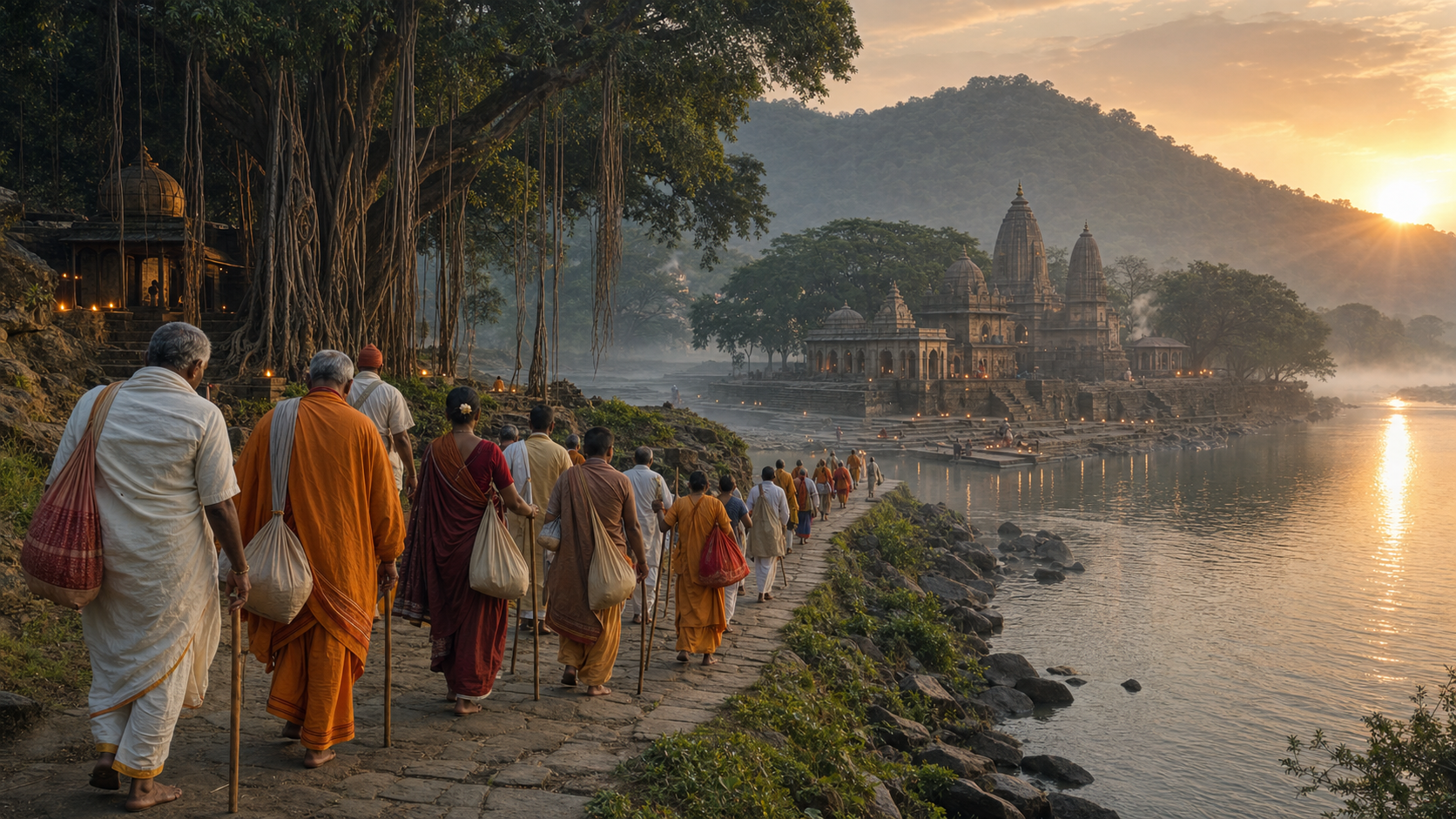
If you reach a tirtha with only a list of darshan times, the journey can shrink into transport, queues, and photographs. You may complete every planned ritual and still miss why this particular river, lake, grove, hill, or route belongs to the worship.
You don’t need specialist training to read a sacred landscape well. You need to hold three things together: the story that consecrates the place, the terrain that gives the story a physical form, and the practices through which pilgrims keep that relationship alive. This method will help you approach a Puranic pilgrimage as a participant rather than a collector of temple visits.
Read the place as story, terrain, and practice
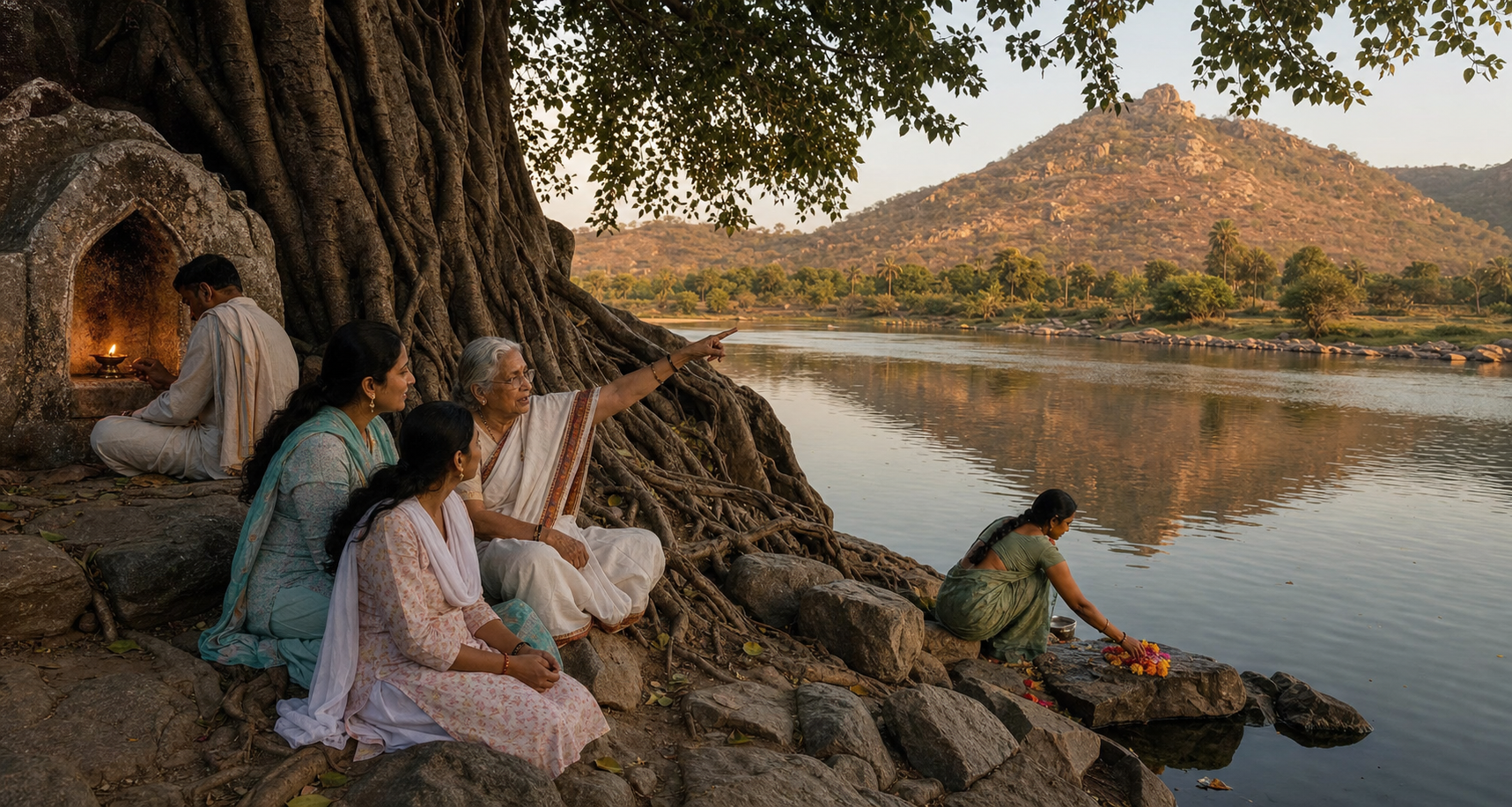
A kshetra is more than a building containing a murti. It is a consecrated field in which deity, community, memory, and land meet. A tirtha is a crossing: often a physical crossing associated with water, but also a passage from ordinary attention toward a more disciplined way of seeing. Puranic geography joins these meanings to actual places that can be approached, circumambulated, bathed in, protected, and revisited.
Begin by separating three layers without pulling them apart:
- Sacred story: What event is remembered here, which deity acts, and what condition of disorder, protection, penance, revelation, or restoration gives the place its meaning?
- Physical setting: Why does the story belong to this lake, riverbank, forest, hill, desert margin, or sequence of settlements? What would be lost if the same shrine were placed in a generic urban enclosure?
- Living practice: Which actions make the relationship present now – snana, pradakshina, archana, abhisheka, yajna, vrata, dana, festival procession, care for water, or protection of a sacred grove?
Pushkar demonstrates the method clearly. Its Puranic memory connects Brahma’s defeat of Vajranabha and the fall of three lotus petals with Jyeshtha, Madhya, and Kanishtha Pushkar. Brahma’s subsequent yajna gives ritual form to the restored order. The lakes are therefore not interchangeable scenery around a temple. Water, story, sacrificial time, and pilgrimage conduct belong to one sacred arrangement.
Karnataka’s Subramanya triad works differently but requires the same quality of attention. Adi Subrahmanya at Kukke, Madhya Subramanya at Nagamangala, and Anthya Subramanya at Ghati form a route across forested ghats, an agrarian interior, and rocky uplands. Naga worship, water, household vows, temple ritual, and regional movement make the circuit coherent.
Story without terrain can make every sacred place sound alike. Terrain without story reduces a kshetra to attractive scenery. Ritual without either can become mechanical. At every stop, ask one question from each layer before moving on.
Let the route become part of the teaching
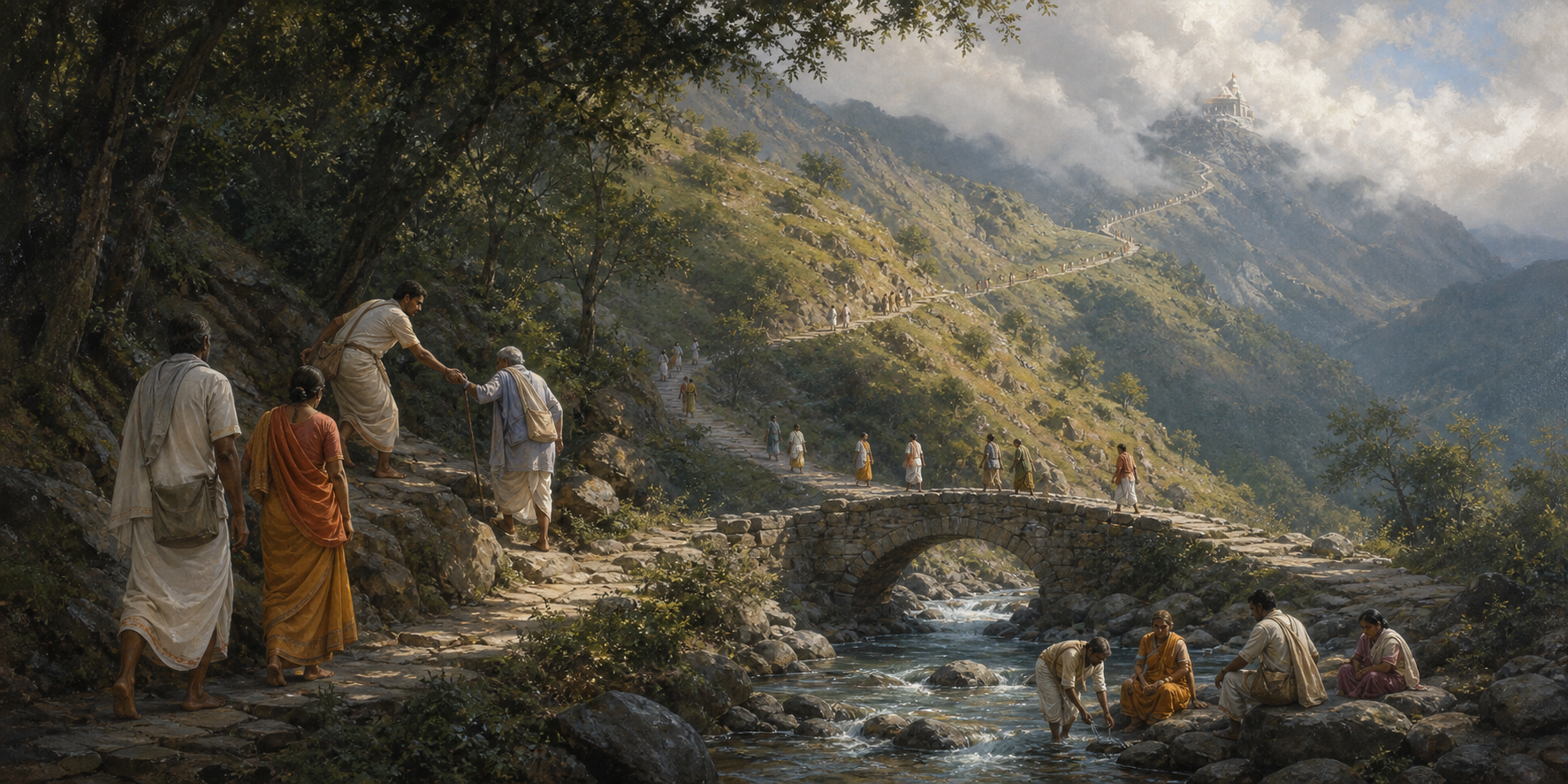
A list tells you what to visit. A sacred route tells you how one place changes the meaning of the next. Sequence is therefore not a logistical inconvenience wrapped around the pilgrimage; it is part of the pilgrimage’s grammar.
| Landscape | Spatial grammar | What to notice |
|---|---|---|
| Karnataka Subramanya circuit | Adi at Kukke, Madhya at Nagamangala, and Anthya at Ghati | The movement from the Kumaradhara and Western Ghats, through Mandya’s agrarian belt, to the uplands near Doddaballapur; also notice how naga worship persists while each kshetra retains its own ritual identity. |
| Pushkar | Jyeshtha, Madhya, and Kanishtha lakes associated with three fallen lotus petals | How sacred water organizes ghats, kunds, bathing, circumambulation, vows, hospitality, and settlement on an arid fringe. |
Do not force the two triads into a single theology. Pushkar’s threefold form belongs to the account of Brahma’s lotus and the sanctification of the lakes. Karnataka’s Adi-Madhya-Anthya pattern joins three regional Subramanya kshetras and can also support a contemplative movement from intention, through discipline, toward realization. That second reading is useful only when it complements the temples’ established identities rather than replacing them.
If you undertake the Karnataka circuit, give each stage a distinct purpose. At Adi, state the sankalpa that brought you onto the route. At Madhya, examine what discipline the sankalpa requires. At Anthya, decide what you will carry home as practice or responsibility. Some pilgrims travel east to west, beginning at Ghati and ending at Kukke; others begin in the Western Ghats. The direction may change, but the middle should not become a hurried refuelling stop.
The full circuit is commonly planned over two to three days. Ghati to Nagamangala is roughly 140-170 kilometres depending on the route, while Nagamangala to Kukke is roughly 220-250 kilometres. Use those figures to understand the scale, not to promise yourself an arrival time. Ghat roads, festival crowds, darshan windows, and seva schedules all require current verification.
Route also shapes theological perception. At Ghati, Subramanya with the naga occupies the forward focus while Sri Lakshmi Narasimha is aligned behind and traditionally viewed through a mirror. That single visual axis expresses harmony between Kaumara and Vaishnava worship without making either deity disappear into the other. Pause long enough to see the arrangement, not merely the queue ahead of you.
Keep sacred origin, physical history, and symbolism in their proper lanes
Modern discussions of pilgrimage often go wrong in one of two directions. One side treats a Puranic account as though it were attempting to be a modern geological survey. The other side assumes that reverence exempts every claim about a present structure from historical examination. Neither approach reads the landscape on its own terms.
The Padma Purana and Skanda Purana preserve the Pushkar cycle through accounts that vary in some details. Its stable narrative core joins Vajranabha’s disruption, Brahma’s intervention with the lotus, the appearance of the lakes, and the yajna intended to restore order. Sarasvati’s delayed arrival, Brahma’s performance of the rite with Gayatri, and the resulting restriction on Brahma worship explain Pushkar’s exceptional ritual position within the tradition. Variation among recensions and regional tellings should prompt careful comparison of claims, not a reflexive dismissal of the whole sacred memory.
Physical chronology asks another kind of question. Temples accumulate repairs, rebuilding, gifts, changed enclosures, and new arrangements for larger congregations. Pushkar’s present Brahma Temple bears later architectural and renovation layers even though the tirtha’s sanctity is rooted in a much older transmitted memory. Karnataka’s three Subramanya institutions likewise reflect medieval and post-medieval patronage, renovation, oral history, and continuing ritual. A rebuilt wall does not create a new tirtha, just as an ancient sacred account does not automatically date every stone in the current complex.
Symbolic interpretation forms a third lane. Pushkar’s three lakes have been read through the three gunas or the gross, subtle, and causal bodies. Karnataka’s Adi-Madhya-Anthya sequence can be contemplated as sankalpa, sadhana, and anubhava. Such readings can deepen a yatra, but they should remain interpretive disciplines. They must not erase the local names, deities, rites, communities, or ecological features that make the places distinct.
When you encounter a disputed or sweeping claim about a pilgrimage place, test it with four questions:
- Is the claim explaining why worship occurs here, or when a surviving structure was built?
- Does it belong to a Puranic narrative, a local oral tradition, an inscriptional history, an architectural judgment, or a later contemplative interpretation?
- If versions differ, which elements vary and which sacred relationships remain consistent?
- Does the proposed symbolism illuminate the actual kshetra, or could it be pasted onto almost any group of three shrines?
This keeps you from flattening faith into archaeology or demanding that archaeology certify metaphysical meaning. Sacred truth, institutional history, and symbolic reflection can speak to one another without pretending to be the same kind of knowledge.
Make your conduct answer to the landscape
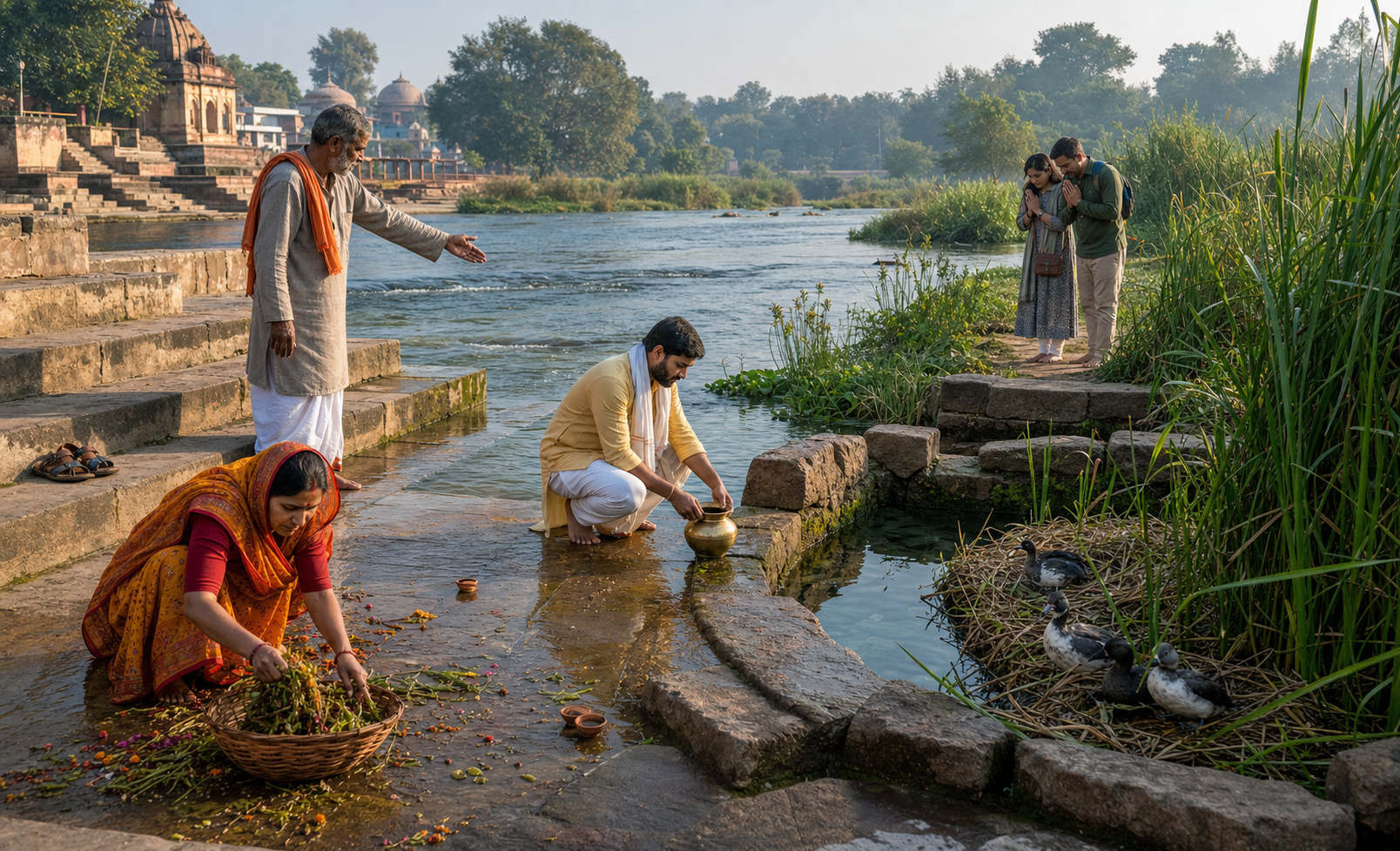
Ecology is not decorative background in a sacred geography. At Kukke, the Kumaradhara, evergreen forest, naga enclosures, anthills, and the memory of Vasuki’s refuge belong to the kshetra’s ritual identity. Sarpa Samskara, Ashlesha Bali, and Naga Pratishta place family observance within that naga-centred setting. At Pushkar, sacred lakes on an arid margin sustain bathing, circumambulation, hospitality, and settlement. Polluting the water or damaging a grove contradicts the very relationships the pilgrimage asks you to honour.
Use this practical protocol:
- Clarify your purpose before booking a seva. If your visit concerns naga dosha, a family vrata, or a specific parihara, follow your family’s established practice and consult a qualified archaka. Do not let general anxiety turn an ordinary darshan into an unprescribed rite.
- Choose consciously between a festival and an unhurried visit. Skanda Shashti and monthly Shashti observances bring special worship to the Subramanya kshetras. Kartik Purnima intensifies snana, pradakshina, dana, and public gathering at Pushkar. A festival reveals the collective life of a tirtha, while a quieter day gives you more room to observe its spatial details. Decide which experience serves your sankalpa and plan lodging and queues accordingly.
- Identify the natural anchor before entering the main queue. Find the river, lake, hill, grove, or directional relationship that the sacred account makes significant. Follow local instructions before bathing or entering a protected enclosure.
- Keep offerings compatible with the place. Do not leave packaging, introduce harmful material into water, disturb animal life, or treat a nagavana as spare ground. Carry away what the temple cannot responsibly receive.
- Participate in the local ritual vocabulary. Snana, pradakshina, archana, abhisheka, dana, annadana, and attentive darshan are not interchangeable tourist activities. Ask what is appropriate at that kshetra and perform fewer acts with greater attention.
- Take home one obligation, not only prasad. Support responsible local hospitality, reduce waste on the route, help preserve a water body or grove where a suitable avenue exists, or maintain the discipline named in your sankalpa.
Naga symbolism also opens a careful conversation across dharmic traditions. Serpent beings appear in Hindu sacred geography, in the Buddhist memory of Mucalinda protecting the Buddha, and in Jain cosmological traditions. Their recurring association with water, fertility, protection, and guardianship reveals a civilizational vocabulary without proving that every tradition teaches the same doctrine. Shared reverence should produce better conduct, not careless homogenization.
Pushkar’s lotus carries a related ethical lesson. Brahma’s creative emblem becomes an instrument against Vajranabha’s violence, after which yajna, gift, and pilgrimage restore a life-sustaining order. Protection is followed by reconsecration; force is not treated as its own achievement. For a pilgrim, the equivalent is simple: do not invoke dharma at a place while behaving in a way that degrades its waters, creatures, workers, or worshippers.
Key takeaways: carry five questions on your next yatra
- What happened here? Retell the sacred origin in two or three sentences, noting any important variant without allowing detail to bury the core relationship.
- Why did it happen here? Name the river, lake, forest, hill, settlement, or ecological condition that gives the account a physical form.
- Why does the route have this order? Notice what changes between the beginning, middle, and culmination, or between one water body and the next.
- Which practice keeps the memory alive? Identify the local rite, festival, circumambulation, vow, offering, or form of darshan that joins the present pilgrim to the place.
- What conduct preserves the relationship? Leave with one precise duty toward the kshetra, its ecology, its ritual discipline, or the community that sustains it.
Your next pilgrimage does not need more stops. Choose one kshetra or one coherent circuit, carry these five questions, and give the land as much attention as the sanctum. If the journey changes how you see the place and how you behave toward it, sacred geography has begun to do its work.
References
- DharmaRenaissance Blog – Adi, Madhya & Anthya Subramanya: A Scholarly Pilgrimage Across Karnataka’s Sacred Triad
- DharmaRenaissance Blog – Brahma’s Warrior Deed: Defeating Vajranabha and Sanctifying Pushkar’s Sacred Lakes
