
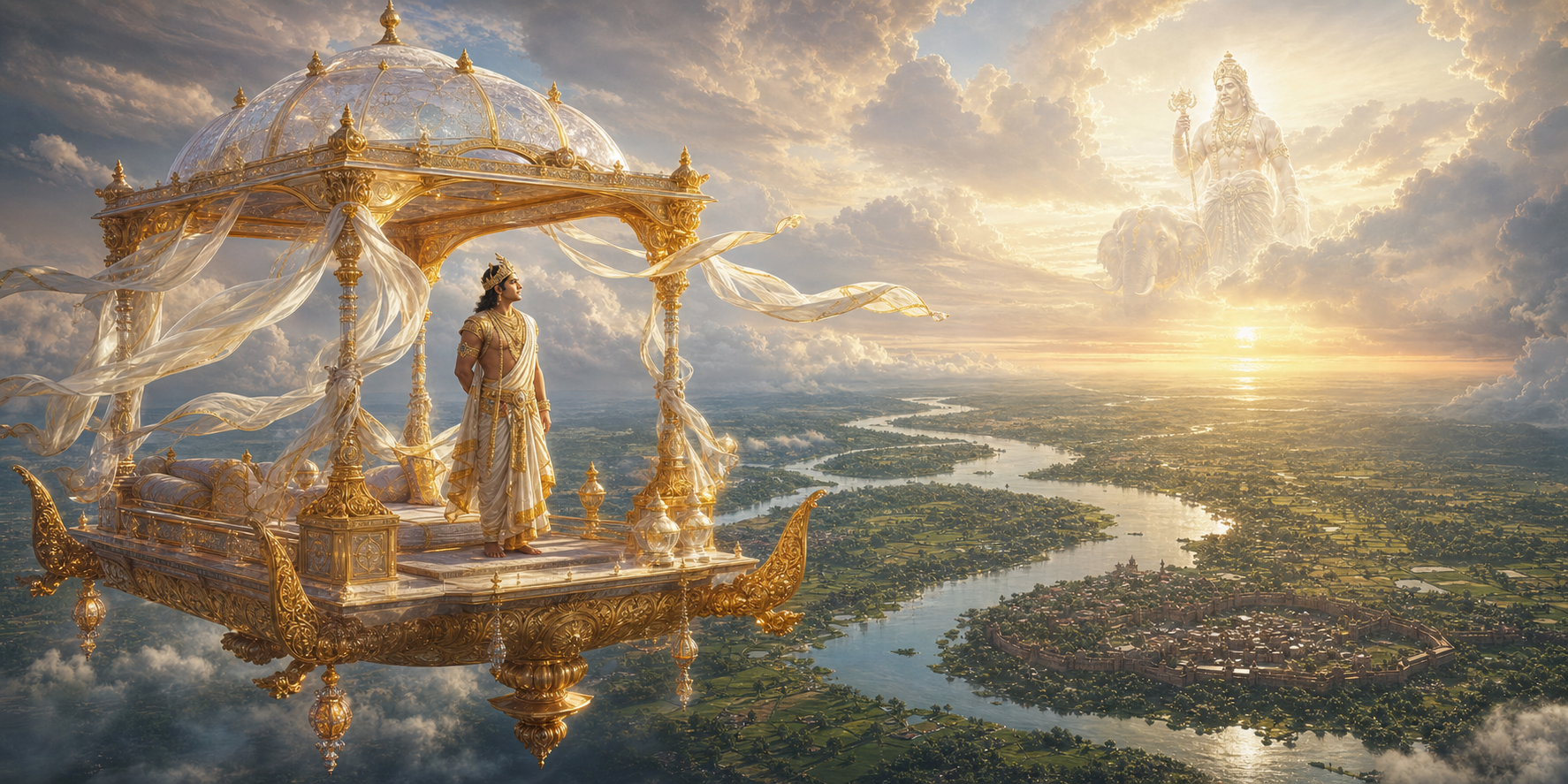
You may have arrived with a blunt question: does Uparichara Vasu’s vimana show that ancient Bharat possessed aircraft, or is it only a spiritual symbol? Neither answer is careful enough. The Mahabharata presents a sky-going vehicle as a real part of its narrative world, but it does not isolate that vehicle from dharma, kingship, or divine order.
You do not have to drain the account of wonder to read it responsibly. You only need to separate three things that are often mixed together: what the epic actually establishes, what its imagery can reasonably mean, and what a modern reader is adding by analogy.
Start with the textual minimum
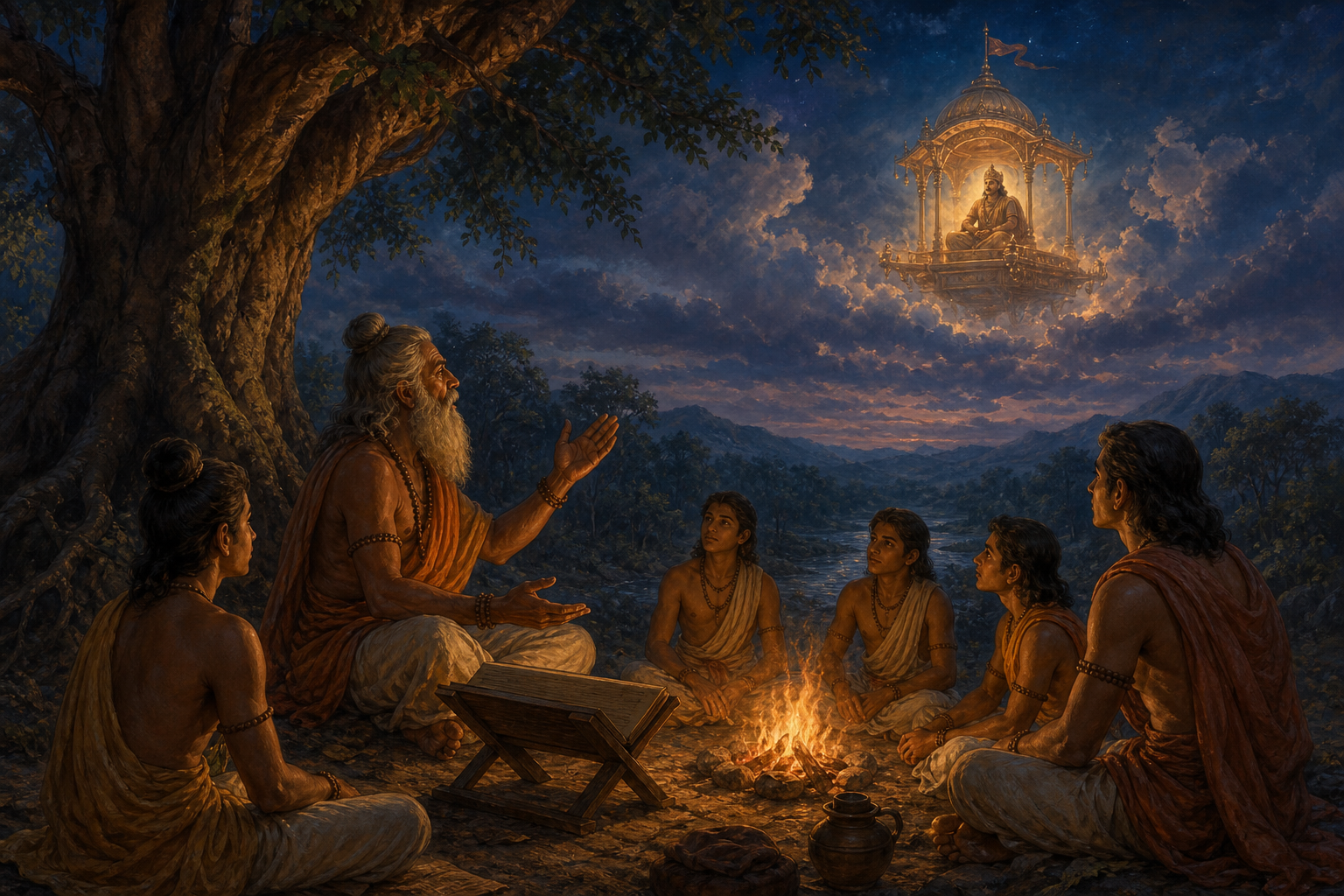
Within the Adi Parva’s Sambhava Parva, Uparichara Vasu is the ruler of Cedi, also written Chedi. His disciplined rule and spiritual merit bring him into friendship with Indra, who grants him a radiant celestial car. The king can consequently move through the upper regions rather than remain bound to terrestrial roads and boundaries.
That narrative foundation gives you four claims you can make with confidence:
- Uparichara Vasu receives the vehicle from Indra; he is not presented as its inventor.
- It is a sky-going car, not merely a stationary palace called a vimana.
- Its appearance is brilliant or gem-like, with some translations using the word “crystal.”
- Its possession is connected to the king’s merit and dharmic standing.
The same account does not provide dimensions, components, fuel, construction procedures, aerodynamic principles, or a reproducible propulsion system. It therefore cannot carry a detailed engineering claim on its own. That limitation does not prove that every technological interpretation is impossible. It tells you where the evidence stops.
The king’s name helps preserve the scene’s defining action. “Uparicara” is commonly understood through upari, meaning above, and carati, meaning moves or goes. “One who moves above” is therefore a fitting explanation of the epithet. Treat that name as part of the epic characterization, however, not as an independent technical record.
This textual minimum is the best starting point when you encounter a confident claim online. Ask whether the speaker is describing the Sanskrit epic, following a particular translation, offering a symbolic interpretation, or reconstructing a machine. Those are four different activities. A persuasive presentation should identify which one it is doing.
Indra’s gift makes flight a test of kingship
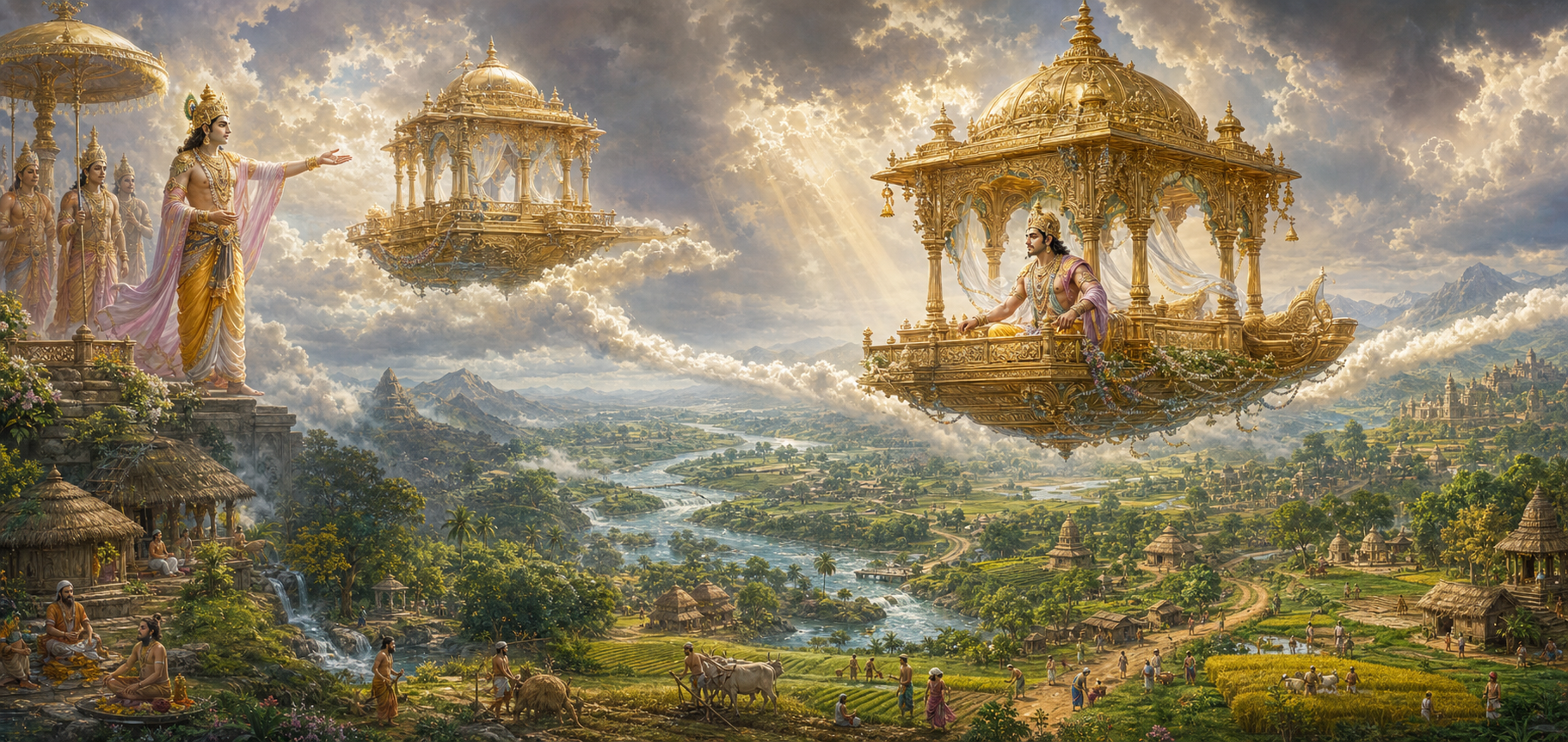
The most important fact about this vimana is not that it flies. It is that Indra bestows it. Uparichara does not seize the car in conquest or acquire it as an extravagant royal possession. Elevated capacity follows disciplined sovereignty.
That sequence gives the scene its political meaning. The king first becomes worthy of trust; only then does his range expand. Flight enlarges his field of vision, his speed of movement, and his ability to act across terrain. The boon is consequently a technology of sovereignty, but sovereignty remains accountable to a higher order.
Indra’s role matters here. As the divine patron who grants the car, he represents authorization rather than mechanical instruction. The gift links royal mobility to cosmic legitimacy. Its implicit rule is clear: unusual power is fitting only when the person directing it is governed by dharma.
This is also where the vehicle’s luminosity becomes politically suggestive. A radiant or crystalline instrument of rule evokes visibility rather than concealment. We can reasonably read that as an image of lucid, answerable power. We should not pretend that the epic is prescribing a modern transparency policy, but the analogy gives you a sharp ethical question for the present: when technology lets a ruler see farther and act faster, what keeps that enlarged reach aligned with the welfare of the ruled?
Use that question when teaching or discussing the episode. Calling the vimana an “ancient surveillance craft” would smuggle a modern category into the story. Saying that aerial mobility intensifies the king’s responsibility stays close to the narrative logic. The distinction preserves both intellectual honesty and the force of the dharmic teaching.
A comparison with Ravana’s Pushpaka Vimana clarifies the difference. Pushpaka is remembered for opulence, capacity, and large-scale transport. Uparichara’s car receives a much more concentrated presentation: brilliance, elevation, responsiveness, and royal sanction. It is fair to contrast their literary functions. It is not fair to invent two technical aircraft classes from that contrast.
Do not turn “crystal” and “vimana” into blueprints

Two words carry much of the modern argument, and both require restraint.
First, “crystal” is a translation choice for imagery that may emphasize a jewel-like, clear, or radiant appearance. Different renderings can convey slightly different material impressions. Unless you are working directly with the Sanskrit of a specified edition, do not build an engineering theory on the English noun alone.
A useful way to handle the description is to rank your conclusions by strength:
- Textually secure: the celestial car is resplendent, luminous, and extraordinary.
- Interpretively plausible: its clarity reflects sattva, purity of intention, lucid perception, or transparent authority.
- Technically speculative: it had a transparent hull, an ultralight crystalline structure, or a particular optical control system.
The third category may stimulate imaginative design, but it must remain labelled as speculation. A metaphorical association between lightness and clarity is not a measurement of mass. An ethical association between transparency and good rule is not evidence for a transparent cockpit.
Second, vimana does not carry one rigid meaning across every Sanskrit context. The word is associated with the idea of measuring or setting out a space, and its semantic range includes a proportioned structure, palace, or sanctum. In epic and Puranic settings, it can also designate the aerial cars or celestial residences of gods and exceptional rulers.
Context must therefore control the translation. It would be wrong to insist that every vimana is an aircraft. It would be equally wrong to erase obvious movement from a scene and translate every vimana as a stationary building. Uparichara’s vehicle belongs to the aerial sense because it carries him through the heavens.
Epic descriptions of celestial movement sometimes use the idea of manojava, or mind-like speed. That expression conveys extraordinary responsiveness and freedom from ordinary impediments. You may explore a philosophical analogy between intention and control, but it does not by itself establish a neural interface or any other modern mechanism.
The same restraint applies to the Vaimanika Shastra. It is widely placed in the early twentieth century and stands outside the classical textual setting of the Mahabharata. Using its proposed mechanisms to fill gaps in Uparichara’s much older account collapses separate textual histories. If you discuss them together, identify the chronology and do not let the later work speak as the epic’s missing engineering appendix.
Read the vimana through four distinct lenses
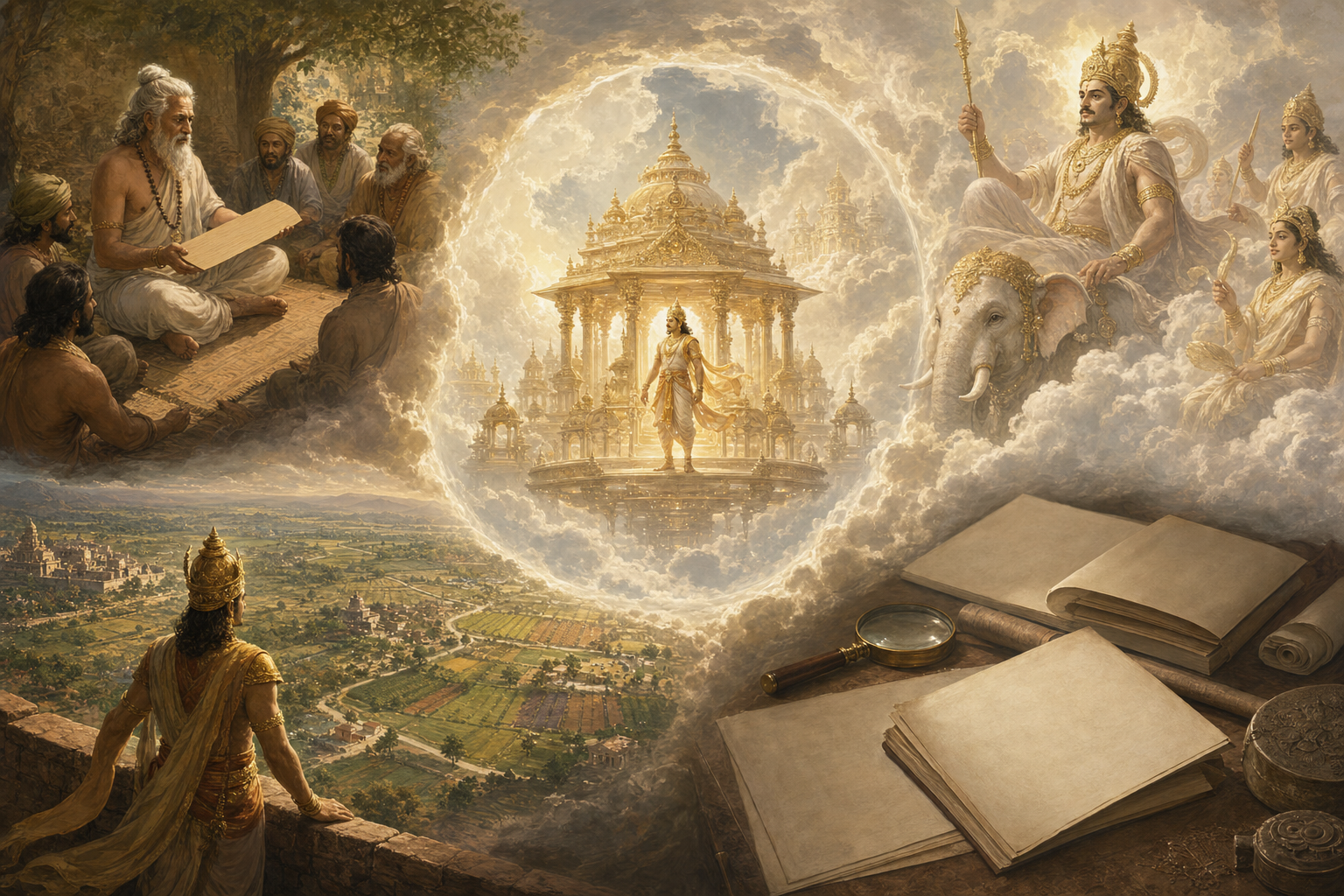
A layered reading lets you take the account seriously without forcing every kind of truth into the same category. Work through these four lenses in order:
- Literal: identify the actors and actions. Indra gives Uparichara a luminous aerial car, and the king moves above the earth. Record that before interpreting it.
- Narrative: ask why this ruler receives the boon at this point in his characterization. The answer directs attention toward merit, friendship with Indra, and the divine authorization of dharmic rule.
- Philosophical: notice how intention, perception, mobility, and authority are joined. A clear and disciplined directing intelligence is matched by a brilliant, responsive vehicle.
- Soteriological: consider ascent as an image of moral and spiritual elevation. Height is not merely a change of location; it corresponds to refinement and fitness.
Each lens answers a different question. The literal lens tells you what occurs in the epic world. The narrative lens explains the scene’s role in the life of the king. The philosophical lens draws out a relationship between mind and power. The soteriological lens asks what genuine elevation requires. Trouble begins when an insight from one lens is presented as proof belonging to another.
The wider Dharmic vocabulary of vimanas makes the last lens especially fruitful. In the Pali Buddhist Vimana-vatthu, vimanas are luminous heavenly mansions associated with the fruits of meritorious action. Jaina cosmographies likewise present celestial vimanas as abodes situated within a morally ordered cosmos. These are not interchangeable descriptions of one vehicle. Their meaningful point of contact is the association between elevation, luminosity, and ethical causation.
Sikh teachings on truthful living and remembrance can be brought into the conversation as an ethical analogy, not as evidence for the same cosmography. That boundary matters. A serious pan-Dharmic reading seeks shared moral grammar while allowing Hindu, Buddhist, Jaina, and Sikh traditions to retain their own categories.
If someone asks whether the account proves that ancient Indians flew mechanical aircraft, you can now give a precise answer. The Mahabharata unmistakably presents a sky-going royal vehicle within its narrative world. The account is important evidence for Bharat’s ancient aerial imagination, religious vocabulary, and political theology. By itself, however, it is not a construction manual, a recovered machine, or an archaeological demonstration of a modern aircraft system.
That answer is not a retreat from the tradition. It prevents fragile claims from obscuring what the episode actually offers: a sophisticated union of mobility, consciousness, moral qualification, and kingship.
Key takeaways for a responsible reading
- The Mahabharata presents Uparichara Vasu’s vimana as a genuine sky-going car within the epic narrative.
- Indra’s gift connects exceptional mobility to merit and dharmic sovereignty, making ethical fitness more central than mechanical detail.
- “Crystal” securely conveys brilliance or gem-like radiance; claims about a transparent or ultralight material remain speculative.
- The meaning of vimana changes with context, so neither “aircraft” nor “palace” should be imposed on every occurrence.
- The early twentieth-century Vaimanika Shastra should not be used to backfill technical specifications into the Mahabharata.
- Literal, narrative, philosophical, and soteriological readings can coexist as long as you do not present one kind of interpretation as evidence for another.
When you examine the account in an edition of the Mahabharata, look in the Adi Parva’s Sambhava Parva and remember that chapter numbering varies between editions and translations. Read the verses together with Uparichara’s characterization rather than extracting the vehicle as an isolated marvel. If possible, compare more than one translation before making a claim about a particular material or mechanism.
Before sharing the next graphic or argument about this vimana, attach one of three labels to every assertion: textual description, reasoned interpretation, or modern analogy. That small discipline protects the credibility of Dharmic history while leaving the epic’s vision of sacred flight fully alive.
References
