

If you are a Minnesota resident deciding whether SF 4115 deserves your support, do not let the debate collapse into whether a resolution is “merely symbolic.” The measure is not a new hate-crime statute. Its immediate job is narrower: place Hinduphobia inside the language Minnesota institutions use to recognize religious bias.
That can matter, but only if the name changes what happens next. You should judge SF 4115 on two levels: whether official recognition is warranted and whether lawmakers, schools, police, campuses, and community services will convert recognition into accessible reporting, consistent classification, and visible follow-through.
What Minnesota is being asked to recognize
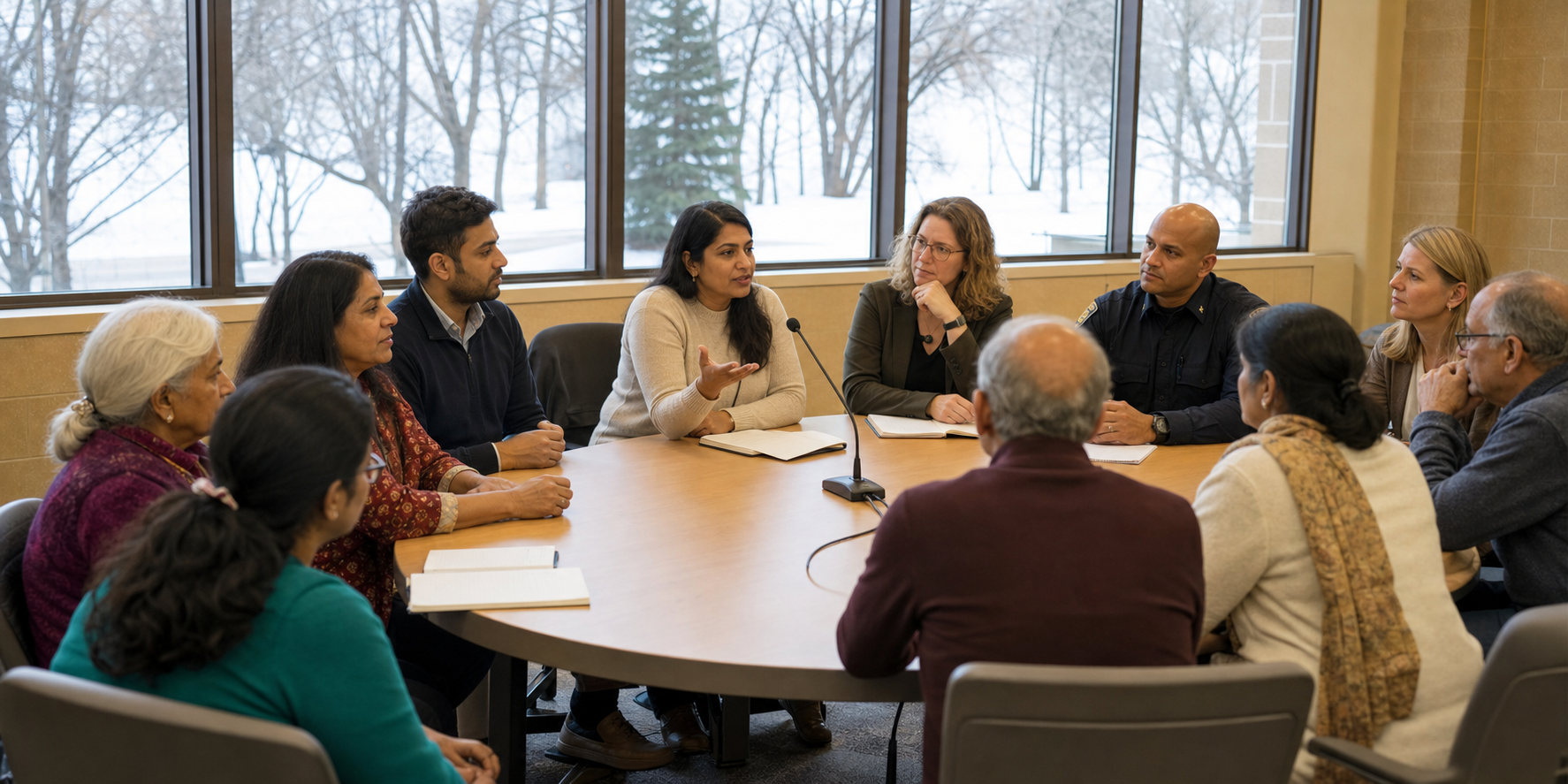
Introduced in the Minnesota Senate on March 9, 2026, SF 4115 addresses discrimination, intimidation, and hatred directed at Hindu Americans. At the stage established here, the measure had been introduced and heard by the Senate Judiciary and Public Safety Committee. Do not describe it as adopted or as law without checking its current legislative status.
The community response was substantial. More than 400 Minnesotans signed a letter within days, asking legislators to recognize Hinduphobia, improve reporting pathways, and include Hindu communities in anti-bias and public-safety work. That figure demonstrates organized constituent support. It is not an incident count and should never be presented as the number of victims.
Committee testimony from Neha Markanda and Raj Dash pointed to hate speech aimed at a temple in Edina, thefts at priests’ homes in Maple Grove, and earlier vandalism and intimidation involving Hindu institutions. Those events are not interchangeable. Hate speech aimed at a Hindu temple carries direct religious context; a theft involving a Hindu victim may require more investigation before motive can be determined.
That distinction is central to responsible advocacy. Record the underlying conduct and the suspected bias separately. Doing so protects victims from having the identity dimension erased while protecting the credibility of Hinduphobia reporting from claims that every offense involving a Hindu is automatically anti-Hindu.
A precise definition protects Hindus and honest debate

A practical working definition of Hinduphobia is hostility, prejudice, exclusion, intimidation, or violence directed at Hindus, Hindu practices, symbols, or institutions because they are Hindu. The words “because they are Hindu” matter. They connect the conduct to identity rather than merely identifying the victim’s religion.
When you evaluate a reported incident, ask four questions:
- What was targeted? Identify the person, temple, home, organization, practice, symbol, event, or belief involved.
- What happened? Record the threat, slur, exclusion, assault, vandalism, theft, harassment, or other conduct without exaggerating it.
- What indicates motive? Look for exact language, symbols, repeated targeting, selection of a Hindu institution, statements by the actor, or other context connecting the conduct to Hindu identity.
- Would the same standard be used for another faith? Anti-bias protection loses legitimacy when one community must prove more, or less, than everyone else.
For example, an anti-Hindu slur placed on a temple is both property damage and evidence bearing on bias. Generic damage with no known identity-related context remains property damage unless an investigation uncovers more. The category should preserve relevant evidence, not decide the entire case in advance.
Criticism of a doctrine, a caste practice, temple management, an Indian political party, or the government of Bharat is not automatically Hinduphobia. It moves toward anti-Hindu bigotry when disagreement becomes collective blame, dehumanization, unequal treatment, intimidation, or hostility toward Hindus as Hindus. Anti-India and anti-Hindu rhetoric can overlap, but neither label should substitute for evidence.
The same precision is necessary across the Dharmic family. Hindu, Buddhist, Jain, and Sikh traditions share civilizational connections and important ethical commitments, but they are not interchangeable reporting categories. An incident targeting a Sikh gurdwara should be recorded as such, not relabeled as anti-Hindu merely to fit a broader campaign. Solidarity becomes stronger when every community’s identity is named accurately.
That is why support offered in committee by the Jewish Community Relations Council matters. Interfaith allies do not have to claim identical experiences. They can insist on the same civic principle: religious hatred should be recognized before normalization makes it harder to confront.
Passage should trigger an implementation test

As a legislative resolution, SF 4115 can become an official statement of Senate values and intent. It can help establish vocabulary, signal an institutional priority, and encourage coordination across education, law enforcement, and community services. It cannot perform those tasks by itself.
| SF 4115 can help Minnesota do | SF 4115 cannot do by itself |
|---|---|
| Name anti-Hindu bias as a recognizable problem | Prove that bias motivated a particular incident |
| Express the Senate’s opposition to Hinduphobia | Create a new criminal offense or change existing evidentiary standards |
| Encourage agencies and institutions to coordinate | Build an accessible reporting system, train responders, or reconcile data automatically |
| Reassure Hindu Minnesotans that their concerns are visible | Guarantee an investigation, remedy, victim service, or accountable outcome |
This is why the strongest case for passage is practical rather than rhetorical. A category that institutions can recognize makes better reporting and training possible. The public should then ask whether those systems were actually built.
If SF 4115 is adopted, implementation should include:
- A common definition. Schools, police departments, universities, and community services need compatible language, including a clear boundary between anti-Hindu bias and legitimate criticism.
- Accessible intake routes. A person should be able to report by a practical channel, understand what information is requested, and learn whether the report is confidential, public, or potentially shared with another agency.
- Dual classification. Intake systems should capture both the underlying conduct and the suspected bias. A vandalism report, for example, should not lose evidence of anti-Hindu motive simply because vandalism is the primary offense category.
- Scenario-based training. Frontline staff should learn how anti-Hindu hostility can appear in threats, slurs, institutional exclusion, temple targeting, and online harassment, while avoiding assumptions unsupported by evidence.
- Victim support and referral. Recognition is incomplete if a victim receives an incident number but no information about safety planning, institutional procedures, community support, or the next point of contact.
- Public accountability with privacy. Agencies should explain how reports are classified, corrected, deduplicated, and resolved, while withholding information that could expose victims or witnesses.
- Continuing community consultation. Hindu organizations should be included in anti-bias and safety initiatives, while Buddhist, Jain, and Sikh organizations should be consulted in their own names about the forms of bias affecting them.
A March 16 Capitol gathering involving SF 4115 author Senator Warren Limmer, Hindu community members, Maple Grove’s police chief and deputy chief, and a city council member showed the kind of coalition implementation requires. The next question is operational: who will improve intake, who will train staff, who will maintain community contact, and who will report whether the process worked?
What you can do before the Legislature acts

If you experience or witness a possible anti-Hindu incident
- Deal with immediate danger first. Contact emergency services if a threat is active. Do not delay safety measures in order to gather photographs or confront the suspected actor.
- Preserve the original evidence. Save exact words, unedited photographs or video, URLs, usernames, messages, dates, times, locations, and any available witness information. Keep an original copy separate from annotated or cropped versions.
- Write a factual sequence. Record what happened before memory becomes less precise. Separate what you personally observed from what another person told you.
- Describe conduct and possible motive separately. Instead of writing only “This was Hinduphobia,” state the act and the evidence connecting it to Hindu identity. Exact language is usually more useful than a broad characterization.
- Use the appropriate channels. Report a possible crime or threat to law enforcement, and report institutional conduct to the relevant school, employer, campus, landlord, platform, or venue. Tell each recipient where else the incident was reported so duplicated records can be identified.
- Ask for a traceable response. Request an incident or case identifier, the classification used, a contact person, and the process for supplying more evidence. If suspected anti-Hindu bias is missing, ask how the record can be corrected or supplemented.
- Protect the affected person’s control. Do not publish a victim’s name, home address, immigration information, children’s details, or identifiable images without informed permission. Public advocacy should not create a second safety problem.
You do not need to decide whether conduct meets a criminal or civil legal standard before reporting it. Your job is to preserve facts and identify relevant context. Institutions and legal authorities must apply the governing rules to the evidence.
If you lead a temple or Dharmic organization
- Publish a named intake contact and a backup contact rather than sending distressed community members through a general mailbox.
- Use a standard incident form that captures conduct, suspected motive, evidence, safety concerns, reporting destinations, consent preferences, and follow-up status.
- Label public claims carefully. Distinguish a community report from corroborated facts and from an official classification. Do not present an allegation as an adjudicated finding.
- Keep original evidence secure and restrict access to people who need it. A public social-media folder is not a responsible evidence archive.
- Agree with interfaith partners on a referral method. An ally who hears about an anti-Hindu threat should know whom to contact, just as Hindu organizations should know where to refer incidents targeting Jewish, Buddhist, Jain, Sikh, or other communities.
- Review outcomes, not only intake totals. A large reporting count reveals little unless you also know whether people received follow-up, classifications were corrected, safety needs were addressed, and repeat locations were identified.
If you want your legislator to act
Verify SF 4115’s current status before writing, then make a constituent request that covers both recognition and implementation. A short message is more useful than a forwarded chain containing unsupported statistics.
Constituent message: I live in [city or ZIP] and ask you to support SF 4115. Naming anti-Hindu bias would affirm that Hindu Minnesotans deserve the same religious freedom and institutional attention as every other community. I also ask you to support accessible reporting, consistent classification, responder training, victim follow-up, and Hindu participation in statewide safety initiatives. Please tell me your position on the resolution and which implementation measures you support.
If you add an incident, use one you can describe accurately and share with permission. If you mention the more than 400 signatories who supported passage, use that number only to demonstrate constituent mobilization. It does not establish the prevalence of Hinduphobia in Minnesota.
Key takeaways
- SF 4115 would provide official recognition of Hinduphobia; it should not be mistaken for a new enforcement statute.
- Naming the bias can improve reporting and institutional awareness only when a precise definition, trained responders, and usable intake systems follow.
- Record the underlying conduct and evidence of possible anti-Hindu motive separately. Hindu identity alone does not prove motive, and uncertainty should not erase relevant context.
- Protect legitimate religious, historical, and political debate by distinguishing criticism from collective blame, exclusion, intimidation, and hostility toward Hindus as Hindus.
- Support solidarity across Hindu, Buddhist, Jain, Sikh, Jewish, and other communities without collapsing their distinct identities or experiences.
- Ask lawmakers how they will vote and what they will do after the vote. Recognition matters; accountable implementation determines whether it reaches a family, student, employee, or temple when an incident occurs.
If you support SF 4115, make your next action specific. Contact your senator with a clear request for passage or the appropriate next legislative step, then ask who will own reporting, training, victim support, and public follow-through. That is how a statement of values becomes a durable protection for religious freedom.
References
