

You may be sincere in worship, meditation, work, and family duty, yet still find that your peace rises and falls with praise, progress, comfort, and other people’s responses. The problem is not that you enjoy life. It is that the mind quietly turns each enjoyable condition into a requirement: this must happen, this must continue, and this must not be taken away.
Vairagya offers a way out without asking you to become cold, passive, or absent from the world. It loosens the demand that changing things provide permanent fulfillment. Joined with dharmic action and contemplative discipline, it lets you participate fully while discovering ananda as steady clarity rather than another passing mood.
Vairagya begins when pleasure stops making promises
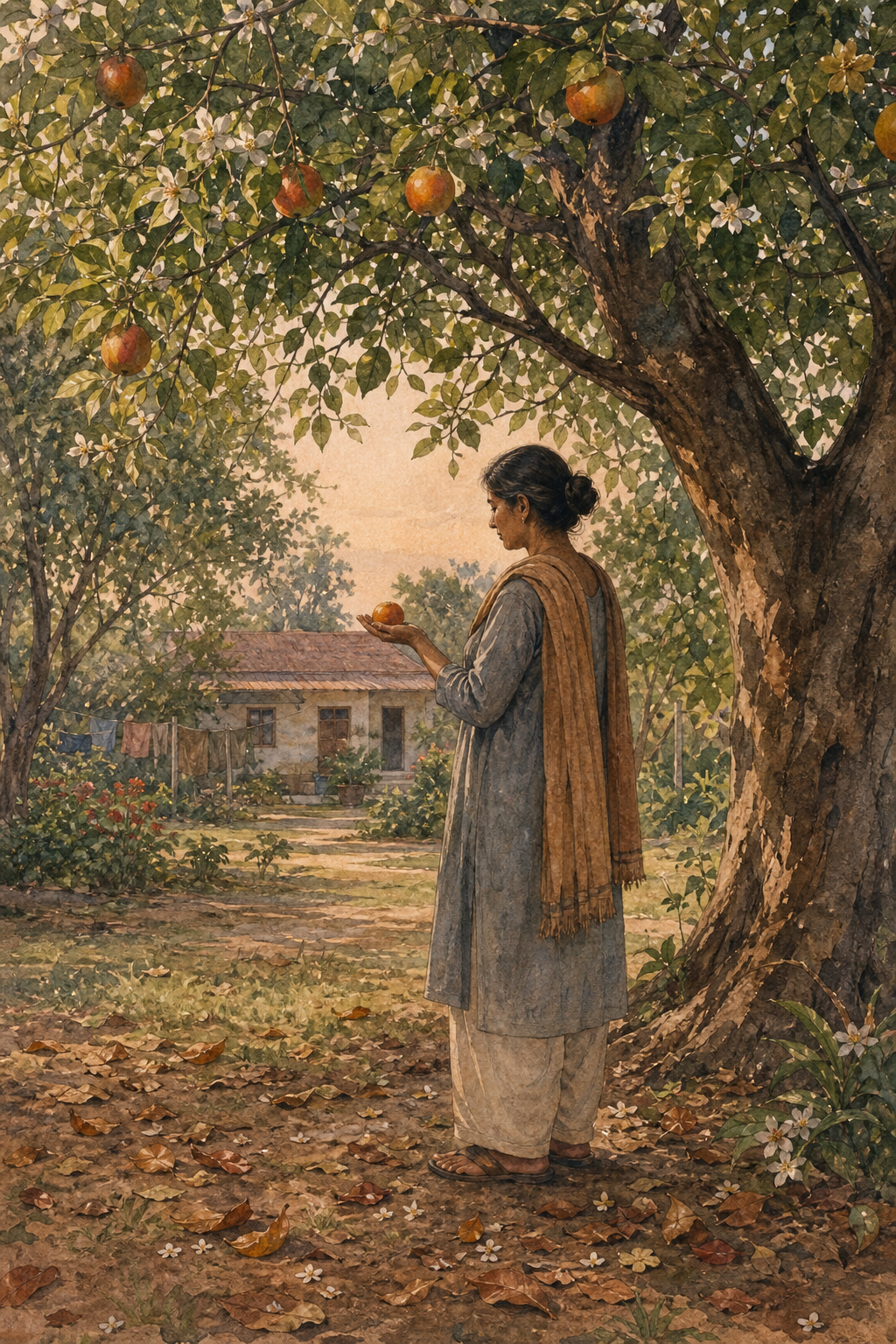
One of the sharpest tests of detachment is not whether you can endure an unpleasant experience. It is whether you can see the limit of an exceptionally pleasant one. King Arishtanemi’s refusal of Indra’s heaven makes that test unmistakable. He is not rejecting misery, corruption, or an unworthy reward. He turns away from celestial enjoyment because it is still produced by merit, limited by time, and followed by return.
The kingdom of desire always offers the same bargain in different clothing: acquire the condition, protect it, and then seek another when it changes. Svarga represents the most refined version of that bargain. Modern equivalents may be prestige, financial comfort, an ideal relationship, spiritual recognition, curated experiences, or a perfectly controlled routine. None of these is necessarily wrong. The mistake is assigning any of them a task they cannot perform: ending the sense of lack.
This is why vairagya should not be translated in practice as dislike. Aversion remains a bond because the unwanted object still controls attention. Nor is vairagya suppression, where you continue to crave something while forcing yourself to appear indifferent. Genuine detachment is lucid valuation. You see an experience as pleasant or painful, valuable or harmful, without confusing its temporary character with your deepest well-being.
Three different inner statements help expose the distinction:
- Attachment: “I need this outcome in order to be complete.”
- Suppression: “I must not want this, or I am not spiritual.”
- Vairagya: “I may prefer this outcome, but my clarity and dharma do not depend on receiving it.”
The movement into freedom follows a practical sequence. Viveka, or discrimination, first reveals what is changing and what you have mistakenly asked it to guarantee. Vairagya then withdraws the extra authority given to that object. Vichara, or inquiry, becomes possible because attention is no longer wholly occupied by pursuit and resistance. The mind can finally examine the awareness in which wanting, receiving, enjoying, fearing, and losing all appear.
Use this sequence when a desire becomes urgent. Ask what you expect the desired object to change within you. Ask whether the satisfaction will remain when the condition changes. Notice which duty, value, or relationship becomes easier to neglect while the mind is bargaining for the result. Then ask whether you can pursue what is legitimate without making your inner balance hostage to success.
You do not have to refuse every opportunity in imitation of a renunciant king. Prince Rama, the intended recipient of Vasistha’s teaching, is destined for public responsibility. For a householder, the relevant renunciation is often not the abandonment of work, family, beauty, or prosperity. It is the abandonment of the belief that possession can secure the possessor.
Cosmic harmony is right relation, not a pleasant vibration

Once craving loses its throne, cosmic harmony becomes more than an attractive phrase. In the Vedic language of rta, existence has an intelligible order. In Kashmir Shaivism, spanda names the dynamic throb of manifestation. Shabda Brahman and the contemplative use of Om approach reality through sacred sound. These ideas do not mean that every preferred event can be produced by maintaining the correct mood. They call you to refine perception, intention, and conduct until your life no longer fights the truth of interdependence and change.
Harmony therefore cannot be measured by how pleasant your day feels. You may act in accordance with dharma while facing fatigue, grief, conflict, or an unwanted result. You may also feel temporarily elated while acting from vanity or compulsion. The reliable question is not “Do I feel spiritually elevated?” but “Are thought, breath, speech, choice, and duty moving in the same ethical direction?”
Hindu darshanas give different metaphysical accounts of this alignment. Those differences matter. Use the language of your sampradaya rather than blending every teaching into a vague claim that all distinctions disappear.
| Dharmic lens | What harmony emphasizes | A useful question for practice |
|---|---|---|
| Advaita Vedanta | Recognition that apparent separation does not define the reality of the Self | What is aware of this changing thought, role, or desire? |
| Vishishtadvaita | The individual as an inseparable mode of the divine whole | Does this choice express loving participation in the whole? |
| Dvaita | Enduring distinction joined to loving concord with Vishnu’s will | Am I offering this action faithfully rather than claiming control? |
| Samkhya-Yoga | Clarity of witness-consciousness amid the processes of Prakriti | Can I observe this mental movement without becoming identical with it? |
The Bhagavad Gita 6.29 describes the yogin who sees the Self in all beings and all beings in the Self. That vision has an immediate ethical consequence. Another person’s welfare can no longer be treated as spiritually irrelevant. Ahimsa, satya, restraint, and service are not decorations placed around meditation. They reduce the contradiction between what you profess in contemplation and what you create through action.
The same practical convergence appears across Dharmic traditions without making their doctrines identical. Buddhism examines dependent arising and loosens the craving that turns changing experience into suffering. Jain dharma disciplines possession and injury through aparigraha, ahimsa, and the equanimity of samayik. Sikh dharma aligns the person with hukam through Naam Simran and carries remembrance into seva. Hindu paths coordinate discernment, devotion, meditation, and selfless work through jnana, bhakti, dhyana, and Karma Yoga. In each case, inner steadiness becomes credible when it changes how you meet other beings.
This also clarifies ananda. Lasting bliss is not uninterrupted excitement, sensory pleasure, or emotional sweetness. Anything that rises as a mental state will change as conditions change. The Taittiriya Upanishad’s progression through the pancha koshas points toward a more integrated account: bodily life, prana, mind, discernment, and bliss cannot be treated as unrelated compartments. Harmony across breath, attention, ethics, and action makes a quieter joy available – one expressed as clarity, care, and a durable ease with change.
A householder’s practice for moving from craving to coherence

A useful routine does not try to manufacture a mystical experience. It repeatedly exposes the places where your stated values and actual habits diverge. Work with the following sequence using the mantra, divine form, or contemplative method appropriate to your path.
- Meet awareness before stimulation. After waking, sit before opening messages, news, or entertainment. Let the body become still and notice the condition of the mind without immediately trying to improve it. This prevents the first demand of the day from setting your inner direction.
- Steady prana without strain. Use gentle Nadi Shodhana or simple, even breathing. A slow range of roughly 5-6 breaths per minute can support calm focus, but the number is secondary to comfort and evenness. Do not force the pace or add breath retention merely to make the practice feel advanced.
- Gather attention around one sacred anchor. Recite Om, an ishta-mantra, or Naam according to your discipline. When attention wanders, return without turning the wandering into a verdict about yourself. This is abhyasa: not a dramatic conquest of the mind, but a dependable return.
- Name the duty before naming the reward. Identify the action that is yours to perform in family, work, community, or sadhana. Dedicate it to Ishvara or lokasangraha. Then state plainly which result you prefer but cannot command. This separates committed effort from the demand that reality validate you.
- Review the day for grasping and alignment. Before sleep, remember where attraction or aversion took control. Identify the story the mind used: “I must win,” “I must be admired,” “I cannot tolerate this,” or “My peace depends on their behavior.” Then name one more dharmic response you could choose when the pattern returns.
Carry the same method into the moment of activation. Suppose a message is delayed, your work is criticized, someone else receives recognition, or a desired purchase begins to feel necessary. First feel the bodily and mental contraction without feeding its story. Name the preference accurately. Remove the false claim of necessity. Then choose the action that remains right even if the preferred result never arrives.
This does not make you passive. Non-attachment concerns ownership of the result, not the quality of the effort. You can prepare carefully, set a boundary, correct an injustice, protect a responsibility, or pursue excellence. What changes is the inner bargain. You stop saying, “I will act rightly if the world pays me in the form I demand.”
Enjoyment can also become part of the practice. Receive a good meal, success, companionship, art, ritual beauty, or material comfort with gratitude. Notice the instant appreciation becomes fear of loss or insistence on repetition. There is no need to spoil the pleasure by condemning it. Simply decline the mind’s invitation to convert a gift into a dependency.
Keep one principal discipline stable. Constantly replacing a mantra, guru, meditation method, or philosophical vocabulary can become another form of appetite. Hindu recognition of ishta protects diversity without requiring perpetual spiritual shopping. Depth usually asks you to remain present when novelty fades and the practice begins revealing the habits you would rather avoid.
Recognize real detachment by what it does to your conduct

Signs that vairagya is becoming mature
- Preference becomes lighter. You can want an outcome, work toward it, and remain capable of wise action when it does not occur.
- Attention returns more readily. A praise, insult, pleasure, or disappointment occupies less mental space after the event has passed.
- Enjoyment becomes cleaner. You can receive what is pleasant without immediately planning how to secure, display, or repeat it.
- Duty becomes less transactional. You act because an action is right, not only because it promises recognition, advantage, or a spiritually impressive self-image.
- Compassion expands. Reduced self-preoccupation leaves more attention for ahimsa, listening, generosity, and seva.
- Change becomes easier to face. Pain is still pain, but it no longer proves that existence has betrayed you.
Counterfeits that should be corrected early
- Numbness: Vairagya clarifies feeling; it does not require you to stop feeling. Persistent hopelessness, inability to manage basic duties, or severe emotional withdrawal should not be romanticized as spiritual attainment. Seek appropriate professional support.
- Neglect: Abandoning commitments that depend on you is not automatically renunciation. Inner freedom should make righteous responsibility cleaner, not disposable.
- Superiority: Looking down on householders, devotees, ritual practitioners, prosperous people, or members of another Dharmic path merely gives ego a renunciant costume.
- Spiritual bypassing: Calling every injury “maya” can become a way to avoid apology, repair, grief, or courageous action. Cosmic language does not cancel consequences.
- Hostility toward the world: Hatred of the body, society, beauty, or nature is aversion, not freedom. The world can be impermanent without being contemptible.
- Chasing elevated states: Visions, calm, devotional sweetness, and subtle experiences may arise in sadhana. If you need them to recur, the object of attachment has changed but the structure of attachment remains.
A simple test brings these signs together: after practice, are you more available for the next right action? If meditation makes you harder to interrupt, less truthful, more self-important, or indifferent to those who rely on you, the experience may be pleasant but the alignment is incomplete. If it produces steadier attention, measured speech, reduced compulsion, and greater willingness to serve, vairagya is entering conduct.
Key takeaways
- Vairagya does not forbid enjoyment; it ends the demand that enjoyment provide permanent completeness.
- Cosmic harmony is tested through right relation – among awareness, breath, speech, duty, other beings, and the order you cannot control.
- Ananda is better recognized as steady clarity and care than as uninterrupted emotional pleasure.
- Viveka reveals the limit of a desire, vairagya removes its authority, and vichara turns attention toward the awareness in which it appears.
- The most trustworthy signs of progress are lighter preference, cleaner duty, less reactivity, and more compassionate action.
Begin with one desire that currently has leverage over you. Do not condemn it or obey it automatically. Name the legitimate preference, release the claim that fulfillment depends on it, and perform the next dharmic action available to you. Repeated sincerely, that small movement is how renunciation becomes harmony and harmony becomes a life capable of recognizing bliss.
References
- DharmaRenaissance Blog – Beyond Indra’s Heaven: King Arishtanemi’s Bold Renunciation and Yoga Vasishta’s Vairagya
- DharmaRenaissance Blog – Bliss in Cosmic Harmony: Align Individual Life with the Universal Rhythm in Hindu Thought
