
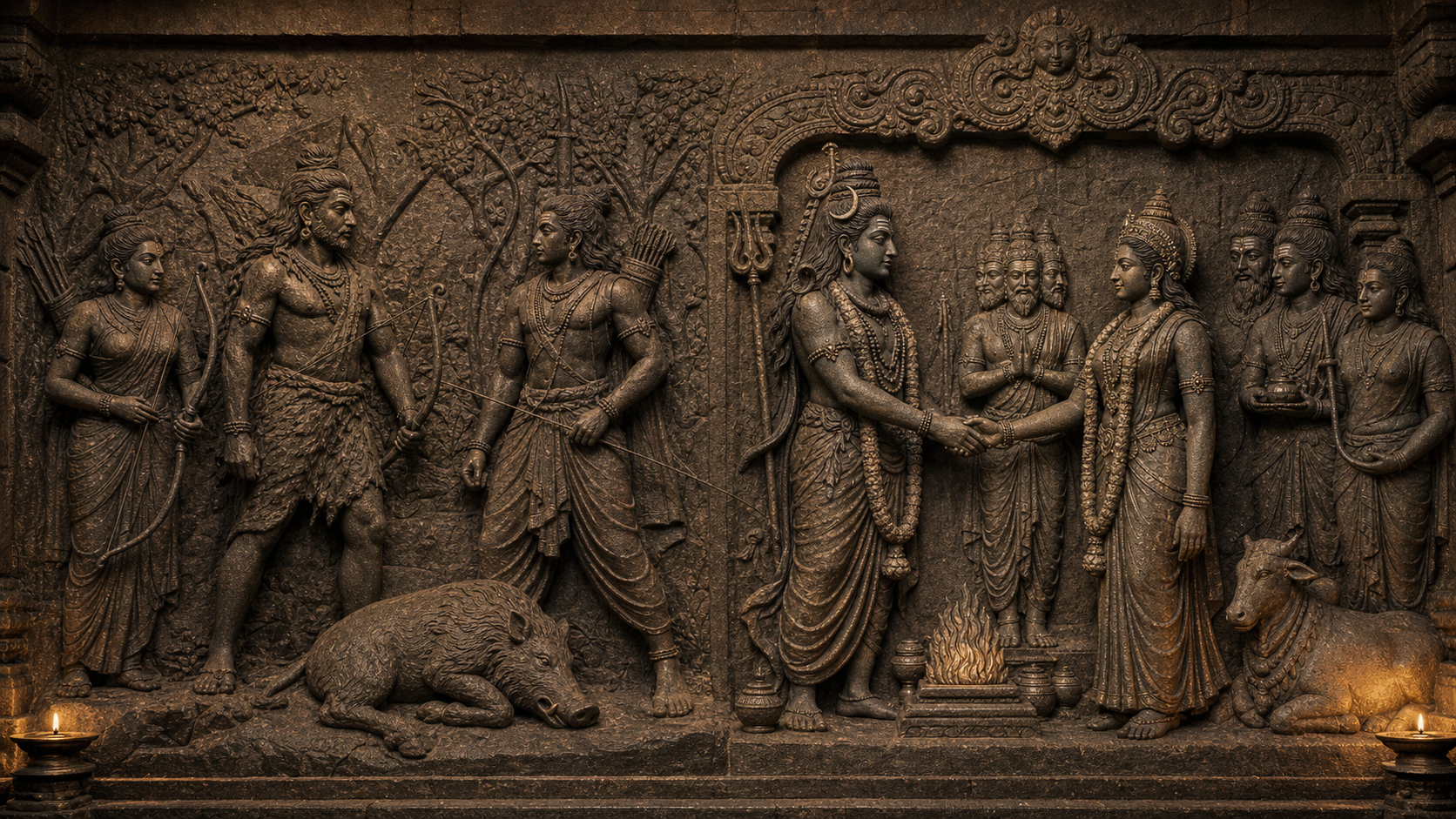
You are standing before a Shiva image in a Tamil temple. One figure carries a bow; another scene centers on joined hands. You may recognize a hunter and a wedding, yet still wonder what the sculptor expected you to see beyond the story.
Use the image as a sequence of clues. Begin with the central action, confirm it through the hands and companions, and only then ask what it demands of you. That method distinguishes Kirata Murti from Kalyanasundara Murti while preserving the spiritual force of both.
Begin with the action, not the ornament
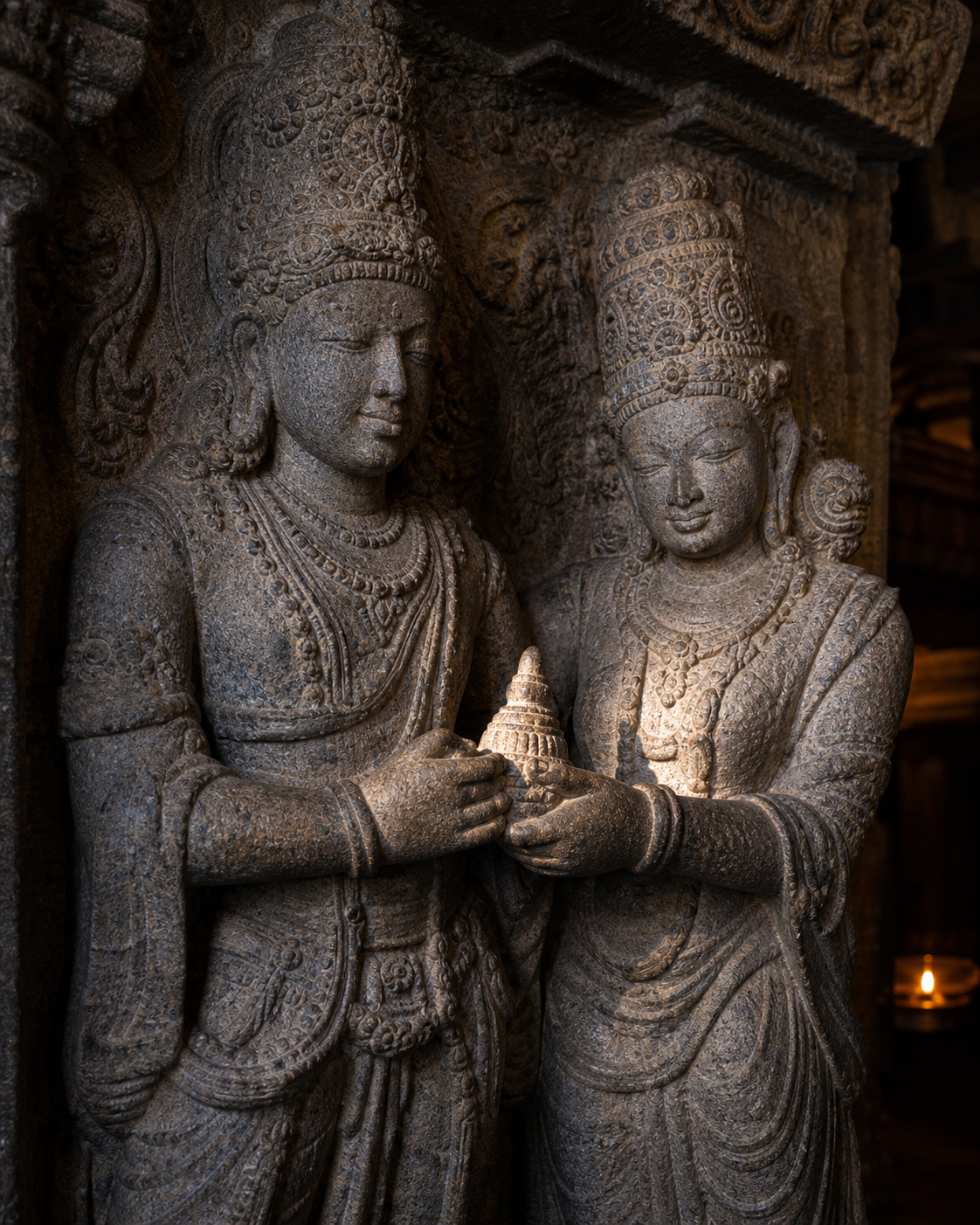
Temple iconography rewards disciplined looking. An isolated object can mislead, especially when a sculpture is damaged, crowded with attendants, or separated from its original ritual setting. The whole composition usually gives the stronger identification.
- Name the action before naming the deity. Are the figures confronting each other, performing austerity, exchanging a wedding gesture, or witnessing a rite?
- Read the hands. A weapon-bearing hand and a marriage clasp perform different theological work.
- Check the supporting objects. Look for a bow, arrows, quiver, ascetic signs, ritual fire, or other contextual clues.
- Identify the surrounding roles. An ascetic, huntress, priest, guardian, witness, or celestial assembly can settle an otherwise uncertain reading.
- Notice the mood. Alert movement points you toward a different manifestation from composed ceremonial stillness.
How to recognize Kirata Murti
Kirata Shiva appears as a forest-dwelling hunter. The most reliable cluster of signs is a bow, arrows or quiver, vigorous bearing, rough or animal-hide clothing, and ornaments associated with life beyond the courtly world. The stance may look ready for confrontation rather than settled in meditation.
Parvati may accompany him in a huntress form, sometimes with attendants that make the scene resemble a complete hunting party. Arjuna may be visible as an ascetic, but his presence can also be implied through matted hair, raised arms, one-legged penance, or another sign of tapas. Do not reject a Kirata identification merely because a clearly labelled warrior is absent.
How to recognize Kalyanasundara Murti
Find the joined hands first. The defining gesture is pāṇigraha: Shiva’s right hand receives or clasps Parvati’s left hand. Those directions belong to the figures themselves, so they appear reversed from your viewpoint when the couple faces you.
The larger wedding assembly can confirm the scene. Vishnu commonly serves as Parvati’s guardian and giver, Brahma officiates as priest, Agni witnesses the rite, and ganas and devas form the celestial gathering. Not every surviving image preserves every participant. The handclasp therefore deserves priority over the number of attendants.
Kirata: why the god arrives as an opponent
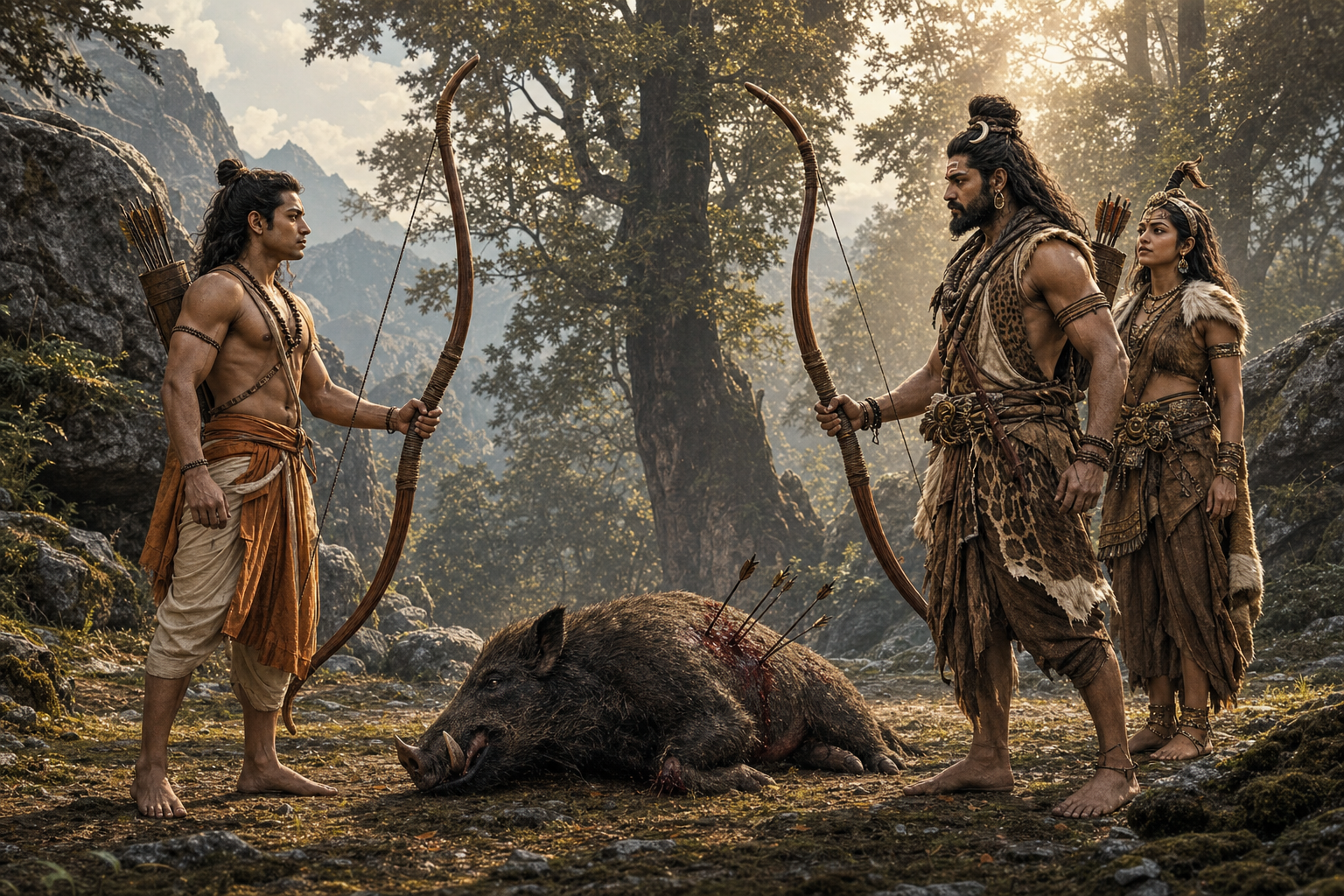
In the Vana Parva of the Mahabharata, Arjuna undertakes severe austerities and encounters Shiva without recognizing him. The deity does not arrive in an immediately reassuring form. He appears as a hunter, meets Arjuna in combat, tests him, and reveals himself only after Arjuna’s courage has passed through humility. Shiva then grants the Pashupatastra.
The episode prevents three easy misreadings. The hunter is not a diminished Shiva, the confrontation is not meaningless hostility, and the divine weapon is not simply a prize for aggression. Power comes after testing, recognition, and the surrender of arrogance. A symbolic reading of the Pashupatastra therefore emphasizes awakened agency joined to responsibility.
This distinction matters whenever you face resistance in your own sadhana. Difficulty is not automatically a divine test; ordinary obstacles can remain ordinary obstacles. Kirata gives you a narrower and more useful question: what does opposition expose about the person seeking power? Arjuna’s skill is real, but skill alone does not qualify him to carry what he seeks.
- What capacity, authority, or recognition are you trying to gain?
- Which criticism makes you defensive because it touches pride rather than principle?
- What harm could follow if you received greater power without greater restraint?
- What evidence would show that your discipline has produced humility, not merely endurance?
These questions turn the image into a practical examination of motive. Kirata does not ask you to become passive. Arjuna must remain courageous and capable. The correction is directed at self-importance, not excellence.
The hunter form also asks you to notice where sacred sovereignty appears. Forest attire and ornaments are not incidental decoration placed outside respectable dharma. Shiva assumes them. Read the form with dignity: it brings forest and tribal ecologies into the sacred field without requiring the deity to appear as a courtly ruler. At the same time, avoid assigning a particular sculpture to a modern community unless an inscription, local tradition, or informed temple authority supports that identification.
Kalyanasundara: the theology is in the joined hands
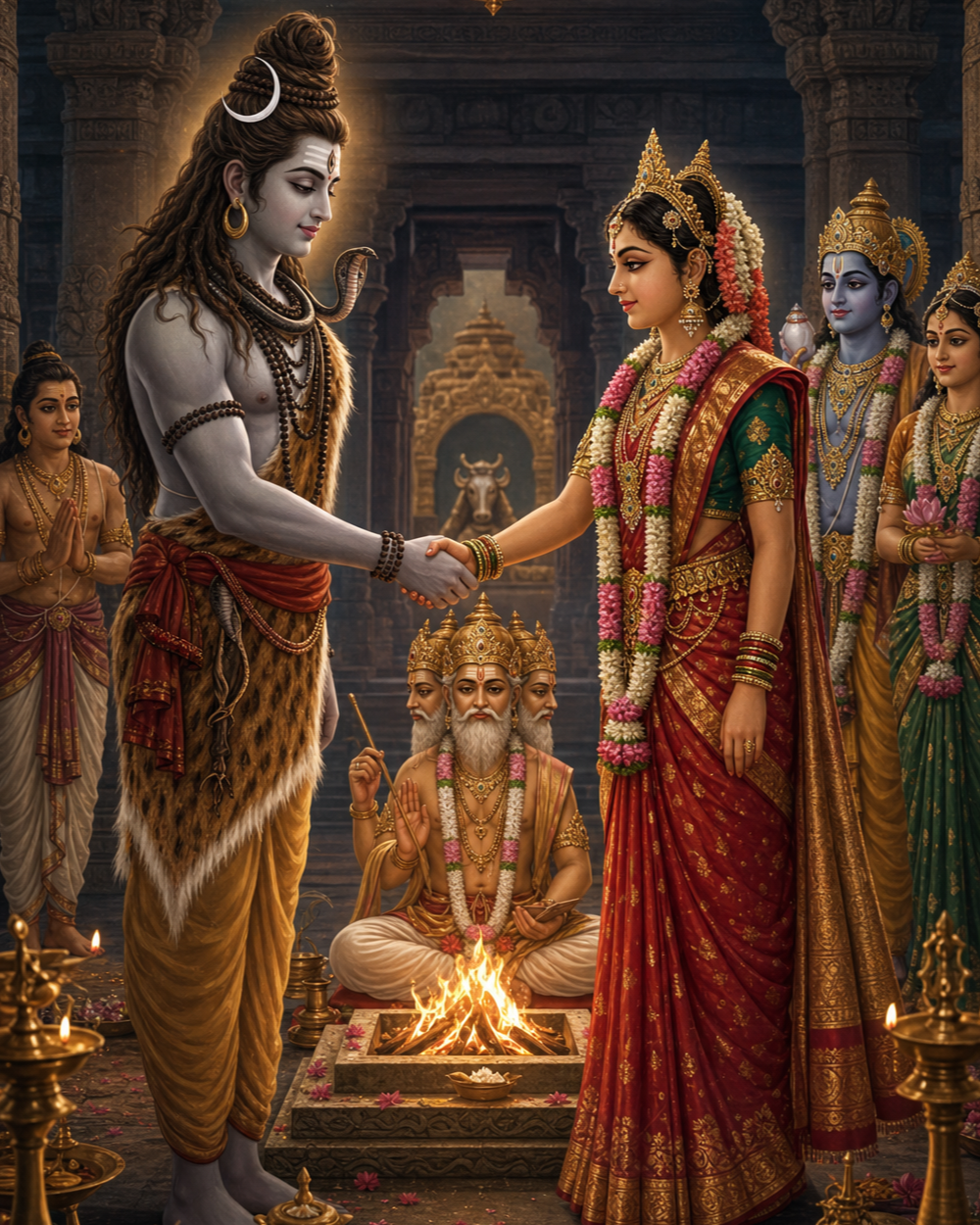
Kalyanasundara is easy to reduce to a decorative divine wedding. The pāṇigraha gesture prevents that reduction. It condenses vow, protection, trust, and mutual entrustment into one visible action. Shiva is not shown as an isolated ascetic who merely tolerates worldly life. Shiva and Shakti stand in a relation through which the world is nurtured and sustained.
Read the composition from the center outward. Begin with Shiva and Parvati’s hands. Then locate the family or guardian role represented by Vishnu, the priestly role of Brahma, the witnessing fire of Agni, and the wider gathering of divine beings. The image makes an exact claim through this arrangement: a sacred bond concerns the couple, but it is not sealed in social emptiness. Vow, witness, kinship, and community belong to the rite.
This is why Kalyanasundara matters to householders. The murti does not treat marriage, work, kinship, and mutual obligation as distractions left behind by serious spiritual people. It presents relational life as a field of dharma. That does not make every relationship automatically righteous. It gives you criteria by which a relationship can become more truthful: promises must be intelligible, responsibilities must be carried, power must answer to trust, and the bond must support rather than consume the lives within it.
- Translate a cherished vow into one observable duty. A promise to care must become time, attention, protection, or material responsibility.
- Ask whether both people can entrust something real to the relationship without surrendering moral agency.
- Identify the witnesses who help the bond remain accountable. Community is not there only to celebrate the beginning.
- Repair the neglected ritual of attention. A repeated act of listening, service, worship, or shared responsibility often carries a vow more faithfully than ceremonial language alone.
In Tamil temple culture, the divine wedding moves beyond carved stone. Celebrations such as the marriage of Meenakshi and Sundareshvara in Madurai allow an entire community to participate in the union. Chola-period bronzes gave Kalyanasundara an especially poised form, and processional worship placed such murtis amid streets, music, devotees, and civic life. The image was made for darshan and relationship, not only for detached visual inspection.
Read the pair as a complete Shaiva discipline
Kirata and Kalyanasundara are not opposites from which you must choose. They reveal two requirements of one life. Kirata tests whether you can bear power without arrogance. Kalyanasundara tests whether you can enter relationship without evading duty. One exposes the ego hidden inside solitary achievement; the other exposes the incompleteness of a freedom that refuses reciprocity.
Their emotional modes make the point visible. Kirata works through raudra, the fierce or forceful register. Kalyanasundara works through saumya, the gentle and auspicious register. Shaiva vision does not discard one to protect the other. Fierceness without tenderness can become domination. Tenderness without discipline can become sentiment. The mature practitioner needs the truth carried by both.
Shaiva Siddhanta gives this pairing a more technical vocabulary. Pati is the Lord, paśu is the bound soul, and pāśa denotes the bonds that constrain it. Kirata can be read as Pati breaking the soul’s bonds through trial, while Kalyanasundara presents the Lord with Shakti as the ground of manifestation and nurture. The first movement loosens what binds; the second reveals what liberated power is for.
That movement should not be forced into a rigid chronology. A temple need not place the two forms side by side, and a devotee does not finish every trial before entering every relationship. Ordeal and grace recur. Tapas may reveal a neglected obligation; love may require new discipline. Treat the murtis as mutually correcting lenses, not as consecutive stages that everyone completes once.
Related complementarities appear elsewhere in the dharmic family: Buddhist renunciation stands beside the Bodhisattva’s compassionate return; Jain communities honor both muni and śrāvaka; Sikh tradition holds together saint and soldier through sant-sipahi and joins temporal with spiritual responsibility through miri-piri. These are analogies, not interchangeable doctrines. Their value here is precise: dharmic life repeatedly refuses the claim that inward freedom and responsible participation must be enemies.
Key takeaways
- Identify Kirata through a cluster of clues: hunter’s weapons and dress, an alert stance, ascetic signs, and sometimes Parvati as huntress or Arjuna in tapas.
- Identify Kalyanasundara through pāṇigraha: Shiva’s right hand clasping Parvati’s left, often within a wedding assembly of Vishnu, Brahma, Agni, ganas, and devas.
- Read Kirata as a discipline of capability, humility, and responsible power rather than as a celebration of combat alone.
- Read Kalyanasundara as the sanctification of vow, reciprocity, household life, and accountable relationship rather than as wedding decoration.
- Hold the forms together: Shaiva life requires both the fierceness that breaks bondage and the tenderness that sustains a shared world.
A five-minute practice for your next temple visit
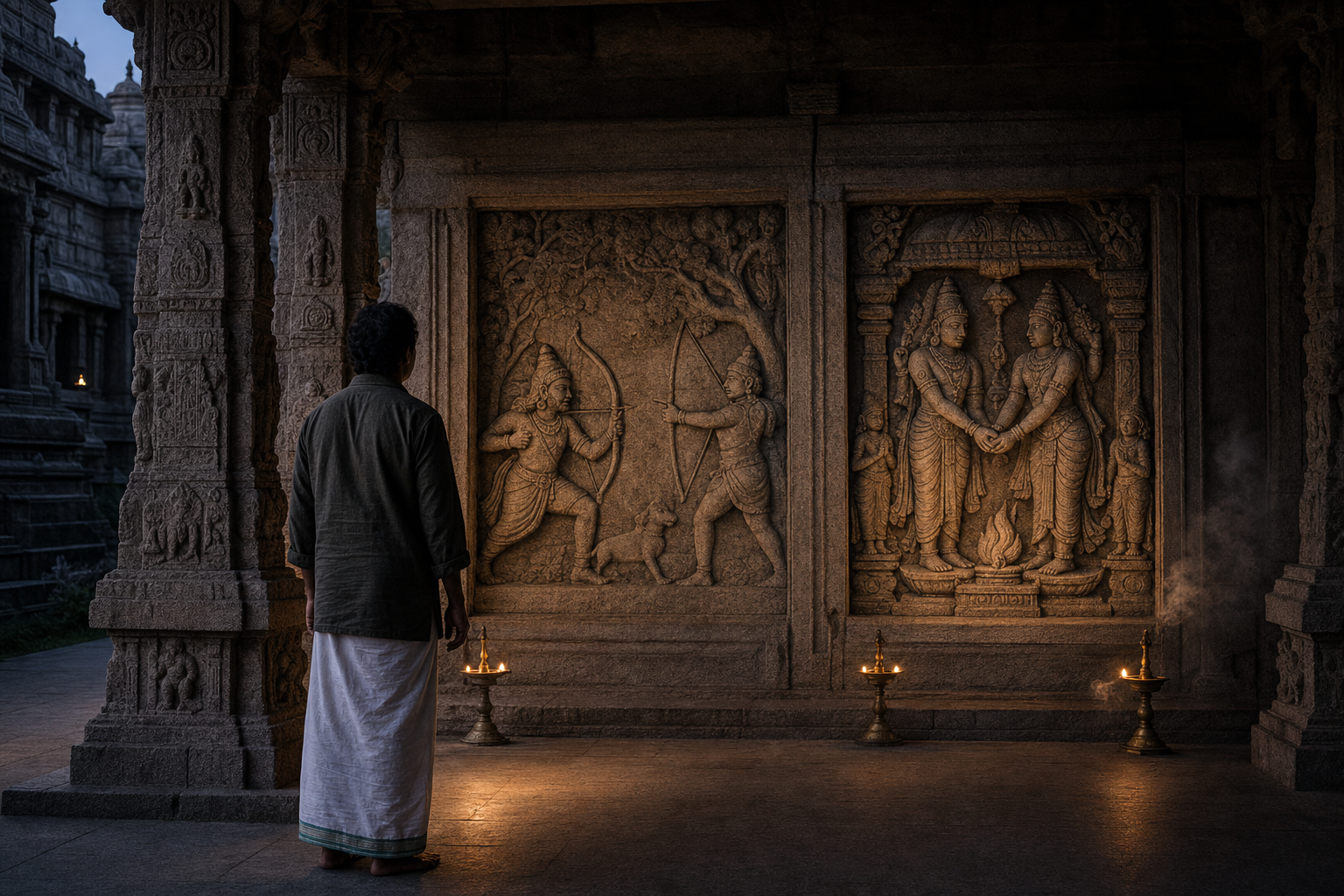
You do not need to identify every attendant before the murti can teach you. Give the image five attentive minutes and keep observation separate from interpretation.
- Take in the entire composition before focusing on faces or ornament. Ask what event is happening.
- Name three visible facts without interpreting them: joined hands, a bow and quiver, an ascetic posture, a ritual witness, or a ceremonial assembly.
- Propose an identification and test it against the central gesture. Do not let one attractive detail overrule the composition.
- Allow uncertainty where the evidence is genuinely ambiguous. The great Mamallapuram relief, for example, is read through both the Descent of the Ganges and Arjuna’s Penance, with the latter providing an important context for ascetic striving and divine response.
- End with one question addressed to your present dharma. Kirata asks what must be purified before you carry more power. Kalyanasundara asks which vow must become a concrete act of care.
If the murti is part of worship or procession, let ritual context lead your behavior. Follow the temple’s rules, avoid obstructing darshan for others, and resist treating the sacred image as a collectible photograph. Looking becomes more accurate when reverence slows it down.
At your next encounter, begin with the bow or the joined hands, but do not stop there. Stay long enough to discover which discipline the image places before you: the humility to be tested, or the fidelity to make a bond real.
References
