
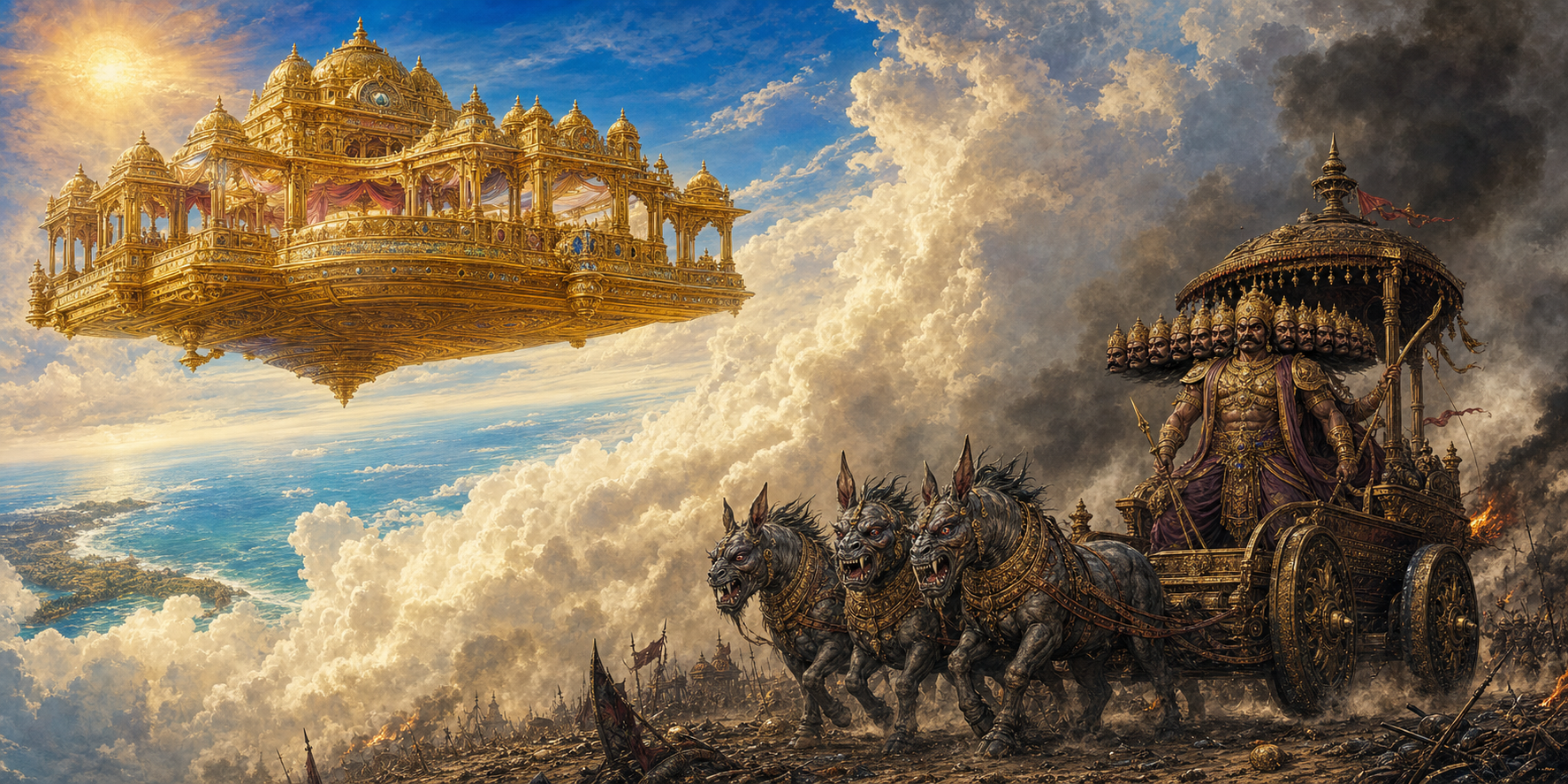
If you came here wondering whether Ravana’s demon-faced mules pulled the Pushpaka Vimana, the short answer is no. That familiar composite image joins two vehicles with different forms, settings, and purposes: Pushpaka is a marvelous aerial conveyance, while the grotesquely drawn vehicle belongs to Ravana’s battlefield imagery.
Keeping them separate does more than settle a visual puzzle. It lets you follow the Ramayana’s moral argument about possession, power, fear, and legitimate rule. It also protects the text from two opposite mistakes: treating every dramatic detail as an engineering specification, or dismissing sacred wonder as if it carried no serious meaning.
Start with the scene: aerial vimana or battlefield chariot?
The quickest way to identify Ravana’s vehicle is to ask what is happening in the scene. Pushpaka travels through the air and requires no team of animals. Ravana’s frightening war-cart appears in the combat world of the Yuddha Kāṇḍa, where draft beasts, martial display, and terror belong to the psychology of battle. These are distinct vehicles rather than two descriptions of one machine.
| Question | Pushpaka Vimana | Ravana’s war-chariot |
|---|---|---|
| Where does it move? | Through the air | Across the battlefield |
| What propels it? | It moves by its own marvelous capacity; no draft animals are required | Mules or donkey-like beasts appear in the martial descriptions, with some traditions stressing piśāca-like faces |
| What does it resemble? | An aerial car or mobile palace able to accommodate many passengers | A terrestrial war-cart built for combat and intimidation |
| What feeling dominates? | Wonder, abundance, elevation, and eventually restoration | Fury, dread, aggression, and coercive spectacle |
| Which episode is the clearest clue? | Rama, Sita, and Lakshmana returning to Ayodhya | Ravana entering or fighting in battle |
This distinction gives you a reliable test for paintings, television scenes, temple art, and performances. An aerial homecoming points toward Pushpaka. Active combat involving a visible team of ghastly animals points toward a war-chariot. If an image supplies neither a name nor enough narrative context, call it a vehicle associated with Ravana rather than automatically labeling it Pushpaka.
The animal-drawn cart is therefore not an evil, damaged, or terrestrial version of Pushpaka. Nor should every ornate vehicle occupied by Ravana be treated as the famous vimana. First identify the episode; only then interpret the vehicle.
Pushpaka’s chain of possession carries the moral plot
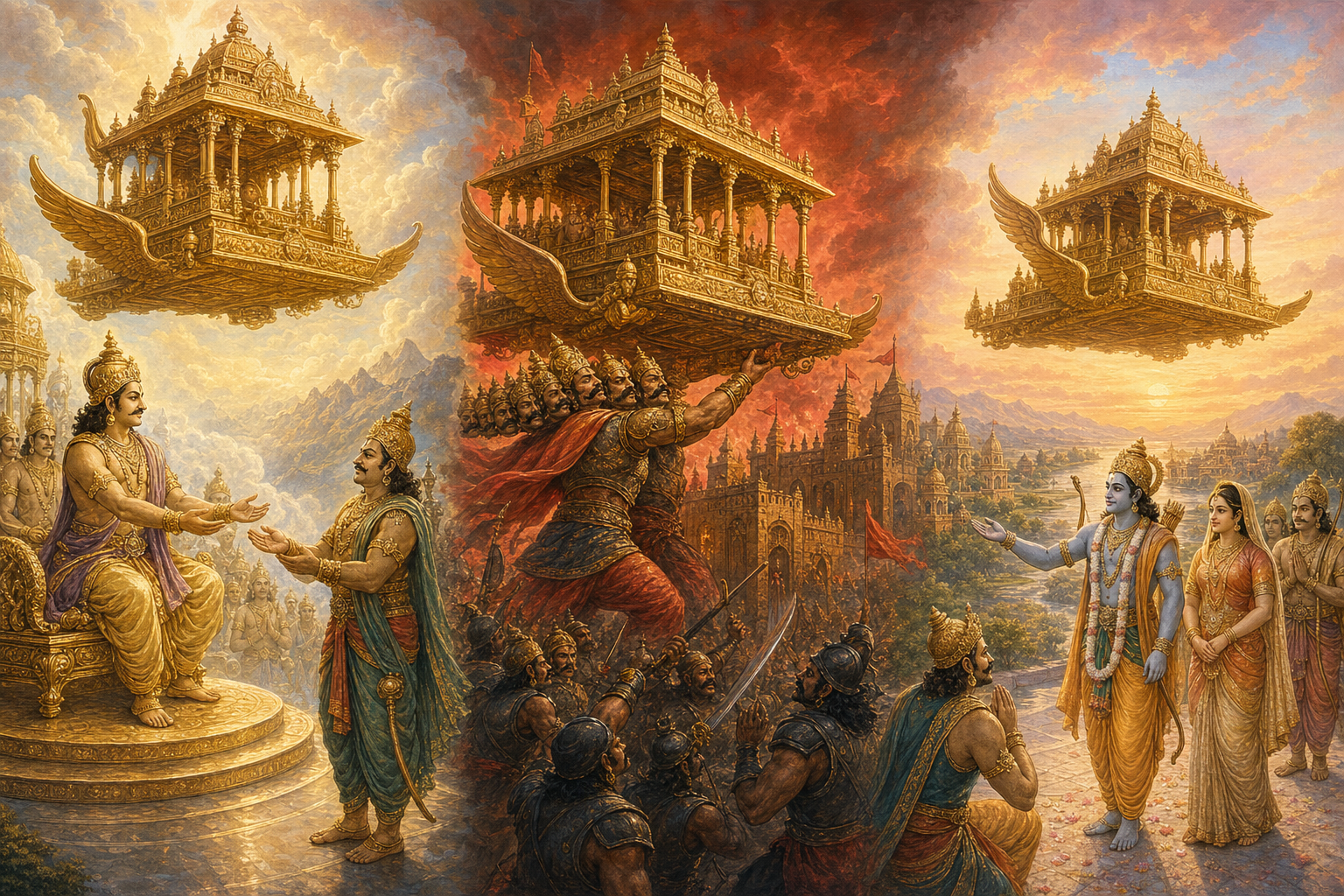
Pushpaka’s importance lies as much in who possesses it as in its ability to fly. Its chain of custody forms a compact history of order disrupted and restored. Viśvakarma originally fashioned it for Kubera. Ravana seized it. After Ravana’s defeat, Rama used it to bring Sita and Lakshmana home to Ayodhya, and the vimana finally returned to Kubera. That movement from rightful ownership through usurpation and back toward rightful order is central to its meaning.
This is why it is too simple to call Pushpaka Ravana’s evil aircraft. The vehicle does not become inherently adharmic merely because Ravana controls it. In his hands, it is evidence of appropriation: splendor detached from rightful possession. When it carries Rama’s party toward Ayodhya, the same splendor serves reunion, homecoming, and the restoration of kingship. Its moral significance changes with the relationship among possessor, means, and purpose.
That distinction matters whenever you interpret power in a dharmic narrative. Magnificence is not proof of legitimacy. Possession is not the same as rightful authority. A ruler may command a palace, vehicle, army, or treasury and still reveal his disorder through the way he acquired and used it.
The contrast becomes even sharper in battle. Rama’s martial vehicle is associated with Matali, the charioteer of Indra, while Ravana’s war-cart is surrounded by imagery of terror. The opposition is not merely expensive equipment versus ugly equipment. One vehicle participates in rightful aid; the other externalizes coercive will. The relevant questions are therefore concrete: Who had the prior claim? How was the object obtained? What end does it now serve? Who bears the cost of its use?
Use those questions when you see Ravana seated in a luminous flying palace. The scene may be displaying his extraordinary reach, but reach alone does not confer dharma. Pushpaka makes the difference between capability and legitimacy impossible to ignore.
The mule and piśāca imagery makes adharma visible
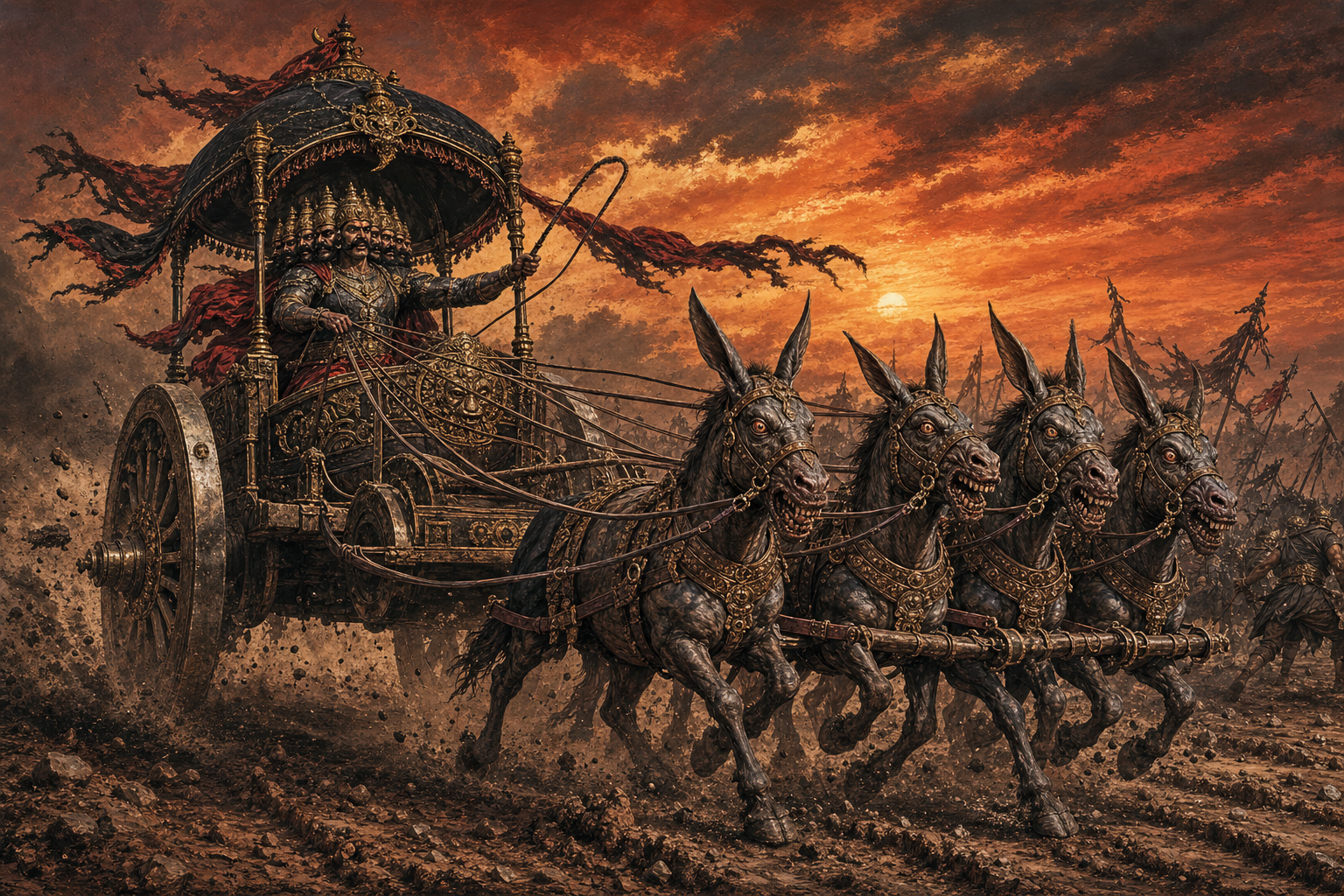
Ravana’s grotesque draft team belongs to a different visual language. Piśācas evoke predatory appetite, unassimilated fear, and threatening spaces at the edge of ordinary order. Giving the animals piśāca-like faces turns the very force pulling the chariot into a spectacle of hunger and menace. The king does not merely travel toward violence; his motion appears to be powered by a devouring disposition.
The mule adds another layer. A useful symbolic reading begins with its hybrid character. It has strength and mobility, yet it traditionally suggests force without generative continuity. Applied to Ravana, the image becomes a judgment on ambition that can advance, conquer, and intimidate but cannot establish a fertile moral order. His project moves, but it does not produce rightful continuity.
This should be handled as interpretation, not as a rigid dictionary in which every mule always means the same thing. Epic symbols gain meaning from their placement. Here the animal, the ghastly face, the battlefield, and Ravana’s conduct reinforce one another. Remove that context and the symbolic claim becomes much weaker.
Classical rasa helps explain why the imagery is so emphatic. The war-cart stimulates raudra, the mood of fury, and bhayānaka, the mood of fear. The ugliness is not decorative excess. It shapes the audience’s bodily response before any philosophical explanation arrives. You feel the distortion of power and then recognize what that distortion signifies. In this sense, battlefield spectacle becomes part of the epic’s moral psychology.
The guṇas offer a second interpretive lens. Ravana’s propulsion can be read as rajas agitated by ambition and tamas made heavy through violence, while Rama’s orientation points toward sattva and ordered action. This does not reduce either figure to a single psychological label. It shows how a vehicle can externalize the condition of the will directing it.
The wider Upanishadic chariot metaphor makes the same method of reading familiar. Rider, charioteer, reins, and horses can represent the ordering of self, intellect, mind, and senses. A chariot is therefore never only hardware in the dharmic imagination. It can show whether power is governed, scattered, disciplined, or captured by appetite. When you examine Ravana’s war-cart, notice not only its appearance but also what seems to be controlling its motion.
Variant depictions require a scene-and-version check
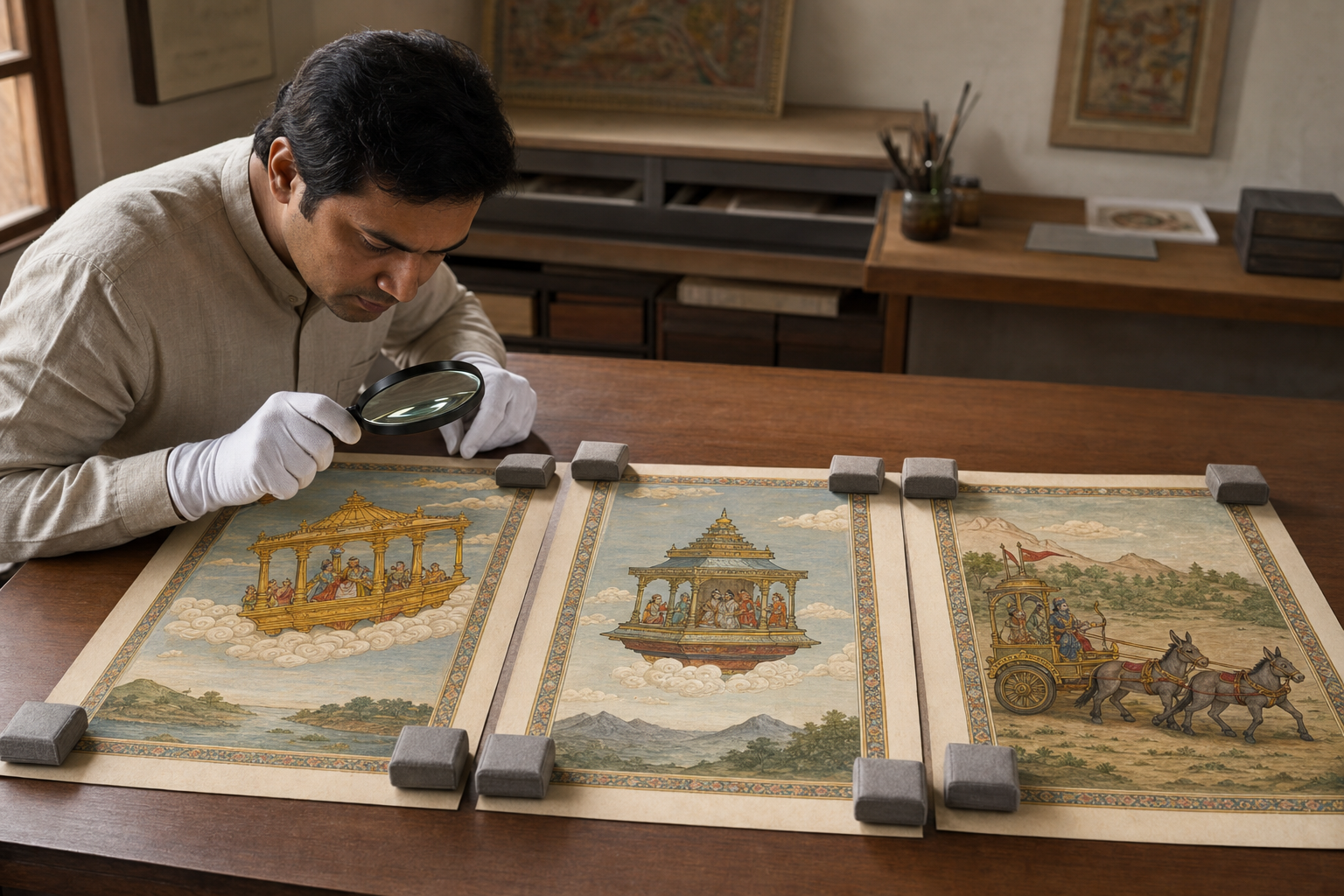
You may encounter an illustration or performance that combines features more freely than the distinction above would appear to allow. That does not automatically make the artist careless, and it does not make every visual choice part of the Sanskrit account attributed to Valmiki. Ramayana traditions have passed through languages, recensions, theatre, dance, painting, and local devotional cultures. Each medium must make the story perceptible to its audience.
Some southern recensions and regional retellings intensify Ravana’s grotesque vehicle, including images of mule-like or donkey-like beasts with demonic faces. Tamil traditions and performance forms such as Yakshagana, Kathakali, and regional koothu can sharpen visual signs so that fury and fear register immediately. Such performative amplification serves rasa and moral contrast, even when a staging choice should not be mistaken for identical wording across every textual tradition.
A painting is not a critical edition, and a performance is not trying to function as one. Visual compression may combine a ruler, his supernatural prestige, and his terrifying military identity in a single memorable vehicle. That combination can preserve the ethical opposition between dharma and adharma while blurring the inventory of vehicles. Your task is to distinguish dramatic faithfulness from textual exactness.
- Name the episode. Is this a flight, an arrival, a return to Ayodhya, a procession, or active combat?
- Observe the mechanism. Does the vehicle move through the air by its own marvelous power, or do visible animals draw it on the ground?
- Identify the tradition. Note whether you are looking at a Sanskrit recension, a vernacular retelling, a temple mural, an illustrated manuscript, or a staged performance.
- Separate description from interpretation. Piśāca-like faces may be visibly present; calling them symbols of predatory appetite is an interpretation that should be presented as such.
- Compare functions before appearances. Ask whether the vehicle marks usurpation, battlefield intimidation, legitimate assistance, or restored sovereignty.
This method prevents two common errors. The first is declaring a regional image false because it is not a literal visual transcription of one recension. The second is projecting a later dramatic detail backward and claiming that every version contains it. Respect for a living tradition does not require us to erase its internal variety.
Read vimāna responsibly, then apply the vehicle test
The Sanskrit word vimāna has a broader range than the modern word aircraft. Depending on context, it can refer to a palace, shrine, elevated carriage, or aerial car. In Pushpaka’s narrative setting, an aerial conveyance is plainly intended: it travels through the sky, carries Rama’s party, and possesses a marvelous capacity to accommodate its passengers. That establishes what it does within the story.
It does not, by itself, establish a historical engineering system. No blueprint, propulsion specification, material analysis, or manufacturing procedure follows from the word vimāna. Calling Pushpaka a modern airplane, helicopter, or spacecraft imports details that the narrative category does not supply. A careful formulation is narrower and stronger: Pushpaka is portrayed as a wondrous aerial car or mobile palace in sacred epic narrative.
This approach neither empties the account of significance nor forces it into a modern technical argument. It honours the form of itihāsa. Wonder can carry theology, kingship, memory, aspiration, and moral reversal without pretending to be an instruction manual. Questions about historical aeronautical technology would require a different kind of evidence; the narrative portrayal alone cannot settle that engineering question.
Key takeaways
- Pushpaka and Ravana’s mule-drawn war-chariot are different vehicles, not competing descriptions of the same one.
- Pushpaka’s moral role follows its chain of possession: made for Kubera, seized by Ravana, used for Rama’s homecoming, and returned to Kubera.
- The mule and piśāca imagery makes coercive appetite visible and creates the battlefield moods of fury and fear.
- Regional recensions and performances may intensify or combine visual motifs, so identify the scene and tradition before making a textual claim.
- Vimāna can denote an aerial car in this narrative without supplying proof of a particular modern technology.
The ethical test travels well across dharmic traditions. Buddhist images of Māra’s forces and the kilesas show craving and fear mobilized against awakening. Jain accounts of the kaṣāyas and raudra dhyāna expose passions that turn thought toward injury. Sikh teachings on haumai and the five thieves diagnose a self driven by pride, desire, anger, attachment, and greed. These teachings are not interchangeable, but they converge on one practical insight: energy becomes dangerous when appetite captures direction.
Use that insight the next time you encounter Ravana’s vehicles. First name the vehicle, scene, and tradition. Then ask what drives it, how its power was acquired, and whom its movement serves. You can apply the same test to an institution, technology, political ambition, or private goal. The decisive question is not merely whether your vehicle can move. It is whether its means, direction, and destination remain aligned with dharma.