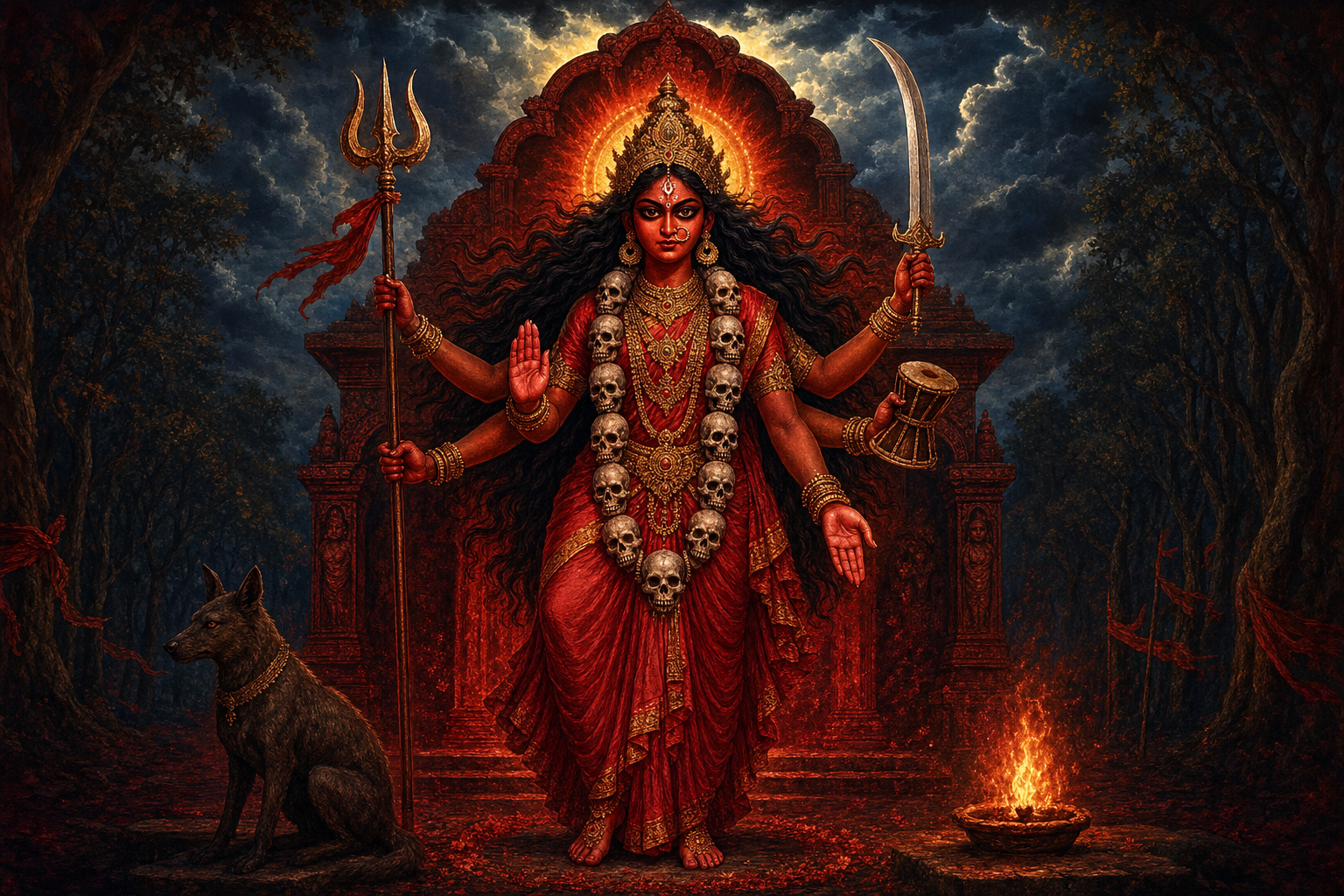
You may have encountered Rakta Chamundi in a temple, a Theyyam performance, a mantra, or an image whose skulls, weapons, and blood-red radiance seemed difficult to reconcile with the compassion of the Divine Mother. The right response is neither fear nor casual fascination. Her fierce form asks whether you can recognize protective power without confusing it with ordinary anger.
Three distinctions will keep your understanding grounded: a terrible appearance can serve a compassionate purpose; symbolic blood does not automatically prescribe a literal offering; and public devotion is not the same as initiatory Tantra. Once those distinctions are clear, Rakta Chamundi becomes a practical teacher of discernment, disciplined courage, and freedom from repeating patterns.
Begin with the problem her fierce form resolves
Rakta means blood or red, but its range of meaning includes vitality, heat, intensity, and life-force. Chamunda recalls the defeat of Chanda and Munda. When those two asuras attack Durga, a dark and formidable emanation arises from her brow and destroys them. The Goddess receives the name Chamunda because she has ended the threat they embodied.
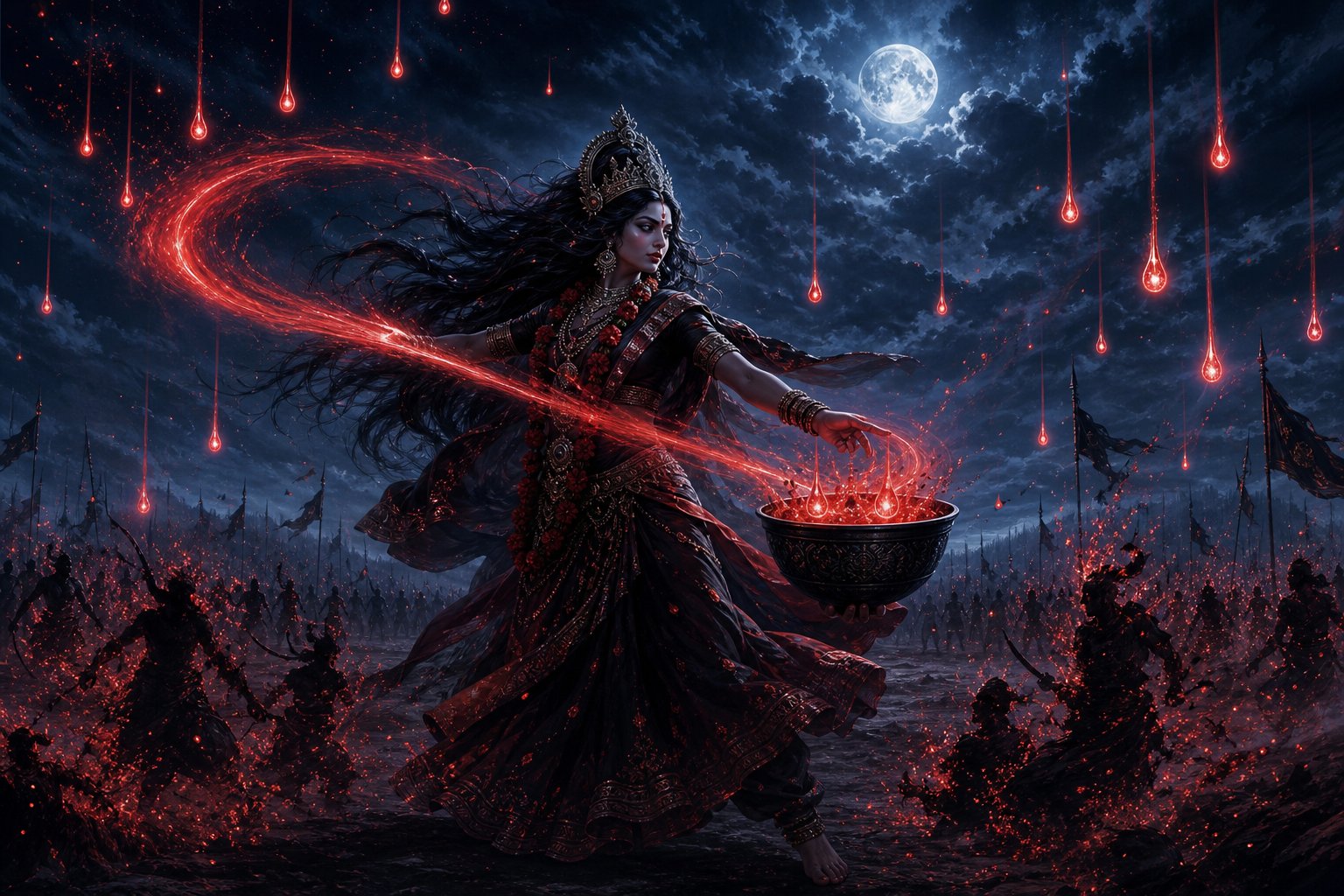
Another decisive image comes from the confrontation with Raktabija. Every drop of his blood that reaches the ground produces another version of him. Striking the visible enemy without stopping his blood therefore multiplies the problem. The Goddess drinks the flowing blood and removes the mechanism by which the asura reproduces. This self-replicating pattern of adharma is central to understanding Rakta Chamundi inwardly as well as cosmically.
The point is not that violence becomes sacred when performed with religious language. Divine wrath has a defined object, remains proportionate to the danger, protects those under threat, and ends when its protective work is complete. Human rage usually does the opposite: it expands its target, feeds itself, and seeks satisfaction after the immediate danger has passed.
This gives you a reliable test for any interpretation of Rakta Chamundi. If it leaves you more attracted to domination, revenge, or spectacle, it has missed her theological centre. If it makes you more capable of confronting harm without becoming hateful, it has understood the relationship between raudra, fierce energy, and karuna, compassion.
Her name also does not prove that a devotee must make a blood offering. Red can signify the force with which delusion is confronted, the vitality redirected toward dharma, and the awareness that stops harmful tendencies before they reproduce. Ritual requirements come from a living temple custom or sampradaya, not from a private guess based on an epithet.
Read the frightening image one attribute at a time
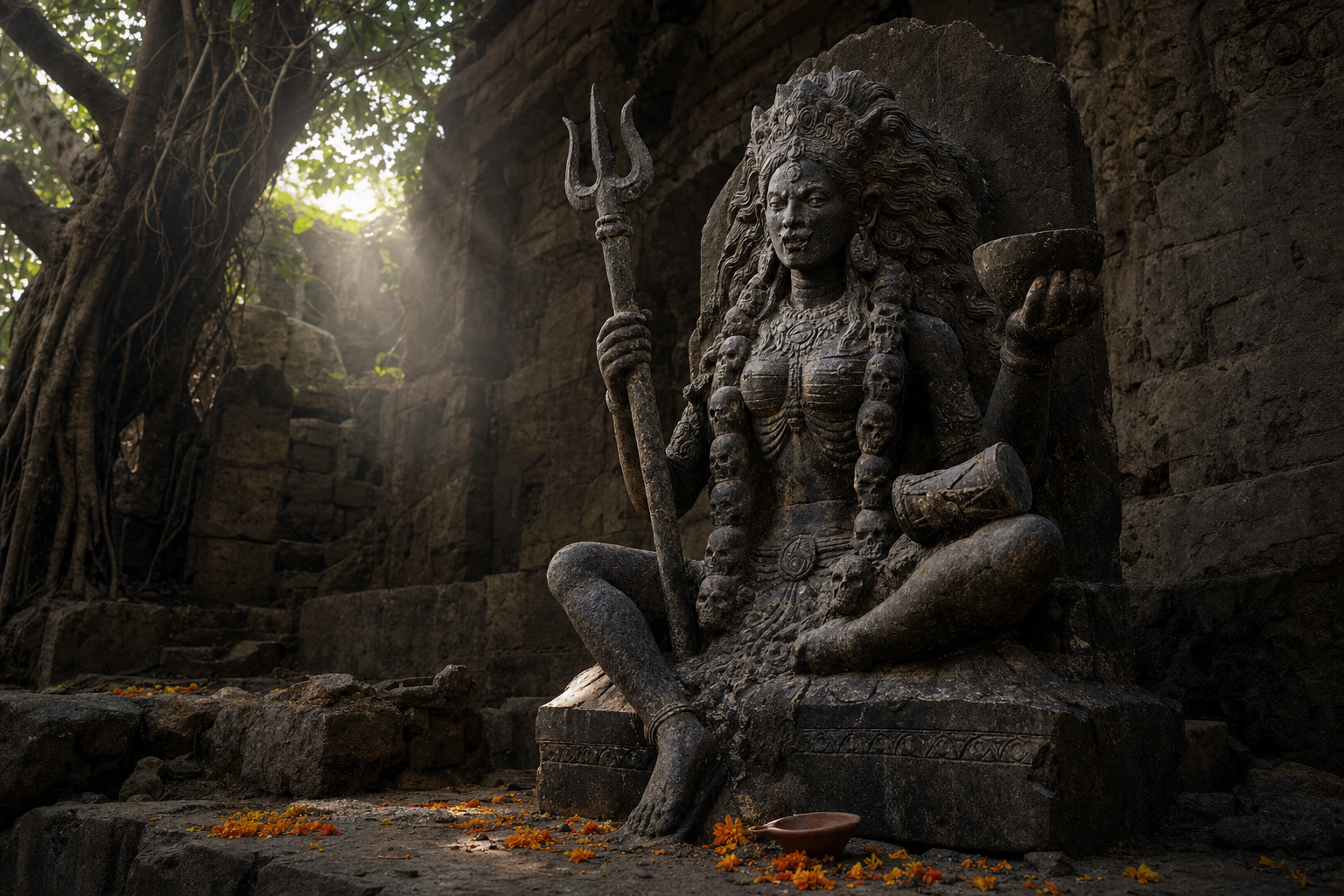
Rakta Chamundi’s iconography is deliberately unsettling because it brings impermanence, fear, and egoic attachment into view. You do not need to romanticize death or treat every attribute as a literal ritual object. Read each feature as part of a disciplined visual theology.
- Red or dark-crimson complexion: vitality has become concentrated spiritual force. The colour announces that passive avoidance is over and that the roots of disorder will be confronted.
- Dishevelled hair: the Goddess is not contained by social appearances. She acts beyond the boundaries through which respectable consciousness often hides uncomfortable truths.
- Garland of skulls and bone ornaments: every embodied identity is impermanent. Status, beauty, possession, and pride cannot survive as permanent foundations of the self.
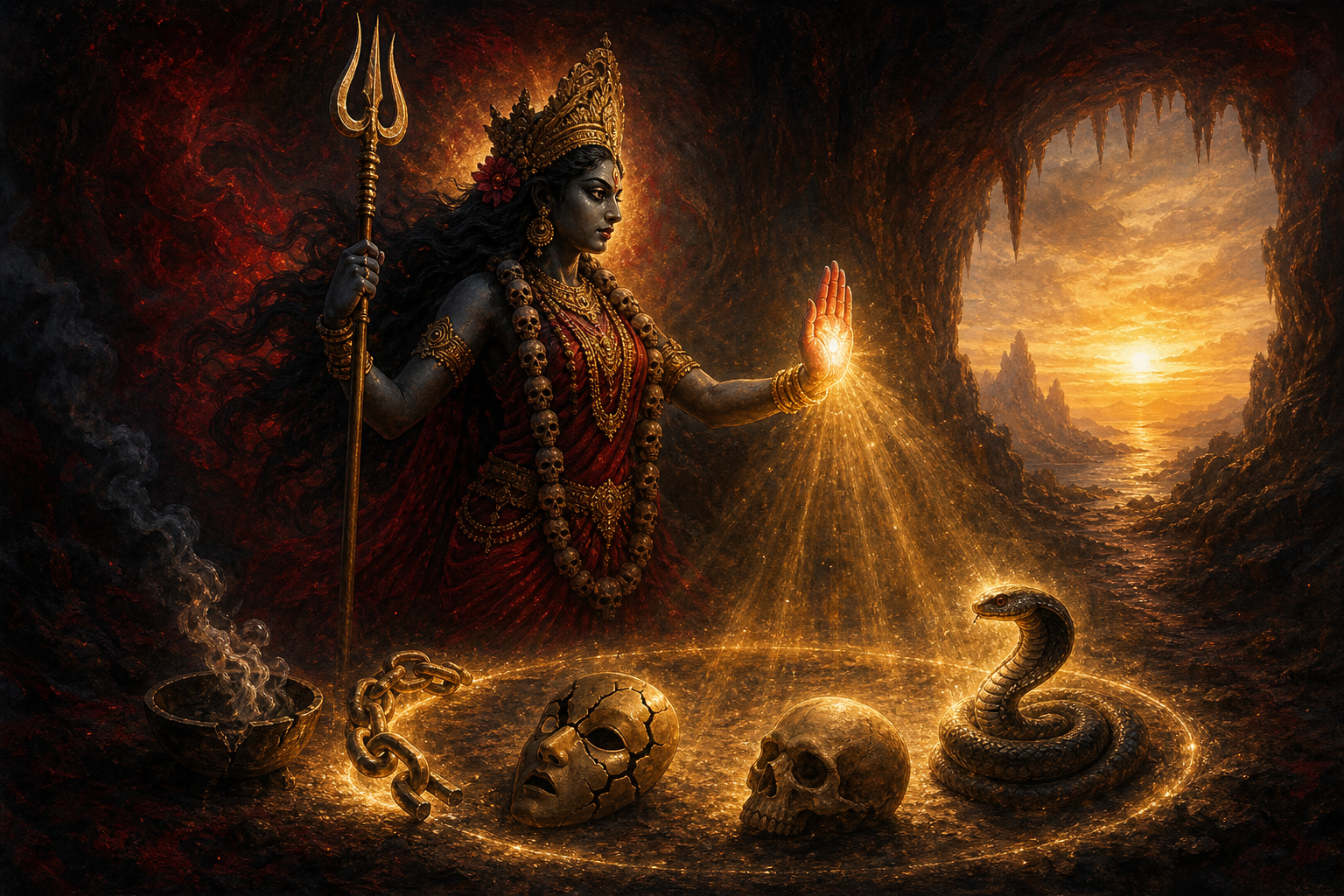
- Sword: the blade signifies viveka, the discrimination that separates truth from projection, duty from impulse, and protection from vengeance.
- Trident: power is gathered and directed rather than scattered. In devotional reading, it reinforces the Goddess’s authority to penetrate deeply rooted obstruction.
- Skull-cup or kapala: nothing arising in the mind remains outside awareness. A thought can be recognized and transformed, or it can be allowed to feed bondage.
- Corpse beneath the Goddess: consciousness has overcome egoic inertia. The image does not glorify killing; it portrays the defeat of that which is spiritually unresponsive and falsely claims independence.
- Cremation ground and flames: every attachment eventually meets change and dissolution. Remembering this gives urgency to sadhana and weakens the ego’s demand for permanence.
- Jackals: creatures of the margins represent vigilance and the Goddess’s sovereignty over places that cultivated life prefers not to see. Their presence warns you not to confuse denial with purity.
- Panchamundi asana: in esoteric interpretation, the seat of five skulls can point to mastery over the five sheaths or other fivefold principles that bind awareness. It is a sign of transcendence through disciplined command, not an object to reproduce without instruction.
Do not collapse Kali, Chandi, and Chamunda into one picture
The names overlap in theology, narrative, and worship, but each emphasizes something distinct. Kali most strongly evokes time, dissolution, and transcendence of the ordered world. Chandi presents the regal and martial power of Devi. Chamunda leans toward the ascetic, skeletal, cremation-ground, and boundary-guarding dimensions of Shakti. Rakta Chamundi intensifies Chamunda’s red, purifying force.
These are devotional orientations, not rigid compartments. A local tradition may identify the forms more closely than another tradition does. Before correcting a temple, performer, or devotee on the basis of a chart, ask which narrative and lineage govern that particular form.
Let the region tell you how the form is being encountered
Chamundeshwari on Chamundi Hills in Mysuru emphasizes victorious and royal guardianship. Chamunda Devi in Himachal Pradesh appears as a protector of mountain communities. Raktha Chamundi Theyyam in North Malabar makes divine agency present through a living ritual performance that blesses and morally addresses the community. In Newar Matrika traditions of the Kathmandu Valley, Chamunda can appear as a liminal protector within Saptamatrika or Ashta Matrika groupings.
When you meet a regional form, ask four concrete questions: What name does the community use? Which story is recited locally? Which offerings belong to public worship? Which practices are restricted to authorized ritual specialists? Those answers matter more than forcing every manifestation into a single pan-Indian template.
Use the Raktabija pattern to interrupt your own repetitions
Raktabija offers a precise model of how a harmful pattern survives. An initial impulse is not always the largest problem. The copies created by reaction can be worse: one insult becomes repeated retelling, one fear becomes constant avoidance, or one grievance becomes an identity that recruits every new event as evidence.
Trying to crush such a pattern with more of the same mental force often feeds it. Suppressed anger can return as resentment; impulsive expression can provoke a new conflict; obsessive argument can keep the disputed thought active. Rakta Chamundi’s intervention suggests that you must stop the reproductive mechanism as well as confront the visible symptom.
- Name the first drop. Identify the exact thought, sensation, word, or event after which the pattern begins multiplying. Avoid a vague label such as “everything makes me angry.” Name the observable beginning.
- Prevent immediate replication. Delay the message, accusation, repost, or decision that would create another copy of the conflict. This pause is containment, not cowardice.
- Apply the sword of viveka. Separate what happened from what you inferred. Then separate what you feel from what dharma requires you to do.
- Redirect the energy. Choose one proportionate act: state a boundary, correct a false claim, protect someone exposed to harm, repair damage you caused, or leave a situation that is feeding needless escalation.
- Remove the seed condition. Ask what repeatedly gives the pattern new blood: wounded pride, secrecy, habitual company, unexamined fear, or access without boundaries. Change that condition instead of fighting each copy separately.
This practice does not ask you to become passive. Rakta Chamundi is not a symbol of passive accommodation. She teaches controlled force: enough clarity to stop harm, enough compassion not to enlarge the circle of enemies, and enough discipline to stop once protection has been achieved.
Before acting fiercely, use three tests. Who will be protected by this action? Is the response proportionate to the actual harm? Can you stop when the danger ends? If you cannot answer all three, ordinary anger may be borrowing the language of dharma.
Choose worship that matches your preparation
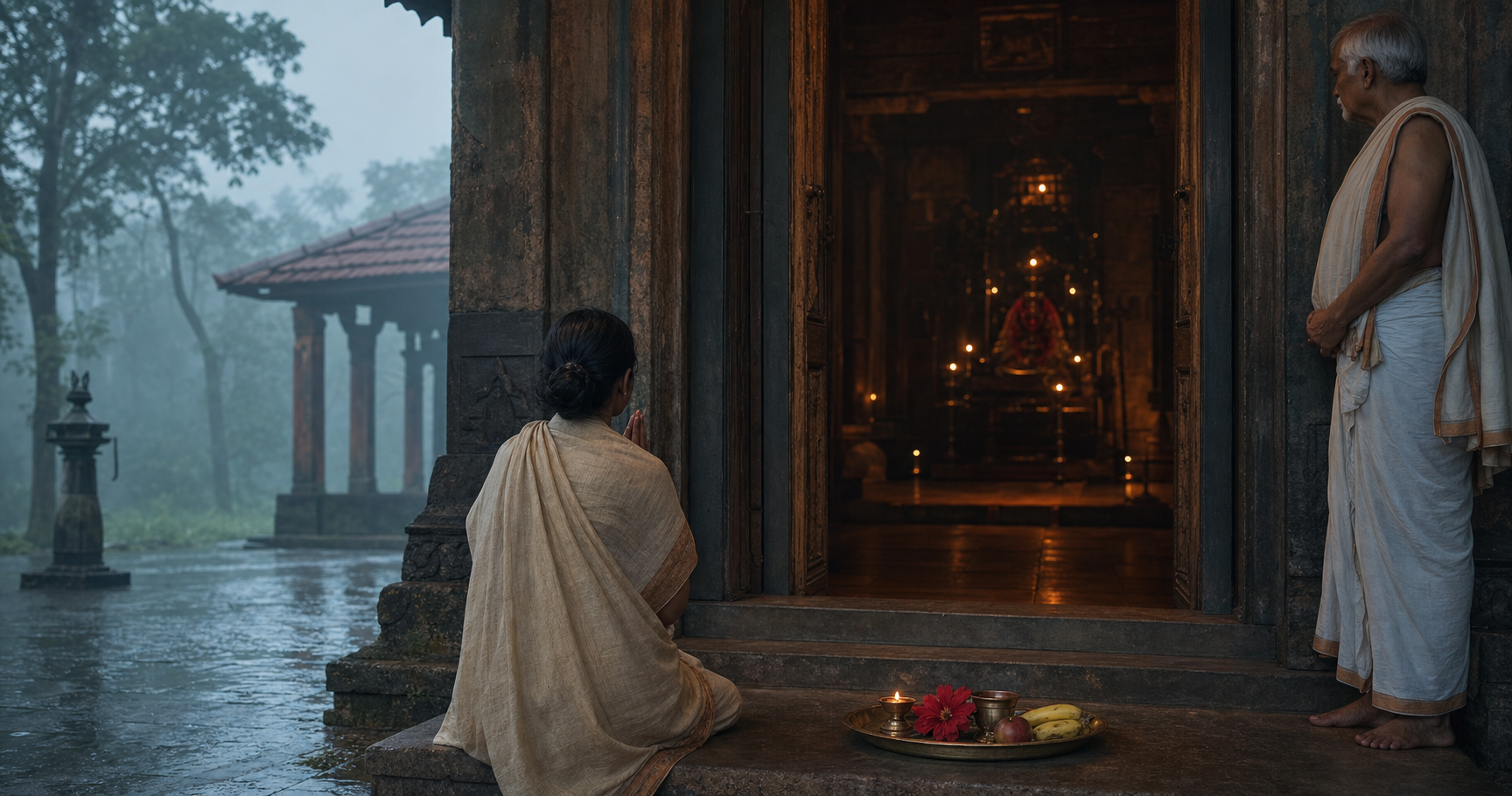
You do not need an extreme ritual to honour a fierce Goddess. Mainstream devotion to Rakta Chamundi belongs within the wider worship of Durga, Chandi, and Devi. A lamp, red flowers such as hibiscus, vegetarian naivedya, prayer, and recitation can express reverence without pretending to possess initiatory knowledge.
A grounded devotional approach can follow this order:
- Locate the practice. Begin with your family tradition, an established temple, or a recognized sampradaya. If you are visiting a regional shrine, follow its public instructions rather than importing a ritual from elsewhere.
- State a dharmic intention. Pray for discernment, protection of the vulnerable, release from a repeating fault, or courage to fulfil a real duty. Avoid requests for revenge, coercive power, or another person’s humiliation.
- Make a simple offering. Light a lamp and offer red flowers or vegetarian food. Perform abhishekam only where it belongs to the established custom and you have been shown how the image is to be served.
- Use an appropriate recitation. The Chandi Path, also known as the Durga Saptashati, is central to the broader tradition. The Navarna Mantra, “Om Aim Hrim Klim Chamundaye Viche,” invokes wisdom, radiance, and transformative force; learn its pronunciation and manner of use within a trustworthy devotional setting rather than inventing additions.
- Complete the prayer through conduct. Do one protective or corrective act that fits your sankalpa. Devotion to the destroyer of proliferating adharma should reduce a real pattern of harm.
Navaratri and Durga Ashtami offer especially suitable occasions to join communal worship. A public temple observance also lets you see how mantra, offering, food, music, and service are integrated. That context is more reliable than assembling a fierce rite from disconnected images or instructions.
Know where ordinary devotion ends and initiation begins
Panchamundi practices, specialized mantras, cremation-ground disciplines, and other esoteric observances are not intensified versions of a home puja. They belong to structured paths requiring ethical preparation, a competent teacher, and the safeguards of a legitimate sampradaya. Symbolic familiarity is not ritual authorization.
The word rakta likewise gives a private devotee no reason to assume that literal blood is required. Many contemporary observances explicitly foreground ahimsa, vegetarian naivedya, and symbolic substitutions. If a practice conflicts with non-harm, bypasses the custodians of the tradition, or promises personal domination, do not mistake its dramatic character for spiritual depth.
Use one further test when choosing guidance: a sound practice should make intention purer, conduct more responsible, and ego less dominant. If secrecy is used mainly to prevent reasonable questions, or if fear is used to demand obedience, step back. Reverence for lineage does not require abandoning discernment.
Key takeaways for your next encounter with Rakta Chamundi
- Her terrible appearance expresses protective Shakti, not malice or uncontrolled rage.
- Rakta signifies blood and redness, but also vitality, heat, and the force needed to stop self-replicating adharma. It is not, by itself, a ritual instruction.
- Her sword, skull-cup, garland, corpse, jackals, and cremation ground teach discrimination, impermanence, vigilance, and mastery over egoic inertia.
- Kali, Chandi, Chamunda, and Rakta Chamundi overlap, yet their emphases and regional identities should not be flattened into perfect synonyms.
- The Raktabija lesson is practical: stop the condition that reproduces a harmful pattern, not merely its latest visible expression.
- Simple public devotion can include a lamp, red flowers, vegetarian offerings, appropriate recitation, and ethical action. Esoteric practice requires qualified guidance.
The next time you stand before Rakta Chamundi, do two things before seeking a more elaborate practice. Identify the habit or injustice that keeps reproducing, and choose one proportionate action that denies it new life. Then let your worship make that action steadier, clearer, and free from hatred. That is a fitting beginning before the blood-red Mother.