

If gratitude has been used to silence your pain – be thankful, stop dwelling, others have it worse – the word itself may feel like a demand. You do not have to override that reaction. A practice that takes away your right to say no is not supporting recovery.
Useful gratitude begins with a smaller question: can you notice one true form of support without denying anything that hurts? The aim is not to manufacture a positive mood. It is to help your attention recognize safety, care, beauty, and sufficiency when they are genuinely present – and then decide how to respond.
Key takeaways
- Settle your nervous system before attempting gratitude. If the practice increases panic, shame, numbness, or dissociation, stop.
- Choose one specific and undeniable fact instead of making a sweeping claim that life is good.
- Gratitude can accompany anger, grief, boundaries, and the recognition that someone harmed you.
- Repetition matters more than emotional intensity. One honest acknowledgment is more useful than a forced list.
- In a dharmic frame, gratitude becomes complete when it influences conduct through seva, reciprocity, restraint, or care.
Begin with safety, not a gratitude list

Trauma changes what attention is trained to do. In an unpredictable environment, scanning faces, rooms, sounds, and exits for danger can be a rational survival response. The difficulty comes when that alarm system keeps working at full intensity even when the present moment contains some measure of safety.
A conventional prompt such as name three things you are grateful for can then feel less like an invitation and more like a test. Survivors of adversity or raw grief may find gratitude inaccessible, invalidating, or activating. Treat that response as information. It does not show a lack of character, devotion, or spiritual maturity.
It helps to separate three layers that are often compressed into the word gratitude:
- Fact: Something supportive is present. The door is locked, the water is clean, a friend replied, or your feet are resting on a stable floor.
- Meaning: That fact tells you something about the present, such as help is available or this moment is safer than an earlier one.
- Feeling: Warmth, relief, tenderness, joy, or appreciation may arise.
You may be able to recognize the fact without accepting a larger meaning. You may understand the meaning without feeling warmth. Start with whichever layer is honestly available. Do not force the third.
Before reflecting, orient yourself to the present. Keep your eyes open if closing them makes you less secure. Feel a supported part of the body, notice a neutral object in the room, or let the exhalation lengthen gently if breath work feels comfortable. Then ask: would noticing one supportive fact be tolerable right now? No is a complete answer. On such a day, saying gratitude is not available is an act of truthful self-respect.
Gratitude also does not settle questions of responsibility. You can appreciate something a person provided and still name the harm that person caused. You can value one memory without reopening contact. Thankfulness does not create a debt, cancel a boundary, require forgiveness, or entitle a benefactor to renewed access to you. These are separate moral decisions.
If an exercise repeatedly intensifies flashbacks, panic, dissociation, or severe shame, stop using it and return to the grounding or support plan you already know. Persistent trauma symptoms warrant help from a qualified trauma-informed mental-health professional. Gratitude is a complementary practice, not a substitute for psychological or medical care.
Why repeated noticing can support dharmic resilience
Attention can learn more than danger
Small moments of appreciation do not erase a history of danger. They give attention additional information. Each time you accurately notice protection, nourishment, kindness, or beauty, you practice holding more than the threat signal in awareness.
Gratitude engages brain networks associated with valuation, emotional regulation, and reward learning, including the medial prefrontal cortex, anterior cingulate cortex, and ventral striatum. Repeated practice may help attention become more efficient at detecting beneficial cues instead of automatically giving danger the entire field.
Appreciative and prosocial states are also associated with parasympathetic regulation and greater heart-rate variability, a marker of flexible autonomic balance. Effects differ by person and context, so this is not evidence that gratitude cures trauma or guarantees better sleep. It supports a narrower and more credible conclusion: carefully paced appreciation can be one useful part of emotional regulation.
Gratitude journaling and letter-writing interventions have produced improvements in mood, hope, life satisfaction, and relationships for some participants, with some benefits remaining at follow-up. The practical lesson is to favor repetition over intensity. A brief, truthful entry made regularly is more useful than trying to summon a dramatic feeling once.
Measure progress by function, not by cheerfulness. Notice whether you can detect support sooner, receive appropriate help with less suspicion, return from activation more readily, or hold pain and protection in awareness at the same time. Those changes matter even when you do not feel happy.
Four traditions, four ethical emphases
Hinduism, Buddhism, Jainism, and Sikhism do not share one metaphysics, and their teachings should not be flattened into a generic spirituality. They do, however, offer compatible ways to keep gratitude truthful and ethically alive.
- Hindu traditions: Krtajnata, or thankfulness, can be cultivated through bhakti, seva, and aparigraha. Receiving something as prasad trains appreciative receiving without treating the gift as an entitlement. Ask: what has been given to me, and how can I honor it without grasping?
- Buddhist traditions: Katannu-katavedi joins gratitude with recognition and reciprocity. Awareness of interdependence reveals the many conditions behind a single meal, breath, teaching, or refuge. This does not remove dukkha; it prevents suffering from becoming the only reality you can perceive.
- Jain traditions: Aparigraha, samayik, and reverence for all jivas connect appreciation with restraint and non-violence. Ask: can I honor what sustains me by taking less, wasting less, or causing less harm?
- Sikh tradition: Shukrana, ardas, naam simran, remembrance of hukam, and chardi kala place gratitude inside courageous engagement with hardship. Seva then carries appreciation into communal care. Resilient spirit does not require a cheerful performance or make injustice acceptable.
Choose the doorway that belongs to your practice and convictions. You do not need to borrow every vocabulary. The shared test is practical: does gratitude make you clearer, less entitled, more compassionate, and more capable of right action? If it merely pressures you to appear serene, something has gone off course.
Use a five-part gratitude practice you can scale
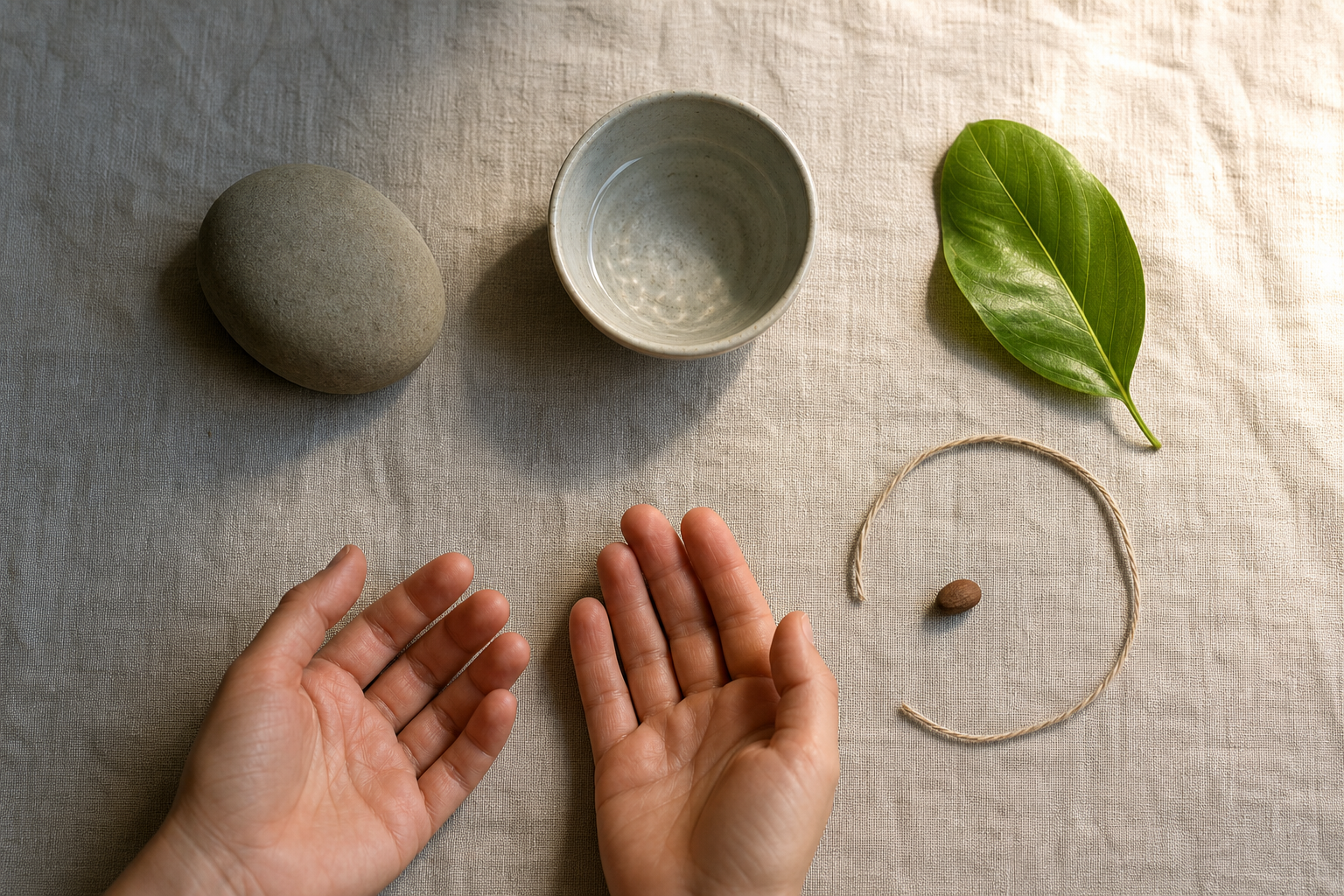
This sequence can take only a few moments. Its purpose is not to accumulate impressive entries. It is to notice one support, receive it without coercion, and let it shape conduct.
- Establish enough present-moment safety. Look around the actual room. Feel the chair, floor, bed, or wall supporting you. Notice whether your breathing, jaw, shoulders, or stomach become easier or more tense. If inward attention is destabilizing, stay with an external object or sound.
- Select one fact too specific to argue with. Avoid a claim such as everything happens for the best. Try the lamp is working, I ate a meal, this person kept their word, or there was one quiet minute. Neutral sufficiency is enough.
- Trace one condition that made it possible. Name a person, living being, natural process, community, institution, skill, or earlier effort involved. This turns an isolated possession into a perception of relationship and interdependence.
- Notice the bodily trace for about twenty seconds. You might feel softness in the face, a fuller breath, warmth, or no change at all. Do not chase a sensation. The pause simply gives the nervous system time to register the experience instead of rushing past it.
- Complete the recognition through action. Thank someone without demanding a reply, care for the object you received, conserve the resource, protect a boundary that preserves safety, or offer a small act of seva. The response should be freely chosen and proportionate.
Begin with one acknowledgment at the start or end of the day. If that remains comfortable, write three brief entries a few times a week. A journal entry becomes more memorable when it records what happened, who or what enabled it, and what you noticed in the body. Reviewing older entries on a low day can restore continuity, but skip the review if comparison with an earlier period increases distress.
Keep some entries playful. The exact color of evening light, a ridiculous joke, a familiar passage, an unexpectedly good musical phrase, or a spontaneous movement can hold attention more readily than a solemn inventory of major blessings. Small pleasures count because the practice concerns accurate noticing, not spiritual grandeur.
A simple journal template is enough:
- What supportive or beautiful thing actually happened?
- Who or what helped make it possible?
- What did I notice in my body, including neutrality or resistance?
- What response, if any, would honor what I received?
Match the practice to the day you are actually having

Your capacity changes. A flexible practice should change with it. Before beginning, decide which of these three modes fits the present moment.
When you feel present and steady
Use the full sequence. Name a support, trace its conditions, stay with its sensory effect, and choose a response. This is also the best time to write a gratitude letter, offer direct thanks, or undertake seva. Do not wait for a crisis to build these pathways.
When you feel activated, guarded, or numb
Reduce the task to one neutral fact of sufficiency: there is water, the appointment is scheduled, the phone is charged, or this room has light. Do not require an emotion, a benefactor, or an explanation. If the fact produces even a little more steadiness, stop there. More is not automatically better.
When you are in a flashback, deeply dissociated, or inside raw grief
Do not attempt gratitude. Orient to the current environment, use a previously established grounding practice, and seek appropriate human support. If there is immediate danger to you or another person, contact local emergency services. Reflection can wait until sufficient safety returns.
You can also evaluate the practice by its aftereffects. Helpful gratitude usually leaves more room for reality. You can appreciate help while retaining discernment, accept care without surrendering boundaries, and recognize pain without being swallowed by it. Harmful gratitude makes you feel guilty for suffering, pressures you to minimize abuse, creates unwanted obligation, or treats anger as spiritual failure. If those patterns appear, simplify the practice, change the prompt, or pause it entirely.
When gratitude is available, let it take one visible form today. Write one honest line, care for one thing you have received, thank one trustworthy person, or perform one quiet act of seva. When it is not available, protect the conditions in which truthful appreciation may return. Both choices can be dharmic.