
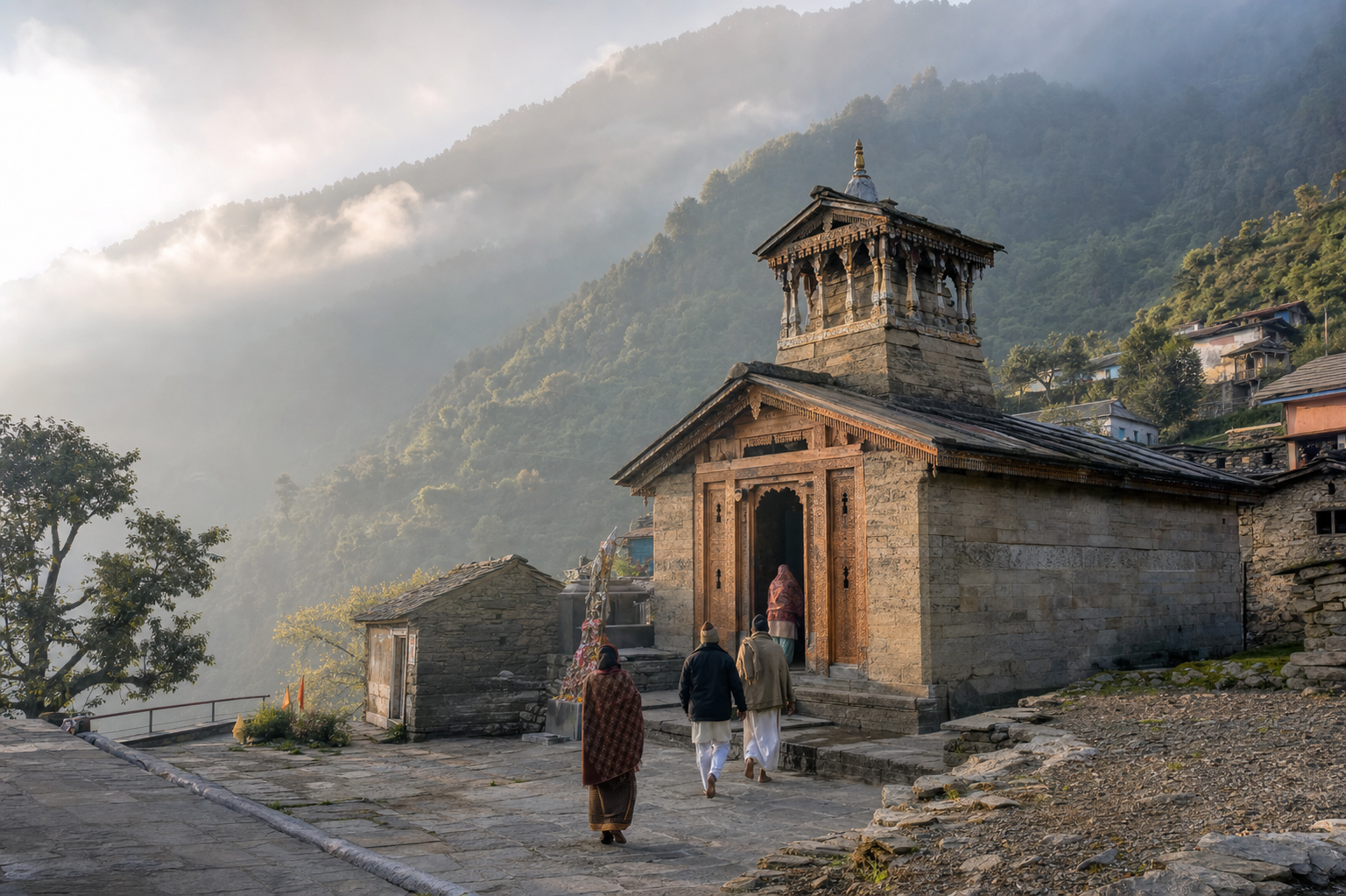
Yog Dhyan Badri can look like a brief halt on the road to Badrinath. Treat it that way, and you may see the sanctum yet miss the tradition that gives the shrine its character. This is a place where the memory of King Pandu, the meditating form of Vishnu, and the seasonal continuity of Badri worship meet.
If you are deciding whether to include Pandukeshwar in your pilgrimage, the answer depends on what you want from the journey. Come for another photograph and the visit will be short. Come prepared to understand tapas, dhyana and living Himalayan worship, and this compact temple can become one of the most purposeful stops in the Badri circuit.
Pandukeshwar’s sanctity rests on three connected traditions
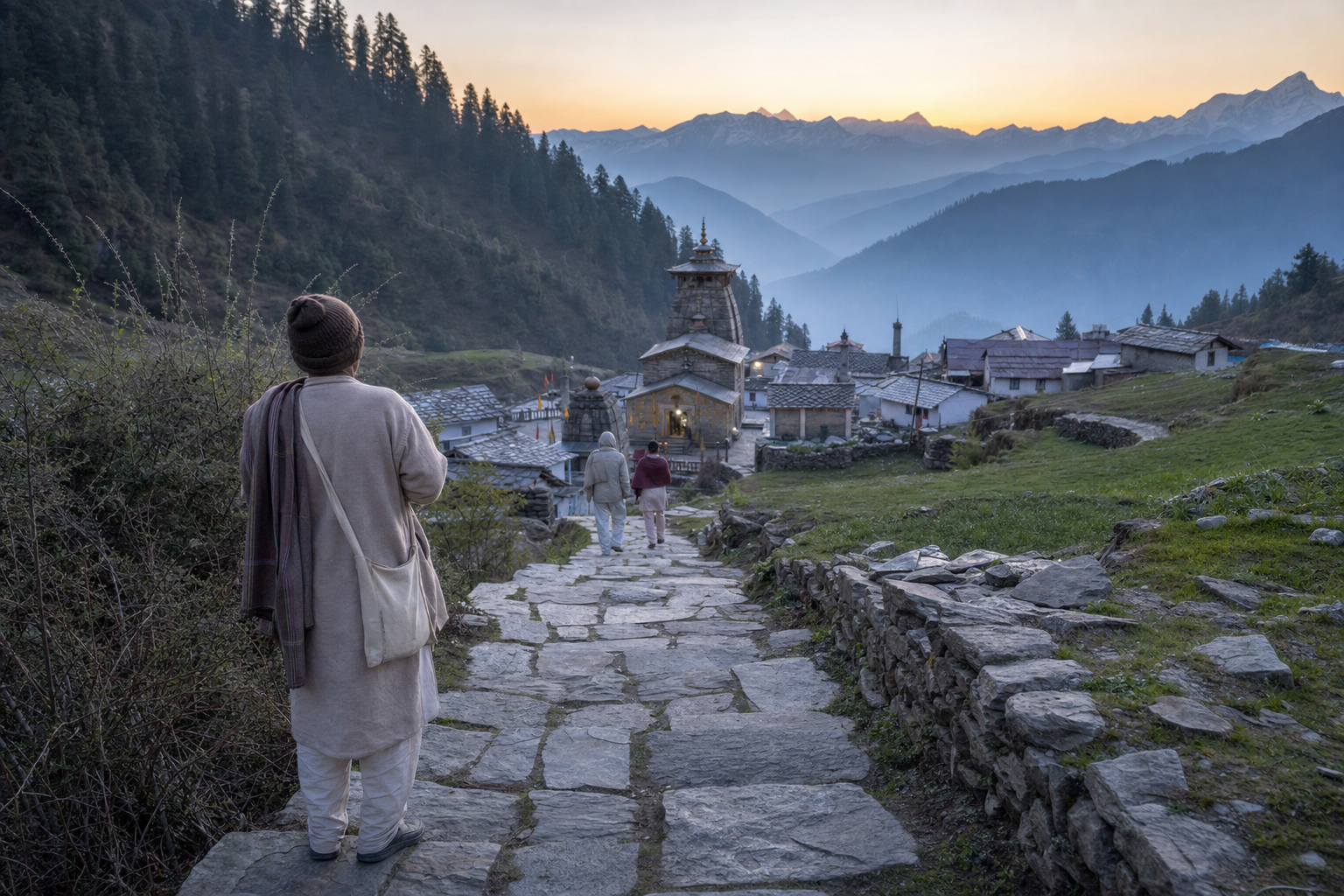
Yog Dhyan Badri stands at Pandukeshwar in Uttarakhand’s Chamoli district, at approximately 1,920 metres in the Alaknanda valley. It lies near Govind Ghat on the road between Joshimath and Badrinath. Its location matters: this is not an isolated monument but part of the sacred geography of Badri-kshetra, a Himalayan landscape associated with renunciation, learning, worship and service.
- The Badri tradition: Yog Dhyan Badri belongs to the Panch Badri and expanded Sapt Badri pilgrimage networks. It expresses one dimension of a larger sacred landscape rather than competing with Badrinath.
- The memory of King Pandu: Sacred tradition associates Pandukeshwar with Pandu’s austerities and liberation. Local oral memory also venerates the area as the birthplace of the Pandavas.
- Living Vaishnava worship: Vishnu is not remembered here only through an Itihasa-linked story. The meditating deity remains the centre of regular seva, festival observance and seasonal worship.
These layers should be held together without confusing their different kinds of authority. King Pandu’s tapas and moksha belong to sacred tradition; the claim about the Pandavas’ birth is specifically part of local oral memory. A respectful pilgrim need not turn either tradition into a modern archaeological assertion. Receive them as memories that shape the community’s understanding of place, moral responsibility and devotion.
That distinction protects both shraddha and historical honesty. It also helps you listen more carefully. When a local retelling connects Pandu with the site, the important question is not merely, “Can this be dated?” It is also, “What dharmic lesson has this community preserved through the story?” At Pandukeshwar, the answer centres on the consequences of action, the need for penance, and the possibility of inward transformation.
The Alaknanda valley’s wider sanctity reinforces this reading. The Skanda Purana’s Badri-kshetra mahatmya frames the region as a landscape of spiritual discipline. Yog Dhyan Badri gives that broad ideal a local form: the remembered austerity of Pandu is placed before a Vishnu murti absorbed in meditation. Story, deity and terrain all point in the same direction.
The meditating Vishnu changes the meaning of darshan
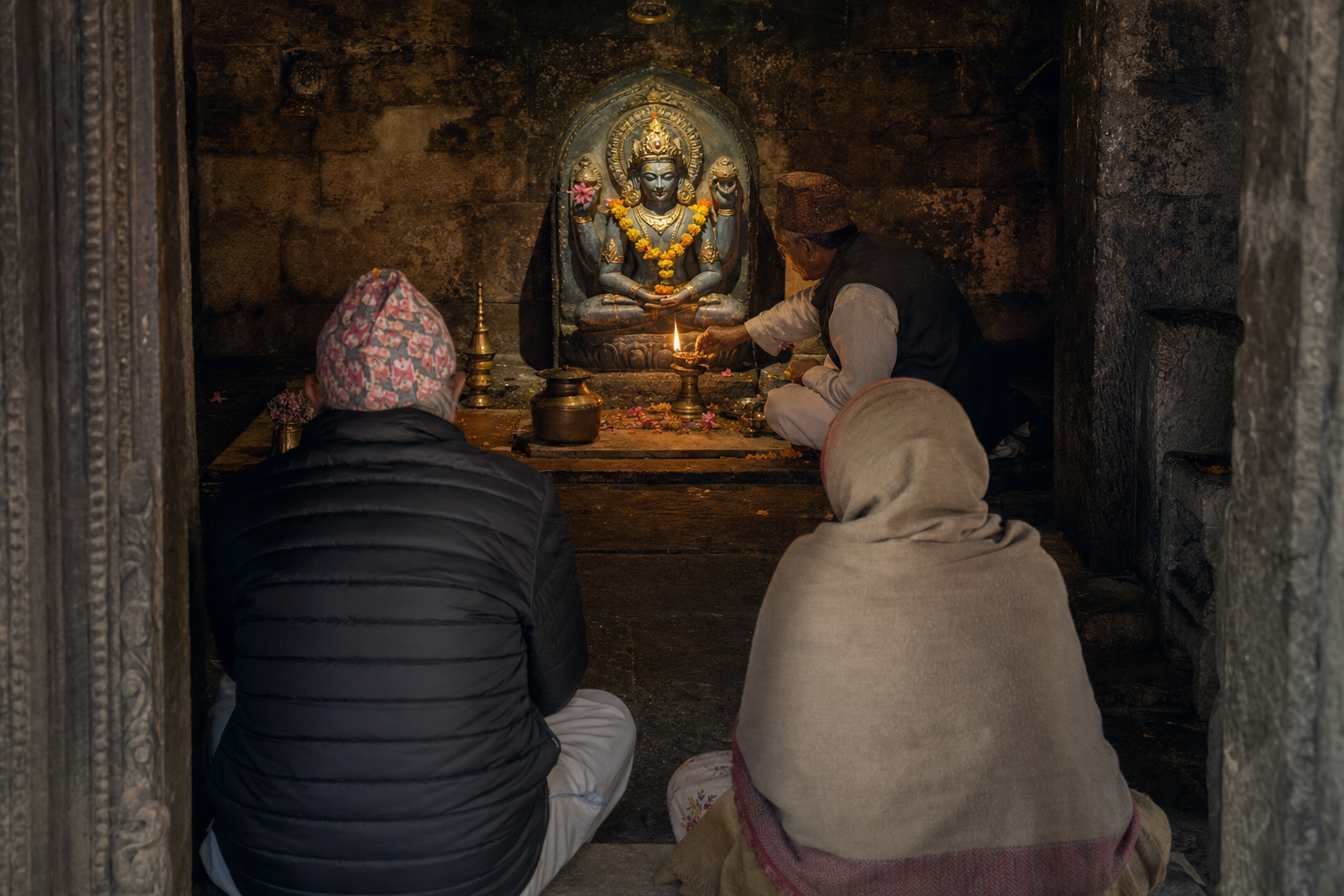
The defining feature of Yog Dhyan Badri is its seated, contemplative form of Vishnu. The icon directs attention away from spectacle and towards gathered awareness. Vishnu remains the object of bhakti, but the devotee encounters him as Yogadhyana Murti: divine presence expressed through stillness.
This changes what you should do in the temple. Darshan is not improved by trying to look at everything at once. Allow the form of the murti to steady your attention. Follow the local sequence of worship, offer pranam, and then remain quiet if space and temple protocol permit. You may repeat a familiar name of Vishnu inwardly, or simply hold your attention without demanding an unusual experience.
The temple should not be treated as a generic meditation room. Its silence arises inside Vaishnava worship, not outside it. Aarti, naivedya, mantra, offering and darshan provide the devotional frame; dhyana deepens your participation in that frame. Bhakti gives attention its object, while disciplined attention keeps bhakti from becoming hurried or mechanical.
Yog Dhyan Badri also reveals a shared contemplative grammar among the Dharmic paths. Hindu yoga and bhakti, Buddhist dhyana, Jain samayik and dhyana, and Sikh simran all give serious weight to disciplined attention. Their doctrines and goals are not interchangeable, and respecting the connection does not require erasing their differences. What they share is the recognition that an undisciplined mind cannot be transformed merely by changing its surroundings.
That is especially relevant on a crowded pilgrimage route. You can travel through an extraordinary sacred landscape while remaining mentally occupied with schedules, traffic and photographs. The meditating Vishnu exposes that contradiction. The outer ascent has religious value when it is accompanied by some inward movement: less distraction, greater restraint, clearer remembrance and a more deliberate relation to action.
Winter worship keeps Badri devotion unbroken
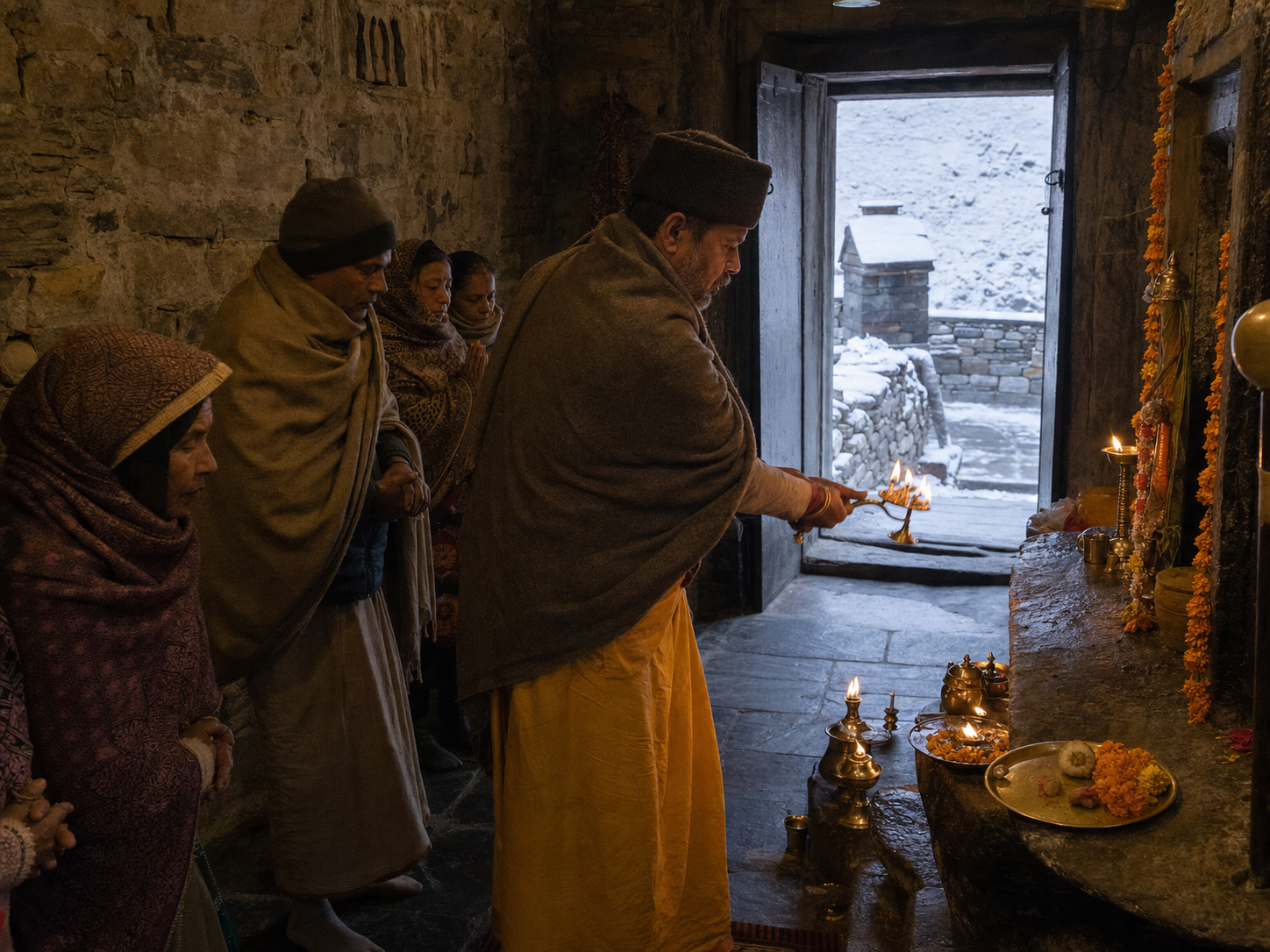
The Himalayan winter closes the high Badrinath temple when heavy snow makes the upper route impractical, but closure of a building does not mean suspension of devotion. Worship continues through lower-altitude sacred centres under the Badrinath Kedarnath Temple Committee’s seasonal arrangements. Within this rhythm, Yog Dhyan Badri serves as a principal place of winter Vishnu worship in the region.
This tradition carries a precise theological lesson. The accessibility of one shrine changes with snow and terrain; the presence of Badri and the community’s obligation to worship do not disappear. Sacred continuity is maintained by adapting the location of ritual life to the Himalayan season. Geography sets the calendar, while seva keeps the relationship intact.
If winter worship is the reason for your visit, do not assume that the ordinary Badrinath season, temple hours or ceremonial arrangements apply unchanged at Pandukeshwar. Confirm the current programme through BKTC advisories and local temple guidance before travelling. The daily cadence typically includes morning mangala aarti, a midday offering and an evening lamp rite, but exact access and timings belong to the current local schedule.
Vaikuntha Ekadashi, Janmashtami, Deepavali and observances linked to the Char Dham calendar give the ritual year additional emphasis. Decide what kind of visit you want before choosing a date. A festival visit offers collective devotion and fuller ceremonial activity; a quieter day may give you more room for reflective darshan. Neither is automatically more authentic. They reveal different dimensions of the same living tradition.
Winter worship should not be approached as an off-season substitute for the “real” shrine. Its importance lies precisely in continuity. By participating respectfully, you enter a community’s response to a recurring Himalayan reality: when the mountain restricts movement, worship finds an appropriate place and continues.
The building and local customs teach the same restraint
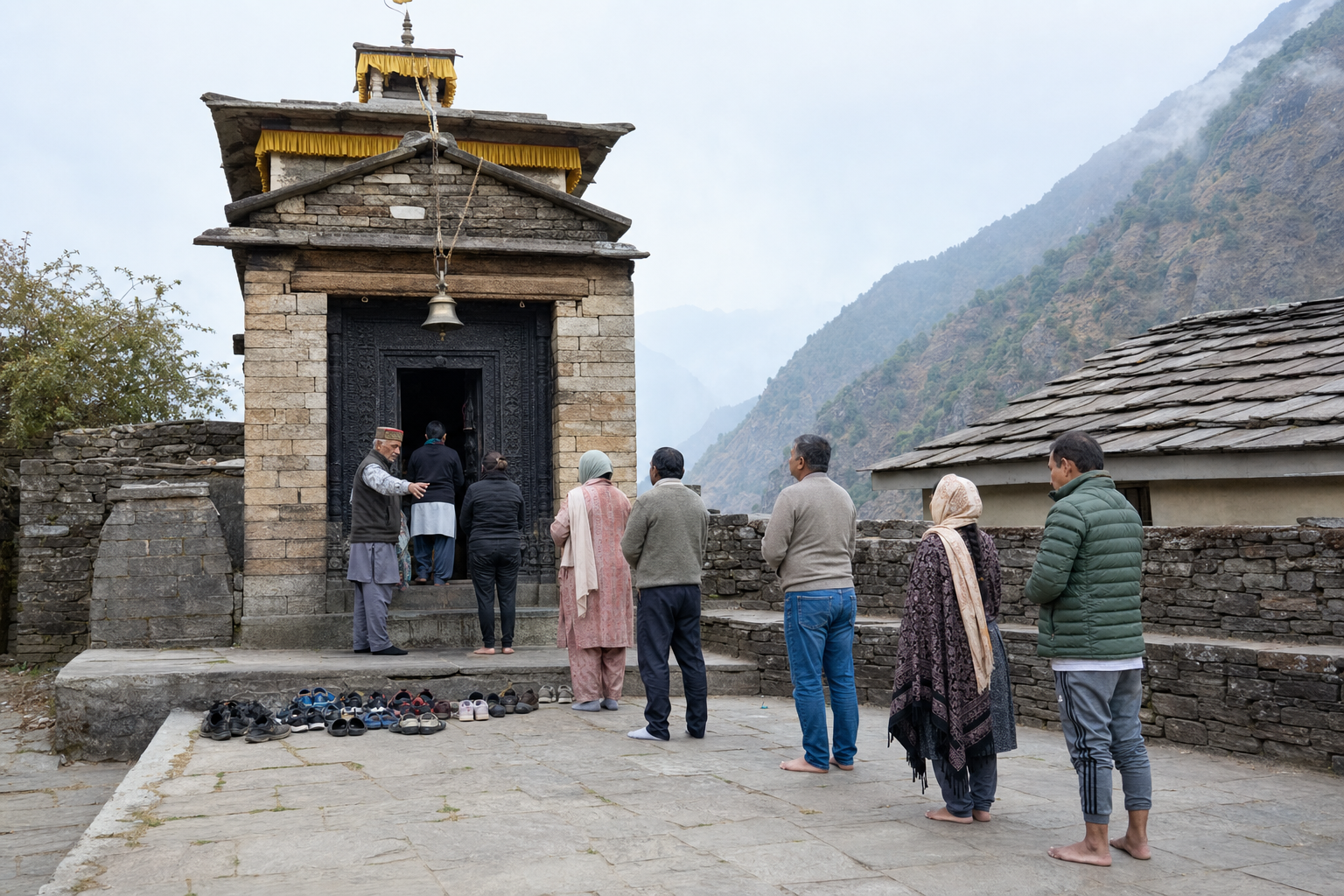
Yog Dhyan Badri’s architecture is modest enough to be overlooked by someone expecting monumental scale. Its compactness is part of the experience. The temple follows a Garhwal expression of the Nagara idiom, with a garbhagriha beneath a restrained shikhara and a mandapa before the sanctum. Local stonework, timber elements and a sloping roof respond to high-altitude conditions and snowfall.
Look for three things as you move through the temple:
- The narrowing of attention: Movement from the congregational mandapa towards the compact sanctum reduces visual distraction and directs the gaze towards the deity.
- The meeting of sacred form and mountain necessity: The shikhara carries the language of Nagara temple architecture, while the roofline and local materials answer the practical demands of the Himalaya.
- The intimacy of darshan: A smaller sacred interior changes your conduct. Lower your voice, avoid blocking others, and let proximity produce attentiveness rather than haste.
The temple’s intangible heritage deserves equal attention. Garhwali devotional songs, satvik offerings and oral retellings of Pandu’s penance carry meaning that masonry alone cannot preserve. These are not decorative additions around the monument. They are ways in which knowledge of the tirtha passes between generations.
If local access and ritual schedules permit, the courtyard around dawn can offer the quietest way to understand the shrine’s contemplative character. Do not fill that interval by staging photographs. Listen for the transition from mountain stillness to temple activity. The change itself makes the relationship between dhyana and seva perceptible: silence prepares attention, and ritual gives that attention direction.
Respect for living custom also means asking before acting. Photography may be restricted, particularly near the sanctum. Dress modestly, observe the movement established by temple attendants, and obtain offerings from authorised counters or locally approved vendors. A donation is most fitting when it supports temple care, community welfare or environmentally responsible infrastructure rather than personal display.
Plan your visit as a practice, not a stopover
Key takeaways
- Yog Dhyan Badri is best understood through three layers: Badri-kshetra, the sacred memory of King Pandu, and continuing Vaishnava worship.
- The meditating Vishnu invites attentive darshan inside a framework of bhakti and temple seva.
- Winter worship expresses the continuity of Badri devotion when snow closes the higher Badrinath shrine.
- Current road, weather, registration and ritual information should be checked before departure; seasonal patterns are not a substitute for a current bulletin.
- Your conduct matters: observe local protocol, minimise plastic, support local livelihoods and leave time for silence.
Pandukeshwar lies on the Rishikesh-Joshimath-Badrinath corridor, near Govind Ghat. Haridwar and Rishikesh are the primary rail approaches, while Dehradun’s Jolly Grant is the nearest major airport. Joshimath is the practical staging town for the onward road journey. The mountain route may look straightforward on a map, but weather and road conditions should determine your plan.
- Choose the season deliberately. The main pilgrimage window generally runs from late spring into early autumn, when passes are open and conditions are milder. Monsoon landslides can interrupt the road, while winter snowfall can narrow access.
- Verify rather than assume. Check Uttarakhand’s Char Dham registration requirements, BKTC guidance, local weather and road bulletins shortly before travel. A plan made weeks earlier can be overtaken by mountain conditions.
- Allow your body to adjust. Pandukeshwar is at about 1,920 metres. Pace the ascent, stay hydrated and avoid treating a tight itinerary as a test of devotion.
- Ask about the day’s temple protocol. Confirm darshan hours, photography rules, offering arrangements and any festival-related changes locally.
- Protect unhurried time. Build enough space into the visit to attend the rite, receive darshan and remain quiet afterwards without delaying other worshippers.
Govind Ghat is also the gateway towards Gurudwara Sri Hemkund Sahib. Hindu and Sikh pilgrims therefore share parts of the valley’s transport, trails and hospitality network. Treat that proximity as a call to practical respect: offer help where appropriate, maintain the discipline of your own pilgrimage, and do not flatten distinct sacred traditions into a vague sameness. Simran and dhyana can resonate as practices of remembrance and attention while retaining their own theological settings.
The environmental discipline is equally concrete. Carry reusable essentials, refuse avoidable plastic, keep waste with you until it can be disposed of properly, and buy from local providers when feasible. In a fragile Himalayan biome, ahimsa is not fulfilled by sentiment alone. It appears in what you carry, what you discard, how heavily you consume and whether the local community benefits from your presence.
Make one final decision before entering the precinct: keep your phone away until worship and a period of quiet attention are complete. You can take a permitted photograph later. Let the first memory be darshan rather than the act of recording it. Then carry one element of the shrine home with you – a daily interval of attentive remembrance, a simpler offering, or a firmer discipline against waste. That is how a visit to the meditating Vishnu continues after the road leaves Pandukeshwar.